Aachen Cathedral is a Roman Catholic church in Aachen, Germany, and one of the oldest cathedral buildings in Europe. Its central core is Charlemagne’s Palatine Chapel, a Carolingian domed octagon built between 793 and 813 and surrounded over the centuries by Gothic, Baroque and historicist additions.
The cathedral combines worship, pilgrimage, imperial history and exceptional architecture in a single monument. Charlemagne was buried here in 814, the chapel served as the coronation church of Roman-German kings from 936 to 1531, and Aachen Cathedral became one of the first sites on the UNESCO World Heritage List in 1978.
Why Aachen Cathedral is important
Aachen Cathedral is one of the few buildings in Europe that has retained its political and spiritual significance for more than a millennium. When you enter the cathedral, you experience a place where power, faith, and European history converge.
In 1978, it was the first German monument to be awarded UNESCO World Heritage status. It is one of the best preserved and most significant architectural monuments from the Carolingian period, with great artistic value due to the bronze doors and marble columns.
With both Classic and Byzantine elements, it became “one of the prototypes of religious architecture which inspired copies or imitations,” according to UNESCO: “the first vaulted structure north of the Alps since Antiquity.” As a building, the cathedral “symbolised the unification of the West and its spiritual and political revival under the aegis of Charlemagne.”
| UNESCO information | Details |
|---|---|
| UNESCO status | Since 1978 |
| Location | Aachen, North Rhine-Westphalia, Germany |
| Type | Cultural heritage |
| UNESCO criteria | Cultural: i, ii, iv, vi |
| Reference | 3 |
| Inscription | 1978 (2nd Session) |
| Property area | 0.2 ha (0.49 acres) |
| Buffer zone | 67 ha (170 acres) |
Charlemagne and the origins of the cathedral
Charlemagne, or Charles the Great, was the king of the Franks, the first emperor in Europe three centuries after the fall of the Roman Empire, and the founder of the Carolingian Empire. He was a very influential man who united large parts of western Europe during his lifetime.
Charlemagne made Aachen his preferred palace because the location was suitable as a permanent seat of power: conveniently situated, with an existing royal palace and prized warm springs. Aachen was not a capital in the modern sense, but it developed into a central place of rule, administration, and representation.
Charlemagne held court here, received envoys, and was buried in the Palatine Chapel after his death in 814. With the construction of the palace complex and the Palatine Chapel, Charlemagne created a representative center of his power, deliberately drawing on ancient and Byzantine models.
The Carolingian St Mary’s Church was built on the remains of a Roman thermal complex and on the site of a Merovingian chapel. The altar of St Mary’s Church was placed in the same position it had in the Merovingian chapel; only its orientation was changed. It was turned 38 degrees in an easterly direction.
In shape and size, it surpassed all churches built north of the Alps up to that time. The Frankish ruler brought experts from all over the empire to Aachen to realise the immense project. Odo of Metz is said to be the architect.
The floor plan is based on a system of measurements referring to the Book of Revelation. The construction of the chapel between 793 and 813 symbolises the unification of the West and its spiritual and political revival under the aegis of Charlemagne.
Architectural history
Charlemagne began the construction of the Palatine Chapel around 796, along with the rest of the palace structures. The construction is credited to Odo of Metz.
The exact date of completion is unclear; however, a letter from Alcuin, in 798, states that it was nearing completion, and in 805, Pope Leo III consecrated the finished chapel. A foundry was brought to Aachen near the end of the 8th century and was utilized to cast multiple bronze pieces, from doors and the railings, to the horse and bear statues.
The Palatine Chapel forms the central building of the Cathedral. The west building and the Octagon in the centre have been preserved to this day.
From 936 to 1531, the original Palatine Chapel saw the coronation of thirty-one German kings. In the Middle Ages, Aachen developed into one of the most important political centers of the empire.
Charlemagne was buried in the chapel in 814. Following Charlemagne’s canonization by Antipope Paschal III in 1165, the chapel became a draw for pilgrims.
Due to the enormous flow of pilgrims, in 1355 a Gothic choir hall was added, and a two-part Capella vitrea (glass chapel) was consecrated on the 600th anniversary of Charlemagne’s death. A cupola, several other chapels, and a steeple were also constructed at later dates.
The Carolingian Octagon
The octagon in the centre of the cathedral was erected as the chapel of the Palace of Aachen between 796 and 805 on the model of other contemporary Byzantine buildings, including the Basilica of San Vitale in Ravenna and the Little Hagia Sophia in Constantinople.
The cathedral mostly uses two distinct architectural styles. First, the core of the cathedral is the Carolingian-Romanesque Palatine Chapel, which was modeled after the Basilica of San Vitale at Ravenna and is notably small in comparison to the later additions. Secondly, the choir was constructed in the Gothic style.
There are portions that show Ottonian style, such as the area around the throne, and some areas were not completed until the 19th century, in revivalist styles.
The original design was of a domed octagonal inner room enveloped by a 16-sided outer wall. The span and height of Charlemagne’s Palatine chapel was unsurpassed north of the Alps for over two hundred years.
The inner octagon, with a diameter of 14.46 metres (47.4 ft), is made up of strong piers, on which an octagonal cloister vault lies, covering the central room. Around this inner octagon is a sixteen-sided circuit of low groin vaults, supporting a high gallery above.
This upper story was known as the Hochmünster, or high church. The arched openings of the lower story are only about half as high as those of the Hochmünster, as a result of which the lower story looks stocky and bulky.
The two floors are separated from each other by an expansive cornice. The high altar and Imperial throne are located on the upper circuit of the Palatine chapel in an octagonal side room, covered by a barrel vault lying on an angle.
Above the arches of the gallery, an octagonal drum with window openings rises, on top of which is the cupola. The high dome gathers light from eight open-arched windows above the drum.
Light is brought in by a three tiered system of circular arched windows. The corners of the octagonal dome are joined with the walls with a system of paired pilasters with Corinthian capitals.
The upper gallery openings are divided by a grid of columns. These columns are ancient and come from St. Gereon in Cologne. Charlemagne allowed further spolia to be brought to Aachen from Rome and Ravenna at the end of the 8th century.
The interior walls were initially lined with a marble facade. The interior of the chapel is embellished by antique columns that Charlemagne probably ordered to be brought from Rome and Ravenna.
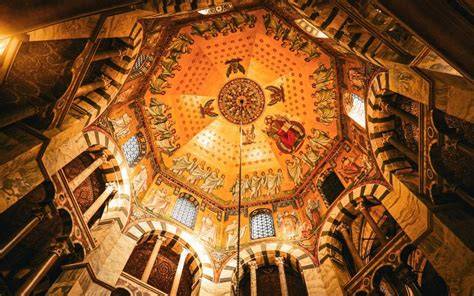
The original cupola mosaic was probably executed around 800 and, according to Medieval sources, depicted Christ as the triumphant Lord of the world, surrounded by the symbols of the Four Evangelists, with the twenty-four elders from the Apocalypse of John offering their crowns to him.
The present-day mosaic dates back to 1880/1881. In 1880-81 it was recreated by the Venetian workshop of Antonio Salviati, according to the plans of the Belgian architect Jean-Baptiste de Béthune.
The current dome mosaic shows Christ as the ruler of the world, surrounded by the apocalyptic beings and the 24 elders of Revelation. Although it is not part of the original Carolingian decoration, the imagery consistently follows the medieval concept of divinely legitimized rule.
Geometric and symbolic design
The question of which geometric concepts and basic dimensions lie at the basis of the chapel’s construction is not entirely clear even today. Works of earlier cathedral architects mostly followed either the Drusian foot (334 mm) or the Roman foot (295.7 mm).
In 2012, the architectural historian Ulrike Heckner proposed a theory of a new, hitherto unknown unit of measure of 322.4 mm, the so-called Carolingian foot, to which all other measurements in the Palatine chapel can be traced back.
Beyond this, there is a symbolic layer to the octagon. Eight was a symbol of the eighth day, Sunday as the Sabbath, and therefore symbolised the Resurrection of Jesus Christ and the promise of eternal life.
Likewise, ten, the number of perfection in Medieval architectural symbolism, is frequent in the Palatine Chapel: Its diameter, including the circuit surrounding the dome, measures a hundred Carolingian feet, equivalent to ten by ten.
The Westwork and the Wolf’s Door
The westwork, or western facade, of the cathedral is of Carolingian origin, flanked by two stair-towers. It is a two-story building, completed by a porch from the 18th century at the west end.
The westwork of Aachen Cathedral dates back to the Carolingian period and was part of the original Palatine Chapel complex. It was once preceded by an atrium, which formed the transition from the secular royal hall to the sacred space of the cathedral.
The bronze leaves attached to the porch, the Wolfstür, or Wolf’s Door, weigh 43 hundredweight altogether. The main entrance to the cathedral was cast in Aachen around 800 and was located between the westwork and the octagon in the so-called hexadecagon up to 1788.
Each door leaf is divided into eight rectangles, a number which had religious symbolism in Christianity as a symbol of Sunday, the day of the Resurrection of Jesus Christ, and of perfection.
The door-rings in the shape of lions’ heads are wreathed by 24 acanthus scrolls. The Wolfstür’s imitation of the shape of the ancient Roman temple door signifies Charlemagne’s claim to have established a New Rome in Aachen with the Palatine Chapel as the distinctive monumental building.
The Wolf Door is associated with the Aachen Cathedral Legend, which is still part of the city’s cultural memory today. According to tradition, when the city council ran out of money during the construction of the cathedral, they made a pact with the devil, who was to receive the first soul to enter the cathedral as payment.
To deceive him, they let a wolf into the church. When the devil realized he had been tricked, he stormed out of the cathedral in a rage and lost his thumb in the right lion’s head door handle.
In the forehall, there is a bronze sculpture of a bear, which was probably made in the 10th century, in Ottonian times. Opposite it is a bronze pine cone with 129 perforated scales, which stands 91 cm high including its base.
The function of the upstairs part of the west facade is not entirely clear. In the western wall, under the great west window, there is a Fensetella, or small window, through which there is line of sight to the court below, the former atrium.
The large western window dates from the modern period. It was designed by Ewald Mataré in 1956, and its design imitates, in abstract form, the structure of the Carolingian bronze gate inside the dome. Bronze and unprocessed quartz form the window itself.
The Gothic choir hall
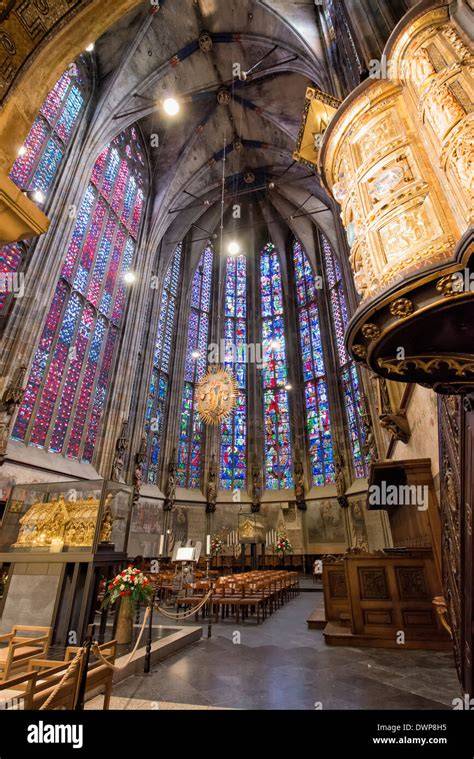
The increased use of the church by pilgrims led to the extension of the Cathedral from 1355 onwards. The Gothic choir hall, completed in 1414, is 25 metres long, 13 metres wide and 32 metres high.
Its outer wall consists mostly of windows. At 25.55 m, the windows of the Choir are some of the largest Gothic windows in Europe. The glass has a total area of more than 1,000 m², giving the Choir hall the nickname “Glass House of Aachen”.
Between 1355 and 1414, on the initiative of the Marienstift and the mayor of Aachen Gerhard Chorus, a Gothic choir was built to the east of the Octagon. Before this there must have been a rectangular Carolingian choir.
The Gothic choir measures 25m in length, 13m wide and 32m high. Its external wall is broken, as much as possible, by windows-the surface area of the glass is more than 1,000m² and led to the name Glashaus, or glass house.
This was conceived as a glass reliquary for the holy relics of Aachen and for the body of Charlemagne. The design is arranged on the model of the Sainte-Chapelle in Paris, likewise a space for important relics and a royal palace chapel.
For protection of the vault of the choir, iron rods were built in at the time of construction, to counter the lateral force on the narrow stone supports and to allow as much space as possible between them for window space.
Chapels and later additions
Adjacent to the outer walls of the hexadecagon are five chapel buildings with irregular floor plans, most of which are double-storey constructions from the Gothic period.
From the 14th century onwards, Gothic chapels were added to the cathedral, most notably the choir hall. These additions did not fundamentally change the building, but rather complemented it in terms of functionality and interior design.
The floor plan and building design of Aachen Cathedral bear witness to its changing significance and use over the centuries. The Carolingian building, a domed octagon, is largely intact.
The Octagon is surrounded by a two-storey, sixteen-sided ambulatory and has an impressive entrance facade. The imperial throne is to be found in the western gallery on the upper storey of the Palatine chapel, or Hochmünster.
The Gothic choir is a single-nave hall with two bays that culminates in a polygon consisting of nine sides of a tetradecagon, built to the east of the Octagon. This building with its unique structure is dominated by rows of windows that are 26 metres high.
Fire, Baroque changes and restoration
The great city fire
In 1656, the great fire of Aachen severely damaged the church: the roofs and the tower, including the bells, were destroyed. The difficult financial circumstances of the church and the city of Aachen only allowed for a temporary restoration.
The Baroque period
With Aachen’s revival as a renowned spa town, a late phase of “baroqueisation” began in the 18th century. The Carolingian Octagon was decorated with stucco in the style of the time, the Choir windows lost their Gothic traceries and the neglected Chapel of Hungary was rebuilt.
During the French period-Aachen was occupied by French troops in 1794 and belonged to France from 1801 to 1815-the Minster was raised to the status of Cathedral Church of the first Diocese of Aachen from 1802 to 1827.
At the same time, it suffered severe damage from looting, such as the removal of the 32 ancient columns from the Hochmünster and the dismantling of all the lead roofs.
Restoration in the 19th century
The restoration of Aachen Cathedral in the 19th century brought about major changes to the building. The Gothic parts of the Cathedral were extensively restored, and a neo-Gothic west tower was erected over the Carolingian west building in 1884.
The Byzantine-like interior decor of the Carolingian building is an impressive culmination of this period. Based on a drawing from 1699, painter and architect Baron de Béthune created the design for the restored mosaic on the dome which was completed in 1881 and depicts the enthroned Christ and the twenty-four elders surrounding him.
The cladding of the pillars and walls with marble and the decoration of the tambour walls and the ambulatory vault with mosaic were carried out between 1900 and 1913 and were designed by the artist Hermann Schaper.
After Schaper’s sudden death, his successor Friedrich Schwarting completed the work with financial support from the German Emperor Wilhelm II.
Damage and reconstruction after the Second World War
During World War II, Aachen, including its famed cathedral, was heavily damaged by Allied bombing attacks and artillery fire, and the subsequent ground fighting when U.S. troops attacked the city, but the cathedral’s basic structure survived.
The glazing of the 14th-century choir hall, the Gothic Revival altar, a large part of the cloister, and the Holiness Chapel were irretrievably destroyed. Reconstruction and restoration took place intermittently over more than 30 years, and cost an estimated €40 million.
Important works and features inside the cathedral
The Imperial Throne
The imperial throne is to be found in the western gallery on the upper storey of the Palatine chapel, or Hochmünster. The simple marble throne on the west gallery is one of the most important symbols of power from the Middle Ages.
It was probably made from ancient spolia on the orders of Charlemagne and served for centuries as the coronation throne of the Roman-German kings. The marble-slab throne that was used for the coronations of Holy Roman emperors from 936 to 1531 is believed to be Carolingian.
Charlemagne himself was not crowned on this throne, but became king in Noyon in 768 and emperor in Rome in 800. It can be assumed that he sat on this throne during the masses held in the Palatine Chapel.
The dome mosaic
The dome mosaic is one of the most striking features of the Octagon. It depicts Christ enthroned as ruler of the world, surrounded by the twenty-four elders of Revelation.
The dome thus reinforces the sacred and political message of the central room. The imagery follows the medieval concept of divinely legitimized rule, even though the present mosaic was renewed in the 19th century.
The Barbarossa Chandelier
The Barbarossa Chandelier, made of gilded copper, was donated around 1165 by Emperor Frederick I Barbarossa in honor of the Virgin Mary and Charlemagne. With a diameter of around 4 meters and a weight of around 300 kilograms, it is one of the largest surviving wheel chandeliers of the Middle Ages.
Its wreath with twelve towers and twelve gates symbolizes the Heavenly Jerusalem of the Book of Revelation. The chandelier hangs from a 27-meter-long, hand-forged chain under the dome of the Carolingian octagon.
The 48 candles are only lit on high holidays, as the chandelier must be thoroughly cleaned after each use. The candles in the Barbarossa chandelier are lit on high holidays, giving the cathedral a particularly festive atmosphere.
The Shrine of Mary
The golden Shrine of Mary from the 13th century houses four central textile relics: Mary’s dress, Jesus’ swaddling clothes, John the Baptist’s execution cloth, and Christ’s loincloth.
These relics made Aachen one of the most important pilgrimage sites in Europe in the Middle Ages. To this day, they shape the religious significance of the cathedral and its role as a spiritual center.
The Mother of Jesus has been the patron saint of the Cathedral from its very beginning. Emperor Charlemagne dedicated the church to her.
As legend has it, relics of the Virgin Mary came to Aachen very early on, including St Mary’s robe in the Shrine of the Virgin Mary and the belt of the Virgin Mary.
Numerous images of the Virgin Mary attest to the continuous veneration of the Mother of Jesus: coloured wooden sculptures, silver statuettes of the Virgin Mary, icon painting, panel painting and the alabaster figure in the Entrance hall of Aachen Cathedral.
The most famous representation of St Mary, however, is the statue of the Virgin Mary in the Cathedral purported to have miraculous powers. Several times during the ecclesiastical year, Virgin Mary’s robe and the festive decoration of the statue are changed in keeping with liturgical guidelines.
The rich collection of garment and jewellery stem in part from royal gifts. Time and again to this day, private individuals also give personal objects of value to the Virgin Mary to express their gratitude or to make an intercession.
The Shrine of Charlemagne
The Shrine of Charlemagne, built between 1215 and 1230, contains the mortal remains of Charlemagne. Its design combines Romanesque forms with early Gothic elements.
The pictorial programs and figures depict Charlemagne as a Christian ruler and exemplary king. The shrine illustrates the close connection between historical memory and religious veneration in the Middle Ages.
Among the cathedral’s significant objects is a sarcophagus decorated with a relief of the Abduction of Proserpine, which once contained the body of Charlemagne.
Bronze sculpture and the pine cone
There were multiple sculptures made of bronze, including an equestrian piece probably meant as a parallel of a statue of Marcus Aurelius in Rome.
In the forehall, there is a bronze sculpture of a bear, which was probably made in the 10th century, in Ottonian times. Opposite it is a bronze pine cone with 129 perforated scales, which stands 91 cm high including its base.
The Cathedral Treasury
The Aachen Cathedral Treasury houses the largest and most important collection of ecclesiastical treasury items north of the Alps. Along with Aachen Cathedral, the Aachen Cathedral Treasury was the first German monument to be entered in the list of UNESCO World Heritage Sites in 1978.
In the Treasury, about 130 works of art are exhibited on three floors. The collection includes liturgical objects, reliquaries and textiles from over a thousand years and documents the continuous use of the cathedral as a spiritual center.
The most prominent inventory items are the cross of Lothar, dating from about 1000 AD and made from gold and inlaid with precious stones, the dark-blue velvet chasuble with embroidered pearls, a reliquary-bust of Charlemagne made from silver and gold, and a marble sarcophagus decorated with a relief of the Abduction of Proserpine.
A central object is the gilded bust of Charlemagne, made around 1350, which contains a skull relic. Its idealized representation has had a decisive influence on the image of Charlemagne as a ruler for centuries.
Among the most famous exhibits are the Lothar cross from the 10th century, which is decorated with hundreds of precious stones and was carried at coronations in the cathedral, and the Proserpina sarcophagus, in which Charlemagne was originally buried.
The Treasury contains the remains of Charlemagne, along with many important artifacts and relics which tell the story of kingships and liturgical practice through history.
Opening hours and tickets for the Cathedral Treasury
The Cathedral Treasury is open Mondays from 10 am to 2 pm, Tuesdays to Sundays from 10 am to 6 pm. You can buy tickets in person at the Cathedral Information Centre.
| Ticket | Price |
|---|---|
| Full Price | € 8.00 |
| Reduced | € 4.00 (children, students, persons holding a severely disabled person’s pass) |
| Family Ticket I | € 8.00 (one adult with up to 4 children aged 17 and under) |
| Family Ticket II | € 16.00 (two adults with up to 4 children aged 17 and under) |
| Audioguide | € 2.00 |
The audioguide is available in German, English, French, Dutch, Italian, Spanish and a German children’s version. Audio guides help a lot with understanding individual pieces and artifacts.
Visiting Aachen Cathedral
Aachen Cathedral is a Roman Catholic Church. It is a place for worship, for individual prayer and for contemplation. It is open to everyone.
Visitors are asked to respect the sacred nature of the place. During church services, the Cathedral is not open to visitors.
Admission to the Cathedral is free. The Choir and the Hochmünster with the imperial throne are only accessible as part of a guided tour.
The cathedral is generally open to the public, but opening hours, access restrictions, and prices vary depending on the time of day, liturgical events, and season.
Opening hours
| Day | Opening hours |
|---|---|
| Monday-Thursday | 11 am to 6 pm |
| Friday and Saturday | 11 am to 7 pm |
| Sunday | 1 to 5:30 pm |
On Friday and Saturday, weddings are held only from 1 pm. Due to special church services, concerts or events, opening hours may change at short notice.
Please always check the homepage for the opening hours of the current week. During church services, the Cathedral is not open to visitors.
Guided tours
Guided tours in English are currently offered daily at 2 pm and on request. Guided tours in German take place every hour between 11 am and 5 pm from Monday to Thursday, 11 am and 6 pm on Friday and Saturday, and 1 pm and 4 pm on Sundays.
This offer is aimed at individuals, families or small groups. The maximum group size is 25 people.
| Tour language | Times |
|---|---|
| English | Daily at 2 pm and on request |
| German, Monday-Thursday | Every hour between 11 am and 5 pm |
| German, Friday and Saturday | Every hour between 11 am and 6 pm |
| German, Sunday | Every hour between 1 pm and 4 pm |
For guided tours and for visits to certain areas, an admission ticket is required. This can be purchased at the Dominformation; however, it is recommended to purchase tickets online in advance, as the number of participants is limited.
Online purchase is currently only possible up to 12 hours before your visit. However, there is an additional contingent at the box office in the cathedral information centre, or Dominformation, which is open daily from 10 am.
Guided tours are available on the hour from Monday through Friday from 11 am until 5 pm, Saturdays from 1 pm until 5 pm, and Sundays from 1 pm until 4 pm. English-speaking tours are available every day at 2 pm only.
Without a guided tour, central elements such as Charlemagne’s throne are not accessible, and Charlemagne’s shrine can only be viewed from a distance. A guided tour brings you up close to these central elements of the cathedral and places what you see in its historical context.
Individual visitors and group prices
| Visitor category | Price |
|---|---|
| Adults | 8,50 € |
| Reduced | 4,50 € (pupils, students, trainees, persons with a severely disabled pass) |
For groups of up to 20 people, bookings can be made a maximum of four weeks in advance.
| Group | Price |
|---|---|
| Adults | Basic fee € 100, from the 11th person € 10 pp |
| Children, youth and school groups | Basic fee € 50, from the 11th person € 5 pp |
Visitor Information Centre
The Cathedral Information Centre, or Dominformation, is the focal point for visitors. Here you can obtain information on the Cathedral and its history, tickets for the Cathedral Treasury, and tickets for guided tours of the Cathedral.
The centre also provides postcards, catalogues, books and more about the Cathedral, as well as tickets for events and concerts in and around the Cathedral.
The Cathedral Information Centre is open Monday to Sunday, from 10.00 to 17.00.
Address: Johannes-Paul-II.-Straße, 52062 Aachen, Germany.
Photography, filming and accessibility
If you wish to take pictures of the Cathedral’s interior, please pay a contribution of €1 to the Domschweizer. Tripods, selfie sticks and flash photography are not allowed in the Cathedral.
A written permit is required for filming and taking photographs for commercial, media and academic purposes and must be presented upon request.
Wheelchair users are asked to ring the bell at the entrance of the Cathedral. The Cathedral staff will be happy to assist with mobile, portable ramps up to 300 kg.
If you are using a power chair, access to the Cathedral is only possible via the Krämertür entrance in Krämerstraße. The lift in the entrance area of the Cathedral Treasury has a weight limit of 300 kg.
How to get to Aachen Cathedral
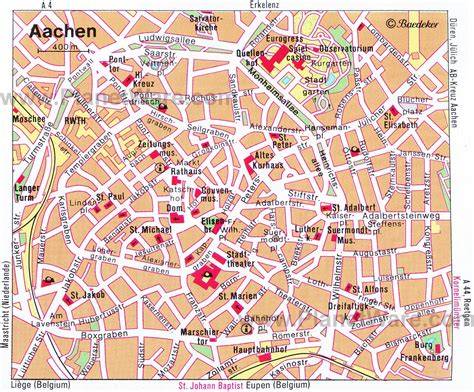
You will find Aachen Cathedral at Domhof 1, 52062 Aachen, Germany. The cathedral is centrally located in the old town.
Aachen main station is approximately 15 minutes on foot from the cathedral. Public transportation is excellent, so you don’t necessarily need to come by car.
If you’re staying in Cologne you can take a day tour to Aachen by train. If you do decide to drive, you will find a couple of parking garages in the vicinity: Parkhaus am Dom, Jesuitenstrasse 12, and APAG Parkhaus Rathaus, Mostardstrasse 5.
On the other hand, if you are staying anywhere near Aachen city center, it’s easy to walk. The old town surrounding the cathedral unfolds in a compact maze of narrow lanes, opening onto squares anchored by baroque fountains featuring whimsical figures.
The cathedral as a place of worship and pilgrimage
As the bishop’s church of the Diocese of Aachen, which was re-established in 1930, Aachen Cathedral today is a lively place of worship with several church services taking place every day.
The Aachen Pilgrimage still attracts large numbers of pilgrims every seven years and keeps the ancient pilgrimage tradition alive. Heiligtumsfahrt in Aachen is a historic Catholic pilgrimage and festival held every seven years, rooted in medieval tradition since at least 1349.
It celebrates the public showing of four revered relics. The Shrine of Mary houses four central textile relics: Mary’s dress, Jesus’ swaddling clothes, John the Baptist’s execution cloth, and Christ’s loincloth.
Aachen Cathedral attracts around one million international guests every year due to its extraordinary importance for the medieval cultural and art history of Europe.
They can visit the central building of the Cathedral and the Aachen Cathedral Treasury and, as part of a guided tour, also the Choir hall and the Hochmünster.
The Eucharistic celebrations are held every weekday at 7 am and 10 am, and on Sundays at 8 am, 10 am, and 11.45 am.
Attending a mass at the cathedral can be a memorable way to experience its religious traditions and architecture. Aachen Cathedral remains a church, a place for individual prayer and contemplation, and a sacred space open to everyone.
What visitors can see around the cathedral
Aachen has more to offer than just the cathedral. It’s a city full of myths and legends, which are really fun to hear about.
Just follow the “Charlemagne Route” and you’ll discover all the main attractions. The starting point is the “Centre Charlemagne”, Aachen’s new city museum that brings the history of the city alive with its exciting exhibition concept.
Together with the palatial city hall, the cathedral forms the heart of the picturesque old town. The old town is a beautiful area: classic European, with cobblestones, many cafes and restaurants, as well as shops.
Aachen Town Hall
Aachen Town Hall was built on the foundations of Charlemagne’s palace. This Gothic masterpiece hosts the Coronation Hall with its monumental 19th-century frescoes depicting Charlemagne’s life.
The replicas of the imperial regalia add theatrical flair, while the cathedral and the town hall together express the political and religious history of Aachen’s medieval center.
Elisenbrunnen and the thermal springs
Aachen’s thermal springs have drawn visitors seeking healing since Roman times. With water temperatures reaching 74°C-the hottest springs north of the Alps-the city’s bathing tradition predates even Charlemagne.
The neoclassical Elisenbrunnen pavilion offers the chance to sample the mineral-rich, sulfurous waters that once attracted emperors and aristocrats. The Carolus Thermen spa complex continues this legacy with modern facilities fed by ancient waters.
Fountains, museums and the old town
The Puppenbrunnen invites interaction, as locals twist its movable bronze figures for luck. The Fischpuddelsbrunnen and Hühnerdieb fountain add playful counterpoints to the imperial grandeur.
The Couven Museum allows visitors to step into an 18th-century bourgeois townhouse with period rooms showcasing Aachen’s domestic life during its spa town heyday. The pharmacy and chocolate kitchen are standouts.
The three-country region
Aachen’s position at the Dreiländereck-the three-country point where Germany, Belgium, and the Netherlands meet-opens possibilities for cross-border exploration.
The Drielandenpunt observation tower marks the exact spot, surrounded by a recreational park where visitors can stand in three nations simultaneously. Belgian Liège and Dutch Maastricht each lie within 30 kilometers, offering distinctly different cultural flavors within easy reach.
While you’re in the area, make sure to visit Cologne as well to see the UNESCO-listed Cologne Cathedral. The Upper Middle Rhine Valley, with its storybook castles perched above the Rhine River, is also not far away.
Who will enjoy Aachen Cathedral?
Anyone who is interested in history would enjoy visiting the cathedral. Visitors have the chance to explore parts of European history that extend beyond major wars or the history of their own country.
Anyone who is interested in art would also enjoy visiting this UNESCO site. From the mosaics in the octagonal chapel-the oldest part-to the stained glass windows and the beauty of the artifacts found inside the cathedral and in the treasury, there’s no shortage of art to marvel at.
Aachen Cathedral, along with the treasury, paints a comprehensive picture of a long-ago time that remains interesting to learn about. A visit gains considerable depth when you know what you are looking at.
Many parts of the cathedral are not self-evident: Charlemagne’s throne on the west gallery is not accessible without a guided tour, and Charlemagne’s shrine in the nave can only be seen from a distance.
You are moving in a space that has been used, changed, and interpreted for centuries. The cathedral’s architecture, relics, mosaics, throne and shrines connect ancient traditions with the political and religious history of medieval Europe.