All Saints of Russia Orthodox Church belongs to the spiritual and historical tradition of the Russian Orthodox Church, an autocephalous Eastern Orthodox Christian church whose origins are traced to the Christianization of Kievan Rus in 988. Its faith is expressed through Byzantine worship, Sacred Tradition, Scripture, the sacraments, veneration of saints, icons, fasting, prayer, and the liturgical celebration of Pascha.
The Russian Orthodox Church is a large branch of the Eastern Orthodox Church. Both churches share many beliefs with other branches of Christianity, including the divinity of Christ and the importance of the study of scripture. However, unlike Catholics, members of the Russian Orthodox Church do not acknowledge the Pope's authority. Instead, they are led by elected patriarchs and councils.
Historical identity and organization
The Russian Orthodox Church (ROC; Russian: Русская православная церковь, РПЦ, romanized: Russkaya pravoslavnaya tserkov', RPTs;[a]), also officially known as the Moscow Patriarchate (Russian: Московский патриархат, romanized: Moskovskiy patriarkhat),[10] is an autocephalous Eastern Orthodox Christian church. The primate of the ROC is the Patriarch of Moscow and all Rus'.
| Aspect | Information |
|---|---|
| Abbreviation | ROC |
| Type | Autocephalous |
| Classification | Christian |
| Orientation | Eastern Orthodox |
| Polity | Episcopal |
| Primate | Patriarch Kirill of Moscow |
| Governance | Holy Synod of the Russian Orthodox Church |
| Liturgy | Byzantine Rite |
| Headquarters | Danilov Monastery, Moscow, Russia |
| Language | Church Slavonic in worship; Russian in sermons and paperwork |
| Founder | Vladimir the Great |
| Origin | 988 Kievan Rus' |
| Independence | 1448, de facto |
| Recognition | 1589 by the Ecumenical Patriarch of Constantinople; 1593 by the Pan-Orthodox Synod of Patriarchs at Constantinople |
The ROC currently claims exclusive jurisdiction over the Eastern Orthodox Christians, irrespective of their ethnic background, who reside in the former member republics of the Soviet Union, excluding Georgia. The ROC also created the autonomous Church of Japan and Chinese Orthodox Church. The ROC eparchies in Belarus and Latvia, since the fall of the Soviet Union in the 1990s, enjoy various degrees of self-government, albeit short of the status of formal ecclesiastical autonomy.
It has 194 dioceses inside Russia.[11] In 2019, the church was described as having 382 bishops, 40,514 full-time clerics, including 35,677 presbyters and 4,837 deacons, 38,649 parishes, 314 dioceses, and 972 monasteries, including 474 male and 498 female monasteries.[1][2] Its region includes Russia, post-Soviet states, and the Russian diaspora.
The Russian Orthodox Church should not be confused with the Russian Orthodox Church Outside of Russia, also known as ROCOR or the Russian Orthodox Church Abroad, headquartered in the United States. The ROCOR was instituted in the 1920s by Russian communities outside the Soviet Union, which had refused to recognise the authority of the Moscow Patriarchate that was de facto headed by Metropolitan Sergius Stragorodsky.
The two churches reconciled on 17 May 2007; the ROCOR is now a self-governing part of the Russian Orthodox Church. Following the collapse of the Soviet Union, discussions concerning the reunification of the churches were initiated. In 2007 the churches were reunited when canonical communion was restored between the Russian Orthodox Church and the church outside Russia.
Origins of Christianity in Kievan Rus
The history of the ROC begins with the Christianization of Kievan Rus', which commenced in 988 with the baptism of Vladimir the Great and his subjects by the clergy of the ecumenical patriarch of Constantinople.[12][13] Christianity was apparently introduced into the East Slavic state of Kievan Rus by Greek missionaries from Byzantium in the 9th century.
An organized Christian community is known to have existed at Kiev as early as the first half of the 10th century, and in 957 St. Olga, the regent of Kiev, was baptized in Constantinople. This act was followed by the acceptance of Christianity as the state religion after the baptism of Olga’s grandson Vladimir I, prince of Kiev, in 988.
In the 10th century, Christianity began to take root in Kievan Rus'.[22] Towards the end of the reign of Igor, Christians are mentioned among the Varangians.[23] In the text about the treaty with the Byzantine Empire in 944-945, the chronicler also records the oath-taking ceremony that took place in Constantinople for Igor's envoys as well as the equivalent ceremony that took place in Kiev.[22]
Igor’s wife Olga was baptized sometime in the mid-10th century; however, scholars have disputed the exact year and place of her conversion, with dates ranging from 946 to 960.[24] Most scholars tend to agree that she was baptized in Constantinople, though some argue that her conversion took place in Kiev.[25]
Olga’s son Sviatoslav opposed conversion, despite persuasion from his mother,[22] and there is little information about Christianity in sources in the period between 969 and 988.[26] Ten years after seizing power, Grand Prince Vladimir was baptized in 988 and began Christianizing his people upon his return.[27]
That year was decreed by the Russian Orthodox Church in 1988 as the date of the Christianization of the country.[27] According to the Chronicle, Vladimir had previously sent envoys to investigate the different faiths.[27] After receiving glowing reports about Constantinople,[27] he captured Chersonesus in Crimea and demanded that the sister of Basil II be sent there.[28]
The marriage took place on the condition that Vladimir would be also baptized there.[28] Vladimir had lent considerable military support to the Byzantine emperor and may have besieged the city due to it having sided with the rebellious Bardas Phokas.[28] By the early 11th century, Christianity was established as the state religion.[29] By the early 13th century, some 40 episcopal sees had been established, all of which ultimately answered to Constantinople.[30]
AD 988 is conventionally regarded as the year that Christianity came to the Russian people as the religion of the realm. However, before Vladimir's option for Christianity there had existed among the Russians Christian communities and rulers.
The consequences for the further development of Russian culture and statehood were momentous. Russia had been transformed from a pagan country with Christian communities to a Christian state, yet with a strong resistance to parting with the old paganism.
The Apostle Andrew and the beginnings of Christian memory
One of the foundational narratives associated with the history of Orthodoxy in Russia is found in the 12th-century Primary Chronicle, which says that the Apostle Andrew visited Scythia and Greek colonies along the northern coast of the Black Sea before making his way to Chersonesus in Crimea.[18][19]
According to the legend, Andrew reached the future location of Kiev and foretold the foundation of a great Christian city with many churches.[20] Then, "he came to the [land of the] Slovenians where Novgorod now [stands]" and observed the locals, before eventually arriving in Rome.[21]
Despite the lack of historical evidence supporting this narrative, modern church historians in Russia have often incorporated this tale into their studies.[12] According to its own history, the Russian Orthodox Church was founded by the Apostle Andrew.
Members of the church believe Andrew traveled after his time with Jesus, the Messiah of Abrahamic tradition, until he encountered Greek colonies in the location of modern Kiev. Andrew then declared that a powerful Christian church would begin from that place and planted a cross in the ground to mark his claim.
A church now exists on the location where Russian Orthodox Christians believe Andrew placed his cross. The story of St. Andrew as the first evangelizer of Russia most likely belongs to the realm of pious legend, a legend which, however, had an effect in the popular choice of the name 'Andrei' among Kievan princes and notables.
Cyril, Methodius, and the language of worship
Historically, the most important event to have consequences for the taking of root of Christianity in Russia was the evangelizing mission undertaken by two Greek brothers from the Balkans, Ss. Cyril and Methodius.
Part of their mission to the Slav lands of Moravia and Bohemia in the ninth century embraced a fundamental aspect of Eastern Christianity: the reception of the faith in the culture and language of the local people.
To this end the service books of the Byzantine Church and those parts of the Bible used in worship were translated into the Slav language for which a new alphabet, Glagolithic, later to be replaced by the more familiar Cyrillic, had been devised.
The elevation of a vernacular to a sacred language of worship heralded the advent of a new language, Church Slavonic, which became the ecclesiastical lingua franca of the Slavs, most especially the Serbs and Bulgarians, from whom the Russians would import the texts of worship.
Vladimir’s conversion and the Christian state
Vladimir’s motives for eventual conversion to Christianity, as well as the events leading up to it, are shrouded in mystery. First of all there are the political considerations. By becoming Christian, Russia would be the youngest nation to join a powerful Byzantine commonwealth on equal term.
The political element in the adoption of Christianity was symbolized by Vladimir's marriage to the Byzantine Princess Anna. And then there are the spiritual and cultural reasons. Christianity had already existed in Kievan Russia for several generations and there was a danger of becoming alienated from his subjects should Vladimir cling tenaciously to the old pagan gods.
So Vladimir accepted Christian baptism from the Byzantine Church c.988 at the southern Greek trading town of Chersones on the Black Sea. The ancient Russian realm centred around the city of Kiev displayed a measure of religious tolerance towards its inhabitants.
Jews and Muslims resided in the land of the Rus, as well as Christians, yet it is hard to determine to what extent the Viking Rus or their Slav subjects may have adopted the faith or in what form, Latin or Byzantine.
There is a far from clear picture of how the Church in Russia was formally organized. Worship assumed the Byzantine form with the regular celebration of the Liturgy of St. John Chrysostom, most likely in Greek, although texts in Church Slavonic were available from the earlier converted Bulgarians and Serbs.
Vladimir had built next to the imperial palace in Kiev a Tithe (Desyatnnaya) Church, so called as Vladimir promised to dedicate a tenth of the income from his lands and newly built churches to the Mother of God in whose honour the church had been built. The church was destroyed during the Mongol invasion.
The earliest mentioned head of the Russian Church was the Greek Metropolitan Michael (988-992). Further Greek prelates, including Leontius, John I, and Theopemtus, headed the largest of the ecclesiastical provinces of the Church of Constantinople, which nominated and elected them to their position.
Dioceses numbered approximately half a dozen and would be centred around such princely realms as Novgorod and Turov. There were no formally organized monasteries during the reign of Vladimir, although chronicles do indicate the existence of small groups of monks.
Vladimir is believed to be the author of the first Statute of the Russian Church which regulated tithes and the appointment of clergy, thus giving an indication of a measure of autonomy within the Church.
The flowering of Kievan Christianity
The period immediately following Prince Vladimir's death in 1015 was one of violent succession to the throne of Kiev. The first Christian ruler of Russia had left no system by which his kin would become rulers.
His sons Boris and Gleb died as "passion-bearers", showing Christian serenity in the face of a violent death at the hands of their half brother Svyatopolk "the Cursed".
Boris and Gleb were venerated for their humility when confronted by an evil destiny and their example has been upheld as an image of a peculiar "kenotic" type of Russian Christian spirituality whereby evil is conquered not through pragmatism or forced response but by a self-emptying to the point of death.
The eventual winner of the princely battles for the throne of Kiev was Yaroslav, later called 'the Wise' (1015-1054). It was during his reign that the Church in Russia grew at a pace far outstripping that of Vladimir.
If under Vladimir the churches numbered no more than a few dozen, travellers to eleventh-century Russia reported that Kiev alone boasted six hundred churches. The most splendid of these was the Cathedral of St. Sophia, consciously modelled on its namesake in Constantinople.
There was no doubt that Yaroslav fancied Kiev as a rival to the Byzantine capital and the enthusiastic building of churches put flesh on this vision. The reign of Yaroslav saw the first rapid flowering of Christian culture in Russia.
The best masters of church architecture were invited from Byzantium, while churches in Pskov and Novgorod betray the influence of Romanesque architecture. Iconography, too, developed and produced the first native Russian genius in this field, St. Alimpy.
Yet it was the art of letters that reached its first apogee under Yaroslav. The Primary Chronicle speaks of his love of the 'sweetness of books', meaning the exclusive promotion of the copying and translation of the Bible and other ecclesiastical writings such as the works of the holy fathers of the Eastern Church.
The greatest example of early Russian literature is undoubtedly the Sermon on Law and Grace by the first native head of the Russian Church, Metropolitan Hilarion (1051-1055). This verbal icon combined a panegyric to Vladimir with a discourse on Russia's place in sacred history.
Hymnography, too, grew with the development of the so called Znamenny chant, a refinement of the chants inherited from Byzantium. The first of the great Russian monasteries, the Lavra of the Caves in Kiev, was founded by two Russian ascetics, Ss. Antony and Theodosius, drawing on the spirituality of the monastic peninsula of Mt. Athos in northern Greece.
And in spite of the occasional anti-Latin rhetoric in the writings of St. Theodosius, the Western Church was rarely viewed with antagonism, even after the rupture in eucharistic communion between the Churches of Rome and Constantinople in 1056.
The dynastic marriages between the princes of Kiev and the royal houses of Europe, most notably between Prince Vladimir Monomakh and Princess Ghita, daughter of the English King Harold, would seem to indicate a continuing Christian fellowship between the Western and Russian Churches that would be extinguished only with the Mongol invasion in the early thirteenth century.
The transfer of the church center to Moscow
While Russia lay under Mongol rule from the 13th through the 15th century, the Russian church enjoyed a favoured position, obtaining immunity from taxation in 1270. This period saw a remarkable growth of monasticism.
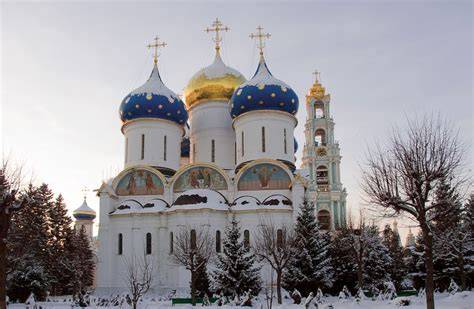
The Monastery of the Caves (Pechersk Lavra) in Kiev, founded in the mid-11th century by the ascetics St. Anthony and St. Theodosius, was superseded as the foremost religious centre by the Trinity-St. Sergius monastery, which was founded in the mid-14th century by St. Sergius of Radonezh, in what is now the city of Sergiyev Posad.
After Kiev lost its significance following the Mongol invasions, Metropolitan Maximus moved his seat to Vladimir in 1299.[31] His successor, Peter, found himself caught in the conflict between the principalities of Tver and Moscow for supremacy in northwest Russia.[32][33]
Peter moved his residence to Moscow in 1325 and became a strong ally of the prince of Moscow.[34] During Peter's tenure in Moscow, the foundation for the Dormition Cathedral was laid and Peter was buried there.[35]
By choosing to reside and be buried in Moscow, Peter had designated Moscow as the future center of the Russian Orthodox Church.[34] Peter was succeeded by Theognostus, who, like his predecessor, pursued policies that supported the rise of the Moscow principality.[36][37]
During the first four years of his tenure, the Dormition Cathedral was completed and an additional four stone churches were constructed in Moscow.[36] By the end of 1331, Theognostus was able to restore ecclesiastical control over Lithuania.[38]
Theognostus also proceeded with the canonization of Peter in 1339, which helped to increase Moscow's prestige.[36] His successor Alexius lost ecclesiastical over Lithuania in 1355, but kept the traditional title.[39]
St. Sergius, as well as the metropolitans St. Peter (1308-26) and St. Alexius (1354-78), supported the rising power of the principality of Moscow. Finally, in 1448 the Russian bishops elected their own metropolitan without recourse to Constantinople, and the Russian church was thenceforth autocephalous.
Autocephaly and the patriarchate
On 5 July 1439, at the Council of Florence, the only Russian prelate present at the council signed the union, which, according to his companion, was only under duress.[40] Metropolitan Isidore left Florence on 6 September 1439 and returned to Moscow on 19 March 1441.[41]
The chronicles say that three days after arriving in Moscow, Grand Prince Vasily II arrested Isidore and placed him under supervision in the Chudov Monastery.[42] Despite the chronicles calling him a heretical apostate, Isidore was recognized as the lawful metropolitan by Vasily II until he left Moscow on 15 September 1441.[43]
For the following seven years, the seat of the metropolitan remained vacant.[44] Vasily II defeated the rebellious Dmitry Shemyaka and returned to Moscow in February 1447.[45]
On 15 December 1448, a council of Russian bishops elected Jonah as metropolitan, without the consent of the patriarch of Constantinople, which marked the beginning of autocephaly of the Russian Church.[45]
Although not all Russian clergy supported Jonah, the move was subsequently justified in the Russian point of view following the fall of Constantinople in 1453, which was interpreted as divine punishment.[46]
Despite the fact that it is possible that the failure to obtain the blessing from Constantinople was not intentional, nevertheless, this marked the beginning of independence of the Russian Church.[47]
The fall of Constantinople and the beginning of autocephaly of the Russian Church contributed to political consolidation in Russia and the development of a new identity based on awareness that Moscow was only metropolitanate in the Orthodox oikoumene that remained politically independent.[47]
The formulation of the idea of Moscow as the "third Rome" is primarily associated with the monk Philotheus of Pskov, who stated that "Moscow alone shines over all the earth more radiantly than the sun" because of its fidelity to the faith.[47]
The marriage of Ivan III to Sophia Palaiologina, the niece of the last Byzantine emperor, and the defeat of the Tatars, helped to solidify this view.[47][49][50]
In 1589, during the reign of Feodor I and under the direction of Boris Godunov, the metropolitan of Moscow, Job, was consecrated as the first Russian patriarch with the blessing of Jeremias II of Constantinople.[51][16]
In the decree establishing the patriarchate, the whole Russian tsardom is called a "third Rome".[52] In 1589 Job, the metropolitan of Moscow, was elevated to the position of patriarch with the approval of Constantinople and received the fifth rank in honour after the patriarchs of Constantinople, Alexandria, Antioch, and Jerusalem.
Church life in the sixteenth and seventeenth centuries
By the turn of the 16th century, the consolidation of Orthodoxy in Russia continued as Archbishop Gennady of Novgorod created the first complete manuscript translation of the Bible into Church Slavonic in 1499, known as Gennady's Bible.[16]
At the same time, two movements within the Russian Church had emerged with differing ecclesial visions.[16] Nilus of Sora (1433-1508) led the non-possessors, who opposed monastic landholding except for the purposes of charity in addition to strong involvement of the church in the affairs of the state, while Joseph of Volotsk (1439-1515) led a movement that supported strong church involvement in the state's affairs.[16]
By 1551, the Stoglav Synod addressed the lack of uniformity in existing ecclesial practices.[16] Metropolitan Macarius also collected "all holy books. available in the Russian land" and completed the Grand Menaion, which was influential in shaping the narrative tradition of Russian Orthodoxy.[16]
The reforms of Patriarch Nikon
By the mid-17th century, the religious practices of the Russian Orthodox Church were distinct from those of the Greek Orthodox Church.[17] Patriarch Nikon reformed the church in order to bring most of its practices back into accommodation with the contemporary forms of Greek Orthodox worship.
Nikon's efforts to correct the translations of texts and institute liturgical reforms were not accepted by all.[17] Archpriest Avvakum accused the patriarch of "defiling the faith" and "pouring wrathful fury upon the Russian land".[17]
The result was a schism, with those who resisted the new practices being known as the Old Believers.[17] Nikon was deposed in 1666, but the Russian church retained his reforms and anathematized those who continued to oppose them; the latter became known as Old Believers and formed a vigorous body of dissenters within the Russian Orthodox Church for the next two centuries.
Old Believers preserve older liturgical forms, devotional practices, and ritual details that they believe were changed unlawfully during Nikon’s reforms. The schism therefore concerned not only church administration but also the meaning of continuity, authority, correct worship, and fidelity to inherited tradition.
Church and state in the imperial period
Following the death of Patriarch Adrian in 1700, Peter I of Russia (r. 1682-1725) decided against an election of a new patriarch, and drawing on the clergy that came from Ukraine, he appointed Stefan Yavorsky as locum tenens.[58]
Peter believed that Russia's resources, including the church, could be used to establish a modern European state and he sought to strengthen the authority of the monarch.[58] He was also inspired by church-state relations in the West and therefore brought the institutional structure of the church in line with other ministries.[59]
Theophan Prokopovich wrote Peter's Spiritual Regulation, which no longer legally recognized the separation of the church and the state.[59] In 1721 Tsar Peter I, the Great, abolished the patriarchate of Moscow and replaced it with the Holy Governing Synod, which was modeled after the state-controlled synods of the Lutheran church in Sweden and Prussia and was tightly controlled by the state.
The chief procurator of the synod, a lay official who obtained ministerial rank in the first half of the 19th century, henceforth exercised effective control over the church’s administration until 1917.
This control, which was facilitated by the political subservience of most of the higher clergy, was especially marked during the procuratorship, 1880-1905, of the archconservative K.P. Pobedonostsev.
The revolution, persecution, and the Catacomb Church
In November 1917, following the collapse of the tsarist government, a council of the Russian Orthodox Church reestablished the patriarchate and elected the metropolitan Tikhon as patriarch.
But the new Soviet government soon declared the separation of church and state and nationalized all church-held lands. These administrative measures were followed by brutal state-sanctioned persecutions that included the wholesale destruction of churches and the arrest and execution of many clerics.
The Russian Orthodox Church was further weakened in 1922, when the Renovated Church, a reform movement supported by the Soviet government, seceded from Patriarch Tikhon’s church, restored a Holy Synod to power, and brought division among clergy and faithful.
After Tikhon’s death in 1925, the government forbade patriarchal elections to be held. In 1927, in order to secure the survival of the church, Metropolitan Sergius formally expressed his “loyalty” to the Soviet government and henceforth refrained from criticizing the state in any way.
This attitude of loyalty, however, provoked more divisions in the church itself: inside Russia a number of faithful opposed Sergius, and abroad the Russian metropolitans of America and western Europe severed their relations with Moscow.
The 1917 revolution destroyed the Russian Empire and plunged the world, and especially the Orthodox world, into darkness. The Church in Russia was subjected to vicious persecution by the atheist Bolsheviks.
Patriarch Tikhon, Head of the Church, anathematized the Bolshevik rulers and suffered imprisonment and torture for his refusal to submit to their demands. However, his successor, Metropolitan Sergius, gave in and, with his notorious Declaration of 1927, made the church in the Soviet Union a political tool of the atheist government.
The majority of the clergy vehemently protested against this concordat, but they were systematically killed. Not only the clergy but Orthodox throughout the land suffered incredibly.
The existence of the Catacomb Church was admitted by the communists themselves. It survives and continues to grow with renewed vigor in spite of the continued and systematic campaign against religion in the USSR.
Renewal during and after the Soviet period
Then, in 1943, benefiting from the sudden reversal of Joseph Stalin’s policies toward religion, Russian Orthodoxy underwent a resurrection: a new patriarch was elected, theological schools were opened, and thousands of churches began to function.
Between 1945 and 1959 the official organization of the church was greatly expanded, although individual members of the clergy were occasionally arrested and exiled. The number of open churches reached 25,000.
A new and widespread persecution of the church was subsequently instituted under the leadership of Nikita Khrushchev and Leonid Brezhnev. Then, beginning in the late 1980s, under Mikhail Gorbachev, the new political and social freedoms resulted in many church buildings being returned to the church, to be restored by local parishioners.
When Mikhail Gorbachev took control of the Soviet Union in the 1980s, he instituted a number of social reforms. Gorbachev refused to continue his predecessor's campaign against religion and formally restored many of the seized lands and structures to the Russian Orthodox Church.
This allowed the church to begin rebuilding its presence in the Soviet Union. The collapse of the Soviet Union in 1991 furthered the spiritual progress, and in 2000 Tsar Nicholas II, the Russian emperor who had been murdered by the Bolsheviks after the October Revolution of 1917, and members of his family were canonized by the church.
When the Soviet Union collapsed in 1991, the church redoubled its efforts, opening new theological schools and restoring old parishes. Since then, the Russian Orthodox Church has become one of the largest branches of the Eastern Orthodox Church.
The Russian Church Abroad
The Russian Revolution of 1917 had severed large sections of the Russian church, including dioceses in America, Japan, and Manchuria, as well as refugees in Europe, from regular contacts with the mother church.
A group of bishops who had left their sees in Russia gathered in Sremski-Karlovci, Yugoslavia, now in Serbia, and adopted a clearly political monarchist stand. The group further claimed to speak as a synod for the entire “free” Russian church.
This group, which to this day includes a sizable portion of the Russian emigration, was formally dissolved in 1922 by Patriarch Tikhon, who then appointed metropolitans Platon and Evlogy as ruling bishops in America and Europe, respectively.
Both of these metropolitans continued intermittently to entertain relations with the synod in Karlovci, but neither of them accepted it as a canonical authority. After World War II the patriarchate of Moscow made unsuccessful attempts to regain control over these groups.
In 1970 it finally recognized an autocephalous Orthodox Church in America, thereby renouncing its former canonical claims in the United States and Canada; it also acknowledged an autonomous church established in Japan that same year.
From the year 1988, the millennium of Christianity in Holy Rus’, significant changes began to occur, culminating in 1992, with the USSR finally dissolved. These changes made it possible for the two parts of the One Russian Church to reconcile and reunite in May 17, 2007.
Core beliefs of Russian Orthodoxy
The Eastern Orthodox Church, of which the Russian Orthodox Church is a major branch, is one of the three most practiced types of Christianity alongside Catholicism and Protestantism. Unlike the other two major types of Christianity, the Eastern Orthodox Church is made up of a number of autonomous branches.
Each branch is allowed to govern itself and given a large degree of independence in its teachings. The heads of the branches come together to debate key theological issues.
The Russian Orthodox Church shares most of the key tenets of Christianity with Catholicism and Protestantism. Its members believe in the biblical God of the Abrahamic tradition and the truth of the Bible.
They believe that Jesus Christ was born of the Virgin Mary and was both the son of God and the living embodiment of God on Earth. They believe that Christ sacrificed himself to the Romans and was crucified to pay for the sins of humanity.
They also believe that he rose from the dead after three days, proving that the power of God is greater than the power of death, and proceeded to preach for forty days before ascending to Heaven.
They also believe that by living a good life and striving to become closer to God through the power of faith, souls can be rewarded by spending eternity in Heaven after death.
The Holy Trinity and Christ
We worship God in Trinity, glorifying equally the Father, Son, and Holy Spirit. We believe that the Lord Jesus Christ is the Son of God, begotten before all ages, and that He is of one essence with the Father.
We believe that Christ incarnate is truly man, like us in all respects except sin. We worship the Holy Spirit as Lord and Life-giver who proceeds from the Father.
Russian Orthodox theology therefore holds together the divinity and humanity of Christ, the reality of the Incarnation, the saving significance of the Cross, and the victory of the Resurrection.
Scripture and Sacred Tradition
The scriptures used in the Russian Orthodox tradition include the Elizabeth Bible in Church Slavonic and the Synodal Bible in Russian. Church Slavonic remains the traditional language of worship, while Russian is commonly used in sermons and administrative documents.
Just as the Grace of the Holy Spirit which descended on the Apostles at Pentecost flows in a living stream down through today's bishops and priests, so Sacred Tradition carries the spiritual life of the Church in an unbroken stream from the time of the Apostles down to Orthodox believers today.
Sacred Tradition includes the unwritten acts and teachings of Christ and the Apostles which the Church preserves unchanged for us all (John 21:25; 2 Thess. 2:15; 2Thess. 3:6).
The power of Sacred Tradition is the power of the Holy Spirit as it influences Orthodox Christians in all ages. Through Sacred Tradition we are in communion with the spiritual life of all preceding generations back to the Apostles.
Saints and intercession
We honor and venerate the saints and ask their intercession before God. Of the saints, Mary, the Mother of God, holds a special place. "More honorable than the Cherubim and beyond compare more glorious than the Seraphim."
Catholics believe that saints can intercede on their behalf throughout their lives and thus pray to saints as well as God. However, the Russian Orthodox Church teaches that saints lack the power to directly intervene in individual lives.
Instead, they petition God to intervene on an individual's behalf. The saints are understood as examples of transformed Christian life and as witnesses to the continuity of holiness within the Church.
Sacraments and the life of the faithful
Baptism and Chrismation are the two sacraments essential to enter into the saving shelter of the Church. Baptism by triple immersion washes away our sins and restores the image of Adam.
With Chrismation, we receive the Gifts of the Holy Spirit, becoming partakers of the fullness of Christ. In the Sacrament of the Holy Eucharist, we partake of the true Body and Blood of Christ in the form of bread and wine for the remission of sins, the healing of body and soul, and for life eternal.
Confession is the fourth essential Sacrament for the life of all Christians. In confession, Christ gives us, through our father confessor, the forgiveness of the sins we commit after Baptism if we truly repent of them.
Ordination, Marriage, and Holy Unction complete the central Mysteries of Orthodoxy. By the laying-on of hands, a bishop transmits Divine Grace to the person being ordained, linking him through the continuing flow of Grace that descended on the Apostles at Pentecost to the uninterrupted succession of Orthodox clergy.
Divine Grace sanctifies the union of two people in matrimony. Orthodox parish priests are usually married; bishops now come from the Church's monastic tradition. The Sacrament of Holy Unction heals infirmities of body and soul.
The Eucharist
The members of the Russian Orthodox Church believe in the transubstantiation of the Eucharist. This means they believe the bread and wine literally become the body and blood of Christ during the rituals of a Christian mass.
While Catholics share this belief, most Protestants believe the gesture is only symbolic. In Orthodox worship, the Eucharist is therefore not merely a commemoration but participation in the true Body and Blood of Christ.
Ordination and church authority
Unlike Catholics, members of the Russian Orthodox Church do not accept the authority of the Pope. While Catholics believe the Pope is Christ's official representative and the Pope's word carries with it the weight of Christ, members of the Russian Orthodox Church believe the Pope is simply the bishop of Rome.
They believe this is an important position, but not divine. The Russian Orthodox Church is organized more like the Catholic Church than like independent Protestant congregations.
Priests oversee and perform Mass at individual parishes and tend to their personal flock of parishioners. Bishops oversee a diocese, which is a collection of parishes in an area.
An especially large diocese may have multiple bishops and a single archbishop to help run its administration. A group of dioceses, and in many cases entire branches of the Eastern Orthodox Church, are ruled by a patriarch.
The patriarch is a single elected individual meant to personally lead a large portion of the Eastern Orthodox Church and whose opinion is highly valued among their branch of the church. In some cases, a council or Synod is appointed above the patriarch, with ultimate authority over the church's stance on important issues.
The Russian Orthodox Church is headed by a patriarch. Its formal governance includes the Holy Synod of the Russian Orthodox Church.
Worship and liturgical traditions
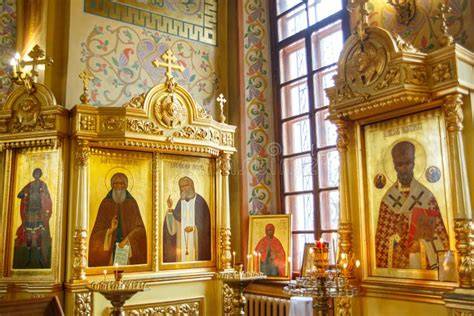
Today, as in Prince Vladimir's time, the Orthodox Church, fully aware that man is a union of body and soul, uses all the beauty of creation to move her faithful children to prayer and worship: icons, beautiful singing, sweet-smelling incense, and majestic services.
Yet if the visible beauty of the Church is dazzling, her unseen beauty and glory are even more compelling, for the Orthodox Church is the Bride of Christ, and within her shelter we can begin to struggle for our salvation.
The Greek word Orthodoxia means "correct praise" or "correct teaching" and in Orthodox worship the praise and teaching are closely interwoven. If you attentively follow the prayers and services of the Church, you can learn from them all her teachings and rich spiritual experience.
The services trace their beginnings back to the Old Testament rites of the Hebrews. They are a treasury of Scripture readings, prayers, hymns, and canons composed by the Saints and pious Christians throughout the ages.
Pascha and the annual cycle
Pascha, Easter, is the Feast of Feasts, the high-point of the Orthodox year. During Pascha, the Church shines with the glory of Christ's resurrection.
Clouds of fragrant incense accompany prayers heavenward; choirs and bells sing out the triumphant news; the faithful greet one another with the holy kiss of peace amid the greeting, "Christ is risen!"
The altar doors are left open all week to show that the Gates of Paradise are opened by Christ for us sinners to enter in for eternal life and joy in heaven.
Orthodox worship follows the Byzantine Rite and integrates Scripture, hymns, processions, incense, candles, prostrations, and sacramental actions into a single liturgical experience.
PASCHA. Resurrection of Our Lord - Midnight Office, Paschal Matins and Liturgy.
Icons, churches, and sacred symbols
Virtually everything you see in an Orthodox Church symbolizes and calls to mind some aspect of our meeting with eternal Divinity. The architecture, liturgical objects, images, sounds, fragrance, and movements of worship are treated as visible signs of the invisible reality of faith.
Domes and the Russian cross
The peaked Russian dome draws our yearning and aspiration upward toward God and the spiritual life. Like its ancestor the round Byzantine dome, the Russian dome celebrates in architecture what is accomplished by the Eucharistic Sacrament, the communion of heaven and earth.
A single dome symbolizes the One Head of the Church, Jesus Christ; three domes stand for the Holy Trinity; five domes point to Christ and the Four Evangelists.
The three-barred cross of the Russian Orthodox Church has a distinctive form. The slanted bottom bar represents the footrest, while the top is the titulus, often "INRI", affixed by the Roman authorities to Christ's cross during his crucifixion.
On top of every dome, and throughout the church, you see the unique Russian three-bar cross. The top bar bears the sign "Jesus of Nazareth, King of the Jews," reminding us that Christ is the King of Glory.
The footboard, which was used by Roman executioners in Christ's time, is slanted up on the right for the thief who repented and down on the left for the thief who railed at Christ.
Standing, candles, and the sanctuary
There are no pews or chairs in most Orthodox Churches. We stand during worship services out of reverence and humility before God.
The absence of rigid pews gives us freedom to move about the Church and feel at home. We are free to venerate icons and light candles, as well as to bow and do the prostrations necessary at times during worship.
Candles burn before the icons and on the altar, signifying the light of truth given by the Lord, illuminating the world with spiritual radiance. Candles also symbolize our soul's burning love of God and the spiritual joy and triumph of the Church.
Raised above the nave, the body of the Church, the sanctuary is where the Church's consecrated clergy perform divine services. The altar in the center of the sanctuary is known as the Holy Throne because the Lord God Himself is present on it.
The screen, called iconostasis, or image stand, is not placed in front of the altar to hide it, but to emphasize the inner mystery of the sacraments.
Icons and veneration
On small icon stands, on the large iconostasis in front of the sanctuary encircling the walls, and even up to the highest dome, holy pictures draw you into the spiritual life of the Church like silent, ever-preaching sermons.
Called icons, from the Greek word for image, the holy pictures of Christ, the saints, and martyrs have deep significance in Orthodox life. Because the Son of God took on human flesh and became incarnate as the God-man Jesus Christ, it became possible to portray the glory of God incarnate.
"Blessed are the eyes which see what you see!" (Luke 10:23). The icons' style may seem austere and strange at first; they do not depict the natural beauty of the material world, but the spiritual beauty of the Kingdom of Heaven.
Icons are venerated, but not worshipped, by Orthodox Christians. Free from the subjective, sentimental, and fleshy quality of Western religious art, the true icon is part of the Church's Sacred Tradition.
A true icon, painted through the power of the Holy Spirit, is in communion with the spiritual life of the Church back to its earliest days. Because of the unity of Sacred Tradition, icons, like Orthodoxy itself, exist as unchanging and ageless windows into the spiritual world.
As you gaze into an icon, the calm eye of eternal truth falls upon you. And you begin to realize the true beauty and order of all things visible and invisible.
All Saints of Russia and the meaning of sainthood
Today the Orthodox Church solemnly celebrates the radiant memory of all saints who have shone forth in the Russian land, glorified by God for their God-pleasing podvigs and holy lives.
They are the firstborn of the Russian Orthodox people, redeemed by the priceless Blood of Christ and sanctified by the grace of the Holy Spirit, delivered to God the Father by Jesus Christ.
They are the blessed fruit of the holy Orthodox faith, of Christianity, planted in the midst of our Russian people.
The Russian saints include missionaries, bishops, monastics, princes, martyrs, passion-bearers, confessors, and ordinary believers whose lives became examples of prayer, humility, repentance, courage, mercy, and faithfulness.
The early examples of Boris and Gleb express a distinctive form of Russian Christian spirituality. They were venerated for their humility when confronted by an evil destiny, and their example has been upheld as an image of a peculiar "kenotic" type of Russian Christian spirituality whereby evil is conquered not through pragmatism or forced response but by a self-emptying to the point of death.
Monastic saints also played a central role in the formation of Russian Orthodoxy. The Monastery of the Caves in Kiev, the Trinity-St. Sergius monastery, and other monasteries became centers of prayer, ascetic practice, education, manuscript culture, iconography, charity, and preservation of Christian memory.
Do you remember what our homeland was before the adoption of Christianity? It was a wild and barbaric country, where human sacrifices were offered to idols, where life was spent in wars, debauchery, cruelty and violence.
Only just had the beam of the Christian faith shone in Russia when the people’s lives were immediately reborn. From a cruel, perverse paganism our people, under the influence of the Christian faith, became a meek people, displaying a rare goodness of soul, simplicity of faith, devotion to Jesus Christ and the Mother of God, such devotion that for the Orthodox faith the Russian people were always prepared to give their very lives.
The celebration of All Saints of Russia therefore joins the history of the Russian people to the wider communion of the Church. It remembers the spread of Christianity from Kievan Rus, the growth of monasteries and dioceses, the witness of martyrs and confessors, and the continuing practice of prayer within Orthodox communities.
Modern developments and public life
In October 2018 the Russian Orthodox Church severed its ties with the Ecumenical Patriarchate of Constantinople, the honorary primacy of Eastern Orthodoxy, after the latter approved the independence of the autocephalous Orthodox Church of Ukraine.
Bartholomew I formally recognized the independence of the Orthodox Church of Ukraine from the Russian Orthodox Church in January 2019. The events reflected continuing disputes concerning ecclesiastical jurisdiction, autocephaly, and the administration of Orthodox communities.
Politically, commentators have noted that the church's influence has additionally increased due to President Vladimir Putin's efforts to gain the support of such conservative institutions.
In a move in the opposite direction from those taken against religion in the twentieth century, in 2013, the government passed a law designed to allow for punishing anyone who intentionally insults religious believers' feelings.
At the same time, tensions between Russia and Ukraine heightened following Russia's 2014 annexation of Crimea. After a new, unified Orthodox church in Ukraine was granted independence from the Russian Orthodox Church in 2018, the Russian Orthodox Church made the significant announcement that it would break ties with the influential Ecumenical Patriarchate of Constantinople.
After the Russian invasions of Ukraine in 2022, the Russian Orthodox Church faced harsh criticism for its willingness to wade into politics and embrace the war. In 2024, the church took a step further, declaring the war a “Holy War.” Many speculated that the church had lost its autonomy and had become more of an extension of Russia’s autocracy.
Geographical reach and cultural legacy
The Russian Orthodox Church has historically influenced architecture, iconography, manuscript culture, music, literature, education, political thought, monasticism, burial customs, public festivals, and the formation of Russian cultural identity.
Its liturgical language is Church Slavonic, while Russian is used for sermons and paperwork; in addition, languages of national minorities in Russia professing Eastern Orthodoxy and local languages in the diaspora, including English, may be used.
Its membership is estimated at more than 90 million. While estimates vary, by the mid-2020s the church had between 95 and 110 million members worldwide. According to the Pew Research Center in 2017, approximately 71 percent of Russians were Orthodox, but surveys conducted in the late 2010s and early 2020s reported varying figures.
The church’s historical path includes the baptism of Kievan Rus, Byzantine ecclesiastical beginnings, the movement of the metropolitanate to Moscow, de facto independence in 1448, recognition of the patriarchate in 1589 and 1593, the Old Believer schism, imperial administration, Soviet persecution, the survival of underground communities, the revival of public church life, and the restoration of monasteries and parishes after 1991.
Within this long history, the memory of All Saints of Russia represents the continuity of Christian life across different periods: the apostolic ideal, the missionary work of princes and bishops, the ascetic witness of monks, the suffering of martyrs, the endurance of families and parishes, and the prayerful work of Orthodox communities.