Anglicanism is a Western Christian tradition that developed from the practices, liturgy, and identity of the Church of England during the English Reformation. Anglicans base their faith on the Bible, the traditions of the apostolic church, apostolic succession, the historic episcopate, the writings of the Church Fathers, the ecumenical creeds, the Thirty-Nine Articles of Religion, and the Book of Common Prayer.
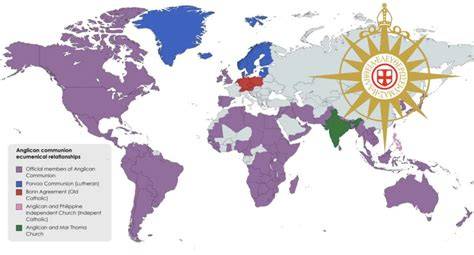
The Anglican Communion is a worldwide family of autonomous churches. It includes the Church of England, the Episcopal Church in the United States, and national or regional Anglican churches across Africa, Asia, Europe, the Americas, Oceania, and the Pacific. These churches govern themselves but remain connected by shared history, doctrine, liturgy, episcopal structure, and communion with the See of Canterbury.
What the name “Anglican” means
The word Anglican originates in ecclesia anglicana, a medieval Latin phrase meaning “the English Church.” At one level, Anglicanism is simply the church of the “Angles,” the people of England. The name has nothing to do with “angels.”
As an adjective, Anglican describes the people, institutions, churches, liturgical traditions, and theological concepts developed by the Church of England. As a noun, an Anglican is a member of an Anglican church. In some countries, Anglicans are called Episcopalians.
The name “Anglican” means “of England”, but the Anglican church exists worldwide. Although the term Anglican is found referring to the Church of England as far back as the 16th century, its use did not become general until the latter half of the 19th century.
The global Anglican Communion
The Anglican Communion is a worldwide family of churches. It is the third-largest Christian communion globally, after the Roman Catholic Church and Eastern Orthodox churches. The communion consists of 42 independent national or regional churches, including the Church of England, the Episcopal Church (USA), the Anglican Church of Kenya, the Anglican Church of Southern Africa and many others.
Each church is autonomous, meaning they govern themselves, but united by shared history, liturgy, and episcopal structure. Today, the Anglican Communion comprises forty-two autonomous provinces, with large memberships in Nigeria, Uganda, Kenya, and other nations in the Global South.
The result of this history is the Anglican Communion of the 21st century: a global family with an estimated 90 million members in over 165 countries. Anglicanism is now found worldwide, even in nations the English never colonized.
Anglicanism is one of the largest branches of Christianity, with around 110 million adherents within the Anglican Communion, and approximately 2.4 million outside of the Anglican Communion, worldwide as of 2025. Other estimates place the global Anglican population at approximately 85 million or 90 million, depending on definitions and methods of counting membership.
By the 21st century, the global centre of Anglicanism had shifted to the Global South, particularly sub-Saharan Africa. In 2020, there were 63,556,000 Anglicans in Africa, 24,400,000 in Europe, 4,565,000 in Oceania, 2,689,000 in Northern America, 1,230,000 in Asia, and 959,000 in Latin America.
| Region | Anglicans in 2020 |
|---|---|
| Africa | 63,556,000 |
| Europe | 24,400,000 |
| Oceania | 4,565,000 |
| Northern America | 2,689,000 |
| Asia | 1,230,000 |
| Latin America | 959,000 |
Early Christianity in Britain
“Anglican” refers to the unique form of Christianity that was passed down through the Church of England. No one is quite sure when Christianity first came to England, but it was well established there by the early fourth century.
According to legend, the founding of Christianity in Britain is commonly attributed to Joseph of Arimathea and is commemorated at Glastonbury Abbey. Many of the early Church Fathers wrote of the presence of Christianity in Roman Britain, with Tertullian stating “those parts of Britain into which the Roman arms had never penetrated were become subject to Christ”.
Saint Alban, who was executed in AD 209, is the first Christian martyr in the British Isles. For this reason he is venerated as the British protomartyr.
Just as Britain was a part of the Roman Empire, so the British Church formed during the fourth century a branch of the Catholic Church of the West. From the Council of Arles in 316 onward, it took part in proceedings concerning the Western Church.
For nearly a thousand years the Church existed in a single, undivided fellowship, from the British Isles in the West to the churches of the East. In the West, the Bishop of Rome had ultimate authority.
Celtic Christianity and the Roman mission
After Roman troops withdrew from Britain, the absence of Roman military and governmental influence and the overall decline of Roman imperial political power enabled Britain and the surrounding isles to develop distinctively from the rest of the West.
A new culture emerged around the Irish Sea among the Celtic peoples with Celtic Christianity at its core. What resulted was a form of Christianity distinct from Rome in many traditions and practices.
The distinction between sub-Roman and post-Roman Insular Christianity, also known as Celtic Christianity, began to become apparent around AD 475. The Celtic churches allowed married clergy, observed Lent and Easter according to their own calendar, and had a different tonsure.
Like the Eastern Orthodox and Oriental Orthodox churches, the Celtic churches operated independently of the Pope’s authority as a result of their isolated development in the British Isles.
In the Gregorian mission, Pope Gregory I sent Augustine of Canterbury to the British Isles in AD 596 with the purpose of evangelising the pagans there, who were largely Anglo-Saxons, as well as reconciling the Celtic churches in the British Isles to the See of Rome.
Augustine landed in Kent in 597 AD. In Kent, Augustine persuaded the Anglo-Saxon king Æthelberht and his people to accept Christianity. Augustine, on two occasions, met in conference with members of the Celtic episcopacy, but no understanding was reached between them.
The conflict of authority in England between church and state certainly dates back to the arrival of Augustine, and has simmered for many centuries.
Eventually, the Christian Church of the Anglo-Saxon kingdom of Northumbria convened the Synod of Whitby in 663/664 to decide whether to follow Celtic or Roman usages. With King Oswiu as the final decision maker, the meeting led to the acceptance of Roman usage elsewhere in England and brought the English Church into close contact with the Continent.
As a result of assuming Roman usages, the Celtic Church surrendered its independence, and from this point on, the Church in England was no longer purely Celtic, but became Anglo-Roman-Celtic.
Although the Roman form of Christianity became the dominant influence in Britain as in all of western Europe, Anglican Christianity has continued to have a distinctive quality because of its Celtic heritage.
England, Rome, and the struggle for authority
For nearly a thousand years the Church in England was an integral part of the Western Church in communion with Rome. The history of Christianity has produced numerous notable separations.
In 1054 came the first major split from Roman administration of the church, when the Eastern Orthodox church and the Roman split apart. Eventually, the Eastern and Western churches split.
The conflict between church and state in England produced several famous episodes. The murder of Thomas a Becket was one of the more famous episodes of this conflict.
The Magna Carta, signed by King John in 1215, contains 63 points; the very first point is a declaration that the English church is independent of its government.
The English Reformation
Anglicanism’s origins lie in the sixteenth-century English Reformation. The formation of the Church of England proved to be a complicated process.
The beginning of the sixteenth century showed significant discontent with the Roman church. Martin Luther’s famous 95 Theses were nailed to the door of the church in Wittenburg in 1517, and news of this challenge had certainly reached England when, 20 years later, the Anglican branch of the church formally challenged the authority of Rome.
In the West, corruption and abuses of power became increasingly evident. For many years, the church tried to reform itself without changing its essential structures. But eventually, leaders realized that more drastic change was needed to recover the truth of the Gospel, expressed by the Scriptures, from theological and moral corruption.
This recovery project, which swept across many nations, came to be called the Reformation. But it happened a little bit differently in England.
Henry VIII and the break with Rome
King Henry VIII received the title Fidei Defensor, or “Defender of the Faith,” from Pope Leo X in 1521 for his treatise critiquing the writings of the German Reformer Martin Luther.
Later King Henry would break with the Church of Rome in 1534 when the Pope failed to grant his divorce to Catherine of Aragon. Henry VIII dissolved the monasteries and abbeys in 1536.
Henry’s Act of Supremacy in 1534 declared the English monarch the “Supreme Head of the Church of England” and led to Henry confiscating monasteries and other Roman Catholic properties.
There is a public perception, especially in the United States, that Henry VIII created the Anglican church in anger over the Pope’s refusal to grant his divorce. However, the historical record indicates that Henry spent most of his reign challenging the authority of Rome, and that the divorce issue was just one of a series of acts that collectively split the English church from the Roman church.
This break resulted in a formal, institutional separation, while genuine theological reformation only transpired gradually through subsequent reigns. Yet Henry remained doctrinally conservative, maintaining traditional Catholic theology while asserting royal rather than papal authority over church affairs.
By Henry’s death in 1547, the Church of England resembled pre-Reformation Catholicism in most of its theological tenets.
Thomas Cranmer and Protestant reform
Substantial Protestant reform occurred later under Henry’s son, Edward VI, who reigned from 1547 to 1553. The key protagonist for introducing Protestant ideas during this period was the Archbishop of Canterbury, Thomas Cranmer.
Archbishop Thomas Cranmer was a major theological architect of the era during the English Reformation. He composed the Book of Common Prayer in 1549 and revised it in 1552.
The first Book of Common Prayer was produced in 1549. In it the Latin liturgy was radically simplified and translated into English, and for the first time a single “use” was enforced throughout England.
Cranmer’s liturgical work incorporated Protestant theological principles and was published in English, not Latin. These changes reflected influence from continental Reformers, particularly Martin Bucer and Peter Martyr Vermigli, who had shaped the burgeoning English Reformation.
The Book of Common Prayer embedded Reformed theology-such as the authority of Scripture and justification by faith-into the hearts and minds of the people through their weekly worship.
Mary I and the restoration of Roman Catholicism
After Edward VI’s death, Henry’s daughter Mary I came to power and reigned from 1553 to 1558. She reversed Cranmer’s religious reforms and restored Roman Catholicism throughout England, along with formal relations with the pope.
Mary also executed approximately 280 Protestant leaders, including Thomas Cranmer, Nicholas Ridley, and Hugh Latimer.
At this point, the English Reformation had only made marginal inroads into popular Christianity in England, and the resurgence of Catholicism met with a mixed reception.
Elizabeth I and the Elizabethan Settlement
Mary I soon died, leaving her sister Elizabeth to reign after her. Elizabeth I’s long reign, from 1558 to 1603, meant that her religious reforms lasted and outlasted her and defined the enduring shape of Anglicanism as a Protestant church.
Elizabeth quickly set out to resolve religious disputes through a series of laws known to historians as the Elizabethan Settlement, which took place from 1559 to 1563.
Elizabeth sought to retain episcopal governance and liturgical traditions while affirming Protestant doctrine and permitting some flexibility on interpretations of the Lord’s Supper.
The Book of Common Prayer of 1559 and the Thirty-Nine Articles of Religion of 1563 became the definitive Anglican formularies, balancing Catholic heritage and Reformed convictions.
Elizabeth accepted the lesser title of “supreme governor” of the church rather than “supreme head” of the church, which belonged uniquely to the Lord Jesus.
The English Reformation, initiated by Henry VIII in the 1530s, cut the ties of the Church in England with Rome, establishing the monarch as the Supreme Governor of the Church of England. It also shifted England toward Protestantism, causing lasting religious, political, and cultural change.
Anglicanism as “Catholic and Reformed”
Anglicanism emerged through the English Reformation as it evolved over the sixteenth and seventeenth centuries, combining theological reform with institutional continuity.
This historical development produced a settlement that values Scripture and tradition, Reformed doctrine and Catholic consensus, preaching and liturgical worship, episcopal governance and congregational participation.
Anglicanism forms a branch of Western Christianity, having declared its independence from the Holy See through the Act of Supremacy in 1534, a separation later consolidated by the Elizabethan Religious Settlement.
Many of the Anglican formularies of the mid-16th century correspond closely to those of historical Protestantism. The Church of England became fully Protestant both in its doctrine, seen in the Thirty-Nine Articles of Religion, and in its worship, seen in the Book of Common Prayer.
Anglicanism was an attempt to respect its Catholic heritage and spurn radical visions of Protestantism while threading the needle between Calvinistic and Lutheran varieties of Protestantism.
In the first half of the 17th century, the Church of England and the associated Church of Ireland were presented by some Anglican divines as comprising a distinct Christian tradition, with theologies, structures, and forms of worship representing a different kind of middle way, or via media.
After the Oxford Movement, Anglicanism has often been characterized as representing a via media, or “middle way,” between Protestantism as a whole and Catholicism.
Anglicanism is not a via media between Protestantism and Catholicism as if it were simply trying to split the difference and attain a hasty compromise or form a hybrid church located somewhere between the two.
For this reason, Anglican doctrine and discipline has been described most simply as “Reformed Catholicism.” The degree of distinction between Protestant and Catholic tendencies within Anglicanism is routinely a matter of debate both within specific Anglican churches and the Anglican Communion.
Richard Hooker and Anglican authority
Anglicanism continued to develop while resisting both the Catholicism of European powers such as France and Spain and the Puritans who wanted a more rigorous mode of religious life in the British Isles, including Presbyterians, Congregationalists, and Baptists.
In this context, Richard Hooker’s Laws of Ecclesiastical Polity, published from 1594 to 1597, provided theological articulation for Anglicanism’s distinctive approach.
Against Puritan agitators who demanded a thorough cleansing of the church of any residual Catholicism, Hooker argued that Scripture contains doctrine necessary for salvation but permits various ecclesiastical arrangements.
Anglicanism only prohibits what is contrary to Scripture. It was permissible then to retain traditions or habits that are absent from Scripture, so long as they are not inconsistent with Scripture.
Accordingly, the wearing of vestments, the lighting of candles, the singing of hymns, and the celebration of church seasons like Lent and Advent were not prohibited.
Anglicanism thus became a church that could accommodate Protestants of many persuasions as well as those who still retained Catholic sensitivities.
Scripture, tradition, and reason
In regard to doctrine, worship, ethics, and ministry, Anglicans consider Scripture to be paramount. This is because Scripture is the ultimate norm of the faith.
Holy Scripture containeth all things necessary to salvation: so that whatsoever is not read therein, nor may be proved thereby, is not to be required of any man, that it should be believed as an article of the Faith, or be thought requisite or necessary to salvation.
Regarding practice, Anglicans are called to “hear, read, mark, learn, and inwardly digest” all of Scripture, as it says in the Book of Common Prayer.
Anglicans understand the Old and New Testaments as “containing all things necessary for salvation” and as being the rule and ultimate standard of faith.
Reason and tradition are seen as valuable means to interpret Scripture, although there is no full mutual agreement among Anglicans about exactly how Scripture, reason, and tradition interact with each other.
Flowing from Hooker’s work is the classic Anglican theological method, often described as a “three-legged stool.” This is not a static formula but a dynamic and interactive method for discerning truth.
Scripture
The Holy Scriptures are the ultimate standard of faith, containing all things necessary for salvation.
Tradition
The wisdom of the Church passed down through the centuries-including the Creeds and the teachings of the early Church-is a vital resource that helps Anglicans faithfully interpret Scripture.
Reason
The God-given faculty for critical thought allows Anglicans to interpret Scripture, learn from Tradition, and apply their faith to the challenges of their contemporary context.
This balanced method allows Anglicanism to be a thoughtful, non-fundamentalist, and contextually sensitive faith, providing the means for a diverse global Communion to navigate complex issues over time, though not always without disagreement and debate.
Anglican creeds and formularies
Anglicans understand the Apostles’ Creed as the baptismal symbol and the Nicene Creed as the sufficient statement of the Christian faith.
Anglicans believe the catholic and apostolic faith is revealed in Holy Scripture and the ecumenical creeds-the Apostles’, Nicene, and Athanasian-and interpret these in light of the Christian tradition of the historic church, scholarship, reason, and experience.
According to the Thirty-Nine Articles, Anglicans affirm the Trinity, Jesus’s full divinity and humanity, Scripture’s sufficiency, election by grace, justification by faith alone, and only two sacraments: Baptism and the Eucharist.
They also affirm the Apostles’ Creed, the Nicene Creed, and the Athanasian Creed. Concerning the seven Councils of the undivided Church, some Anglican formularies affirm the teaching of the first four Councils and the Christological clarifications of the fifth, sixth, and seventh Councils insofar as they are agreeable to Holy Scripture.
Anglicans reject the notion of purgatory, the necessity of priestly celibacy, and the authority of the pope in the English churches.
Rejected too is the Catholic view of the transubstantiation of the elements of bread and wine during the Lord’s Supper. Instead, it is asserted that “The Body of Christ is given, taken, and eaten … only after an heavenly and spiritual manner.”
Yet Anglicans affirm Jesus’s real presence, received spiritually by faith. As such, the 1662 Prayer Book asserts that communicants of the supper “spiritually eat the flesh of Christ, and drink his blood.”
Core Anglican beliefs
Anglicans are Christians
Anglicans believe that Jesus Christ is the Savior of the world. They believe that the Bible, Holy Scripture, tells the true story of the human race, from creation to the fall.
The Bible tells the story of God raising up the people of Israel and then from that people a Messiah, the promised one. It tells of Jesus being born of the virgin Mary, living, dying, rising again, and ascending to heaven.
The Bible also tells the story of the founding of Christ’s Church and its mission to the world in his name through the Holy Spirit.
Anglicans believe that each and every person is loved by God and that salvation is offered in the name of Christ to all who believe in him.
The Church as the Body of Christ
Christians are sinners, they are saints, and their history is full of both sin and grace. Anglicans baptize those who come to Jesus in repentance and faith, along with their children.
Anglicans gather at the Lord’s table to share the holy meal, the Eucharist. These two means of grace are called Sacraments, and they point to God’s work and presence in all of creation.
Baptism is for the forgiveness of sins, the giving of the Holy Spirit, and initiation into the Church. The Eucharist is the ongoing sacred meal in which Anglicans believe Christ’s presence is given to them in the bread and wine, a participation in his body and blood.
Human dignity and social responsibility
Anglicans believe in the sanctity of all life from conception. They believe in serving and advocating for the poor, the outcast, the stranger, and the marginalized in the name of Jesus Christ.
The Anglican tradition has also expressed its mission through concern for the poor, social responsibility, peace, reconciliation, and the care of creation.
Relations with other Christians
Anglicans do not believe that they are the only true Church. They believe that other churches that confess Jesus as Lord, baptize in water in the name of the Father, Son, and Holy Spirit, and believe in the Gospel and the Bible are fellow Christians.
Anglicans affirm that Orthodox, Protestant, Baptist, Lutheran, Presbyterian, non-denominational, Roman Catholic, and other churches that affirm the ancient faith of the Church are their brothers and sisters in Christ.
The Book of Common Prayer
No document has shaped Anglican identity more than the Book of Common Prayer. Thomas Cranmer’s liturgical masterpiece established English as the language of worship and created a common liturgical framework uniting Anglicans across the ages.
The first Book of Common Prayer was compiled by Thomas Cranmer, the then Archbishop of Canterbury, in 1549. It was called common prayer because it was intended for use in all Church of England churches, which had previously followed differing local liturgies.
The Latin liturgy was radically simplified and translated into English, and for the first time a single use was enforced throughout England.
The Book of Common Prayer has been revised numerous times since then, the most significant revision being the first, in 1552. All revisions since then, before the modern era, were very conservative revisions.
The 1662 English Book of Common Prayer forms the historical basis for most Anglican liturgy around the world. The 1662 edition was a slightly revised version of the Prayer Book that attempted to encourage liturgical unity in the aftermath of Oliver Cromwell’s protectorate and the restoration of the English monarchy.
While several countries have their own prayer books, all borrow heavily from the English tradition rooted in Cranmer’s original work. The Book of Common Prayer has evolved into a global family of prayer books used in over 50 countries and 150 languages.
While most Anglican provinces have developed their own native liturgies, the Book of Common Prayer remains normative for Anglican faith and practice. It has provided the substructure and culture for the continuing expressions of Anglican worship.
The Prayer Book’s contents extend beyond public worship. It contains various prayers, readings, and scriptural selections which have formed Anglican spirituality for centuries.
Its catechism teaches doctrine; its Ordinal defines the nature of various ministries; its baptism, marriage, and burial services mark life’s key passages.
Anglican worship and practice
Anglican worship is diverse, and it is best understood by visiting and attending a local congregation. What is common to all is an inheritance of worship that recognizes the supremacy of the Bible and often finds expression through the Prayer Book.
To understand what and how Anglicans pray is to understand what they believe. The Prayer Book, described as the Scriptures arranged for worship, provides helpful resources for everything from personal daily devotions to large public gatherings of worship.
It includes prayers for every season of life. Anglicans follow the Church year, a Christian calendar of seasons, feasts, and fasts.
Music and singing
Anglican worship may include traditional hymns, Psalms, and a variety of other music. While timeless hymns are honored, Anglican congregations may sing different kinds of music to appeal to different tastes, experiences, and temperaments.
The Collect
The prayer at the beginning of the service is taken from a collection of prayers that have been assembled to coincide with the church calendar. The “prayer of the day” seeks to focus the congregation together on Jesus Christ and ask the Lord to lead the congregation in worship.
Reading Scripture
Anglicans believe that the whole Bible speaks of God’s glorious gospel. Therefore, services commonly include portions of the Old and New Testaments, including Psalms.
The Creeds
The Creeds are statements of faith written by the early Church and recited by the people during the service after the hearing of the Word.
Christians recite the Creed to recommit their lives to Christ and be reminded of what they believe. The Creeds proclaim succinctly to those interested in becoming believers in Jesus Christ what Christians believe.
The Creeds also keep the Church accountable to the Gospel.
The Prayers of the People
Anglicans respond to God and his Word by relating to him in and through prayer. In prayer they listen to the Lord, give thanks, present petitions and requests, and pray both corporately and individually.
Confession and absolution
The Confession of Sin and Absolution is placed after the hearing of God’s Word as an opportunity to respond to the Gospel of Jesus Christ.
Worshippers are given the opportunity to individually and corporately acknowledge and repent of their sins and to confess their need for Jesus Christ.
The priest then proclaims the Gospel: that by grace through faith in Jesus Christ complete forgiveness is offered to all who repent and trust in Christ.
The Peace
The purpose of “The Peace” before Communion is to remind members of the church of the peace of Christ given because of the Gospel and to allow members of the church who have been at odds with one another to “make peace in Christ” before they come to the Communion table.
Holy Communion
Jesus Christ gave the command for his people to break bread and drink wine not only as a memorial of his death and resurrection, but as an invitation to have fellowship with Christ through faith.
Anglicans believe in the “real presence of Christ” not only in the bread and wine, but among the church gathered for Communion.
Thus, the whole Communion service is called a “sacrifice of praise and thanksgiving.” Taking Communion is not just an individual encounter but a corporate experience of Christ’s presence among his people.
Anglicans celebrate the traditional sacraments, with special emphasis being given to the Eucharist, also called Holy Communion, the Lord’s Supper, or the Mass.
The Eucharist is central to worship for most Anglicans as a communal offering of prayer and praise in which the life, death, and resurrection of Jesus Christ are proclaimed through prayer, reading of the Bible, singing, giving God thanks over the bread and wine for the innumerable benefits obtained through the passion of Christ, the breaking of the bread, the blessing of the cup, and the partaking of the body and blood of Christ as instituted at the Last Supper.
The consecrated bread and wine are considered by Anglican formularies to be the true body and blood of Christ received in a spiritual manner.
The sacrament is understood as an outward and visible sign of an inward and spiritual grace given by Christ which conveys forgiveness and cleansing from sin.
While many Anglicans celebrate the Eucharist in ways similar to the predominant Latin Catholic tradition, a considerable degree of liturgical freedom is permitted and worship styles range from simple to elaborate.
Receiving bread and wine
Those who have trusted in Jesus Christ as their Lord and Savior and who are “in love and charity with their neighbor” are welcome at the Lord’s Table for Communion in congregations that follow this practice.
The bread is placed on an open palm and may be eaten followed by drinking from the common cup or may be “intincted,” or dipped, into the common cup of wine.
A person who does not wish to receive Communion may come forward and cross their arms across their chest as a sign to request a prayer and blessing, or remain seated for reflection and prayer.
Sacraments and sacramental rites
There are only two sacraments ordained by Christ in Anglican teaching: Baptism and the Eucharist. The Communion also honors confirmation, ordination, marriage, reconciliation of the penitent, and unction of the sick as important religious rites.
Anglicans believe in holy matrimony, confession and reconciliation, ordination and confirmation, and anointing of the sick and dying as sacramental rites that convey God’s grace.
Anglican church structure
In terms of church governance, Anglicanism retains the threefold episcopal order of bishops, priests, and deacons, which is regarded as an order of ministry established by the apostles.
Anglicans retain three orders of ordained ministry: bishops, priests, also called presbyters or elders, and deacons.
| Order | Primary function |
|---|---|
| Bishops | Provide episcopal oversight and serve as chief administrative officials of the church. |
| Priests or presbyters | Oversee local churches, proclaim the Gospel, administer the sacraments, and bless and pardon in God’s name. |
| Deacons | Assist priests, help administer the sacraments, and help spread the Gospel. |
The bishop is the chief administrative official of the church, and the highest figure of this rank is the Archbishop of Canterbury.
Priests, who may be men or women depending on the member church, are responsible for overseeing the local church, proclaiming the Gospel, blessing and pardoning in God’s name, and administering the sacraments.
The function of the deacon is to assist the priest; deacons help to administer the sacraments and are also called upon to help spread the Gospel.
Parishes, dioceses, and provinces
The diocese, under the authority of a bishop, is the basic administrative unit throughout the Communion.
The diocese is made up of parishes, or local church communities, each under the care of a pastor. In many of the national churches, dioceses are grouped into provinces.
In some churches, parishes may be grouped below the diocesan level into rural deaneries and archdeaconries.
Synodical government
Most Anglican provinces employ synodical structures where laity, clergy, and bishops jointly make decisions.
The Church of England’s General Synod comprises three houses: bishops, clergy, and laity. Major decisions require approval from all three houses in order to pass.
Anglicanism retains episcopal governance, but its structures also include congregational participation and shared decision-making by bishops, clergy, and lay members.
The Archbishop of Canterbury
The provinces within the Anglican Communion have historically been in full communion with the See of Canterbury and thus with the Archbishop of Canterbury, whom the Communion refers to as its primus inter pares, or “first among equals.”
The Archbishop of Canterbury is united with the Anglican Communion as its senior bishop and titular leader. The Archbishop calls the decennial Lambeth Conference, chairs the meeting of primates, and is the president of the Anglican Consultative Council.
The Archbishop of Canterbury serves as a “focus of unity” for the Communion and convenes its members in different ways.
The Anglican Communion has no central government or single figure with binding legal authority. The Archbishop of Canterbury is not a pope and does not exercise universal jurisdiction over the autonomous provinces.
Anglican instruments of communion
What holds this diverse, global family of churches together is not common administration but shared tradition and shared belief.
The Anglican Communion has no central government or single figure with binding legal authority. Instead, unity is sought through relational and consultative bodies known as the Instruments of Communion.
Their purpose is to convene the leaders and people of the Communion for prayer, counsel, and fellowship, fostering the “bonds of affection” that connect the global family.
The Archbishop of Canterbury
The Archbishop of Canterbury is a focus of unity for the Communion and convenes its members in different ways.
The Lambeth Conference
The first meeting of global Anglican bishops took place in 1867 at Lambeth, the residence of the Archbishop of Canterbury.
This meeting was called to address disputes in South Africa related to the deposition of the controversial Bishop John Colenso and to consider mechanisms for inter-Anglican relations between the various provinces.
The meeting agreed on the need for regular episcopal consultation, determining that the bishops of the Anglican provinces would gather every ten years for a meeting chaired by the Archbishop of Canterbury.
The Lambeth Conference was neither a college nor a synod, but a forum for discussion-a bellwether for the mind of the Anglican Communion.
Since its inception, the Lambeth Conference, which meets every 10 years, has constituted a principal cohesive factor in Anglicanism, even though its decisions are not binding and must be approved by the individual churches.
The Anglican Consultative Council
The Anglican Consultative Council is the representative body of the Communion. It uniquely includes bishops, clergy, and laity in its membership.
The Primates’ Meeting
The Primates’ Meeting is a gathering of the senior archbishops and presiding bishops from each province for prayer and consultation.
Anglicanism and apostolic succession
Anglicans base their Christian faith on the Bible, traditions of the apostolic church, apostolic succession, the historical episcopate, and the writings of the Church Fathers.
Anglicans confess the godly historic Episcopate as an inherent part of the apostolic faith and practice and therefore as integral to the fullness and unity of the Body of Christ.
The Anglican church, although it has apostolic succession, is separate from the Roman church.
Anglican churches retain the ancient catholic patterns of governance, sacraments, and practices while also affirming the Protestant Reformation’s emphasis on the supreme authority of Scripture and justification by faith.
The Oxford Movement and Anglo-Catholicism
Some controversial innovation emerged with the rise of the Oxford Movement in the nineteenth century.
This was led by a group of clergy who wanted to reassert Anglican’s Catholic heritage by stressing the centrality of the Eucharist, apostolic succession, Latin spirituality, and connections to the medieval church, combined with a concern for the poor living in English slums.
Eventually, this Anglo-Catholic party began to adopt a more liberal view of Christian doctrine and ethics, joining high-church ecclesiology with an openness to biblical criticism, doctrinal development, and modern thought on issues like evolution.
Soon it dominated the English Church over and against an evangelical minority. This species of Anglo-Catholicism, with its spirituality, liturgy, social concern, and liberal theology, took hold of much of Anglicanism in provinces not shaped by missionary expansion.
Anglicanism and the British Empire
The Anglican church was spread worldwide first by English colonization and then by English-speaking missionaries.
Wherever the English empire went, the Anglican Church went with it. Just as the English language spread with the British Empire, so did Anglican Christianity.
British colonialism spread Anglicanism globally from the seventeenth century onward. The Church of England followed explorers, traders, colonists, and missionaries into all parts of the world.
When Anglicans resettled in new lands, they brought their personal faith with them. Chaplains and pastors were often among their number. Additionally, many Anglicans traveled as missionaries to share the Gospel.
Anglican missionary societies established churches, schools, and hospitals in Africa, Asia, the Pacific, and the Americas.
These efforts were complex: while missionaries often operated within colonial power structures, many also advocated for indigenous peoples and translated Scriptures into local languages, inadvertently providing tools for both cultural preservation and transformation.
While Anglicanism provided community and spiritual meaning to millions, its spread often came at tremendous cost to indigenous cultures and was implicated in colonial oppression.
An honest appraisal of this history requires acknowledging the complexity of the relationship between mission, colonial expansion, indigenous leadership, and cultural change.
Autonomous Anglican churches
The first Anglican diocese outside Britain was established in 1787 in Nova Scotia, Canada.
By the nineteenth century, Anglican churches existed throughout the British Empire, including in many parts of Africa, India, Southeast Asia, Oceania, Australia, New Zealand, and North America.
Many regions were placed under the aegis of newly appointed Anglican jurisdictions in places like Canada and India.
Eventually, English bishops were sent to provide episcopal oversight to these colonies, but by the twentieth century, often coterminous with decolonization, local Anglican clergy soon became the episcopal leaders of these burgeoning Anglican churches.
The mid-20th century brought a fundamental shift. Former colonial churches became autonomous provinces within the Anglican Communion, led by local bishops and clergy.
A crucial development in Anglican history was the evolution from mission dioceses, controlled by the Church of England, to fully self-governing autonomous churches.
This was not merely a political necessity but a theological fulfilment of Anglicanism’s own principles of shared governance and local leadership through bishops.
The Episcopal Church in the USA, formed after the American Revolution, set the first precedent. This was followed by churches across the globe, especially in the mid-20th century, as they gained political independence and began to adapt their worship and life to their own cultural contexts.
Mission and the Five Marks of Mission
Historically, sharing the faith and missionary activity have always been a distinctive feature of Christianity. In the Great Commission, Jesus instructed his followers to make disciples of all nations, and this continues to be a central calling of the global Church.
The Anglican Way is not an end in itself. From its foundations, Anglicanism has understood itself as a part of the universal Church, with a mission that extends beyond its own boundaries.
The ultimate purpose of the Church is to participate in the mission of God, or missio Dei. Missio Dei is Latin for “the Mission of God.” It refers to the belief that God is the primary agent of mission, actively working to reconcile, restore, and redeem all of creation through Jesus Christ and the Holy Spirit.
Instead of the church having a mission, the church is an active participant in God’s mission.
In the Anglican tradition, this idea is expressed through the Five Marks of Mission, which are widely adopted across the Communion as a framework for its work.
- Tell: To proclaim the Good News of the Kingdom.
- Teach: To teach, baptise, and nurture new believers.
- Tend: To respond to human need by loving service.
- Transform: To seek to transform unjust structures of society, to challenge violence of every kind, and to pursue peace and reconciliation.
- Treasure: To strive to safeguard the integrity of creation and sustain and renew the life of the earth.
Ecumenical relationships
Anglicans are deeply committed to building ecumenical relationships and working for the visible unity of the Church.
Their unique identity as both “Catholic and Reformed” allows Anglicanism to act as a “bridge church,” finding common ground with Roman Catholic and Orthodox churches as well as with Protestant traditions.
The Anglican Communion is actively engaged in formal dialogues with most of the world’s major Christian families.
In 1966 Archbishop of Canterbury Arthur Michael Ramsey met with Pope Paul VI, the first such meeting since the Reformation.
A milestone in Anglican-Roman Catholic relations was reached in 1982 when Pope John Paul II met with Archbishop of Canterbury Robert Runcie to discuss prospects for reconciliation between the two churches.
The Anglican Communion is in full communion with bodies like the Old Catholic Churches of the Union of Utrecht and the Mar Thoma Syrian Church of Malabar, allowing Anglicans to share a common Eucharistic life with them.
Modern tensions in the Anglican Communion
As with any global Christian denomination, ruptures and fault lines began to emerge in worldwide Anglicanism.
Today, the Anglican Communion’s geographic shift has introduced theological tensions, particularly regarding biblical interpretation and ethics, as well as mechanisms for dealing with disputes between provinces.
Obstacles in Anglican-Roman Catholic relations also emerged when the Anglican Communion began to ordain women as priests and bishops in 1989 and when the Episcopal Church in the United States of America consecrated V. Gene Robinson, an openly gay man, as the Anglican bishop of New Hampshire in 2003.
Both Robinson’s consecration and the blessing of same-sex unions by individual American and Canadian congregations met with opposition within the Anglican Communion.
National churches in the Global South-the postcolonial countries in Africa, Asia, and South America in which a large majority of the world’s Anglicans lived in the early 21st century-raised vigorous objections to these developments.
In 2004, the leaders of the member churches of the Anglican Communion agreed to a moratorium on the ordination as bishops of individuals in same-sex relationships.
Meanwhile, traditionalists, demanding that the American church repent, took steps to establish alternative institutions that stressed a more conservative form of Anglicanism.
In 2007, some American congregations that had withdrawn from the Episcopal Church in the United States of America placed themselves under the jurisdiction of Archbishop of Nigeria Peter Akinola and formed the Convocation of Anglicans in North America.
Other American churches that had withdrawn from the Episcopal Church placed themselves under the jurisdiction of Gregory James Venables, the primate of the Anglican Church of the Southern Cone of America.
In 2008, more than 300 bishops from Africa, Asia, North America, Australia, and the United Kingdom attended the first meeting of the Global Anglican Future Conference in Jerusalem.
Although the conference expressed both the desire to remain within the Anglican Communion and respect for the Archbishop of Canterbury, its official statement, the Jerusalem Declaration, decried the Communion’s failure to discipline the “false gospel” promoted by some American and Canadian churches.
Affirming a traditional Anglicanism, the declaration rejected same-sex marriage and refused to recognize the authority of “heterodox,” or unorthodox, priests and bishops.
About 230 of the bishops attending GAFCON subsequently boycotted the 2008 Lambeth Conference of Anglican bishops.
In 2009, members of the Convocation of Anglicans in North America joined members of other churches that had left the Episcopal Church in the United States to launch the Anglican Church in North America.
The new church appointed as its primate former Episcopal bishop Robert William Duncan, an outspoken traditionalist who had led the diocese of Pittsburgh out of the Episcopal Church two years earlier.
With the support of primates from several other Anglican churches, largely in Africa and South America, the Anglican Church in North America announced its intention to join the Anglican Communion.
The Episcopal Church’s consecration of Mary Glasspool, who was in a same-sex relationship, as a suffragan bishop in the diocese of Los Angeles in 2010 increased tensions between liberals and traditionalists within the Anglican Communion.
It also prompted a rebuke of the Episcopal Church from Archbishop of Canterbury Rowan Williams for breaking the 2004 moratorium.
Later that year, the Anglican Communion imposed sanctions on the Episcopal Church, barring it from participating in ecumenical dialogue and removing its decision-making powers in matters of church doctrine.
Provinces and extra-provincial churches
The Anglican Communion comprises autonomous national and regional provinces. Examples include the Episcopal/Anglican Province of Alexandria, the Church of Bangladesh, the Anglican Church of Burundi, the Anglican Church of Kenya, the Anglican Church of Korea, the Anglican Church of Mexico, the Anglican Church of Rwanda, the Church of the Province of Uganda, and the Church in the Province of the West Indies.
Other provinces include Igreja Episcopal Anglicana do Brasil, Iglesia Anglicana de Chile, the Nippon Sei Ko Kai or Anglican Church of Japan, the Episcopal Church in Jerusalem and the Middle East, the Anglican Church of Melanesia, the Church of the Province of Myanmar, the Church of the Province of South East Asia, the Anglican Church of South America, and the Province of the Episcopal Church of South Sudan.
There are also five additional churches that are considered extra-provincial to the Archbishop of Canterbury: the Church of Ceylon, Bermuda, the Lusitanian Church, the Falkland Islands, and the Reformed Episcopal Church of Spain.
Some churches that are not part of the Anglican Communion or recognized by it also call themselves Anglican, including churches within the Continuing Anglican movement and the Anglican realignment.
Leading Anglican figures
From the turmoil of the English Reformation to its modern global expansion, the Anglican way was shaped by a diverse lineage of thinkers across five centuries.
- Thomas Cranmer
- Richard Hooker
- Hugh Latimer
- J. C. Ryle
- William Temple
- C. S. Lewis
- John Mbiti
- Leon Morris
- John Stott
- J. I. Packer
- Alister McGrath
- Desmond Tutu
- N. T. Wright
- Emily Onyango
- Elizabeth Tish Warren
- Titus Chung
- Rowan Williams
- Kathryn Tanner
- Katherine Sonderegger
Over the years, Anglicanism has produced theologians like C. S. Lewis, John Stott, and J. I. Packer, poets like John Donne, George Herbert, and Charles Wesley, activists like William Wilberforce, mystics like Evelyn Underhill, and many other examples of faithful living.