Archbishop Eusebius Joseph Beltran was an American Catholic bishop who served as the second Bishop of Tulsa from 1978 to 1992 and as the third Archbishop of Oklahoma City from 1993 until his retirement in 2010. He was born in Ashley, Pennsylvania, on August 31, 1934, ordained a priest for the Diocese of Savannah-Atlanta on May 14, 1960, and died as Archbishop Emeritus of Oklahoma City on September 12, 2025, at the age of 91.
His ministry was marked by pastoral service, support for Catholic schools and Catholic Charities, concern for vocations, involvement in the civil rights movement, assistance to Vietnamese Catholics, ministry to young people, and the promotion of the cause of canonization of Father Stanley Rother. His episcopal motto was “We Are One In Christ.”
Basic biographical information
| Event | Date | Age | Title or place |
|---|---|---|---|
| Born | 31 Aug 1934 | Ashley, Pennsylvania, Diocese of Scranton | |
| Ordained priest | 14 May 1960 | 25.7 | Priest of Atlanta, Georgia, USA |
| Appointed bishop | 17 Feb 1978 | 43.4 | Bishop of Tulsa, Oklahoma, USA |
| Ordained bishop | 20 Apr 1978 | 43.6 | Bishop of Tulsa, Oklahoma, USA |
| Appointed archbishop | 24 Nov 1992 | 58.2 | Archbishop of Oklahoma City, Oklahoma, USA |
| Installed | 22 Jan 1993 | 58.3 | Archbishop of Oklahoma City, Oklahoma, USA |
| Retired | 16 Dec 2010 | 76.2 | Archbishop of Oklahoma City, Oklahoma, USA |
| Died | 12 Sep 2025 | 91.0 | Archbishop Emeritus of Oklahoma City, Oklahoma, USA |
Archbishop Eusebius Joseph Beltran was born in Ashley, Pennsylvania, on Aug. 31, 1934, the son of Joseph C. Beltran and Helen Rita Kozlowski. Joseph was born in Spain and migrated to Pennsylvania, where he worked in the coal mines. Helen was second generation Polish and a homemaker.
The fifth of nine children, Eusebius Joseph Beltran was born in Ashley, Pennsylvania, on Aug. 31, 1934, into a devout Catholic family. Many of his family moved to Georgia in the 1950s. Of the eight siblings, four chose the religious life-two became priests and two women religious.
Two Beltran sons became priests, Joseph in 1955 and Eusebius in 1960, both for the Archdiocese of Atlanta, while a daughter, Sponsa, joined a Franciscan community, serving children at a mission in Liberia.
Education and priestly formation
His college and theological schooling were received at Saint Charles Borromeo Seminary in Overbrook, Penn. After studies at St. Charles Seminary in Overbrook, Pennsylvania, Eusebius Beltran was ordained a priest on May 14, 1960.
He was ordained a priest in the Cathedral of Christ the King, Atlanta, Georgia, on May 14, 1960, by Most Reverend Francis E. Hyland. Following his ordination, he began his ministry as a parochial vicar for the cathedral, then Sts. Peter and Paul Church, Decatur, before being named pastor at St. Mary’s Church, Rome.
Priestly ministry in Georgia
In addition to serving in many parish assignments, he was appointed presiding judge of the Metropolitan Tribunal and later as vicar general. Following ordination, he was immediately chosen to work part-time in the chancery, and in 1963 he was named vice chancellor and the presiding judge of the Metropolitan Tribunal of the Archdiocese of Atlanta.
He served as pastor of Holy Cross Church, Atlanta, from 1966-1972, and St. Anthony of Padua Church, Atlanta, from 1972-1978. In addition to his duties as vicar general, he served as a pastor.
His first assignments as pastor were a parish in Rome, Georgia, and then a parish in the Atlanta suburbs; however, he gave up this assignment to take responsibility for an urban parish serving Black Catholics.
Father Beltran was priest-secretary of the Atlanta Synod of 1966, which was the diocesan response or implementation of Vatican II. He accompanied Archbishop Paul Hallinan to the sessions of Vatican Council II in the early 1960s as a “peritus,” or adviser.
Involvement in the civil rights movement
As a young priest, Eusebius J. Beltran was active in the American civil rights movement, including in the state of Georgia. He joined Civil Rights marches and demonstrations, including the Selma to Montgomery marches.
He was present in both Selma and Birmingham at historic marches in Georgia. The Georgia Bulletin recalled his role for Civil Rights - pointing out Beltran did not tout his own role in the state and region.
In a 2015 interview with the Office of Archives and Records of Atlanta, Archbishop Beltran downplayed his own role in Civil Rights efforts. Instead, he drew attention to the work of St. Katharine Drexel in supporting the Black community many years before the Civil Rights movement gained momentum.
In an interview in the Office of Archives and Records for Atlanta, his humility spoke loudly, with his articulation of it. Beltran instead “drew attention to the work of St. Katharine Drexel in supporting the Black community many years before the Civil Rights movement gained momentum.”
Mother Katharine Drexel financially supported Our Lady of Lourdes Church and school in Atlanta, which her order, the Sisters of the Blessed Sacrament, staffed for decades.
“Archbishop Beltran said that St. Katharine Drexel had ‘the greatest effect on the future of Black people in America. She doesn’t get any credit for it, but I give it to her because I believe she did it.’”
Bishop of Tulsa
Beltran was appointed Bishop of Tulsa on February 28, 1978, by Saint Paul VI and was ordained and installed as the second Bishop of Tulsa on April 20, 1978, at Holy Family Cathedral, Tulsa.
He was appointed a bishop on Feb. 28, 1978, by St. Paul VI and was ordained and installed the second Bishop of Tulsa on April 20 at Holy Family Cathedral, Tulsa. The principal consecrator was Most Reverend Charles A. Salatka of Oklahoma City.
The principal consecrator was Most Rev. Charles A. Salatka of Oklahoma City. Co-consecrators were Most Rev. Thomas A. Donnellan of Atlanta, Ga., and Most Rev. Andrew J. McDonald, Little Rock, Ark.
During his 15 years in Tulsa, he was known for his concern for Catholic Charities, for Catholic school education and for vocations to the priesthood. In each of these areas, he is credited with developing innovative programs and extending the Church’s reach throughout eastern Oklahoma.
During his nearly 15 years in Tulsa, he became known for his concern for Catholic Charities, for Catholic schools and for vocations to the priesthood. He developed innovative programs and extended the church’s reach throughout Eastern Oklahoma.
Bishop Eusebius Beltran of Tulsa returned to Atlanta to visit St. Anthony of Padua Church, where he had served as pastor, for a November 1982 homecoming Mass. He was later appointed Archbishop of Oklahoma City.
Archbishop of Oklahoma City
On November 24, 1992, Archbishop Beltran was appointed Metropolitan Archbishop of Oklahoma City. On Nov. 24, 1992, it was announced that he had been appointed to succeed Archbishop Charles A. Salatka as Oklahoma City’s third archbishop.
He was installed on January 22, 1993, in the Oklahoma City Civic Center, in the presence of Most Rev. Agostino Cacciavillan, the Papal Pro-Nuncio, and Most Rev. Charles A. Salatka, Archbishop Emeritus of Oklahoma City.
His installation took place on Jan. 22, 1993. According to the archdiocese, the ceremony was held in Oklahoma City’s Civic Center Music Hall because the Cathedral of Our Lady of Perpetual Help could not hold all those expected to attend.
He received his pallium on June 29, 1993, from Saint John Paul II. He later received the pallium, the sign of an archbishop’s office, from St. John Paul II on June 29, 1993, the feast day of Sts. Peter and Paul, in St. Peter’s Basilica.
His nephew Joe Cebulski, parishioner of St. George Church, Newnan, remembered him with affection. “We were with him in Rome when he received his pallium from JPII and were fortunate enough for a private audience with JPII.”
He added that on that same trip, they met Cardinal Joseph Ratzinger, who helped sing Happy Birthday to one of their fellow pilgrims. “My memories with Archbishop Beltran, who we called Father Zeb, Bishop Zeb, then Archbishop Zeb, are many of the best memories of my life,” said Cebulski.
Pastoral priorities in Oklahoma City
During his 18 years as Archbishop of Oklahoma City, he developed many programs for the archdiocese. Archbishop Beltran developed many programs during his 18-year tenure.
His ministry continued the priorities that had characterized his work in Tulsa: Catholic education, Catholic Charities, vocations, pastoral outreach and service to communities throughout Oklahoma.
“Archbishop Beltran was indeed a good shepherd,” Paul S. Coakley, Archbishop of Oklahoma City, said. “He served as a bishop in Oklahoma for many years, both as bishop in the Diocese of Tulsa and here in the Archdiocese of Oklahoma City. His accomplishments are numerous to be sure.”
Our Lady of Guadalupe Catholic Camp
He was responsible for building Our Lady of Guadalupe Catholic Camp, which opened in 2000 and thrives to this day. During his 18 years as Archbishop of Oklahoma City, he developed many programs including Our Lady of Guadalupe Catholic Camp, which opened in 2000 and thrives to this day.
“Here in the archdiocese, one of the things I think Archbishop Beltran would have been most proud of and most dearly remembered for was the development of our beautiful camp - Our Lady of Guadalupe Catholic Camp - to serve young people from around the archdiocese,” Archbishop Coakley said.
“Young people were always a very important part of his ministry as bishop and as a priest. That’s part of his lasting legacy in the Archdiocese of Oklahoma City and beyond.”
The camp reflected Archbishop Beltran’s sustained devotion to young people and his belief that Catholic ministry should provide opportunities for faith formation, community and service.
The cause of canonization of Father Stanley Rother
Perhaps one of his greatest achievements began in 2007 when he was granted permission to begin the Cause for Canonization of Father Francis Stanley Rother, a native of Okarche, Oklahoma.
Perhaps one of his greatest achievements began in 2007 when he was granted permission to open a sainthood cause for Father Stanley Rother, a priest of the archdiocese who was murdered in 1981 in Guatemala while on mission.
After three years of research and interviews, more than 7,000 documents were sent to the Congregation for the Causes of Saints in Rome. After years of research and interviews, more than 7,000 documents were sent to the Congregation for the Causes of Saints in Rome.
On Dec. 1, 2016, Pope Francis officially recognized Father Rother as a martyr for the faith. Ten years later, his vision came to fruition as Father Stanley Rother was declared the first U.S. martyr by Pope Francis, which led to his beatification in Oklahoma City on Sept. 23, 2017, at which Archbishop Beltran was a principal concelebrant.
He is the first recognized martyr from the United States and the first U.S.-born priest to be beatified. Blessed Stanley Rother is the first U.S.-born priest to be beatified.
Archbishop Beltran concelebrated Blessed Stanley Rother’s beatification Mass in Oklahoma City on Sept. 23, 2017, in downtown Oklahoma City - an event attended by more than 20,000 people from around the world.
“His saintly life has become well known beyond the boundaries of Oklahoma and Guatemala and the faith of those familiar with his life has been greatly strengthened. How grateful we are to almighty God this day for the beatification of Father Rother,” Archbishop Beltran said in remarks at the Mass.
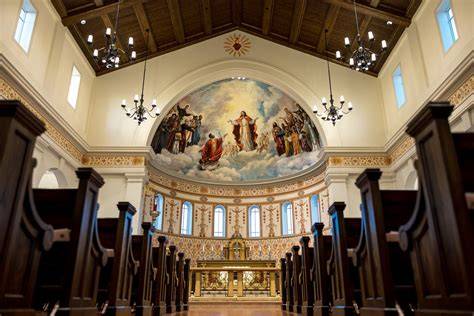
Ground was broken for the Blessed Stanley Rother Shrine in south Oklahoma City in 2019, and it was dedicated in 2023. A small chapel in the shrine is the permanent resting place of the body of Father Rother.
Support for Catholic communities
Archbishop Beltran’s ministry included a passionate commitment to the Vietnamese Catholic community of Oklahoma. For many who live in the heart of Oklahoma City, Archbishop Beltran will long be remembered for his passionate commitment to the Vietnamese Catholic community of Oklahoma.
Vietnamese Catholics at Our Lady’s Cathedral Parish in Oklahoma City presented frequent expressions of gratitude for the role he played in guiding acceptance and support for arriving immigrants from Vietnam throughout his active years in Oklahoma.
He con-celebrated at Masses which used the Vietnamese translation of the Novo Ordo Mass. His work with Vietnamese Catholics formed part of his broader pastoral concern for immigrant communities and for the full participation of Catholics in the life of the Church.
Archbishop Beltran was also remembered for his commitment to Catholic Charities and for working with people experiencing poverty and homelessness.
“A commitment to Catholic schools. A commitment to Catholic Charities and working with the poor. He was a great friend to all, and I know he will be sorely missed. He affected many lives and many hearts,” Archbishop Coakley said.
Leadership, affiliations and public service
Archbishop Beltran was a long-time member of the Equestrian Order of the Holy Sepulchre of Jerusalem, receiving the distinguished Silver Palm. He was also a fourth-degree member of the Knights of Columbus.
He had served as a member of the Board of Directors of Saint Gregory’s University, Shawnee. He also served on the U.S. Conference of Catholic Bishops Committee on the Liturgy; the Committee for the North American College, Louvain, as chairman; the USCCB Committee for the American College, Rome; the USCCB Latin America Committee and the Board of Regents for Conception Seminary.
He also served on the National Conference of Christians and Jews, and various local boards, organizations and committees. He served on a number of the U.S. Conference of Catholic Bishops’ committees, including the liturgy committee and Latin America committee.
He was on the board of the National Conference of Christians and Jews and served on various local boards, organizations and committees. His service reflected involvement in liturgy, priestly formation, international Catholic work, higher education and ecumenical relations.
Priests and bishops connected with his ministry
Archbishop Beltran ordained or consecrated notable members of the leadership of the Roman Catholic Church in the United States.
Bishop Daniel Henry Mueggenborg
Daniel Henry Mueggenborg - a native of Okarche, Oklahoma - was ordained to the priesthood by Archbishop Beltran on July 14, 1989.
Mueggenborg, who attributes his priestly vocation to the inspiration of Stanley Rother, went on to serve as an Auxiliary Bishop in Seattle, Washington, and as a Titular Bishop. He now serves as Bishop of Reno, Nevada.
Archbishop Anthony Basil Taylor
Anthony Basil Taylor - an Oklahoman who was born in Texas - was named Archbishop of Little Rock by Pope Benedict XVI, and then consecrated on June 8 in Little Rock by Archbishop Beltran, with Bishops Edward James Slattery of Tulsa and Peter J. Sartain of Seattle.
Bishop Taylor is remembered fondly for his years of ministry in Oklahoma, including the expansion of the availability of Spanish language liturgies at parishes in the state.
He is a former pastor of Saint Monica’s Parish in Edmond and twice of Sacred Heart in Oklahoma City. Taylor was a long-time member of the Knights of Columbus, Oklahoma Council No. 1038, and now belongs to the Knights in Arkansas.
Retirement and later ministry
As required by Church law, Archbishop Beltran submitted his resignation to Pope Benedict XVI on Aug. 31, 2009, upon reaching the age of 75. When he reached 75 on Aug. 31, 2009, he submitted his resignation to the pope as required by canon law.
His retirement became effective on Dec. 16, 2010, at which time he assumed the title of apostolic administrator until Feb. 11, 2011. It was accepted by Pope Benedict XVI a year later, and his retirement became effective on Dec. 16, 2010.
He then enjoyed the title of Archbishop Emeritus of Oklahoma City. He remained busy in retirement assisting with Confirmations, Masses and visits to the aging and ill.
He remained busy in his retirement years, assisting with Confirmations and Masses, making many visits to the aging and ill, and interacting with fellow residents of St. Ann’s Retirement Home.
Archbishop Beltran lived his final years at St. Ann’s Retirement Home in Oklahoma City, where his last birthday on earth was celebrated with a “parade” around the campus on August 31.
For people who knew him personally, his later years retained the same qualities associated with his public ministry. “He was one of the amazing priests ever,” said Jennifer Cawley Alvillar, whom he baptized at Easter Sunday Mass in 1969 at Holy Cross Church, Atlanta.
“His mind was completely sharp,” she said of the archbishop. On the wall behind the archbishop’s chair were photos of all the popes he met.
At one point, Archbishop Beltran told the family, “Follow me. I want to show you my private chapel.” One room of his home was a dedicated prayer chapel with a relic of Blessed Stanley Rother.
She said Archbishop Beltran was a humble priest and always deflected to others. “He loves and praises everyone else,” Alvillar said.
She recalled that the archbishop specifically mentioned the work of Catholic Charities and their work with the unhoused. “He was so proud of the way Catholic Charities operated in Oklahoma City,” she recalled. “He was generous with his time,” she said.
Death, funeral and burial
Eusebius Joseph Beltran, Archbishop Emeritus of the Archdiocese of Oklahoma City, died September 12, 2025, at age 91. He died as Archbishop Emeritus of Oklahoma City after a priestly ministry of 65.3 years and an episcopal ministry of 47.3 years.
Archbishop Eusebius J. Beltran, who headed the Archdiocese of Oklahoma City from 1993 until 2010, died at age 91 Sept. 12, 2025.
A Vigil Service for Beltran was held on Tuesday, September 23, at 6:30 p.m. at the Cathedral of Our Lady of Perpetual Help in Oklahoma City. His body lay in repose at the Cathedral from 10 a.m. to 9 p.m.
The Funeral Mass for Archbishop Emeritus Beltran was held at the Blessed Stanley Rother Shrine, 700 S.E. 89 Street, in Oklahoma City, at 10 a.m. His body lay in repose from 7 a.m. until 10 a.m. that morning.
A funeral Mass was celebrated at the Blessed Stanley Rother Shrine in Oklahoma City Sept. 24 for retired Archbishop Eusebius J. Beltran, followed by interment at Resurrection Cemetery.
After Mass, his body was interred at Resurrection Cemetery in northwest Oklahoma City. His death place was Oklahoma City, Archdiocese of Oklahoma City, Oklahoma, and his original burial place was Resurrection Memorial Cemetery, Oklahoma City.
“We thank God for Archbishop Beltran and the many ways in which he served faithfully and tirelessly,” Archbishop Coakley said. “He was a great friend to all, and I know he will be sorely missed. He affected many lives and many hearts.”
Episcopal consecration and apostolic succession
The principal consecrator of Archbishop Beltran was Archbishop Charles Alexander Kazimieras Salatka, Archbishop of Oklahoma City. The principal co-consecrators were Archbishop Thomas Andrew Donnellan, Archbishop of Atlanta, and Bishop Andrew Joseph McDonald, Bishop of Little Rock.
His episcopal lineage included Archbishop Charles Alexander Kazimieras Salatka, Archbishop Egidio Vagnozzi, Adeodato Giovanni Cardinal Piazza, O.C.D., Basilio Cardinal Pompilj, Antonio Cardinal Agliardi, Giovanni Cardinal Simeoni, Alessandro Cardinal Franchi, Pope Pius IX, Francesco Saverio Maria Felice Cardinal Castiglioni, Giuseppe Maria Cardinal Doria Pamphilj, Buenaventura Cardinal Córdoba Espinosa de la Cerda, Archbishop Manuel Quintano Bonifaz, Archbishop Enrico Enríquez, Pope Benedict XIV, Pope Benedict XIII, Paluzzo Cardinal Paluzzi Altieri Degli Albertoni, Ulderico Cardinal Carpegna, Luigi Cardinal Caetani, Ludovico Cardinal Ludovisi, Archbishop Galeazzo Sanvitale, Girolamo Cardinal Bernerio, O.P., Giulio Antonio Cardinal Santorio and Scipione Cardinal Rebiba.
Among those ordained to the diaconate by Archbishop Beltran was Archbishop Edward Joseph Weisenburger. Among those ordained to the priesthood were Bishop Daniel Henry Mueggenborg, Archbishop Peter Bryan Wells and Bishop Anthony Basil Taylor.
He was the principal consecrator of Archbishop James Peter Sartain and Bishop Anthony Basil Taylor. He was a principal co-consecrator of Bishop Luis Rafael Zarama Pasqualetto and Archbishop Edward Joseph Weisenburger.
tags: #archbishop #eusebius #beltran