Canterbury Cathedral contains centuries of historic graffiti, including masons’ marks, crosses, biblical scenes, names, initials, dates, faces, hands and feet. These marks are being surveyed, recorded and shared with visitors through the Canterbury Cathedral Historic Graffiti Research Project, which began in October 2018 as part of The Canterbury Journey and continues with a team of volunteers.
The graffiti reveals the activities, beliefs and identities of people connected with the Cathedral, from the medieval craftsmen who built it to schoolboys who traced their hands and feet and later visitors who commemorated events. Its preservation depends on documenting the marks, protecting particularly significant examples and distinguishing historic graffiti from temporary contemporary installations that are designed not to damage the building.
What can be found across Canterbury Cathedral
Masons' marks, scenes of devotion, names, faces, hands and feet are all etched across the walls of the Cathedral and are now being surveyed, recorded and shared with visitors by our Historic Graffiti Research team.
The marks belong to different periods and reflect different purposes. Some were practical signs made by craftsmen, while others expressed religious devotion, recorded personal presence or preserved the memory of a visit. Together, they form a record of ordinary activity alongside the Cathedral’s better-known architecture, sculpture, stained glass and monuments.
The Canterbury Cathedral Historic Graffiti Research Project
The Canterbury Cathedral Historic Graffiti Research Project began in October 2018 as part of The Canterbury Journey - a Heritage Lottery Funded restoration and community engagement project - and continues to this day with a team of volunteers surveying and recording graffiti, and sharing the discoveries made with visitors.
The project treats historic graffiti as evidence that can be studied and interpreted rather than as meaningless damage. Recording the marks helps researchers understand where different groups of people worked, worshipped, visited or spent time inside the Cathedral.
Historic graffiti tours explore a selection of different types of historic graffiti from different periods in the Eastern Crypt, Quire and Trinity Chapel.
Masons’ marks: signatures of the builders
Some of the earliest marks in the Cathedral were made by the men who built it, to indicate their work. You can identify these marks by their repetition and quality.
Repeated patterns and consistent workmanship help distinguish masons’ marks from other forms of graffiti. They were connected with the organisation of building work and preserve traces of the workforce responsible for constructing and finishing parts of the Cathedral.
| Feature | Recorded detail |
|---|---|
| Unique masons’ marks in the Eastern Crypt | 42 |
| Construction period associated with the Eastern Crypt workforce | 1179-81 |
The number of unique masons’ marks in the Eastern Crypt is 42, suggesting the size of workforce that built it between 1179-81.
Graffiti as an expression of devotion
From simple crosses, to complex biblical scenes, most medieval graffiti across the Cathedral were marks of faith.
These devotional marks range from brief and easily understood symbols to more elaborate images. Their presence indicates that medieval graffiti could be a form of prayer, meditation or religious identification, rather than simply an act of defacement.
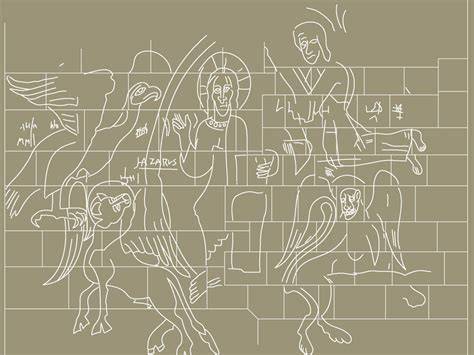
The largest graffiti in the Cathedral, located in the Eastern Crypt, is over 6 sqm. It depicts Christ surrounding by the four evangelists.
This work, known as “Christ in Majesty”, is behind protective glass, but please do ask a guide to illuminate it for you.
The image is accompanied by a digital drawing interpretation by David White, Historic Graffiti Research Team.
Hands, feet and traces of childhood
The marks left by school boys across the centuries - who traced round their hands and feet - can be found around the Great Cloister.
There are over 70 footprints in the Great Cloister.
The surviving outlines provide a particularly direct connection with the people who made them. Unlike a formal inscription, a traced hand or foot records the physical presence and approximate scale of an individual in a simple, immediate form.
Names, initials and dates
Many post-medieval pieces of graffiti may commemorate an event, perhaps a visit to the Cathedral.
Names, initials and dates can preserve evidence of personal visits and significant moments. They also show how the Cathedral continued to function as a place where individuals left signs of their presence long after the medieval period.
The mark of the Master of the Tomb
The mark of William Boolde in the Crypt is possibly that of Mayor Boolde of Canterbury (1457-8), or William Boolde, a monk at the Cathedral who was described as ‘master of the tomb’ in about 1490.
The uncertain identification illustrates one of the challenges of interpreting historic graffiti. A mark may be connected with more than one possible person, and its meaning may depend on its location, date and relationship to the surrounding architecture.
Notable dimensions and discoveries
| Discovery | Detail |
|---|---|
| Unique masons’ marks in the Eastern Crypt | 42 |
| Largest feasting scene in the Cathedral | 23ft |
| Footprints in the Great Cloister | 70+ |
| Area of the largest graffiti in the Cathedral | over 6 sqm |
The length of the largest feasting scene in the Cathedral is 23ft.
The variety of forms and sizes demonstrates that Canterbury’s historic graffiti is not a single category. It includes small personal marks, repeated workshop signs, religious images, large scenes and physical outlines made by tracing around hands and feet.
How historic graffiti is preserved
Surveying and recording are central to the preservation of historic graffiti. The Historic Graffiti Research team documents the marks and shares the discoveries made with visitors, allowing fragile or difficult-to-see evidence to be studied without encouraging new marking of the Cathedral’s fabric.
Protective measures are used for especially important examples. “Christ in Majesty” is behind protective glass, while a guide can illuminate it so that visitors can see the work without direct contact with the historic surface.
Preservation also requires distinguishing historic marks from modern additions. Historic graffiti is part of the building’s accumulated evidence, whereas new marking on protected walls, pillars or other property can cause irreversible damage.
Historic and contemporary graffiti at Canterbury Cathedral
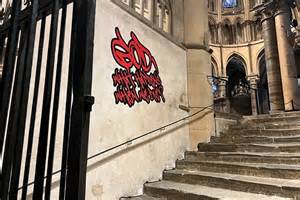
The relationship between historic graffiti and contemporary visual culture was explored by “Hear Us”, a temporary art installation featuring bold graffiti-style transfers that asked questions of God.
“Hear Us” was a collaboration between poet Alex Vellis, curator Jacqueline Creswell and diverse communities. The project was inspired by Matthew 7:7-8 and explored the act of asking God a question, for guidance and understanding in life’s complexities.
The participants were marginalised local communities who did not feel the Cathedral was a place for them, and they were asked to create answers to the question: “What would you ask God?”.
The result was a major new art installation of bold colourful graffiti-style lettering pasted onto some of the pillars in the Cathedral and in the Eastern Crypt that have a direct link with historic graffiti and mason marks found in the building.
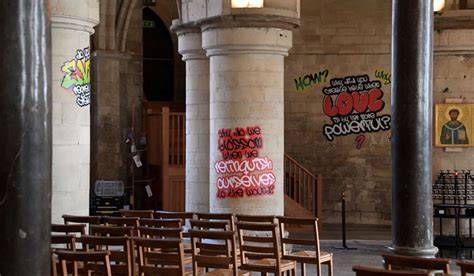
The works were attached to walls using colourful stickers and were mainly displayed in the crypt, with some works scattered around the main Cathedral building.
“Hear Us” was a temporary art installation that was carefully developed in conjunction with heritage experts to ensure that no damage was caused to the historic fabric of the Cathedral.
The temporary transfers were designed to leave no mark or adhesive, and the project did not encourage or condone the making of graffiti on property owned or under the care of others.
Why the installation provoked debate
The installation attracted criticism as well as praise. US vice-president JD Vance wrote on X: “It is weird to me that these people don't see the irony of honoring 'marginalized communities' by making a beautiful historical building really ugly.”
Elon Musk commented “absolutely” to the post.
Visitor Daniel from Warrington said: “I think it ruined the environment,” and added: “It's not what I came to see, I want to see how it was originally was and the graffiti spoils the vibe.”
Other visitors responded differently. Alex Palmer from Chartham volunteers at Canterbury Cathedral and said he was won over by the art installation.
“Normally I can't stand graffiti but I am coming around to it now,” he said. “There are lots of important questions being asked with this artwork and it has got me thinking.”
The Dean of Canterbury, the Very Revd David Monteith, said that the installation “intentionally builds bridges between cultures, styles and genres”.
He added that it “allows us to receive the gifts of younger people who have much to say and from whom we need to hear much”.
“Above all, this graffiti makes me wonder why I am not always able to be as candid, not least in my prayers,” he said.
Graffiti, voice and public space
“Graffiti is often the language of the unheard. It can be a way for the powerless to challenge injustice or inequity but it can equally be an act of vandalism, division or intimidation. Whichever it is, the reaction graffiti provokes is visceral - and it is this emotional punch that we want “Hear Us” to have.”
The installation presented graffiti as a means of reclaiming public spaces, preserving cultural heritage, and affirming identity.
“We could easily have rendered the questions to God as medieval-style calligraphy …neatly hung on canvas within the Cathedral, but they would likely have gone unnoticed and unremarked upon - with few, if any, choosing to engage with the questions of faith and meaning at their heart.”
“Seeing this graffiti imagery juxtaposed against the Cathedral’s stonework - much of which is covered with centuries-old scrawled religious markings and historic graffiti - is undoubtedly jarring and will be unacceptable for some.”
“But how can considering sincere questions of faith and meaning within a place of worship be sacrilegious or desperate? Or how can a temporary transfer that will leave no mark or adhesive be seen as vandalism?”
“There is a rawness which is magnified by the graffiti style which is disruptive. There is also an authenticity in what is said because it is unfiltered and not tidied up or sanitised.”
“This installation intentionally builds bridges between cultures, styles and genres and in particular allows us to receive the gifts of younger people who have much to say and from whom we need to hear much,” he added.
Temporary installation dates
“Hear Us” officially opened on October 17 and ran until 18 January with a special programme of events including an artist’s talk, historic graffiti tours, mini talks and family-friendly graffiti-themed activities.
The installation was described as being on display at Canterbury Cathedral from 17 October to 18 January.
Its temporary character was important to the preservation discussion: the project was intended to create a visible connection with historic graffiti without adding permanent marks to the Cathedral.
Graffiti, sacred space and changing uses
An article about the “Hear Me” exhibit in the Catholic World Report was ascribed to loss of the sense of holiness and a loss of sacred aesthetics.
Today’s problem seems to be the idea of “transitory holiness.” It’s built into ideas of churches as “multifunctional” places, a notion in vogue immediately after Vatican II that lingers in various mutations today.
“Transitory holiness” seems something like a bad reverse transubstantiation. The church is “holy” from 7:30 am to 1:00 pm for Sunday morning Masses. By 3:00 pm, it transforms into a concert hall with good acoustics for the local choir, especially when choir stalls or other “churchy” architecture provide a good photo backdrop for a Christmas concert. By 6:00 pm, it might mutate into avant-garde “culture,” like the Paderborn chicken dance or the Canterbury indoors street art and tagging festival.
John M. Grondelski, author of “Canterbury’s graffiti and the lost sense of holiness, goodness, and beauty”, elaborates on this topic in his comments about the exhibit.
It should be noted that Catholic and Anglican traditions have had some differences nearly 500 years since the Dissolution of the Monasteries which were forcibly closed by Henry VIII between 1536 and 1541.
The dissolution, a period of immense change driven by the king’s break from papal authority, involved the seizure of monastic wealth and the dispersal or destruction of monastic libraries.
Visiting and learning about the graffiti
Visitors can explore the historic graffiti through a dedicated Historic Graffiti guided tour. The tour explores historic graffiti throughout the Cathedral and includes examples from the Eastern Crypt, Quire and Trinity Chapel.
New dates for this and other specialist tours are added regularly.
Free 15-minute Mini Talks offer a bite-sized exploration of the Cathedral’s history, and guided tours are the perfect way to discover the Cathedral’s amazing history, spaces, and secrets.
The Mini Talks include the Cathedral’s 1,400 years of history, from the Black Prince and the turbulent Thomas Becket to Historic Graffiti and stained glass.
Other guided programmes include “The Inside Story” Tour, which covers the story of Canterbury Cathedral through its soaring architecture, beautiful medieval stained glass and the history that helped make and shape the Cathedral.
From the Cathedral’s origins in the 6th century, the tour encompasses 1,400 years of history, with tales of royalty, clergy and everyday craftsmen who made the Cathedral what it is today, set amid a background of wars, political struggle and tales of bravery.
The “St Thomas Becket Story” Tour explores the places in the Cathedral associated with the life and death of the renowned saint and martyr, from the location of his shocking murder in 1170 to the site of his first tomb, where over 700 miracles were reported, and shows how the story was re-told in stained glass.
The Stained Glass Windows Tour offers an introduction to the history and range of stained glass found at the Cathedral, from medieval to modern, including richly detailed Bible-story windows, Miracle Windows and the oldest stained glass in England.
Gentle Tours are step-free tours delivered at a gentle pace in a smaller group and split into two parts with a comfort break.
Through these forms of interpretation, graffiti can be understood in relation to the wider history of the Cathedral: its construction, worship, pilgrimage, artistic traditions, changing communities and continuing preservation work.
Historic graffiti at Canterbury Cathedral is therefore both a physical record and an interpretive challenge. Masons’ marks document the people who built the Cathedral, devotional images reveal forms of medieval faith, and names, dates, hands and feet preserve traces of later visitors and everyday life.
The ongoing research project ensures that these marks are surveyed, recorded and shared, while protective measures and heritage expertise help safeguard the historic fabric. Temporary projects such as “Hear Us” have also shown how contemporary graffiti-style art can create discussion about faith, identity and public space when it is carefully installed and removed without damage.
tags: #canterbury #cathedral #graffiti