The Cursed Sepulchre gives the Soulblight Gravelords their faction terrain in the form of three spooky mausoleum-like houses, while the accompanying Manifestations of the Grave add the Hand of Nagash, the Unholy Reliquary and the Sanguine Swarm to the army. The kit is thematically appropriate, easy to build and especially appealing to players who enjoy painting terrain.
The Cursed Sepulcre/Nexus of Grief is one sprue twice that makes three Spooky houses. It ALSO makes the faction terrain for Nighthaunt, in the guise of a Nexus of Grief. Which is interesting and a bonus if you run both factions! Whilst ostensibly a “multibuild” kit the difference is so negligible between the two you can easily use this for both factions.
What the Soulblight Gravelords release contains
The Manifestations come on two sprues and go together very easily. Monopose, no variation. No surprise there. The primary feature on all three is dramatic spooky smoke.
| Manifestation | Description | Base |
|---|---|---|
| Hand of Nagash | Big flying skeleton hand | 120mm oval |
| Unholy Reliquary | Floating vampire coffin | 50mm round |
| Sanguine Swarm | Two bat swarms | 40mm round |
If you asked me what to expect from the SBGL spells and terrain I’d have guessed “Bats, coffin and some spooky houses”. This is basically that, but with a massive hand (of Nagash!) added to that list. It’s not groundbreaking or innovative in terms of design, but fits the army theme perfectly and sits well in the range.
It is now clear that GW are rounding out each and every faction with both Faction Terrain and Manifestations as their 4th ed Battletomes are released. So these are no surprise. This is nice for completeness and balance and no faction is left out.
The Cursed Sepulchre and Nexus of Grief
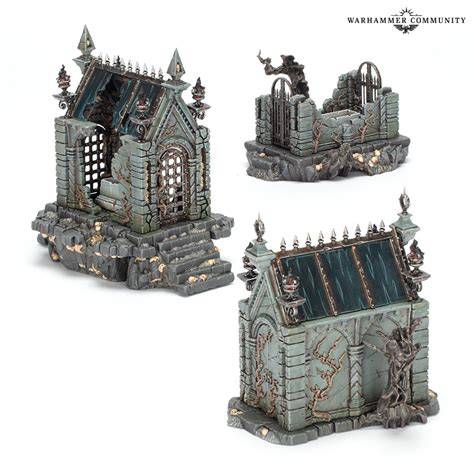
The Cursed Sepulcre is made up of three spooky houses. Two with rooves, one without. The houses have a strong mausoleum and graveyard character, with details that immediately establish them as Soulblight Gravelords terrain.
There is pretty clever design here. Each house is the same parts from each sprue mirrored. So each has a base made of the same part twice, the long sides are the same etc. The assembly here is VERY neat and it being just one sprue repeated is clever sprue design. They manage to make three unique buildings out of one sprue and it’s slick sprue design.
The plastic is dense and the things feel solid. They have a stone/flagstone base level, which puts them at different heights also. The Cursed Sepulchre therefore has more physical presence than a flat terrain piece, and the varying heights help the three buildings read as a unified group rather than identical copies.
The difference between Sepulcre and Nexus is which side of each wall/gate you use. Those with shear stone and creeping vines are for Soulblight Gravelords and those with stone blocks and roses (a motif of the faction) are for Nighthaunt.
This is a neat distinction, but really I don’t think it comprises a ‘multi-build’ kit. Build it however you like and use it as both?! I varied which sides of walls I used for variation and to make it more interesting for myself.
You also have some minor options, where you put the dead tress (or leave them off) and what corbels to use on the roof ridge ends. This isn’t a lot, but with the wall options is enough to make you feel you’re making choices in the build.
Details and construction quality
I am a sucker for a nice terrain kit and this IS a nice terrain kit. Really enjoyed building it and goes together so nicely. The little details like skulls, candles, and vines all really sell the theme and the models.
The tombs/mausoleums are roughly equable to the Garden of Morr ones of old and as I have an unbuilt set of that to hand (waiting for a graveyard terrain project I can never find time for…) I thought to do a little compare and contrast. It's a world of difference in the 15 years that separate these kits.
The Garden of Morr parts are thin and flimsy, joints don't line up well. The Sepulcre tombs have bases with real depth which create a nice change in height across them. Such a big evolution of kits.
Having said that the Garden spooky houses do have roughly the same base footprint as the new ones. So if you have those you could get away with using them as your faction terrain.
Rules and battlefield function
Across the realms there are many places drenched in the energies of death - sites of necromantic potential where hundreds or even thousands of souls met their tragic end amidst violence and horror. Such areas are rich pickings for the Soulblight Gravelords.
They contain bounteous quantities of desiccated flesh and yellowed bone ready to be transformed into undead soldiery or used to patch up damaged warriors. Better still, practitioners of death magic can siphon the grim energies permeating these locations to restore their unnatural vitality.
Locus of Shyish
A palpable aura of death lingers over these ancient burial sites, dormant necromantic energy that can be harnessed by Shyishan practitioners.
Effect: Each time a friendly SOULBLIGHT GRAVELORDS WIZARD casts a SUMMON SPELL from the ‘Manifestations of the Grave’ lore, you can measure the range and visibility from this terrain feature instead.
This ability allows a Soulblight Gravelords Wizard to use the Cursed Sepulchre as the point from which range and visibility are measured when casting a Summon Spell from the Manifestations of the Grave lore. Positioning the terrain feature can therefore influence how easily those Manifestations enter the battlefield or affect targets.
Leeching Soil
When blood is spilt upon this unhallowed ground, it is hungrily absorbed by the tainted earth and the withered roots running through it.
Effect: Each time a model, friendly or enemy, is slain while it is within 9" of this terrain feature, Heal (1) this terrain feature.
The ability is triggered whenever a model is slain within 9" of the Cursed Sepulchre, regardless of which side the model belongs to. The terrain feature is therefore connected to fighting around the mausoleums, with nearby casualties feeding the corrupted ground.
Defensive characteristics
The Cursed Sepulchre has the keywords FACTION TERRAIN, WARD (6+), DEATH, SOULBLIGHT GRAVELORDS.
Units with the WARD keyword have the ‘Ward Save’ passive ability. The number after the WARD keyword indicates the ward value for the ward save. If a unit had WARD (5+), for example, its ward value would be 5. If a unit has more than one ward save, only the ward save with the lowest value applies to it; the other has no effect.
WARD SAVE: Whether through their uncanny reflexes, unnatural toughness or a source of mystical protection, these warriors can avoid otherwise lethal attacks.
Effect: In step 1 of the damage sequence, make a ward roll of D6 for each damage point in this unit’s damage pool. If the roll equals or exceeds this unit’s ward value, remove that damage point from the damage pool.
Models cannot move across, be set up on or end moves on any part of this terrain feature. Subtract 1 from hit rolls for attacks that target a unit that is behind or wholly on this terrain feature, unless that unit charged this turn or has the FLY keyword.
Visibility and measuring from faction terrain
A target model is visible to another model, which we’ll call the observing model, if you can draw a straight line through the air, whether horizontal, diagonal or vertical, from any point on the observing model to any point on the target model that does not intersect any objects except for other models in the observing model’s unit.
A target unit is visible to an observing unit if at least 1 model in the target unit is visible to at least 1 model in the observing unit. A model is always considered to be visible to itself.
If a rule or ability requires a target to be both within a given range of and visible to the unit using that ability, or to a model in that unit, both conditions must be met by the same model in the target. You could not, for instance, target a unit where one model is within range but not visible and another model is not in range but is visible.
If any part of another model can be seen by an observing model, both the target model and its unit are visible to that observing model.
In some cases, it might not be immediately clear whether a model is visible. If so, stoop down to get a look from behind the observing model. If any part of the other model is visible, even if it is just the tip of a spear, then that model is visible for rules purposes.
Some abilities allow you to heal a unit. To heal a unit, remove a number of damage points from the unit equal to the number in brackets after ‘Heal’, e.g. Heal (2).
The Manifestations of the Grave
As with most of the endless spells the Manifestations also offer some interesting opportunities for a fun kitbash, as you get a large and unusual model. The set’s three models are visually distinct, although all share dramatic sculpted magical smoke as a major design element.
I’m not a huge fan of sculpted ‘magic’ personally, so struggled with this a little and it led me to kitbash the big hand. I feel that the basic models here are pretty easy to assemble and get on the table.
Sanguine Swarm
The Sanguine Swarm, being honest, are a little lazy. The faction has bats on its bats. There's a unit of bats and multiple models have bats on them, one has a swarm of bats as a weapon.
Sure, vampires love bats, we get it, but a swarm of bats as a spell isn’t super imaginative. Could it have been a GIANT bat? Or just a giant bat head, or bat-winged vampire tree monster?
The bats come in strings joined at the wings. I was surprised to find that there was only one point of contact from each ‘string’ of bats to the base thing. These are flimsy and may well snap in use. Not super impressed.
Being honest, given that the Manifestation also kinda sucks, I think these may well end up as more Fellbat bases in the army.
Unholy Reliquary
The Unholy Reliquary is much better. The model has its own quite nice sculpted base of cracked flagstones with supernatural energy flowing up into the floating coffin. All goes together nicely and looks good.
The skeleton has an armoured carapace, breastplate, in the style of the Blood Knights, which I chose to leave off, as I preferred the look of the naked skeleton. Either way it looks cool.
The coffin and skeletal figure create a strong visual link to vampire aristocracy, ancient burial places and the unnatural magic of Shyish. The model also benefits from a compact silhouette compared with the more extended bat swarm.
Hand of Nagash
The HAND OF NAGASH is boss. Big floating death hand coming RIGHT at YOU! What's not to love? Every set of Manifestations has a star and this is clearly the Soulblight one. HANDS down.
The Hand is supported by and protruding from a swirling vortex of death energy. Easy build and not many parts, the vortex being only two pieces.
This was a little much sculpted magic for me however and I therefore set about my only kitbash of this set. I nearly just had it bursting from the ground, Evil Dead style, but in the end went for a variation on the ‘coming right at you’ build.
I closed the fingers up a little, cutting and pulling them together, to make more of a grip. Then I added a stream of corpses and bloody matter cascading from the hand.
This supports the whole thing on a brass rod up the middle, meaning I could drop the magic vortex and make it more horrid in one go! Most of the gore lumps and stream is made from various bits stuck together and then bulked out with expanding polyurethane glue.
I like doing experimental, unpredictable builds like this, the expanding glue gives a random element that is fun. Came out pretty well. Certainly grim!
I like this model and it makes a dramatic addition to the army.
Painting the Manifestations
Fast, big and loose: That's how I like to paint terrain! Big brush and a can do attitude! This ideology must and can apply to magic spells as well.
Seems to me that the Manifestations are magic, so you can paint them in whatever wacky scheme you please! Washes and a big brush are probably your friends here, as all the sculpted ‘magic smoke’ won't lend itself to dry brushing.
For the Manifestations I did all the smoke/magic in my signature spooky green, Helio Deep Green mixed with white, blended into black, then pure black at the tips.
All the bones are a cool, blue white and the bats I did in Orange, to make them interesting/standout. I’ve basically used colours from my army here, but why not go a little nuts with spells?
Bright MAGIC colours? Slosh some contrast paints around and they’d really pop.
I think my fave here is the Unholy Reliquary, which I’ve basically done in different tones of the same green shade, with just a little grey/brown stone on the base. It looks ethereal and magical as a result and I’m happy with the effect.
Painting the Cursed Sepulchre
For the terrain you can employ a whole range of techniques to paint them, as there's plenty of textures and surfaces here to help you out.
As I am a special oil painting snowflake I’m not going to talk about specific paints here, only general colours.
To paint the Sepulcre I first lightly glued each house to a piece of wood, so I’d have something to hold onto whilst I painted it. This is pretty easy to prise off after it's all dry.
Then I basically attack them with various techniques that are easy to apply and accentuate the textures of the terrain features. Stick em to some wood, get a big brush.
I used the colours from my army so they would fit in nicely. Which is easy as It’s basically rusty metal, stone, mud, bones and ‘special stuff’, roses, candles etc.
Rusty metal
- Ochre/Sienna washes all over- wait to dry
- Sponge Paynes Grey, really dark blue, almost black, all over
- Highlight pointy tips, spikes etc
- Wash again
- Sponge again
The resultant layers make for a nice effect and the patterns of orange/red oil wash make a really nice rusty metal effect. This is good here as the roof panels are almost flat. So the running rust adds texture.
Stone and mud
This is the same as basing my army. Using two shades of grey and Paynes grey to shade.
- Base in dark grey
- Rough highlight the centre of each stone
- Light paynes grey wash- let it dry
- Sponge light grey, high points
- Sponge brown, Umber, all over
- Random Paynes grey shading in recesses, at bottoms of walls etc
- Wash all the muddy bits in brown, umber
Roses, candles and other details
The Special stuff I just painted in the desaturated orange from my army, so that the roses and candles stand out against all the stone.
Overall I went for the fast, technique heavy painting here. Lots of washes, sponging and layers to create texture. Fast, dirty and fun.
Building and painting assessment
The Cursed Sepulchre is a strong terrain kit because it combines solid construction, useful visual variation and a clear faction identity. The one-sprue-repeated design is efficient, while the mirrored parts and selectable wall faces prevent the three houses from feeling completely identical.
The terrain is also more forgiving to paint than a highly ornate character model. The surfaces naturally support washes, sponging, rust effects, dry textures and broad colour blocking, while skulls, candles, vines and roses provide small areas for contrast.
The Manifestations are more uneven. The Sanguine Swarm is thematically predictable and structurally delicate, the Unholy Reliquary is a compact and attractive sculpt, and the Hand of Nagash is the standout model of the set.
Soulblight Gravelords get their mandatory spells and terrain. Nothing staggering in terms of concepts, BUT some really nice kits and if you like terrain then the Sepulcre/Nexus kit is definitely a winner. Also who DOESN’T want a BIG hand bursting into their games??