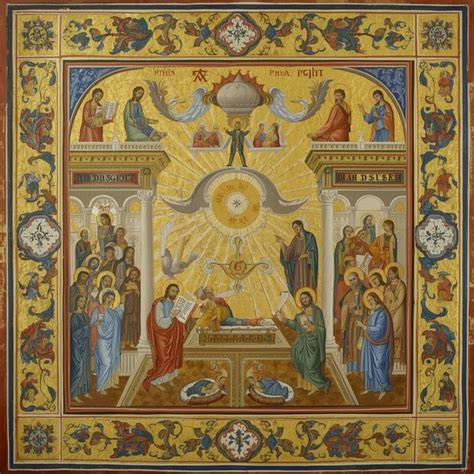
A Divine Liturgy icon represents the Eucharistic worship of the Church as a heavenly reality, often showing Christ, angels, liturgical vessels, the Eucharistic bread, and the chalice. In the elaborate Greek type called ΘΕΙΑ ΛΕΙΤΟΥΡΓΙΑ, or Theia Leitourgia, “Divine Liturgy,” the liturgy is celebrated in heaven by Christ, who is robed as a bishop though depicted with a bare head.
Standing angels are important identifying elements of this type. Instead of being seated at a table, Jesus stands and is generally depicted twice. The composition connects the earthly Eucharistic rite with the worship of heaven and presents the Divine Liturgy as an event involving Christ and the entire heavenly host.
Greek Eucharistic icon types
When we think of Greek Eucharistic icons, we commonly think first of the standard type called Ο ΜΥΣΤΙΚΟΣ ΔΕΙΠΝΟΣ, Ho Mystikos Deipnos, - “The Mystic Supper.” It represents the institution of the Eucharist, what Protestants commonly call “The Lord’s Supper,” the same event depicted in Leonardo da Vinci’s famous “Last Supper” painting.
It shows Jesus seated at a table with his apostles. There are, however, other Greek Eucharistic types. There is the elaborate ΘΕΙΑ ΛΕΙΤΟΥΡΓΙΑ (Theia Leitourgia), “Divine Liturgy,” which shows the liturgy being celebrated in heaven by Christ robed as a bishop, though with bare head; look for standing angels as identifying elements in this type.
There is also the similar Η ΘΕΙΑ ΚΟΙΝΩΝΙΑ (He Theia Koinonia) “Holy Communion” type, which we generally call “The Communion of the Apostles.” It too depicts Christ standing at an altar, giving communion to the apostles, who approach from left and right.
Again Christ is shown twice, at left in the so-called metalepsis of the wine, and at right in the so-called metadosis of the bread. This represents Christ giving the communion in and to the Church on earth.
| Icon type | Greek name | Principal scene |
|---|---|---|
| The Mystic Supper | Ο ΜΥΣΤΙΚΟΣ ΔΕΙΠΝΟΣ | Jesus seated at a table with the apostles |
| Divine Liturgy | ΘΕΙΑ ΛΕΙΤΟΥΡΓΙΑ | The liturgy celebrated in heaven by Christ and the angels |
| Holy Communion | Η ΘΕΙΑ ΚΟΙΝΩΝΙΑ | Christ giving the Eucharist to the apostles at an altar |
An allegorical Eucharistic icon
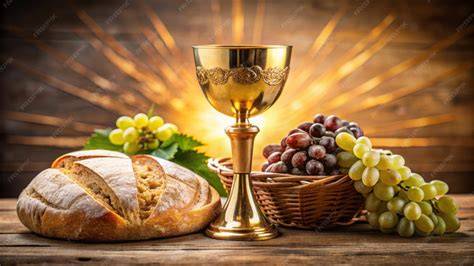
There is, however, an uncommon allegorical icon of the Eucharist that is apparently borrowed from a Western prototype. It shows Christ with blood spurting from his side into a chalice at left, and on the right his fingers rest on the eucharistic bread, which is stamped with the word NIKA, meaning “He conquers.”
The chalice and bread are the chalice of wine and loaf of bread used in the Eucharist rite, which Eastern Orthodoxy considers to be also the blood and body of Christ.
The image makes the Eucharistic symbolism visible through the direct association of Christ’s blood with the chalice and his body with the bread. The word NIKA on the bread means “He conquers,” a Greek victory inscription frequently associated with Christ.
The Eucharistic inscription
The inscription on the banner below Jesus reads:
ΛΑΒΕΤΑΙ ΦΑΓΕΤΑΙ ΤΟΥΤΟ ΕCΤΙ ΤΟ CΟΜΑ ΜΟΥ ΠΙΕΤΑΙ ΕΞ ΑΥΤΟΥ ΠΑΝΤΕC TOYTO ECTI TO AIMA MOY
Labetai phagetai touto esti to soma mou
Pietai ex autou pantes touto esti to [h]aima mou
“Take, eat, this is the body of-me
Drink of it all [of you], this is the blood of-me”
The inscription is borrowed from Matthew 26:26-28:
Ἐσθιόντων δὲ αὐτῶν λαβὼν ὁ Ἰησοῦς ἄρτον καὶ εὐλογήσας ἔκλασεν καὶ δοὺς τοῖς μαθηταῖς εἶπεν, Λάβετε φάγετε, τοῦτό ἐστιν τὸ σῶμά μου. καὶ λαβὼν ποτήριον καὶ εὐχαριστήσας ἔδωκεν αὐτοῖς λέγων, Πίετε ἐξ αὐτοῦ πάντες, τοῦτο γάρ ἐστιν τὸ αἷμά μου τῆς διαθήκης τὸ περὶ πολλῶν ἐκχυννόμενον εἰς ἄφεσιν ἁμαρτιῶν.
“And as they were eating, Jesus took bread, and blessing, he broke it and gave it his disciples, saying: ‘Take, eat, this is my body’; And taking the cup and giving thanks, he gave it to them, saying: ‘Drink of it all of you; for this is my blood of the new covenant which is poured out for many for the remission of sins.‘”
How the inscription is arranged
The calligrapher arranged the words of the inscription in an odd way. Here is how he did it in transliteration:
LABE TAI PHAGE TAI TOU TOESTI TOSOMAMOU PIE TAI E XAU TOU PAN TES TOU TOESTI TOAI MA MOU
Compare that with how it should be read:
LABETAI PHAGETAI TOUTO ESTI[N] TO SOMA MOU PIETAI EX AUTOU PANTES TOUTO ESTI[N] TO [H]AIMA MOU
The apparent irregularity results from the use of ligatures. You can see that the calligrapher has used some ligatures, which you must learn to recognize if you want to read Greek icon inscriptions.
Ligatures in Greek icon inscriptions
First, he has joined the letters S and T in this form. Next, he joins the Greek Y (u) and O like this, placing the Y atop the O.
He also joins the A and N, as in the word pantes, meaning “all.” These joined letters can make a continuous inscription appear to divide words differently from the intended reading.
Be sure to notice the very little mark that looks like an apostrophe above the first letter A in the word [H]AIMA, meaning “blood.” When it is written as a crescent with the opening facing the right, as it is here, it signifies what was called the “rough” breathing in ancient Greek.
It means simply that you add an “h” to the beginning of the word if you want to pronounce it as in ancient Greek. In later Greek, however, including icon inscriptions, that “h” was no longer pronounced; it was silent.
But the Greeks still often wrote it in, as in this inscription, though frequently it is omitted on upper case letters. The spelling [H]AIMA therefore preserves an older writing convention even though the initial sound was no longer pronounced in later Greek.
Different forms of the same letters
The calligrapher has written the word “this” - TOYTO (touto) - in two ways. In one he writes it without a ligature, but the second time he writes the same word with the ligature combining the O and Y (u).
It is very common in Greek inscriptions to see “S” written as C. That is how it is written in this example. Later Greek icons may instead use the form Σ.
When written in lower case letters, “s” at the beginning or within a word is written as σ; but at the end of a word it becomes ς.
The Cretan Eucharistic icon
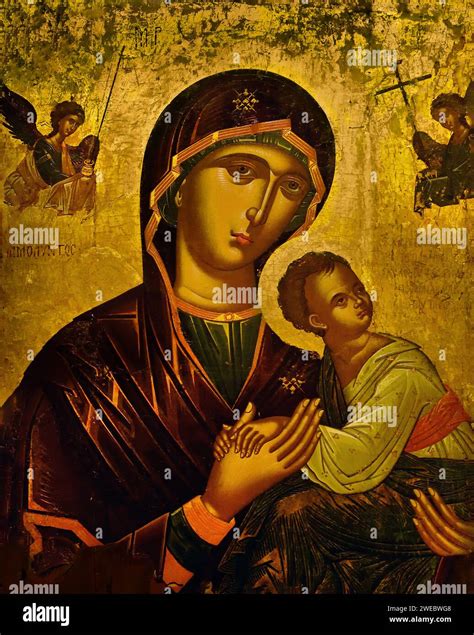
A Cretan Eucharistic icon is very influenced by Western Roman Catholic art. Jesus sits enthroned on the creatures symbolizing the four Evangelists, his feet resting on a globe symbolizing the cosmos.
Mary is at left, John the forerunner, the Baptist, at right. Blood spurts from the side of Jesus through his fingers and into a golden chalice held by a small angel. Another angel opposite him holds the Eucharistic bread.
More angels above hold the symbols of the Passion - the cross and ladder, the pillar to which Jesus was tied when scourged, the crown of thorns and the sponge on a reed.
The Gospel inscription on the book
The inscription on the book is taken from the Gospel of John 6:56-57:
Ὁ τρώγων μου τὴν σάρκα καὶ πίνων μου τὸ αἷμα ἐν ἐμοὶ μένει κἀγὼ ἐν αὐτῷ.
Ho trogon mou ten sarka kai pinon mou to haima en emoi menei, kago en auto.
“Who feeds on my flesh and drinks my blood remains in me and I in him.”
καθὼς ἀπέστειλέν με ὁ ζῶν πατὴρ κἀγὼ ζῶ διὰ τὸν πατέρα, καὶ ὁ τρώγων με κἀκεῖνος ζήσει δι’ ἐμέ.
Kathos apestele me ho zon pater kago zo dia ton patera, kai ho trogon me kakeinos zesetai di eme.
“As the living father sent me and I live by the Father, so who eats me, even he shall live by me.”
The Heavenly Liturgy icon in Athens
An icon of the Heavenly Liturgy is held by the Byzantine and Christian Museum in Athens, Greece. It is a detailed rectangular wooden icon depicting the Heavenly Liturgy, or Divine Liturgy, centered on the representation of the Holy Trinity and surrounded by various ranks of the heavenly host.
The image is painted by Ioannis, or John, and dates to the late 17th century AD. It was donated by the Historical and Ethnological Society of Greece.
| Feature | Information |
|---|---|
| Institution | Byzantine and Christian Museum, Athens, Greece |
| Material | Wood, Tempera paint, Gold leaf |
| Date range | Late 17th century AD |
| Origin | Unknown |
| Painter | Ioannis (John) |
| Museum reference | BXM 2222 |
The Holy Trinity at the center
The Holy Trinity is placed prominently in the center on a raised, richly decorated red altar. Christ, God the Son, is seated on the left, depicted as a young man in an ornate, dark green garment with gold patterns.
His right hand is raised in a gesture of blessing. God the Father is seated on the right, depicted as an elderly man with a long white beard, wearing a flowing white cloak.
His left hand holds a staff, and his right hand is raised. The Holy Spirit is symbolized above and between them by a dove within a golden circle of light.
Between Christ and God the Father, on the altar, rests an open book, likely the Gospel or a service book, with clear, stylized inscriptions. The entire central scene is framed by golden halos.
Angels and the heavenly hierarchy
The figures are surrounded by numerous angels and archangels, representing the heavenly hierarchy engaged in the Liturgy. Archangels and Angels are positioned in the mid-ground, many of whom are holding candles, scrolls, or liturgical vessels.
The highest ranks, like the Seraphim and Cherubim, with multiple wings and fiery colors, frame the scene. Their placement emphasizes the ordered structure of the heavenly host around the central mystery of the Divine Liturgy.
Inscriptions, some in Latin, such as CHERUBIM, PRINICIPATUS, and ANGELI, identify the different orders of the heavenly host, reinforcing the highly structured and theological nature of the composition.
Style and historical character
The icon's dense composition, bright colors, and use of gold leaf are characteristic of post-Byzantine art, particularly the period influenced by Venetian and Western European styles, while maintaining Orthodox iconography.
The combination of Orthodox theological imagery with Western-influenced compositional features is also visible in Eucharistic scenes in which Christ is enthroned, the Passion instruments are displayed above him, and angels directly present the chalice and Eucharistic bread.
The museum label identifies the object as follows:
Εικόνα με παράσταση της Ουράνιας Λειτουργίας. Ζωγράφος Ιωάννης. Τέλη 17ου αι. Δωρεά Ιστορικής και Εθνολογικής Εταιρείας. BXM 2222.
“Icon of the depiction of Heavenly Liturgy. Painted by Ioannis. Late 17th c. Donated by the Historical and Ethnological Society of Greece. BXM 2222.”