The Gnostic Book of Changes is a study of the I Ching, or Book of Changes, that interprets its symbolism through Analytical Psychology and the Western Mystery Tradition. Its central purpose is to demonstrate that the symbols of this Eastern oracle correspond with those of systems such as the Kabbalah, Hermeticism, Alchemy, Gnosticism, and Jungian psychology.
The I Ching is presented not merely as a collection of predictions, but as a symbolic language for examining consciousness, experience, transformation, and the relationship between visible events and invisible causes. Its images are intended to be approached intuitively and reflectively rather than reduced to fixed definitions.
What the Gnostic Book of Changes Examines
The metaphor used throughout is that of the Great Work of Transformation -- a concept which describes the willed alteration of consciousness from a differentiated to a unified state, and which in various traditions has been called Individuation, The Path, The Tao, or simply: The Work.
This book is an effort to show the similarities between the symbolism of the I Ching and some of these other systems. It is hoped that when this succeeds it may give a new perspective on the non-verbal foundations of the human psyche-- that Great Mystery which is beyond the description of language, yet constitutes both the original source and ultimate destination of all differentiated awareness.
The lowest common denominator for all valid mystical systems is that they use symbols to describe a reality which transcends language, and that even if the symbols of one viable system are superficially different from those of another, upon careful examination a correspondence will be found between them.
If we find for example, that the symbols of the Kabbalah and the I Ching are empirically valid, then we must look for a deeper reality which unifies them both. Obviously, the I Ching doesn't describe one reality and the Kabbalah another -- since they both work, they must both refer to the same reality, though their symbols appear at first glance to be entirely different.
The I Ching as an Ancient Oracle and Book of Wisdom
The I Ching was first written down in 1143 BCE as a book of oracles -- its purpose was to provide answers to questions about the unknown.
The I Ching, or Book of Changes, has exerted a living influence in China for thousands of years. Today, it continues to enrich the lives of readers around the world. First set down in the dawn of history as a book of oracles, it grew into a book of wisdom with the inclusion of commentaries on its oracular pronouncements, eventually becoming one of the Five Classics of Confucianism and providing a common source for both Confucianist and Taoist philosophy.
Like any mantic system such as the Tarot or astrology, the Book of Changes is ultimately dependent upon the subjective evaluation of the querent: its efficacy is measured by the ability to perceive and accurately interpret one's experience in symbolic terms.
The I Ching is one of the world's most ancient manuscripts. While some obscure Sumerian or Egyptian texts may pre-date it slightly, the I Ching is unique in that it is more available today than at any other time in its history: it has to be the oldest continuously published book on the planet.
The editor of this study has no idea of how many translations, how many editions, how many commentaries must exist for this single volume -- many thousands, certainly, considering its long life. Continuing commentary on The Book of Changes by its millions of students is an ancient and open-ended labor of love.
Translation, Language, and Interpretation
Unless you are fluent in Chinese, you must depend upon a translation if you wish to study the ancient and venerable I Ching, or Book of Changes.
There are many English interpretations of this world classic, four of which are both well-regarded and generally available.
| Translation | Year |
|---|---|
| The James Legge translation | 1899 |
| The Wilhelm/Baynes translation | 1950 |
| The John Blofeld translation | 1965 |
| The Da Liu translation | 1975 |
In addition to these original translations there are numerous paraphrases in English which restate the Chinese symbolism in modern Western idiom. Although paraphrases are often extremely valuable while learning to decipher the meanings of the lines of the I Ching, they are not viable substitutes for the original images, and no serious student of the book should rely upon them exclusively.
For that matter, there's no such thing as a "perfect" translation either, and there probably never will be. The pictorial characters of Chinese writing have far too many nuances of meaning to ever be fully transposed into English.
Evidence for this is found in the fact that the four respected scholars named above sometimes vary widely in their interpretation of the same original material.
Chinese, with its thousands of pictorial characters, appears to be a formidable tongue indeed -- in one Chinese- English dictionary there are no less than thirty-five Chinese characters which are pronounced “ching” in English. Their various meanings range from: "A warp in a loom," to "Rice which is not glutinous."
Indeed, so problematic is this language, that scholars themselves are in disagreement about how to translate this book's very title: I Ching, Yi King, Yi Jing and Xi Qing have all been rendered in various times and places.
It is obvious then that the accuracy of any given translation is highly dependent upon the individual translator's intuition and feeling for the two languages concerned.
One Line, Several Meanings
Here's an example taken from the fourth line of the first hexagram:
- Legge: We see the subject as the dragon looking as if he were leaping up, but still in the deep. There will be no mistake.
- Wilhelm: Wavering flight over the depths. No blame.
- Blofeld: Leaping about on the brink of a chasm, he is not at fault.
- Liu: The dragon leaps from the abyss. No blame.
We easily perceive that although the subject matter of every translation is similar, the actual rendering is not -- each of the above lines communicates a distinctly different message in the English language.
R. L. Wing's paraphrase is arguably the most popular version of the I Ching in the United States today. Notice that although his definition of the above line is much more specific than any of the translations, by its very specificity it leaves less room for one's intuition to encompass the infinity of possible interpretations:
A time of choice is at hand. Because of an amplification in your CREATIVE POWER you must decide whether to enter the public eye and serve society, or whether to withdraw and work on your inner development. Follow your deepest intuition and you will not make a mistake.
Of course it is this very ambiguity which enables the I Ching to match the seeming infinitude of situations offered by experience -- that's why the more "exact" paraphrases are of only limited value.
Each of the above translations of hexagram 1:4 is "correct" to one degree or another, but their ultimate truth transcends language entirely.
Symbolic Rather Than Literal Meaning
As Confucius says in the Great Treatise: "The written characters are not the full exponent of speech, and speech is not the full expression of ideas."
This is because in the I Ching we are dealing with a connotative rather than a denotative system: a language of symbolic images analogous to that of dreams.
C. G. Jung, a life-long student of the I Ching, clearly recognized this association:
As you have found out for yourself, the I Ching consists of readable archetypes, and it very often presents not only a picture of the actual situation but also of the future, exactly like a dream. One could even define the I Ching oracle as an experimental dream.
C. G. Jung -- Letters, August 24, 1960
This suggests that the exact definitions demanded by our scientifically-oriented expectations lose much of their precision when interpreting the I Ching just as they do when we attempt to accurately decipher the dream images flowing through our sleep.
Thus we are put in the awkward position of having to rely upon the tools of intellect to comprehend and describe a realm of consciousness which transcends reason itself.
Anyone who has ever had a mystical experience or taken a powerful psychedelic drug can attest that there are dimensions of awareness which far transcend our ability to render in mere language.
It is this level of awareness which the I Ching addresses -- indeed, it is not too much to say that the I Ching is a bridge to a transcendent, dreamlike world in which language is more of a handicap than a help.
Yet, "handicap" or not, language and the reasoning function which manipulates it are among the highest attainments of human evolution - lifelines which must never be abandoned if we are to explore our deeper levels of awareness without becoming hopelessly lost.
Intellect, Intuition, and Discipline
There is a wide gulf between the automatic rejection of anything that cannot be measured against some pre-conceived standard of expectation and the superstitious acceptance of every inner image at face value.
The discipline necessary to resolve this paradox is a fine line spanning this gulf and to walk it with full commitment is one of the most challenging exercises that the human mind can undertake.
The efficacy of the I Ching is therefore linked to the reader's ability to hold symbolic, intuitive, and rational perspectives together without reducing one of them to the others.
The I Ching and the Perennial Philosophy
This implies that human consciousness is linked to a universal source which expresses itself uniquely within different cultures, yet in its essence is always the same.
One of the least important facts about the I Ching is that it emerged in China -- what is of supreme importance is that it is universally valid for anyone who uses it, regardless of language or culture.
Aldous Huxley identified these ubiquitous correspondences as components of what he called (after Leibniz) the "Perennial Philosophy":
The Perennial Philosophy has spoken almost all the languages of Asia and Europe and has made use of the terminology and traditions of every one of the higher religions. But under all this confusion of tongues and myths, of local histories and particularist doctrines, there remains a Highest Common Factor, which is the Perennial Philosophy in what may be called its chemically pure state.
It is only the act of contemplation, when words and even personality are transcended, that the pure state of the Perennial Philosophy can actually be known.
The records left by those who have known it in this way make it abundantly clear that all of them, whether Hindu, Buddhist, Hebrew, Taoist, Christian or Mohammedan, were attempting to describe the same essentially indescribable Fact.
All of the systems within the Western Mystery Tradition fit into this category -- Alchemy, the Kabbalah, Hermeticism, and Gnosticism being only a few of many which are available to us.
In modern times Jung's Analytical Psychology has emerged as an empirical and scientific description of the human psyche based upon the principles of the Perennial Philosophy.
The I Ching and the Western Mystery Tradition
It is the specific purpose of this treatise to demonstrate that the symbolism of the I Ching, an Eastern oracle book, is perfectly compatible with the symbolism of the Western Mystery Tradition.
Aliester Crowley, in his book, Magick in Theory and Practice made this crucial observation many years ago:
The Yi King is mathematical and philosophical in form. Its structure is cognate with that of the Qabalah; the identity is so intimate that the existence of two such superficially different systems is transcendent testimony to the truth of both.
The comparison is based on the idea that different symbolic systems can preserve a common structure even when their images, terminology, and cultural settings appear unrelated.
Structure and Editorial Method
The present volume is built upon an edited and annotated version of the James Legge I Ching translation of 1899 -- readily available in the Dover facsimile reprint of 1963, and in a much handier 1971 Mentor re-arrangement by Raymond Van Over.
Despite the latter work's marked improvement over the original version, considerable controversy remains about Legge's general approach to the I Ching.
His often awkward "literal" translation of Chinese into English, the arbitrary way in which he separated the Confucian commentary from the original lines (thus making the English version structurally different from the Chinese document), and his apparent refusal to regard the book as much more than a collection of curious epigrams has evoked a great deal of criticism from other commentators.
Consequently, the Wilhelm/Baynes translation has long been regarded as the standard of comparison, and Legge's version is often perceived as verbose pedantry.
While there is some justification for this view, I feel that there is far more in Legge's I Ching than has been commonly recognized -- when the Confucian commentaries are put back with their corresponding lines and Legge's footnotes are retrieved from their fine-print oblivion, edited, and placed where they logically belong, there begins to emerge some real insight into the original images.
What I have done with Legge's material is what any modern editor who was familiar with the I Ching might do if he received the book as a manuscript submitted for publication -- re-phrase awkward 19th Century syntax, delete extraneous commentary, and in general make the book as lucid as possible without altering its general style or original meaning.
To assist me in this process I have had the advantage of constant reference to the modern translations of Wilhelm, Blofeld and Liu.
In general, I have not altered the translation of the original Chinese lines, but at times have edited Legge's often wordy commentary considerably.
All alterations of original lines (other than minor rephrasing for clarity) are acknowledged in the text, with reference made to the authority of the other translators.
Whenever there is disagreement among them, Wilhelm's commentary usually prevails.
Actually, the only line that I have changed drastically is line three of hexagram number ten.
Because of the importance of making comparisons when interpreting an English translation from the Chinese, I have also included Wilhelm's version of each of the lines.
[Note,2009: Six more translations and two paraphrases have been added to the working manuscript since the above was written.]
Dynamic and Magnetic Polarity
One of the most structurally minor, yet conceptually significant, changes I have made concerns the extremely important relationships between the lines of the hexagrams, which depict positive and negative forces in terms of sexual polarity.
The I Ching was written by patriarchs in a patriarchal era when women were regarded as inferior to men.
Consequently, the commentaries usually have a male bias, and the yin, or female lines (depending on their placement in the hexagram), frequently symbolize "negative" situations.
Since the Book of Changes is an empirically viable system, and since as presumably enlightened moderns we perceive that sexually prejudiced attitudes are as illogical as having a "preference" for one over the other pole in an electrical circuit, we must be able to interpret the truth of the I Ching as symbolic rather than literal.
In order to evoke and emphasize an unbiased polarity in the lines of the hexagrams, I have altered the original text to the extent of identifying each line as either "dynamic" or "magnetic."
This nomenclature is taken from the philosophy of Actualism, as developed by Russell Schofield and described by Ralph Metzner in his book Know Your Type -- Maps of Identity (1979):
Actualism distinguishes two basic polarities of energy relationships, dynamic and magnetic.
The dynamic pole is outgoing, expressive, giving, masculine, yang. The magnetic pole is incoming, receptive, feminine, yin.
In a broader sense, the dynamic aspect of consciousness is functional and the magnetic is structural.
Function moves through structure, and is given body or form by structure.
Energy (dynamic) is embodied (in-formed) into matter (magnetic).
- the flow of electric current (dynamic) through a conductor (magnetic);
- the flow of life through the human body;
- the structuring of sound energy into meaningful verbal patterns.
An unstructured dynamic expression is random and incoherent; a magnetic without dynamic function is an empty and powerless structure.
Hexagram One: The Dynamic
The first hexagram symbolizes Heaven, and the second symbolizes Earth: Force and Form.
(As consciousness is to the body it inhabits, so Force is to Form and Heaven to Earth.)
Form is magnetic, or "negative" in polarity, and Force is dynamic, or "positive."
In esoteric symbolism "Heaven" does not mean the universe above us -- it means the consciousness within us.
The first two hexagrams, because they are the "cosmic parents" of all the others, are especially rich in their associations.
| Aspect | Hexagram One |
|---|---|
| Other titles | The Creative, The Symbol of Heaven, The Creative Principle, Force, The Key, Creativity, The Originating, Creative Power, Primal Power, Yang, The Life Force, Kundalini, God the Father |
| Polarity | Dynamic |
| Symbolic principle | Heaven, Force |
Judgment and Image
Legge: The Dynamic represents what is great and originating, penetrating, advantageous, correct and firm.
Wilhelm/Baynes: The Creative works sublime success, furthering through perseverance.
Blofeld: The Creative Principle . Sublime Success! Persistence in a righteous course brings reward.
Liu: The Creative brings great success, benefiting all through perseverance.
Ritsema/Karcher: Force: Spring Growing Harvesting Trial. [This hexagram describes your situation in terms of the primal spirit power that both creates and destroys. It emphasizes that dynamic, unwearied persisting, the action of Force, is the adequate way to handle it. To be in accord with the time, you are told to: persist!]
Shaughnessy: The Key: Primary reception; beneficial to determine.
Cleary(1):Heavencreates, develops, brings about fruition and consummation.
Cleary(1): The creative is successful; this is beneficial if correct.
Wu:The Originator is primordial, pervasive, prosperous and persevering.
Legge: Heaven, in its motion, gives the idea of strength. The superior man, in accordance with this, nerves himself to ceaseless activity.
Wilhelm/Baynes: The movement of heaven is full of power. Thus the superior man makes himself strong and untiring.
Blofeld: This hexagram symbolizes the power of the celestial forces in motion, wherewith the Superior Man labors unceasingly to strengthen his own character.
Liu: Heaven moves powerfully; the superior man strengthens himself unceasingly.
Ritsema/Karcher: Heaven moves persistingly. A Chun tzu uses originating strength not to pause.
Cleary(1): The activity of heaven is powerful; superior people thereby strengthen themselves ceaselessly.
Wu: Heaven moves in full strength. Thus the jun zi strives ceaselessly to be self-reliant.
Confucian Commentary
All things owe their inception to the vast and originating power of The Dynamic. It contains all the meaning of the word: Heaven.
Clouds move, rain falls, and the myriad things appear in their created forms.
The sages comprehend the link between the end and the beginning.
They understand how the changes of the six lines of the hexagram are accomplished, each in its season, and with this knowledge they ascend toward Heaven as though mounted on six dragons.
The intent of The Dynamic is to transform everything so that it reflects its correct nature as originally conceived by the mind of Heaven.
Thereafter, this great harmony is preserved in union and firm correctness.
The sage appears aloft, high above all things, and the myriad states are harmoniously united.
For the Chinese, the dragon has been from the earliest times a symbol of dignity, wisdom, sovereignty and sagehood.
It is the symbol of the superior man, and especially the "great man," exhibiting all the virtues and attributes of Heaven.
Although the dragon's home is in the water, it can disport itself on land, and also fly through the air.
The sage rules in the world of men as Heaven rules nature.
He sees the connection between the end and the beginning as the law of cause and effect in the operations of nature and human affairs.
The various steps in that course are symbolized by the lines of the hexagram, and the ideal sage, conducting his ideal government, is represented as driving through the sky in a carriage drawn by six dragons.
The Dragon, Life Force, and Transformation
The Dynamic is the life force itself.
The Superior Man tirelessly furthers the Great Work of Transformation.
The image of a dragon appears in every line of this hexagram, except the third.
Like most symbols, the dragon has both a positive and a negative aspect.
In Western myth, it is usually an adversary which the hero must conquer before he can obtain a treasure or often, a captive maiden.
The Chinese, on the other hand, regard the dragon positively.
Blofeld comments: In China, the dragon has always been regarded as a highly admirable creature of celestial origin. Dragons provide rain; make rivers run and rule the ocean.
The European dragon is clearly of another species.
This seeming anomaly may say more about how east and west perceive the forces of nature, rather than refer to any true differences in the forces perceived.
Wilhelm compares the dragon to the electrical energy within a thunderstorm -- as lightning it can destroy us, but in the form of electricity it can be harnessed to do useful work.
A dragon is nothing if not a huge serpent, and this suggests the idea of the "serpent power," or Kundalini energy which when aroused in the human body has been likened to a sudden jolt of electricity running up from the base of the spine to the top of the head.
The Kundalini force is equated in turn with sexual energy -- dynamic power which ensures the continuance of all but the most primitive of living organisms.
Without the powerful energy of sexuality, life as we know it could not exist.
When the dragon remains unconquered in the cave-like depths of the unconscious, the life force autonomously rules our lives and we become passive vehicles for random desires and appetites.
This "electricity" will flow wherever it finds a circuit of least resistance, and under these conditions an individual's life is largely "created" by chance and circumstance.
When one begins the Work, the task of Individuation, one assumes the role of the hero or warrior, who does battle with the dragon in order to bring it under his will.
This is a great struggle, and success is not guaranteed, but if one is able to control the primordial power of the life force, the treasure (or the maiden, which in the male psyche amounts to the same thing), is obtained.
This is tantamount to attaining a higher level of consciousness -- in its highest form it constitutes "enlightenment."
Force, Form, and Consciousness
There is an invisible universe within the visible one, a world of causes within the world of effects.
There is force within matter, and the two are one, and are dependent for their existence on a third, which is the mysterious cause of their existence.
There is a world of soul within a world of matter, and the two are one, and caused by the world of spirit.
F. Hartmann -- Paracelsus: Life and Prophecies
This polarity is also reflected in the relationship between the ego and the Self -- in a properly regulated psyche, the ego is always magnetic to the dynamic Self.
The symbolism of all of the hexagrams works on many different levels, and this is especially true of the first two, which must be studied together for a full comprehension of each.
Kabbalists, for example, will recognize in these two figures the same forces found in Chokmah and Binah on the Tree of Life.
Line One: The Hidden Dragon
Legge: In the first line, dynamic, we see its subject as the dragon lying hid in the deep. It is not the time for active doing.
Wilhelm/Baynes: Hidden dragon. Do not act.
Blofeld: The concealed dragon refrains from action.
Liu: The hibernating dragon does not act.
Ritsema/Karcher: Immersed dragon, no availing-of.
Shaughnessy: Submersed dragon; do not use.
Cleary(1): Hidden dragon: Do not use it.
Cleary(2): The hidden dragon is not to be employed.
Wu: The dragon lying submerged is not to be used.
This line describes power that exists but remains concealed. The position is too low. The dynamic power is stored up and hidden.
This is the originating power which is the source of life and growth.
The actions of the superior man demonstrate his virtue every day, but when concealment is required he restrains the full expression of his work and takes no action.
The dragon can be the symbol of the superior man, or the great man -- the sage on the throne.
For the light-giving force is still below.
The life- sustaining force is still submerged.
Because the yang is in the lowest position.
The Master said:"There he is, with the powers of the dragon, and yet lying hid. The world cannot influence him, for he does not pander to its approval.
He lives withdrawn from the world without regret, and its disapproval doesn’t bother him.
He rejoices in this opportunity to further his work, but if circumstances do not favor this he can as easily retire.
He cannot be separated from the source of his being. This is the dragon lying hid."
Meaning of the Hidden Force
At the outset, the man is unknown, like a dragon lying hidden.
The occasion is not yet ripe for his appearance.
He is not moved by public opinion and the desire for fame.
He bides his time in self-confidence and silence.
A transformation ensues.
The man appears among his peers, although not yet in a position of authority.
His virtues are displayed, and his goodness becomes known.
The prognosis is good for his impact upon the world.
It is propitious to see him.
The time is not ripe for action.
You have all the Creative Power that you need to achieve your aim, but you must wait for the opportune moment.
If necessary, you may direct activities from behind the scenes.
The image suggests the dragon in its cave.
The forces of the unconscious psyche are hidden from conscious awareness and constitute a potential threat.
To take action under such circumstances would at the very least be to risk an unpleasant or unmanageable confrontation with a superior force.
Since this is the bottom line of the hexagram, the image reminds us of the serpent power, or Kundalini, lying coiled and asleep at the base of the spine.
Those who have experienced the premature and uncontrolled release of this force have attested to its extremely negative qualities -- both physical pain and acute psychological stress are commonly described.
If this is the only changing line, the hexagram becomes number forty-four,Temptation, the corresponding line of which reads in part: ". If she moves in any direction, evil will appear."
This reinforces the idea of taking no action whatsoever under the prevailing conditions, despite your possible temptation to do so.
The unconscious is not a demoniacal monster, but a natural entity which, as far as moral sense, aesthetic taste, and intellectual judgment go, is completely neutral.
It only becomes dangerous when our conscious attitude to it is hopelessly wrong.
To the degree that we repress it, its danger increases.
Jung -- The Practice of Psychotherapy
- There are concealed forces in the situation. Take no action when you are unaware of the hidden consequences.
- Energy is gathering in the unconscious psyche. Leave it alone -- it will express itself when the time is ripe.
Line Two: The Dragon Appearing in the Field
Legge: The second line, dynamic, shows the dragon appearing in the field. It will be advantageous to meet with the great man.
Wilhelm/Baynes: Dragon appearing in the field. It furthers one to see the great man.
Blofeld: The dragon is perceived in an open place; it is advantageous to visit a great man.
Liu: The dragon is seen on the field. There is benefit in meeting a great man.
Ritsema/Karcher: Visualizing dragon located-in the fields. Harvesting: visualizing great people.
Shaughnessy: Appearing dragon in the fields; beneficial to see the great man.
Cleary(1): Seeing the dragon in the field: It is beneficial to see a great person.
Wu: There appears the dragon in the field. It will be advantageous to see the great man.
The dragon has moved from concealment into the open field, where its power can be perceived and recognized.
Already the influence of character reaches far.
The great man's deeds are everywhere distributed.
Because his virtue is being widely recognized.
The correct accumulation of power creates beneficial results.
The superior man consolidates his perceptions and evaluates their implications with bemused detachment, as befits a virtuous ruler.
The Master said:"There he is, with the qualities of the dragon, and occupying exactly the central place.
His everyday speech and conduct is natural and without affectation.
He is on guard against depravity, and thereby preserves his inner virtue.
The world recognizes his power because he does not call attention to it.
Such expressions of integrity are the qualities of a ruler, and transform the world."
Meeting the Great Man
We have the superior man developing, by means of the processes described, into the great man, with the attributes of a ruler, the appearance of whom is a blessing to men.
Take note of a person who is active in the field of your interest.
Although he may not be in a position of Creative Power, his conduct is above reproach and therefore he has significant influence.
It would be to your advantage to align yourself with him.
Ways of Studying the Hexagrams
To get a fuller grasp of the numinously beautiful structure of the I Ching and the transcendent reality which it reflects, one should meditate on each of the hexagrams as often as possible -- one can never exhaust their meaning.
The first two hexagrams (because they are the "cosmic parents" of all the others), are especially rich in their associations.
- Compare and contrast the general ideas in the first three hexagrams, noting how the third is a logical progression of the first two.
- The Confucian commentary on The Dynamic is particularly rich in meaning. Read it over and over again -- it contains the principles of the Work as outlined in more detail in the other hexagrams. Compare the sixth sentence with the ideas in hexagram number twenty, Contemplation.
- Compare the first two hexagrams with hexagram number eleven, Harmony, and number twelve, Divorcement, noting the implications of the symbolism in terms of the proper management of the Work.
The symbolism of the first hexagram can therefore be approached through several interconnected images: Heaven, creative force, the dragon, Kundalini, the Self, the life force, and the dynamic pole of consciousness.
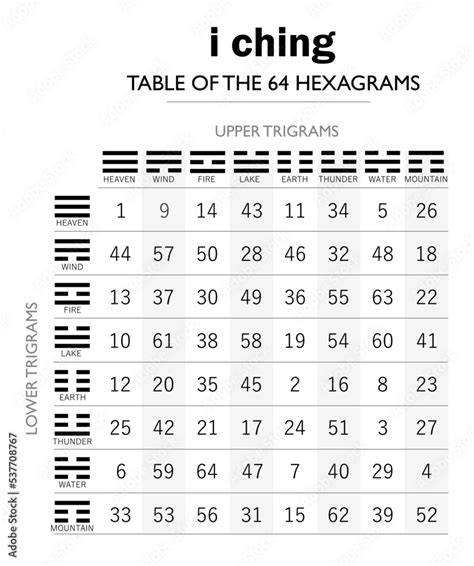
These images describe not a single fixed meaning but a field of relationships in which power may remain hidden, become visible, or be expressed through disciplined transformation.
I Ching Deep Dive: Hexagram 20 / Contemplation or Viewing
The Dynamic represents the movement of originating power, while the hidden and appearing dragon show how that power changes its relation to consciousness, circumstance, and action.