The hand attributed to Saint Mary Magdalene is traditionally preserved at Simonopetra Monastery on Mount Athos in Greece. It is said to be incorruptible, to retain bodily warmth, to exude a pleasant fragrance, and to be associated with miraculous healings.
The relic is venerated in the Eastern Orthodox Church as the incorrupt hand of the Holy Myrrh-bearer and Equal to the Apostles, Saint Mary Magdalene. Its preservation is understood by believers as a sign of the holiness of Mary Magdalene’s body and her continuing spiritual presence.
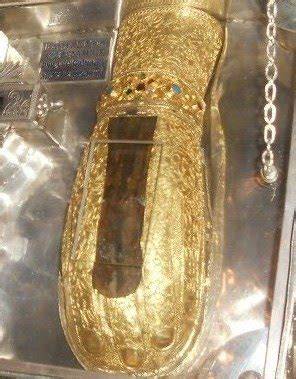
Where the hand of Mary Magdalene is kept
The hand is kept at the Holy Monastery of Simonopetra on Mount Athos, one of the most important Orthodox monastic communities. The monastery has preserved the relic for many centuries.
The relic has also been taken outside Mount Athos for public veneration. In 2024, the incorrupt hand of Saint Mary Magdalene and a piece of Holy Wood from the Cross of the Lord were brought from the Holy Monastery of Simonopetra to the Holy Evangelistria Church in Nea Ionia.
The most sacred relics arrived at the Holy Evangelistria Church in Nea Ionia and were received, with the appropriate honours, by His Eminence Metropolitan Ignatius of Demetrias, head of the holy Clergy, the Authorities and the faithful people.
The holy Relic of Saint Mary Magdalene remained for veneration in the Evangelistria Church, until noon on Wednesday, 25 September 2024, and during its stay there a rich devotional program of holy services took place.
How the relic is described
It is said to be incorruptible, exudes a lovely fragrance, gives off a bodily warmth as if still alive and performs many miracles.
Father Gervasios emphasised that “the victory of incorruption over decay is now a fact and the Holy Relic testifies to it irrefutably, as it not only remains incorruptible, but also warm.”
For Orthodox Christians, these characteristics are not treated merely as unusual physical properties. They are understood as signs that the saints can share in divine grace not only through their souls but also through their bodies.
It reminds us that the people who gave their lives for Christ sanctify not only their souls but also their bodies and share in this holiness and we all, through their honour and veneration, receive the Grace and blessing that comes from it of them.
Mary Magdalene as the Holy Myrrh-bearer
Mary Magdalene - sometimes referred to as the Magdalene, the Madeleine or Mary of Magdala - was a woman who, according to the Bible’s four canonical gospels, accompanied Jesus as one of his followers, witnessing his crucifixion and resurrection.
She is mentioned 12 times in the canonical gospels, more than any other woman, excluding Jesus’ family.
Mary’s epithet ‘Magdalene’ suggests that she could have come from the fishing town of Magdala, situated on the western shore of the Sea of Galilee in Roman Judea.
In the Gospel of Luke, she’s referred to as having supported Jesus ‘out of their resources’, suggesting she was wealthy.
Mary’s said to have remained loyal to Jesus throughout his life, death and resurrection, accompanying him to his crucifixion, even when he had been abandoned by others.
After Jesus died, Mary accompanied his body to his tomb, and it is widely recorded in multiple gospels that she was the first person to whom Jesus appeared after his resurrection.
She was also the first to preach the ‘good news’ of the miracle of Jesus’ resurrection.
Her role as the first witness of the Resurrection explains the Orthodox title “Equal to the Apostles” and the traditional title “Apostle of the Apostles.”
Mary Magdalene in Christian tradition
Other early Christian texts tell us that her status as an apostle rivalled that of Peter, since her relationship with Jesus was described as intimate and even, according to the Gospel of Philip, involved kissing on the mouth.
This has led some to believe that Mary was Jesus’ wife.
However, from 591 AD onwards, a different portrait of Mary Magdalene was created, after Pope Gregory I conflated her with Mary of Bethany and an unnamed ‘sinful woman’ who anointed Jesus’ feet with her hair and oils.
Pope Gregory I’s Easter sermon resulted in a widespread belief that she was a sex worker or promiscuous woman.
Elaborate medieval legends then emerged which portrayed her as wealthy and beautiful, and her identity was hotly debated leading up to the Reformation.
During the Counter-Reformation, the Catholic Church re-branded Mary Magdalene as a symbol of penance, leading to an image of Mary as a repentant sex worker.
It was only in 1969 that Pope Paul VI removed the conflated identity of Mary Magdalene with Mary of Bethany.
Nonetheless, her reputation as a repentant sex worker still persists.
Saint Mary Magdalene remains a powerful figure in the Catholic Church a model of radical conversion, faithful discipleship, and courageous proclamation of the Gospel.
Recognizing her significance, the late Pope Francis elevated her July 22 memorial to the rank of a feast, calling her “an apostle of hope for the world.”
Traditions about her final years
Tradition has it that Mary, her brother Lazarus and Maximin (one of Jesus’ 72 disciples) fled the Holy Land after St. James’ execution in Jerusalem.
The story goes that they travelled by boat without sails or rudders, and landed in France at Saintes-Maries-de-la-Mer.
There, Mary began preaching and converted the local people.
For the last 30 years of her life, it is said that Mary preferred solitude so she could properly contemplate Christ, so lived in a high-up mountain cave in the Saint-Baume mountains.
The cave faced northwest, making it rarely lit by the sun, with water dripping all year round.
It is said that Mary fed on roots and drank dripping water to survive, and was visited by angels 7 times a day.
Different accounts about the end of her life persist.
Eastern tradition states that she accompanied St. John the Evangelist to Ephesus, near modern-day Selçuk, Turkey, where she died and was buried.
Another account held by Saintes-Maries-de-la-Mer states that angels recognised that Mary was close to death, so lifted her in the air and laid her down at Via Aurelia, near the shrine of St. Maximin, meaning she was thus buried in the town of Saint-Maxim.
The hand and other relics attributed to Mary Magdalene
Mary remained elusive in death, with supposed relics such as a skull, a foot bone, a tooth and a hand being the source of reverence and scrutiny in equal measure.
- The left hand is reportedly preserved at Simonopetra Monastery on Mount Athos.
- A foot bone is situated at the basilica of San Giovanni dei Fiorentini in Italy.
- A tooth believed to have belonged to the apostle is located at the Metropolitan Museum of Art in New York.
- A skull attributed to Mary Magdalene is venerated at the basilica of Saint-Maximin-la-Sainte-Baume in southern France.
Another relic said to have belonged to Mary Magdalene is a foot bone situated at the basilica of San Giovanni dei Fiorentini in Italy, which, it is claimed, is from the first foot to have entered Jesus’ tomb during his resurrection.
Finally, a tooth believed to have belonged to the apostle is located at the Metropolitan Museum of Art in New York.
The skull at Saint-Maximin-la-Sainte-Baume
The skull of Mary Magdalene can be found in the South of France in the once Gallo Roman town of Villa Latta or Tégulata, which after the death of Maximin (one of Jesus’ seventy-two disciples), became St. Maximin-la-Sainte-Baume.
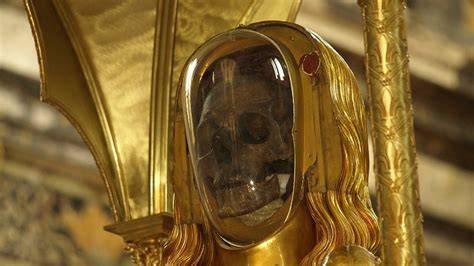
The skull of Mary Magdalene rests most of the year in the crypt of the Basilique Sainte Marie Madeleine, a massive Gothic basilica whose construction began in 1295 under Charles II of Anjou, King of Naples, Count of Provence and nephew of St. Louis (King of France).
It was on this ground, that Mary Magdalene’s body was buried by her good friend Maximin (1st bishop of Aix), and later hidden for centuries only to be re-discovered on December 10, 1279 during excavations ordered by Charles II himself.
Mary Magdalene’s remains were found intact except for her jaw bone.
In the dust inside the tomb was a wooden tablet wrapped in wax.
“Here lies the body of Mary Magdalene.”
Also found in her tomb was the Sainte Ampoule, a glass sphere containing earth soaked with blood of Jesus Christ collected by Mary Magdalene at the foot of the cross.
Reunion of the jawbone and skull
Mary Magdalene’s jaw bone had been sent to Rome after a previous excavation of her tomb and before the Saracen invasion of 710 AD, when all important relics in France were hidden.
In Rome, Mary Magdalene’s jaw bone had been venerated for centuries.
With the news of the 1279 discovery, Pope Boniface VIII returned the jaw bone to St. Maximin-la-Sainte-Baume and on April 6, 1295 it was reunited with the skull of Mary Magdalene.
The pope then published the pontifical bull for the establishment of the Dominicans at Sainte Baume and St. Maximin.
The Dominicans chose Mary Magdalene as co-patroness of their Order of Preachers.
The “noli me tangere” relic
Noli me tangere, meaning “touch me not” is the Latin version of words spoken, according to John, by Jesus to Mary Magdalene when she recognized him after his Resurrection.
John 20:17 Jesus said to her, “Do not cling to me, for I have not yet ascended to the Father; but go to my brothers and say to them, ‘I am ascending to my Father and your Father, to my God and your God.’”
When first opening the tomb of Mary Magdalene in 1279, there was a wonderful smell of perfume that filled the air, and there was a small piece of skin attached to her skull in the spot where Jesus touched her after his Resurrection.
The bishops who witnessed the excavation called the piece of skin “noli me tangere,” for they realized that through the miracle of Jesus’ touch the skin was still alive.
Those in charge of the relics carefully sealed the noli me tangere in a glass vase.
Less than a century later, at the time the gold reliquary was created to house the skull with its golden hair carried by four golden angels, the artist designed a special place below the skull to put the glass vial containing the precious noli me tangere.
The relics during the French Revolution
In 1793 during the French Revolution the shrine was broken into and the relics thrown about.
The basilica at St. Maximin was saved from utter destruction by transforming it into a government store placing over the great doors the words - Fournitures Militaires or “Military Supplies.”
Joseph Bastide, sacristan of St. Maximin, removed the skull of Mary Magdalene along with the Sainte Ampoule and the noli me tangere.
After the Revolution, Bastide brought his treasure to the archbishop.
The Sainte Ampoule was unfortunately stolen from the basilica.
Scientific examination of the skull
Her suspected skull, housed in a golden reliquary in the French town of Saint-Maximin-la-Sainte-Baume, was analysed by scientists, though they were unable to definitively conclude whether it is Mary Magdalene’s.
The skull was last analysed in 1974 and has remained inside a sealed glass case since.
Analysis suggests that it is the skull of a woman who lived in the 1st century, died at around 50 years old, had dark brown hair and wasn’t originally from Southern France.
There is no scientific way to accurately determine whether it is Mary Magdalene’s, however.
This distinction is important when discussing the hand attributed to Mary Magdalene as well: its religious significance rests on the tradition of the Church and the history of veneration, while its identification cannot be established through the available evidence with absolute certainty.
The hand in the history of relic veneration
In the twelfth century, Bishop Hugh of Lincoln visited the monks of the Abbey of Fecamp.
They showed him their most prized relic, the hand of Mary Magdalene.
Bending close, as if to kiss the relic, Hugh snapped off a piece with his teeth.
Hugh defended himself by saying that no relic was more holy than the Eucharist, which passed his lips every Sunday.
The monks were probably more upset, however, by the fact that he pocketed the tidbit he’d bitten off.
In fact, the bishop was participating in a proud tradition of relic theft.
From the ninth to the twelfth centuries, this practice pitted one monastery against another in competition for fragments of famous saints.
Relics offered protection in the form of miracles, but that wasn’t all: an impressive one could put your town on the map, bringing in pilgrims, money, and prestige.
No wonder some monks went to drastic lengths to secure them.
Why medieval monasteries sought relics
There even seem to have been professional relic dealers, like the mysterious Duesdona, who raided the Roman catacombs for holy martyrs to trade away.
It was a good trade: a single saint’s body could be divided into many saleable relics.
Theologians held that “the whole was in each part,” meaning that the saint was equally present in each fragment of their body, no matter how small.
As Paulinus of Nola writes, “Wherever a drop of dew has fallen on men in the shape of a particle of bone, the tiny gift from a consecrated body, holy grace has brought forth fountains in that place, and the drops of ashes begotten rivers of life.”
Indeed, the saints-as embodied in relics-were very much alive to their communities.
Relics were paraded through fields of failing crops, and marched out with soldiers into battle.
Oaths were sworn on them.
In lean times, people applied to them; in fat times, they thanked them.
As Lionel Rothkrug puts it, “Even the pope, whatever theoretical claims were made for him, in practice owed most of his authority to the fact that he was the guardian of the body of St. Peter.”
Holy theft and the meaning of possession
Perhaps the strangest thing about relic theft is how open monks were about their capers.
In fact, we know about it mostly because they wrote about it, quite unabashedly.
There was a whole genre devoted to the topic of furta sacra, or holy theft.
Scholars contend that many of these tales were exaggerated or even fabricated outright.
But that only makes the problem more perplexing.
It’s strange enough to cheerfully confess that you or one of your brothers stole a holy relic.
It’s even stranger to say so if you actually didn’t.
There are a few explanations.
First of all, a story of theft could give an otherwise dubious relic a plausible backstory.
Or the story could cover up other means of acquisition: theft might actually be preferable to commerce, which crassly reduced holy saints to the status of commodities.
But the most important explanation is a theological one.
Because relics were infused with the living presence of a saint, capable of working miracles, they were perfectly able to stop a thief.
Any relic that didn’t wish to be moved could simply become too heavy to lift, or cause all the doors of the church to spontaneously lock.
By this logic, if a relic was stolen, it wanted to be.
Public veneration of Mary Magdalene’s relics
The skull is widely regarded as one of the most precious relics in all of Christendom.
On the saint’s name day, July 22, the skull and other relics from other European churches are paraded around the town.
You can find the skull of Mary Magdalene in the crypt behind an iron grate every week of the year but one.
As most crypts are, it is deep under the ground floor of the basilica, down a narrow stone staircase.
The skull of Mary Magdalene is in the crypt behind the iron grate in the center just behind her alabaster sarcophagus.
It is difficult to see the skull through the iron grate even when you stand close.
During the feast of Mary Magdalene, the relic is traditionally brought into a more prominent place for veneration.
The skull of Mary Magdalene in its gold reliquary weighs approximately 400 kilos, which is 880 pounds.
It is carried by eight men, with eight on the side ready to alternate, from the basilica through the streets of St. Maximin-la-Sainte-Baume in a candlelight procession with songs and prayers.
When they take the skull of Mary Magdalene out of doors they cover the skull with a gold face for protection.
The hand of Mary Magdalene is venerated according to a similar principle: the relic is not treated as an ordinary historical object but as a material reminder of a saint whose life was devoted to Christ and whose witness began with the Resurrection.
Mary Magdalene with a skull in Christian art
As one of the most prominent female figures in the Bible, Saint Mary Magdalene has inspired countless works of art.
Most paintings portray her in penitent reflection recalling how Jesus cleansed her of seven demons or adoring the resurrected Christ, signifying her encounter with the Lord on Easter Sunday.
But one particular iconography associated with Mary Magdalene shows her holding or contemplating a skull.
For instance, a 17th-century painting by French artist Georges de La Tour depicts the saint with a skull on her lap, gazing at a burning candle in a dimly lit room.
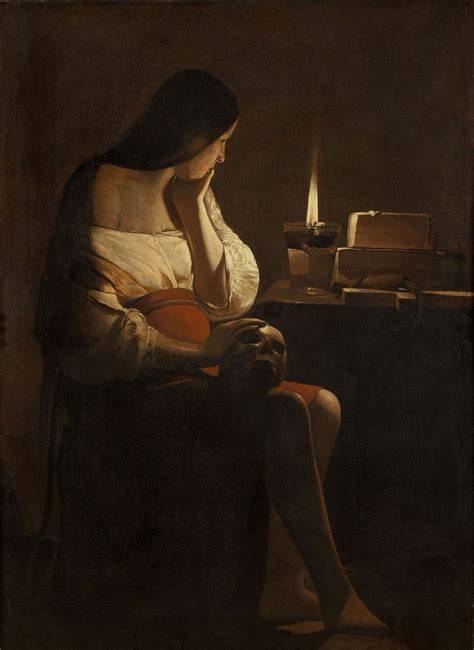
Why is she represented in such an eerie way?
Though it may seem grim at first glance, saints depicted with skulls are not uncommon in Christian iconography.
The skull serves as a powerful reminder of memento mori, a Latin phrase meaning “remember death.”
Far from being morbid, this symbol encourages the saints to live each day with their souls prepared to meet God.
It reflects a deep awareness of the fleeting nature of earthly life and a longing to dedicate every moment to the divine.
The image of Saint Mary Magdalene with a skull specifically represents her deep repentance and contemplative solitude.
After Jesus freed her from the demons that tormented her soul, she became one of His most devoted followers.
Her unwavering commitment led her to stand at the foot of the Cross alongside the Blessed Virgin Mary and Saint John, witnessing Christ’s passion, death, and burial.
She also had the great honor of being the first to encounter the Risen Christ and announce the resurrection to the apostles, earning her the title “Apostle of the Apostles.”
The spiritual meaning of the relic
The hand attributed to Mary Magdalene is therefore connected with several themes: her role as a witness of the Resurrection, her identity as a myrrh-bearing disciple, the Orthodox understanding of bodily incorruption, and the wider Christian tradition of venerating the physical remains of saints.
Metropolitan Ignatius observed that “The presence of Saint Mary Magdalene, the Princess of Mount Athos, is a great support for all of us in a time where we are living through declining situations, people are disheartened and tired of the deterioration of our culture.”
Therefore, such events are sanctification, respite, breath of life, presence of holiness, strengthening in the work we are called to do.
Metropolitan Ignatius also observed that the exuberant presence of the people of the local Church is a proof that “in our country there is a unifying force, called the Orthodox faith.”
The difficulties are many, the future, for many, uncertain, but as long as we keep this unity and as long as we honour the respects of our faith, there is hope for our country.
In today’s disconnected and disoriented world, we can all draw strength from the witness of Saint Mary Magdalene, whoteaches us that fervent discipleship and total conversion remain the true path to hope and renewal.