Holi Dahan is the bonfire ritual observed on the eve of Holi to commemorate the survival of Prahlad, a devoted worshipper of Lord Vishnu, and the burning of Holika, who attempted to kill him. The story symbolizes the triumph of devotion, righteousness, and divine protection over tyranny, arrogance, and evil.
Holi Dahan is more than a ritual performed on the eve of Holi. It is a sacred reminder of divine love, steadfast faith, and the transformative power of surrender. As bonfires light up the night sky, communities gather not just to celebrate but to reflect. The flames symbolize more than the burning of wood. They represent the burning of ego, negativity, and ignorance.
The Holi Dahan Story
There was once a demon king by the name of Hiranyakashyap who won over the kingdom of earth. He was so egoistic that he commanded everybody in his kingdom to worship only him. But to his great disappointment, his son, Prahlad became an ardent devotee of Lord Naarayana and refused to worship his father.
Once in India there was a king. He was a wicked man: boastful, greedy and cruel. Everyone had to do exactly as he commanded. He even told his people that he was a god so that they had to worship him too. This king had a son called Prahlad, who was as kind as his father was cruel.
Hiranyakashipu tried several ways to kill his son Prahlad but Lord Vishnu saved him every time. When his father learnt this he was very angry. ‘My son disobeys me. He must be punished!’
One day when Prahlad was walking in the countryside he saw a woman on her knees. Her hands were clasped and her head bowed. She was praying: ‘Lord Vishnu, who takes away fear. I surrender to you, great lord.’
Prahlad was angry. ‘Woman, why do you pray to the Lord Vishnu when you know that your king is god.’ The woman turned her face to Prahlad. There were tears on her cheeks. ‘My kittens have fallen into the well,’ she said. ‘I am praying that they will be saved.’
As she spoke a tiny miaow sounded from the well. To Prahlad’s astonishment he saw a little paw clinging to its edge. Gently the woman picked up the kitten and put it down safely on the ground. Then they heard another miaow, and another. One by one the kittens crawled out of the well.
‘My prayer has been answered,’ the woman cried joyfully and fell to her knees. As Prahlad made his way home, he thought about what had happened. 'My father is not a god after all,' he thought. From this day forth I will worship Lord Vishnu.
Prahlad’s Devotion and the King’s Persecution
Prahlad’s devotion was not born out of fear or desire for reward. It was rooted in love. Even as a child, he understood something profound: that true strength lies in surrender to the Divine. Faith anchored him when everything else was uncertain.
Hiranyakashipu was enraged. He could tolerate many things, but not defiance from his own son. Prahlad’s refusal to worship him was seen as betrayal. The king tried to persuade him gently at first, then threatened him, and finally subjected him to horrific punishments. Yet nothing could shake Prahlad’s devotion.
He called the guards. ‘Take my son and thrown him off the tallest cliff in the land!’ So Prahlad was taken to a cliff and tossed over the edge. Down, down, Prahlad fell. As he fell he prayed to Lord Vishnu to protect him. And the god heard him so that his fall was gentle and he was not hurt.
When he discovered that the prince was unharmed the king was furious. How could his son have survived such a fall?
‘Very well,’ he said. ‘Toss him into a nest of snakes. Let us see how he manages to climb out of that one!’ Prahlad was taken to the snake pit. How he trembled when he looked in and saw the hundreds of snakes twisting below him. How thick their bodies were - as thick as a grown man’s arm.
As he was pushed in he prayed to his god. The snakes hissed and curled round Prahlad’s body, but were unable to hurt him.
When he learnt that Prahlad was unharmed, the king became even more angry: ‘Put him amongst a herd of elephants!’ he shouted. ‘But first taunt them so they become angry and trample him.‘ He rubbed his hands gleefully. ‘This time, he will not escape,’ he chuckled.
As soon as they saw Prahlad, the elephants raised their trunks and trumpeted loudly. Prahlad tried not to show his fear as they charged towards him. Again he prayed to his god to protect him. And to the watchers’ astonishment, as soon as the elephants reached Prahlad, they stopped still and lowered their trunks, nuzzling him gently.
Holika’s Plan
‘What am I to do?’ the king said to his sister that night, when the news of his son’s escape reached him. ‘How am I to get rid of him?’ The king’s sister, whose name was Holika, wanted to see Prahlad dead as much as he did.
‘Leave it to me,’ she said to him. ‘I have an idea. In the morning I will build a giant bonfire and walk into it - and dare Prahlad to follow me.’
‘You will be burnt alive,’ the king said, aghast. ‘Not I,’ she smiled. ‘The flames cannot harm me. I have magic powers that will protect me.’
Holika possessed a boon that made her immune to fire. Confident in her power, she agreed to help her brother eliminate Prahlad. The plan seemed simple. Holika would sit in a blazing fire with Prahlad in her lap. The flames would consume the child while she would remain unharmed.
‘Then that is indeed a good plan,’ smiled the king. At last he would be rid of his son.
The Bonfire and Holika’s Death
In the morning, Holika ordered her servants to build a huge bonfire in front of the palace. Men and women ran to and fro, gathering sticks. Then a burning torch was held to the sticks.
The sticks were very dry and the flames leapt up quickly. Soon a fire was burning merrily. It was so hot and burned so fiercely that no one dared stand close to it.
As the flames leapt ever higher Holika called Prahlad to her. ‘My boy,‘ she said to him. She pointed to the bonfire. ‘Let us see who is the bravest. Show your courage one more time. Follow me into the fire.’ And with that Holika marched into the flames.
Her magic powers kept her from being harmed. But now Lord Vishnu was watching over Prahlad, as he had done many times before. Praying to his god, Prahlad followed her into the fire.
As the flames grew higher, Lord Vishnu took away Holika’s magic powers and granted them to Prahlad instead. There was a sudden whoosh as the flames caught Holika. In a trice all that was left of her was a few glowing embers.
But Prahlad stood in the midst of the fire, unharmed by the roaring flames. Holika was not aware that the boon worked only when she entered the fire alone. Prahlad, who kept chanting the name of Lord Naarayana all this while, came out unharmed, as the lord blessed him for his extreme devotion.
Holika’s death was a punishment from the gods for trying to kill her nephew. This is the origin of Holika Dahan, translated as “Holika’s Death,” when Hindus light bonfires the night before Holi.
Hiranyakashipu and Narasimha
The story of Prahlad and the divine incarnation of Narasimha is not merely a popular legend passed down orally. It finds detailed narration in sacred Hindu scriptures such as the Bhagavata Purana and the Vishnu Purana.
When Hiranyakashipu demanded proof of Vishnu’s existence, Prahlad replied that the Lord was everywhere. Enraged, the king struck a pillar and challenged Vishnu to appear. In that moment, Vishnu manifested as Narasimha, the half man half lion avatar.
This form was neither human nor animal, satisfying the conditions of the boon. Narasimha killed Hiranyakashipu at twilight, on a threshold, using his claws rather than weapons. Each detail bypassed the boon’s protections.
Prahlad’s surrender had invoked divine intervention. He did not command it. He trusted in it.
Narasimha’s appearance is one of the most dramatic episodes in Hindu mythology. It reveals that divine love is not passive. It protects, nurtures, and when necessary, confronts injustice.
Meaning of Holika Dahan in Hindu Mythology
Victory of Good over Evil
Holi is an ancient Hindu festival celebrated on the full moon day of the Hindu month of Phalguna, typically falling in March. The festival has mythological and seasonal significance.
The Hindu festival of Holi is a celebration of the victory of good over evil. The most popular legend associated with Holi is that of Prahlad and Holika, symbolizing the triumph of devotion and righteousness over tyranny.
Thus, Holi derives its name from Holika. And, is celebrated as a festival of victory of good over evil. Holi is also celebrated as the triumph of a devotee.
Holi Dahan reinforces a universal theme found in many traditions: good ultimately triumphs over evil. This victory may not be immediate, but it is inevitable. Faith is not blind optimism. It is confidence rooted in divine order.
Triumph of Devotion over Tyranny
In the Bhagavata Purana, Prahlad is portrayed as the ideal devotee whose unwavering bhakti transcends fear, suffering, and worldly attachment. The text emphasizes that devotion to Vishnu surpasses material power, royal authority, and even supernatural boons.
Through Prahlad’s steadfast faith, the scripture presents a timeless truth that divine grace protects those who surrender completely. By grounding the narrative in these revered texts, Holika Dahan becomes more than a cultural celebration.
Prahlad’s only weapon was the name of Vishnu. His bhakti, or devotion, became his shield. This illustrates a profound spiritual truth: remembrance of the Divine creates inner strength that external threats cannot destroy.
Prahlad’s story assures believers that perseverance in righteousness bears fruit. His survival illustrates that divine protection may not always prevent trials, but it ensures ultimate victory.
Destruction of Ego and Arrogance
Hiranyakashipu represents the ego that seeks control and domination. Prahlad represents the soul that seeks truth. Their conflict is not just historical. It is symbolic of the inner battle each person faces.
Hiranyakashipu’s arrogance blinded him. His desire for absolute control led to his downfall. He believed that his boon made him superior to cosmic law.
Holika’s downfall teaches a powerful lesson. Power without righteousness leads to destruction. Her boon could have protected her, but her intention corrupted its purpose.
The contrast between father and son reveals an eternal truth. Arrogance isolates and destroys. Humility connects and protects.
Faith, Surrender, and Divine Protection
Prahlad did not pray for safety. He simply trusted. His faith was simple, pure, and fearless.
Choosing the Divine over the ego is rarely easy. It often means standing alone. It means holding on to values even when pressured to abandon them. Prahlad’s defiance was not rebellion. It was alignment with a higher truth.
Faith, when anchored in love rather than fear, becomes indestructible. Chanting, prayer, and meditation are not rituals performed to appease a distant deity. They are practices that awaken courage and clarity.
For Prahlad, Narasimha was not a terrifying figure but a loving protector. The same form that destroyed tyranny embraced the devotee with compassion. This duality reflects the nature of divine grace. It is fierce against wrongdoing and tender toward devotion.
Dharma and the Triumph of Righteous Living
Dharma, or righteous living, forms the backbone of this narrative. Prahlad upheld dharma even when threatened. Hiranyakashipu violated it in pursuit of power.
Holika Dahan marks the moment when dharma prevails. The fire becomes a gateway from oppression to freedom. This transition mirrors personal transformation.
By confronting inner demons and surrendering them to the Divine, one experiences liberation. The image of a child sitting peacefully in fire is powerful. It represents innocence protected by faith.
The Symbolism of the Holika Dahan Fire
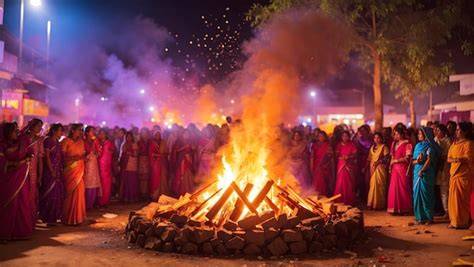
The ritual of Holika Dahan, observed on the eve of Holi, or Chhoti Holi (little Holi), commemorates this mythological story. Bonfires are lit to represent the destruction of arrogance and evil and the triumph of devotion.
Holika Dahan is observed on the full moon night of the Phalguna month. Communities gather around a bonfire that represents the pyre of Holika. Offerings are made, prayers are recited, and people circle the flames seeking blessings.
Fire is a purifier. It consumes impurities and leaves behind ash, a reminder of impermanence. By participating in Holika Dahan, devotees symbolically cast their negativity into the flames.
The bonfire ritual is participatory theology. It translates philosophy into action. As people cast offerings into the fire, they are encouraged to mentally release negative patterns.
Burning Negativity
The flames symbolize more than the burning of wood. They represent the burning of ego, negativity, and ignorance. The ritual invites introspection. Which qualities are we nurturing? Which need to be offered to the fire?
The ashes of the Holika fire are considered sacred. Many people take a small amount home as a symbol of purification. The act signifies letting go of resentment, jealousy, and fear.
Just as Holika burned, so too can negative tendencies be reduced to ash. The festival occurs at the threshold of spring, reinforcing the theme of renewal.
Renewal and New Beginnings
As the sacred fire glows in shades of violet and gold, old burdens turn to ash, making space for hope, healing, and radiant new beginnings.
From ashes arises possibility. The fire represents the end of harmful tendencies and the beginning of a more righteous, hopeful, and spiritually conscious life.
The solemnity of Holika Dahan gives way to celebration. This progression reflects the spiritual journey. After burning negativity comes the blossoming of happiness.
How Holika Dahan Is Observed
Even today, people enact the scene of 'Holika's burning to ashes' every year to mark the victory of good over evil. In several states of India, specially in the north, effigies of Holika are burnt in the huge bonfires that are lit.
There is even a practice of hurling cow dungs into the fire and shouting obscenities at it as if at Holika. Then everywhere one hears shouts of 'Holi-hai! Holi-hai!'.
The tradition of burning 'Holika' is religiously followed in Gujarat and Orissa also. Here, people render their gratitude to Agni, the god of fire by offering gram and stalks from the harvest with all humility.
Further, on the last day of Holi, people take a little fire from the bonfire to their homes. It is believed that by following this custom their homes will be rendered pure and their bodies will be free from disease.
At several places there is also a tradition of cleaning homes, removing all dirty articles from around the house and burning them. Disease-breeding bacteria are thereby destroyed and the sanitary condition of the locality is improved.
Families pray for harmony. Farmers pray for abundance. Children learn the story and internalize its moral framework. The act of gathering itself strengthens community bonds.
Holika Dahan and the Seasonal Meaning of Holi
Holi marks the arrival of spring, the victory of good over evil, and the celebration of love and unity. The holiday occurs during an agriculturally fruitful time of the year, giving people good reason to revel.
In 17th-century India, Holi was a festival that celebrated agriculture, good spring harvests and fertile land. The festival signifies the transition from winter to spring, a time of renewal, harvest, and prosperity.
Celebrants of all ages and walks of life come together to join in the festivities. Holi transcends social and cultural boundaries, bringing people together in the spirit of joy and forgiveness.
After the bonfire, the next day of Holi bursts forth in color and joy. Devotion is not somber. It is vibrant and alive. Prahlad’s faith leads not to isolation but to communal joy.
Other Mythological Associations of Holi
Radha, Krishna, and the Tradition of Colors
Holi also celebrates the divine love between Radha and Krishna, reflecting themes of joy and togetherness.
In another story from the Braj region of India, where the Hindu deities Radha and Krishna grew up, the festival is celebrated as Rang Panchami, commemorating their divine love for each other.
According to devotional lore, the dark-blue-skinned Krishna despairs about whether the fair-skinned Radha will like him because of his skin color. His mother teasingly suggests that he color Radha’s face in any color she wishes.
From this playful act grew a ritual of color-throwing. The story is also behind Phagwah, the Holi celebration in Indo-Caribbean Hindu communities.
During the actual day of Holi, people rush to the streets and throw colored powder in the air, and children have fun stirring up trouble and pranking adults and other kids alike.
Dhundhi and the Tradition of Pranks
The Ogress Dhundhi was a troublesome creature in the kingdom of Prithu; she would devour young, innocent children, and cause chaos.
Ogress Dhundhi was invulnerable to man-made weapons like swords and arrows, but thanks to a curse from Shiva, her Achilles heel was being pranked by little boys!
Eventually, the king called on the boys of his kingdom to attack the ogress. She was no match for the pranks and jokes thrown at her by these youths.
This legend became the basis for the traditionally high-spirited and boisterous nature of children during the celebration of Holi.
Kama and Shiva
And in parts of South India, Holi is sometimes linked to the god of love, Kama, and Lord Shiva.
After the death of his consort, Sati, the god Shiva withdrew into deep meditation. The gods, seeking to restore cosmic balance, had Kama shoot arrows at Shiva.
Angered at the interruption, Shiva opened his third eye and burned Kama to ashes. This upsets both Kama’s wife, Rati, and Shiva’s own wife, Parvati.
Rati performs her own meditative asceticism for 40 days, after which Shiva understands, forgives out of compassion and restores the god of love. This return of the god of love is celebrated as Holi.
Holi Dahan in the Broader Holi Festival
The Hindu festival of Holi is a celebration of the victory of good over evil. While Holi is traditionally known for its exuberant use of colors, music, and festive gatherings, it is also a time for spiritual reflection and cultural appreciation.
On the night before Holi, people all over India light bonfires, a practice known as Holika Dahan. On the actual day of Holi, people rush to the streets and throw colored powder in the air.
The colored powder tradition, Dhuleti, has become popularized outside of India and is celebrated on many college campuses around the United States.
Many Hindus see the day as an opportunity to connect with family and make new friends, often through smearing color and shouting the Hindi greeting “Holi Hai!” (“It’s Holi!”)
In all interpretations, Holi is seen as a festive day to end conflicts, forgive the past and start a new season.
Colors, Food, and Festive Symbols
Yet colors play a significant role in Holi, representing various emotions and elements of nature. Red symbolizes love and fertility, yellow signifies prosperity and new beginnings, blue is associated with the divine Krishna, and green embodies the rejuvenation of life and the onset of spring.
Many of the colored powders used to celebrate are made with natural ingredients, such as dried marigold, hibiscus flowers and henna leaves.
| Color | Symbolic meaning |
|---|---|
| Red | Love and fertility |
| Yellow | Prosperity and new beginnings |
| Blue | The divine Krishna |
| Green | Rejuvenation of life and the onset of spring |
Sweet delicacies such as gujiya, a dumpling-like pastry, are eaten to symbolize abundance. The traditional Indian milk drink thandai, infused with sugar, spices, nuts and saffron, and the yogurt drink lassi, usually flavored with fruits, spices or herbs, are also popular.
And in some traditions, a cannabis-infused milk drink called Bhang is enjoyed.
Scriptural Significance
The devotion of Prahlad is beautifully described in the Bhagavata Purana, particularly in the Seventh Canto, which focuses on bhakti as the highest path.
One well known verse attributed to Prahlad’s teachings translates as: “Hearing and chanting about Vishnu, remembering Him, serving His lotus feet, offering worship, prayers, servitude, friendship, and complete surrender of the self - these nine forms of devotion are the true path of spiritual life.”
This verse emphasizes that devotion is not limited to ritual alone. It includes remembrance, surrender, service, and love. Prahlad embodied these principles fully, even in the face of persecution.
Another verse reflecting Prahlad’s fearless faith can be translated as: “For one who has taken shelter of the Supreme Lord, fear does not arise, even amidst the greatest danger.”
These scriptural affirmations strengthen the message of Holika Dahan. They remind readers that Prahlad’s survival was not a miracle of chance, but the natural outcome of complete surrender.
Similarly, the Vishnu Purana recounts the confrontation between Hiranyakashipu and Narasimha with philosophical depth. It highlights how cosmic justice operates beyond human calculation.
The conditions of Hiranyakashipu’s boon are carefully overturned by divine wisdom, reinforcing the idea that arrogance rooted in ego can never outwit dharma.
The Inner Meaning of the Holika Dahan Characters
Holika Dahan is not merely a retelling of an ancient myth. It serves as a spiritual mirror. The characters represent qualities within each individual.
| Figure | Symbolic meaning |
|---|---|
| Hiranyakashipu | Ego and material obsession |
| Holika | Misplaced confidence and the misuse of power |
| Prahlad | Faith and surrender |
| Vishnu | Divine grace |
| Narasimha | Divine protection and justice |
The ritual invites introspection. Which qualities are we nurturing? Which need to be offered to the fire?
As people cast offerings into the fire, they are encouraged to mentally release negative patterns. The act of gathering itself strengthens community bonds. Holika Dahan unites people in shared reflection.
In modern life, this lesson remains powerful. Whether facing injustice, peer pressure, or inner doubt, choosing integrity over arrogance reflects Prahlad’s spirit.
Mindful and Responsible Observance
As students, embracing Holi in a mindful way can help preserve its true essence while making the festivities more enjoyable and meaningful.
- Many commercial Holi colors contain harmful chemicals that can damage the skin and environment. Opt for natural, organic, or homemade colors made from turmeric, beetroot, and flowers to make the celebration safe and sustainable.
- Holi is a festival of joy, but it is crucial to respect others’ comfort levels. Always seek consent before applying colors and avoid any behavior that makes others uncomfortable.
- Holi is not just about colors; it is also a time to enjoy music, dance, and cultural performances. Organizing poetry recitals, folk dances, and traditional music sessions can make the celebration more immersive and educational.
- The ritual of Holika Dahan represents the burning away of negativity. Students can participate in this tradition while being mindful of sustainability-use minimal wood and biodegradable materials to reduce environmental impact.
- Holi is an excellent time to let go of past grievances and embrace a fresh start. Take this opportunity to mend broken friendships and spread love and happiness.
- Traditional Holi celebrations often involve water fights, but with increasing water scarcity in many parts of the world, it is responsible to minimize water usage. Dry Holi celebrations with colors and music can be just as fun while being environmentally friendly.
- Food is a big part of Holi celebrations! Enjoy traditional Holi treats like gujiya, thandai, and dahi vada while appreciating the cultural significance behind them.
Celebrating Holi mindfully ensures that we honor its traditions while making responsible choices that benefit our communities and the environment.