The Holy Cross Novitiate is a year of intensive formation in which men deepen their relationship with God, learn the spirit and practices of the Congregation of Holy Cross, live in brotherhood, and discern whether they are called to profess vows as religious priests or brothers. Entering the novitiate marks official admission into the Congregation of Holy Cross, even though several years of formation remain before profession of perpetual vows.
In the summer following their postulant year, men in formation journey to the mountains of Cascade, Colorado, just outside Colorado Springs, for a year of prayer, silence, reflection, community life, apostolic service, and discernment. The year’s rigorous program is intended to assist them in discerning their profession of First Vows in the summer and to prepare them for the vowed, fraternal, and apostolic life of Holy Cross.
What is a novitiate?
A novitiate is a house of formation where new members of religious congregations get to know God, their community and themselves better. The purpose of the novitiate, by which life in an institute begins, is to give the novices a greater understanding of their divine vocation, and of their vocation to that institute.
During the novitiate the novices are to experience the manner of life of the institute and form their minds and hearts in its spirit. At the same time their resolution and suitability are to be tested.
The novitiate is a unique time in the life of any Holy Cross priest or brother. It is a time of deep and profound prayer, wonderful and frustrating time with community, and a year devoted to perhaps the most important question each person hopes to answer: How is God calling me to holiness?
The novitiate is the beginning of life in the congregation. Novices are helped to form themselves in meditation and prayer, in the mutual services of a common life, in apostolic service, and in knowledge of the history and spirituality, character and mission of Holy Cross.
In short they are challenged and helped to open their hearts to the gospel, to live under the same roof with one another, and to create a brotherhood of disciples. The novitiate is their apprenticeship in celibacy, poverty, and obedience.
Location and setting
The Holy Cross Novitiate is located in Cascade, Colorado, in the foothills of the Rocky Mountains just outside Colorado Springs and in the shadow of Pike’s Peak.
The former Cusack mansion was donated to the Congregation of Holy Cross in 1978. The main house was built in Cascade, CO prior to 1920.
The Cusack family, originally from Chicago, built the large home with materials from a Chicago bank that had been destroyed in a fire. The marble and other materials were shipped from Chicago to make a home for the Cusack family.
The family lived in the home for only a few years. Even before the home was completed, the mother of the family passed away.
The children built Holy Rosary Chapel in 1931 to honor their parents who built the mansion on Highway 24. Ann Cusack was one of the children from the original family.
She offered all the property, including the large, original cottage, the main house, and the barns to the Congregation of Holy Cross. At the time, Holy Cross was looking for a second novitiate in the United States.
The first novitiate was in Vermont. The first Novice Master who served in Cascade was Rev. Nicholas Ayo, C.S.C.
The chapel at the novitiate is truly the heart of the home and of community life. Overall, it’s a simple space. The furnishings aren’t fancy.
Only the view of the mountains out of the large, south-facing, windows would catch your eye. Still, it’s in this simple chapel where most of the “work” of the Novitiate is done.
For most of the time that Holy Cross has been here in Cascade, the chapel hasn’t had an official dedication, an official name. Just this past year, though, it was named the Chapel of the Transfiguration.
Just as Jesus went up on a mountain and was transfigured before his disciples, so everyone who enters as a novice, and comes up to this mountain, seeks to be transfigured.
Through entering into prayer in a deep and sustained way, God begins to reshape the novices according to his own image. After a year of prayer and meditation it’s hard not to come away changed.
Admission and the beginning of the novitiate
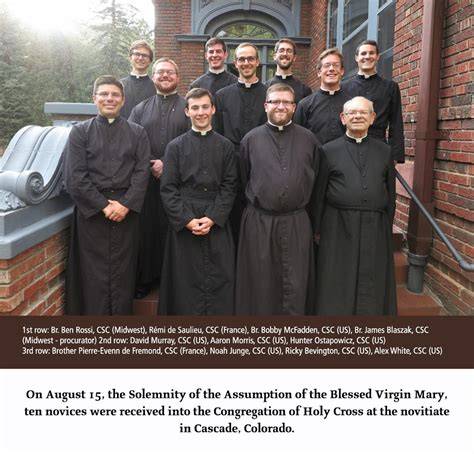
Just a few weeks ago five young men arrived at the Holy Cross Novitiate, located just outside of Colorado Springs in the shadow of Pike’s Peak. For the next few days they were introduced to the property, the schedule they would keep for the next 52 weeks, and the purpose of the novitiate.
Then, on August 13th, the five men gathered in the chapel, together with the Novitiate staff and Holy Cross Religious from the area. During Vespers, Fr. Jeff, the novice director, put to each of them these brief but powerful questions: “What do you wish? What do you seek?”
They replied, “I wish to discern the call to live religious life in Holy Cross. If this be God’s will for me, I also seek to follow Christ through profession of vows in this religious family.”
Although nothing in the chapel had changed after their answer, something profound had taken place within each of those five men. Fr. Jeff called each one by name to come forward, sign his name in the novitiate book of enrollment, and gave him his religious habit.
For novices, the habit is a simple black cassock and cloth cincture. Each of the men was now formally religious of the Congregation of Holy Cross.
Although they have not yet professed vows, they are now novices, prepared by grace and formation to live the life of a Holy Cross religious and discern what God has in store for them.
Entering the Holy Cross Novitiate in Cascade, Colorado, marks official admission into the Congregation of Holy Cross, even while several years of formation remain before profession of perpetual vows.
The purpose of the year
The purpose of the year is to provide a foundation for happy, healthy, and holy priestly or brotherly life in Holy Cross. There aren’t nearly as many distractions as there are in normal life, so the novices are able to focus on the things that matter most.
It is a year set apart for men in formation to set the foundation to be happy, healthy, and holy priests and brothers in Holy Cross. They can discern, prayerfully and thoroughly, whether God is calling them to religious life, and, if so, prepare for professed life in the congregation.
The novitiate is a period of deepening relationship to God, of strengthening the bond of unity with brothers in community, of initiation in the vowed life, and of maturation and formation for apostolic ministry and mission.
This is a decisive period of formation during which the men embrace the discipline of the vows, foster a greater openness to the movement of the Spirit in their lives, and experience the blessedness and challenge of brothers living together in unity.
Novices are urged to embrace their discernment process more fully. They explore different forms of prayer and learn to assume individual responsibility in their relationship with the Lord.
They are encouraged to ask deeper, more personal questions and to grow in the habit of listening to God in silence. They also cultivate the adaptability necessary for life in Holy Cross.
They will be asked to move through different ministries, work with diverse groups of people, and navigate the challenges of culture while seeking to remain faithful to the Gospel.
Men emerge from the novitiate with a heightened self-knowledge, a more profound understanding of their beloved-ness in the eyes of God, and better equipped to live the vowed life, the fraternal life, and the apostolic life as men of Holy Cross.
Prayer as the foundation of novitiate life
Life at the novitiate is fundamentally one of prayer. Starting at 6:30 am with the Office of Readings, novices gather six times per day for common prayer, accompanied by one hour of common meditation in the presence of the Blessed Sacrament.
In the novitiate we pray all of the Liturgy of the Hours together each day: the Office of Readings, Lauds, Daytime Prayer, Vespers, and Compline. We also have two daily meditations, and regular Eucharistic Adoration.
The high point of each day is Mass. All told, the novices are together in the chapel for several hours a day.
Prayer is foundational for both discernment and preparation, as well as for developing a relationship with God. Everything in the life of the novitiate is built to help foster prayer.
The structure of the days, weeks, and months encourages prayer and makes it possible. By separating themselves, physically and electronically, from the busyness of normal life, the novices are able to make time for an essential piece of the novitiate: prayer.
Every stage of formation is about helping men to develop their relationship with God and be more and more conformed to his Son. Within that, the purpose of the novitiate in particular is to discern whether to profess vows in Holy Cross, and, if so, to prepare to live those vows well.
During the first half of the year, novices are trained in different forms of prayer: Lectio Divina, contemplative prayer, devotional prayer, and other forms of prayer.
As they explore new ways of deepening their relationship with the Lord, long periods of silence - especially “Grand Silence” - assist the men in developing their interior lives and listening more attentively to God’s call.
Silence and interior transformation
The novitiate is set apart from ordinary life. The novices spend much of the day in silence and they don’t have cell phones, regular access to the Internet, or trips home.
Because of its unique and intense nature, Holy Cross men tell stories about their novitiate year for the rest of their lives. For that reason it can be a little mysterious to families and friends.
From time to time the novices will joke that when they get to talk to their families and friends on the phone, they get all the news they can from the outside world but don’t have much to share themselves.
Not much seems to have happened. It’s not entirely true, though. Not much has happened that you’d be able to observe from the outside.
Perhaps not even something you could readily describe, even if you wanted to. Inside, though, each of these men is being transformed.
Slowly but inexorably God is making the novices more and more like himself.
A typical daily schedule
The schedule at the Holy Cross Novitiate is focused on developing a prayerful rhythm of life aimed at supporting the novices in their Christian discipleship, while also helping them discern God’s will for their lives with greater clarity and trust.
It is a year apart from the bustle of ministerial life, but one that is intended to prepare them for the living out of an apostolic vocation.
| Time or period | Activity |
|---|---|
| 6:30 am | A typical day at the novitiate begins at 6:30 am with the Office of Readings. |
| Morning | Common meditation, morning prayer, breakfast in silence, conference, silent recollection, and Mass. |
| Midday | Midday meal with spiritual reading, followed by midday prayer. |
| Afternoon | Two hours of manual labor and two hours of avocation time. |
| 5:00 pm | Another period of common meditation begins at 5:00 pm. |
| 5:45 pm | Evening prayer at 5:45 pm, followed by dinner, clean-up, and recreation. |
| 8:00 pm | Night prayer at 8:00 pm, followed by Grand Silence. |
A typical day at the novitiate begins at 6:30 am with the Office of Readings, followed by common meditation, morning prayer, and breakfast in silence. Novices then attend a conference consisting of a lecture and discussion, followed by a period of silent recollection and Mass.
During the midday meal, one of the men is tasked with reading from a spiritual work, while his fellow novices eat in silence. Following lunch is midday prayer, then two hours of manual labor - a time devoted to stewardship of the novitiate property.
The men then engage in two hours of avocation time, during which they are encouraged to pursue an interest of their choosing: learning a language, playing music, woodworking, and other activities.
Another period of common meditation begins at 5:00 pm, followed by evening prayer at 5:45 pm, dinner, clean-up, an hour of recreation, and night prayer at 8:00 pm.
The end of night prayer marks the beginning of Grand Silence.
Study and intellectual formation
Novices’ education emphasizes personal reflection and ministry outreach. Discussion-based conferences are conducted 3-4 days per week.
Topics include methods and modes of prayer, the vows, the Holy Cross Constitutions, the Psalms, and integration of the active and contemplative life.
Novices study the Constitutions of the Congregation of Holy Cross to learn the Rule they are invited to follow and live by. They also explore in detail the evangelical counsels of poverty, chastity, and obedience.
Novices learn about and reflect on spirituality, prayer and community history, and participate in faith formation by becoming familiar with Scripture, Catholic doctrine and the sacraments.
They also engage in personal prayer and spiritual direction.
Community life and brotherhood
“How good and how pleasant it is, when brothers dwell together as one!” (Psalm 133:1)
In living together and in spending time together at prayer, at table, and in the performance of manual labor on the property, novices learn the value of common life and brotherhood.
The novitiate, like all stages in formation in Holy Cross, is a school of learning to love: “If we do not love the brothers whom we see, then we cannot love the God whom we have not seen” (Constitution 4:34).
The brotherhood expressed in a lifetime of mutual support and challenge is an inestimable aid to the pursuit of holiness, to faithful living of the vowed life, and to stoking the fire of apostolic zeal.
While this communal bond begins with the postulancy, it is at the novitiate where men in formation begin to learn what it really means to call each other a brother in Holy Cross.
In Holy Cross we talk often about the importance of our common prayer, common purse, and common table. These are essential dimensions of our common life together.
They are part of what makes us more than simply a group of men working together. Prayer in common is, of course, absolutely necessary to our life as priests and brothers.
As our Constitutions say: “Without prayer we drift” (3:25).
“Our vows bind us together in community. We commit ourselves to share with one another who we are, what we have and what we do. Thereby we form a community as did those who first believed in Christ’s resurrection and were possessed by His Spirit. The whole group of believers was united, heart and soul.”
Constitutions of the Congregation of Holy Cross, 5:46
The common purse
Our living of the life of poverty comes from the idea of the “common purse.” We make an effort to submit our desires, whether they be for new clothing or a new phone, to the will and needs of the community.
The common purse expresses the commitment to share with one another who we are, what we have and what we do.
The common table
The common table, meaning eating meals together, may seem from the outside to be of less importance to our common life than the others. But anyone in Holy Cross will tell you that it is indispensable.
This is no different at the Holy Cross Novitiate. Though life at the novitiate doesn’t change dramatically from day to day, common meals give the novices the opportunity to talk about their reading, prayer, recent ministry experiences, or simply the news of the day or a funny thought that has come to mind.
As with any family, when people eat together they have a chance to get to know each other in new and sometimes surprising ways.
Cooking for one another
At the novitiate, unlike much of the rest of the time of formation, the novices also cook for each other. Some novices have never cooked before, much less for a crowd.
Others have a lot of experience in the kitchen. With the five novices here now, along with three staff members, each novice is up to cook about once a week.
Breakfasts consist mostly of cereal and bagels, and lunches are mostly leftovers. Dinner is when the novices have the chance to flex their culinary muscles.
Novices have a lot of freedom when it comes to planning their meals, within reason, of course. They can try a new recipe from one of the many cookbooks in the kitchen or go back to a family favorite.
This year they have eaten Italian, Mexican, and Belizean specialties. They have had hearty soups and stews.
Many of the novices have learned to bake bread to go along with their meals. On Sundays they have their “community night,” which means that the novices are able to make something extra special.
As you might imagine, not everything works out perfectly. Sometimes the pasta comes out a bit mushy or the chicken a little dry.
Part of the common table, though, is that the novices try their best to eat and be appreciative of everything that they’re given. They know that cooking for each other, even if not done perfectly, can be an expression of love and care.
Cooking meals for each other is no small thing. It is one expression of the companionship that members of Holy Cross pledge to each other when they enter into this life.
Here at the novitiate, that companionship is made tangible each day in the kitchen.
Manual labor and avocations
Manual labor is part of the daily schedule and is devoted to stewardship of the novitiate property. Novices spend two hours in work periods and learn to share responsibility for the place in which they live.
The men also have two hours of avocation time, during which they are encouraged to pursue an interest of their choosing: learning a language, playing music, woodworking, and other activities.
These periods provide a structured balance between prayer, study, community responsibilities, personal development, and rest.
Apostolic service and ministry
Novices spend one day per week in ministry in the community. On Sunday mornings, they assist at Sacred Heart Parish in Colorado Springs and its associated mission chapels, Our Lady of Perpetual Help and Holy Rosary.
They serve at Masses and provide catechetical formation for children and adults alike. They also visit the Congregation’s senior sisters.
Novices provide liturgical ministry at the Church of Our Lady of Loretto and visit the Congregation’s senior sisters. They form community together-planning and leading prayer, cooking meals and leading meetings.
They also spend time acclimating to the area and culture by attending workshops and serving others in the South Bend, Indiana, community.
The novitiate is not separated from the Church’s mission. Rather, apostolic service helps novices connect prayer, community life, the vows, and the needs of the people they hope to serve.
The vows and discernment
The primary purpose of the novitiate is to foster a deepened relationship with God and with one’s brothers in community. This stage of formation is also clearly oriented toward discernment of the profession of vows.
The novitiate is an apprenticeship in celibacy, poverty, and obedience. During this year, men embrace the discipline of the vows and explore what it means to live them in community.
Holy Cross priests dedicate their lives to Christ through the vows of chastity, poverty, and obedience. These evangelical counsels are virtues that aim to conform the professed man to Jesus Christ, his model and example.
The vows are also intended to direct one’s life toward the service of God and neighbor. As ordained members of the clergy, Holy Cross Priests assist the faithful both in their apostolic ministry and, in a special way, through their administration of the sacraments.
Holy Cross Priests are consecrated to the Sacred Heart of Jesus.
Holy Cross Brothers dedicate their lives to Christ through the vows of chastity, poverty, and obedience. These evangelical counsels are virtues that aim to conform the professed man to Jesus Christ, his model and example.
The vows are also intended to direct one’s life toward the service of God and neighbor. Holy Cross Brothers are laymen called to be with the People of God in fraternal solidarity, love, and service.
Their vocation manifests the universality of the brotherhood begun by Christ. Saint Joseph is the patron of Holy Cross Brothers.
Priest or brother?
Men in formation have the opportunity to explore in depth whether the Lord Jesus may be calling them to lay down their lives as a priest or as a religious brother.
We are united in one Holy Cross family, but priests and brothers have distinct ways of living the call to make God known, loved, and served.
With the support of their formators, men typically select a path during their novitiate year.
First vows
Novices admitted to profession of vows do so in a Mass presided over by the Provincial Superior or his delegate.
Each man, kneeling before the altar and with hands placed on the Book of Gospels, makes his profession of vows according to the Constitutions of the Congregation of Holy Cross for a period of one year.
This first vows profession marks the beginning of at least three to four years of temporary vows, renewed on an annual basis.
At the conclusion of the novitiate year, novices profess first vows, thereby becoming temporarily professed seminarians and brother scholastics.
The newly-professed then make their way back to Moreau Seminary where they will pursue theology studies and advance to final profession in this band of brothers committed to making God known, loved, and served.
The Holy Cross formation pathway
Formation is the process by which a man prepares for life as a priest or brother, and every religious community conducts it a little differently.
Continued discernment is an essential part of formation, since the process gives a man the tools and experience he will need in order to discern well. Formation also helps a man grow in his identity as a priest or brother.
The process does not change a man into something he is not; rather, it helps a man become who he really is and who God created him to be.
Holy Cross formation programs incorporate the pillars set forth by Saint John Paul II in Pastores Dabo Vobis: human, spiritual, intellectual, and pastoral formation.
Since Holy Cross is preparing men for religious life, its programs also emphasize formation for community life and for living the vows of poverty, chastity, and obedience.
Old College Undergraduate Seminary
For men aged 18-22 who have not yet earned their bachelor’s degree, Old College is a unique program that allows them to experience seminary life first-hand while earning a degree of their choice from the University of Notre Dame or neighboring Holy Cross College.
Collegians live on Notre Dame’s campus, and together they discern their calls while participating in daily Mass, Liturgy of the Hours, regular adoration and confession, spiritual direction, and more.
Old College is a unique program that allows undergraduate men to experience seminary life first-hand while earning a degree of their choice from the University of Notre Dame or neighboring Holy Cross College.
Moreau Seminary Postulant Program
Once a man has obtained a four-year degree, he is eligible to spend a year living with the Holy Cross community at Moreau Seminary on the campus of the University of Notre Dame.
During this year, he pursues coursework in philosophy, serves in a ministry placement, and participates in a series of formation conferences, all while continuing to explore God’s call.
The yearlong postulancy, offered to college graduates under the age of 35, offers the opportunity to enter into a rhythm of prayer and live alongside the temporarily professed men in formation who are completing their graduate studies in theology.
The Postulant Program allows one to discern one’s vocation to Holy Cross more deeply while also preparing one for the novitiate, which would be the next stage in formation for priesthood or brotherhood in Holy Cross.
Temporary vows
After men return from the novitiate, they embark on a period of 4-5 years of temporary vows, which are renewed annually.
During this time, they earn a Master of Divinity, or, for some brothers, a Master of Arts in Theology, from the University of Notre Dame.
Men also take on a wide variety of ministerial work, including care for the poor and homeless, pro-life counseling, parish administration, campus ministry, a summer abroad at one of Holy Cross’ foreign missions, and much more.
Their responsibilities increase over the course of this time and provide countless preparatory experiences that will help them live out their unique vocations.
Final vows and ordination
Final Vows and Ordination are two of the biggest events of the year, when new brothers and priests officially join the Holy Cross community.
Final Vows takes place in late August; it is when all men who have completed their periods of temporary vows make a solemn promise to live out the vows of poverty, chastity, and obedience in Holy Cross.
For men who have discerned the call to be a brother of Holy Cross, Final Vows is the culmination of their formation. It is here that they publicly and permanently devote their lives to serve the People of God.
After their profession, they enter into full-time ministry, serving on campuses, in hospitals, in homeless shelters, and anywhere else where a brotherly presence is needed in the lives of the faithful.
Ordination takes place on the Saturday of the Easter Octave; it is when men who have discerned the call to the priesthood are invested with the power to administer the sacraments.
Men who have discerned the call to serve God’s people through administering the sacraments profess perpetual vows alongside the brothers.
It is at this point that they officially join the Holy Cross community. The next day, they are ordained to the diaconate and embark on a six-month placement to serve at a Holy Cross parish or similar apostolate.
In the spring, they are at last ordained priests through the laying on of hands - both the hands of the ordaining bishop and of the entire Holy Cross community.
Holy Cross identity and mission
According to The Congregation of Holy Cross' website, “To serve with zeal ‘to make God known, loved, and served, and thus save souls’” - that was the charge that Blessed Basil Moreau, the founder, gave the Congregation of Holy Cross.
Moreau founded the Congregation on March 1, 1837, in Sainte-Croix, which at the time was a small village outside of Le Mans, France.
Holy Cross is an apostolic religious congregation composed of two distinct societies of religious brothers and religious priests “bound together in one indivisible brotherhood.”
Throughout its history, the mission has been to share in the Church’s mission by working as educators in the faith.
In all of its ministries, whether schools, parishes, or other works of missionary outreach and social justice, Holy Cross serves side-by-side with collaborators through educating hearts and minds and building communities of the coming kingdom.
At Holy Cross, the work entrusted to the congregation extends beyond the borders of France to the rest of the world. The mission sends its members across borders of every sort.
Sometimes these are international borders between countries; other times they are socio-economic, cultural, and linguistic barriers that hinder people from hearing and accepting the Good News of Jesus Christ.
Wherever they find themselves, members seek to imitate Christ, who humbly took on flesh for salvation, by embracing and serving each local community in whatever situation it may be.
Today, the Congregation of Holy Cross consists of over 1,200 perpetually professed religious brothers and religious priests.
Through vowed religious life, apostolic work, and the conviction that “the cross is our only hope,” the congregation strives to be men with hope to bring in the 16 countries in which its members live and serve.
Relationship with local parish life
Sacred Heart Parish has been staffed by members of the Congregation of Holy Cross since 1984.
In 1984, Bishop Richard Hanifen was installed in the newly-created Diocese of Colorado Springs. He requested assistance from the Congregation of Holy Cross, based in South Bend, Indiana, for pastoral duties at Sacred Heart Church and Our Lady of Perpetual Help in Manitou Springs and Holy Rosary Chapel in Cascade as mission churches of Sacred Heart Church.
Holy Cross Priests have served Sacred Heart Parish ever since.
Each year, Sacred Heart Parish welcomes a new class of Holy Cross Novices. The novices spend a year in prayer and discernment at the Holy Cross Novitiate in Cascade, CO.
During the year, they participate in parish life as they continue on their journey of discernment, learning the history of Holy Cross and learning the meaning of the vows of poverty, celibacy and obedience.