“Carlo Acutis: Roadmap to Reality” is a documentary about the life, faith, digital experience, and legacy of Carlo Acutis, the first millennial to become a Catholic saint. The film examines how Acutis navigated modern technology, devoted himself to the Eucharist, and pointed young people toward real human encounters rather than dependence on the virtual world.
The documentary also follows a group of high school students on a two-week pilgrimage from North Dakota to Italy to visit Carlo’s tomb. As a central requirement of the journey, the students disengage from technology and leave their phones at home while learning about Acutis, his faith, and his understanding of the digital age.
What “Carlo Acutis: Roadmap to Reality” Is About
Carlo Acutis: Roadmap to Reality explores the life and legacy of the soon-to-be Saint Carlo Acutis and how he navigated the modern world. It tackles urgent technology-related questions, examining how the virtual landscape threatens our fundamental understanding of what it means to be human.
The film also tracks the journey of a group of high school students who embark on a two-week pilgrimage from North Dakota to Italy to visit Carlo’s tomb. A requirement for their pilgrimage: disengage from technology and leave their phones at home.
The film features Carlo’s family and friends sharing their firsthand experiences and his impact on their lives. It also includes well-known voices in the Catholic Church and technology experts who offer a model for young people to engage in the digital world.
The documentary blends live action, animation, and documentary-style interviews with Acutis’ family, friends, tech experts, and scholars to tackle urgent questions about artificial intelligence and the technological world we live in.
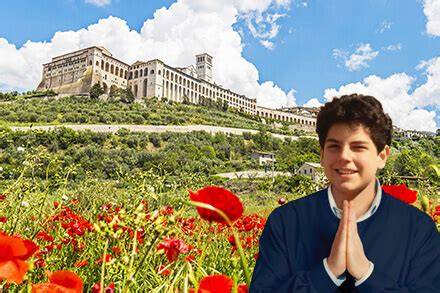
The Film’s Central Idea: Using Technology to Return to Reality
“One of the themes in the film is that he [Acutis] was online to lead people offline. He was online to lead people back to the Eucharist, back to real encounters,” Tim Moriarty, director of the new Acutis film and founder of Castletown Media, told CNA.
Moriarty believes that a film about this young soon-to-be saint is needed because “Carlo’s life provides a road map away from the distractions of the virtual world to the real world, especially through his devotion to the Eucharist - his ‘highway to heaven.’”
In a world losing itself to screens, teenage mystic Carlo Acutis saw beyond our social media-addicted society and offered an answer--if we're willing to listen.
Carlo Acutis: Roadmap to Reality explores the life of the first millennial saint while following teens on a phone-free pilgrimage to his tomb, immersing them in his story, his passion for Christ, and a search for meaning in a digital age.
The Phone-Free Pilgrimage from North Dakota to Italy
The film follows a group of high school students who embark on a two-week pilgrimage from North Dakota to Italy to visit Acutis’ tomb. One of the requirements for the pilgrimage was for the young people to disengage from technology and leave their phones at home.
The students’ journey gives the documentary a contemporary storyline alongside its exploration of Acutis’s life. Their experience connects the questions raised by the film with the practical challenges of stepping away from smartphones, social media, and constant digital communication.
The pilgrimage immerses the teenagers in Acutis’s story, his passion for Christ, and a search for meaning in a digital age.
<อtagvideo>Carlo Acutis Roadmap to Reality trailerCarlo Acutis and His Digital Mission
Carlo Acutis (3 May 1991 - 12 October 2006) was an English-born Italian Catholic teenager known for his devotion to the Eucharist and his use of digital media to promote Catholic devotion.
Born in London and raised in Milan, he developed an early interest in computers and video games, teaching himself programming and web design and assisting his parish and school with digital projects.
When Acutis was 14, his parish priest asked him to create a webpage for his parish, Santa Maria Segreta in Milan. After this, a priest at his high school asked him to create a website to promote volunteering.
Acutis created a website dedicated to cataloguing each reported Eucharistic miracle in the world and maintaining a list of the Marian apparitions recognised by the Catholic Church.
Acutis launched the website in 2004 and worked on it for two and a half years, involving his entire family in the project. It was unveiled on 4 October 2006, the Feast of St. Francis, only days before his death.
Because he was hospitalised, Acutis was not able to attend the debut of his exhibition at Rome's Church of San Carlo Borromeo. The exhibition was also presented at his high school, the Leo XIII Institute.
Depictions of Acutis often show him with a laptop computer, as a symbol of his method of evangelization.
Carlo Acutis’s Faith and Devotion to the Eucharist
Carlo Acutis is known for his great devotion to the real presence of Jesus in the Eucharist. Active in parish life, he served as a catechist and helped inspire several people to convert to Catholicism.
On 16 June 1998, when he was seven years old, Acutis received his First Holy Communion at the convent of Sant’Ambrogio ad Nemus, Milan. Acutis was also a frequent communicant, often in the Ambrosian Rite, and attended Eucharistic Adoration.
His attendance at the latter has led him to often be depicted with a monstrance. At the centre of his digital work was the same devotion that shaped his daily life: drawing attention to the Eucharist and encouraging people to encounter Christ through the Church.
When Acutis was 12 years old, he became a catechist in his parish, Santa Maria Segreta. At the time, the Italian catechetical structure typically relied on young team leaders in youth groups, as contrasted with adults, to deliver religious education to their peers.
In 2006 Acutis told his mother and grandmother of his intention to become a priest.
His Childhood and Family
Carlo Acutis was born on 3 May 1991 in London as the eldest child of Italian parents Andrea Acutis and Antonia Salzano, members of wealthy Italian families.
Acutis's parents worked in London and Germany before he was born, and moved back to Italy and settled in Milan shortly after his birth in May 1991.
His baptism took place on 18 May 1991, two weeks after his birth, in the Church of Our Lady of Dolours, Chelsea. His paternal grandfather, Carlo, was his godfather, and his maternal grandmother, Luana, was his godmother.
Neither of his parents were religious. Acutis's mother Antonia grew up in a secular family. She was confirmed while she was in college and was married in the church, but she did not attend Mass before Acutis was born.
She testified that her son's faith and his insistent questions brought her back to the faith.
In September 1997, Acutis attended his first primary school, the San Carlo Institute in Milan. As the school was at a distance from their home, three months later he transferred to the Marcelline Tommaseo Institute, run by the Sisters of St. Marcellina.
Upon completing middle school, Acutis went on to the Jesuit Instituto Leone XIII high school.
Early Religious Formation
Acutis was three years old when his maternal grandfather, Antonio Salzano, died. Several days earlier, he had been present when his grandfather received the Anointing of the Sick; his grandfather was said to have appeared to him in a dream asking for prayer.
Shortly after his death, Acutis put on his coat while his grandmother was minding him and asked to be taken to church. When she asked him why, he said he wanted to pray for his grandfather, who, he declared, "had gone to see Jesus".
When Acutis displayed an interest in Catholic religious practice, his questions were answered by the family's Polish babysitter.
In the summer, Acutis would stay with his mother's parents in Centola, a town in the Salerno province of Campania. After spending the day at the beach, he would join a number of older women in the local parish church to pray the rosary.
Acutis showed an interest in the lives of saints, especially Francis of Assisi, Anthony of Padua, Padre Pio, Francisco and Jacinta Marto, Dominic Savio, Tarcisius, Bernadette Soubirous, and Mary Magdalene de' Pazzi.
He is said to have prayed to his guardian angel frequently and exhibited a special devotion to St. Michael the Archangel.
His Influence on Other People
The Acutis family employed a Hindu immigrant from Mauritius, Rajesh Mohur, to work in their household. He and Acutis became friends.
In time, after speaking with Acutis about Christianity, Mohur asked to be baptised. A friend of Mohur's, Seeven Kistnen, also converted and was baptised after meeting with Acutis and hearing him speak about the faith.
Mohur's mother, visiting from Mauritius, attended Mass with Mohur and Acutis, who talked with her at length afterwards, and she too asked to be baptised.
Active in parish life, he served as a catechist and helped inspire several people to convert to Catholicism.
Carlo Acutis’s Character
Acutis's parish priest said of him that: Carlo was a young man who was exceptionally transparent. He really wanted to progress in loving his parents, God, his classmates, and those who loved him less.
He wanted to apply himself in his studies to educate himself in his catechism class as well as in school and computer science.
His story presents a teenager whose interests included computers and video games but whose life was also shaped by prayer, study, service, friendship, and participation in parish life.
His Illness and Death
On about 1 October 2006, Acutis developed an inflammation of the throat. His parents took him to a doctor, who diagnosed him with parotitis and dehydration, which a second doctor, a family friend, confirmed.
A few days later, Acutis's pain worsened and he had blood in his urine. By the Sunday, 8 October, he was too weak to get out of bed for Mass.
Acutis was brought to a clinic specialising in blood diseases, and was diagnosed with acute promyelocytic leukaemia.
He was given little chance of recovery. He was rushed to intensive care and put on a ventilator. After a sleepless night, Acutis was transferred to San Gerardo Hospital north of Milan - one of only three hospitals in Italy equipped to treat his condition.
The hospital staff called in their chaplain to administer the anointing of the sick. When a nurse came in to care for Acutis, he asked her not to wake his parents since they were already very tired and he did not want to worry them more.
Acutis offered his suffering both for Pope Benedict XVI and the Catholic Church, saying: "I offer to the Lord the sufferings that I will have to undergo for the Pope and for the Church."
The doctors treating his final illness had asked him if he was in great pain, to which he replied: "There are people who suffer much more than me."
His final words to his mother were: Mom, don't be afraid. Since Jesus became a man, death has become the passage towards life, and we don't need to flee it. Let us prepare ourselves to experience something extraordinary in the eternal life.
Acutis fell into a coma and was taken to the intensive care unit for a blood-cleansing treatment. After a cerebral hemorrhage, he was declared brain dead on 11 October.
Acutis was officially pronounced dead the next day, 12 October 2006, at 6:45 pm. He was 15 years old.
Carlo Acutis’s Tomb in Assisi
His parents brought his body home to lie in repose, and people came to pay their last respects for four days. A crowd of strangers attended his funeral, including young people who had abandoned the Church, and those who returned for a memorial Mass three months later.
It was Acutis's final wish to be buried in Assisi. On 6 April 2019, his body was brought to the Sanctuary of the Spoliation and venerated at its final resting place.
Overnight, the procession stopped at the Cathedral of San Rufino and the diocesan choir sang a Non io, ma Dio, ("Not me, but God"), a hymn especially composed for the occasion by Marco Mammoli.
Since his death, his relics have been displayed in Assisi, and his exhibitions on Eucharistic miracles have travelled worldwide.
While Acutis's body may appear incorrupt behind the glass of his casket, it is actually encased in wax moulded to look like his final appearance - a common style of presenting saints' bodies so pilgrims can see how the person looked shortly after death.
The rector of Santa Maria Maggiore in Assisi, where Carlo's tomb is housed, said that Acutis's body was discovered "fully integral", though not intact.
Beatification and Canonization
The call for Acutis to be beatified began soon after his death. The Church in Assisi was active in promoting Acutis's cult, the Catholic practice of venerating or showing devotion to a holy individual.
On 12 October 2012, the sixth anniversary of his death, the Archdiocese of Milan opened his cause for canonisation. The opening of the diocesan investigation was held on 15 February 2013, with Cardinal Angelo Scola inaugurating the process.
Scola said Acutis was not called to be "a movie star, but a star in Heaven" and that Acutis was "a new treasure in the Ambrosian church".
On 13 May 2013, the Congregation for the Causes of Saints issued a nihil obstat stating there was nothing preventing the cause from moving forward. He was then named a Servant of God.
The Lombardy Episcopal Conference approved the petition for the official canonisation cause to proceed in 2013.
Pope Francis confirmed his life as one of heroic virtue on 5 July 2018, declaring him Venerable.
In 2020, he was beatified by the Catholic Church after its recognition of a 2013 miracle in Campo Grande attributed to his intercession.
A second miracle in Italy was attributed to him in 2024, making him eligible for canonisation.
Acutis was canonised on 7 September 2025, alongside Pier Giorgio Frassati. Acutis is the first millennial to become a Catholic saint.
| Event | Date | Place or detail |
|---|---|---|
| Birth | 3 May 1991 | London, England, United Kingdom |
| Baptism | 18 May 1991 | Church of Our Lady of Dolours, Chelsea |
| First Holy Communion | 16 June 1998 | Convent of Sant’Ambrogio ad Nemus, Milan |
| Confirmation | 24 May 2003 | Santa Maria Segreta Church in Milan |
| Death | 12 October 2006 | San Gerardo Hospital, north of Milan |
| Beatification | 10 October 2020 | Basilica of Saint Francis of Assisi, Assisi, Italy |
| Canonization | 7 September 2025 | Saint Peter's Square, Vatican City |
The Eucharistic Miracles Exhibition
In memory of Acutis, Bishops Raffaello Martinelli and Angelo Comastri have helped to organise a travelling photo exhibition of all the Eucharistic miracle sites.
It has since travelled to dozens of different countries across five continents.
The preface to the print version of the exhibit was written by Cardinal Angelo Comastri and has been translated into 18 languages.
It has travelled to more than 10,000 places, including churches, congressional palaces, youth clubs, and welcome centres.
The exhibit was also brought to the canonisation of Francisco and Jacinta Marto in Fátima, Portugal.
Why Carlo Acutis Is Associated with the Internet
Due to his enjoyment of video games in life, Acutis has been described as the "first gamer saint".
Part of Acutis' popularity has been linked to how easily young people can identify with him, symbolized in the red polo shirt he is often shown wearing.
He has been referred to as the "patron saint of the Internet" and "God's influencer".
His laptop, red polo shirt, and monstrance have become recognizable attributes associated with his life, interests, and Eucharistic devotion.
Filmmakers
- Jim Wahlberg
- Tim Moriarty - Writer, Director, Producer
- Christian Surtz
- Theresa Cooley
- Sean Beeson
Cast and Participants
- Antonia Salzano Acutis
- Andrea Acutis
- Bishop Andrew Cozzens - Chair, National Eucharistic Revival
- Rod Dreher
- Chris Stefanick
- Msgr. James Shea - President, University of Mary
- Katie Prejean McGrady - Host, The Catholic Channel
- Alex Jones
- Bishop David Toups
- Timothy O’Malley - McGrath Institute for Church Life
- Msgr. Roger J. Landry - National Director, The Pontifical Mission Societies USA
- Msgr. Anthony Figueredo - Author, Blessed Carlo Acutis: 5 Steps to Being a Saint
- Fr. Chris Alar, MIC - Provincial Superior, Marian Fathers United States and Argentina
- Gretchen Boll
- Sofia Carozza - Research Fellow in Neurology, Harvard University
- Emily Gietzen
- Fr. Josh Hill - Chaplain, Bishop Ryan Catholic School
- Alexander Keller
- Courtney Mares - Author, Carlo Acutis: A Saint in Sneakers
- Fr. Jacob Magnuson - Chaplain, St. Mary’s Central High School
- Rajesh Mohur
- John Cavadini, PhD - McGrath Institute for Church Life
- Fr. John O'Brien, SJ - Director, Martyrs’ Shrine, Canada
- Mattia Pastorelli
- Brett Robinson - McGrath Institute for Church Life
- Charles Richter
- Abigail Schmidt
- D.C. Schindler - Professor, John Paul II Institute
- John Slattery - Ethicist, Duquesne University
- Nicklaus Sobolik
- Taryn Hauf
- Mara Nielsen
- Jerome Richter - Executive Vice President, University of Mary
- Flavia Maria Zauli
- Fr. Patrick Mary Briscoe, OP - Editor, Our Sunday Visitor
- Sabrina Ferrisi - Journalist, National Catholic Register
Release, Distribution, and Film Details
“Carlo Acutis: Roadmap to Reality,” the highly anticipated documentary on the life of the soon-to-be saint, will be released in theaters nationwide for a limited time from April 27-29.
The release date coincides with Pope Francis’ canonization of Carlo Actuis, the Catholic Church’s first millennial saint, on April 27.
Castletown Media, in association with Catholic filmmaker Jim Wahlberg, made the announcement on Feb. 12. Castletown Media is producing the film and Fathom Events will distribute it.
“Roadmap to Reality” explores the life of Acutis and the lessons he offers young people regarding the challenges of the digital world.
Moriarty called the release of the documentary “providential.”
| Film detail | Information |
|---|---|
| Title | Carlo Acutis: Roadmap to Reality |
| Directors | Tim Moriarty, Christian Surtz |
| Screenwriters | Tim Moriarty, Theresa Cooley |
| Distributor | Fathom Events |
| Production companies | Wahl St. Productions, Castletown Media |
| Genre | Documentary, Faith & Spirituality |
| Original language | English |
| Runtime | 1h 35m |
| Theatrical release | Apr 27, 2025, Limited |
Critical and Audience Responses
Mark Jackson of Epoch Times wrote that “Soon-to-be Saint Carlo Acutis's impact on his millennial peers was profound.”
Ryan Devir of Film Threat wrote that Carlo Acutis: Roadmap To Reality “succeeds in giving viewers a worthwhile primer for further investigation.”
One viewer described the film as “A must see for the first millennial saint!” and praised its presentation of how to live in the current world while surrendering one’s life to Christ without allowing the digital age to take away one’s soul.
Another viewer called it an “Inspiring. Great documentary,” while noting that they wanted to see more videos of Carlo.
Other viewers described the documentary as fascinating, inspiring, and a real story, while one review considered it too short and lacking enough details or information.