The Da Vinci Code presents Mary Magdalene as the wife of Jesus, the mother of his children, the bearer of his bloodline, and the intended leader of the Christian movement. These claims are central to the novel’s conspiracy narrative, but they are not supported by reliable historical evidence. No reputable scholar has found evidence that Jesus and Mary Magdalene were married or had a child.
The historical Mary Magdalene was almost certainly more important than the traditional image of a repentant prostitute suggests. The New Testament portrays her as a wealthy supporter of Jesus’ ministry, a witness to his crucifixion and burial, and the first person to encounter and announce his resurrection. Modern scholarship and several early non-canonical Christian texts present her as an influential disciple and, in some traditions, a rival to Peter for authority within the early Jesus movement.
What The Da Vinci Code claims about Mary Magdalene
According to the novel, “The marriage of Jesus and Mary Magdalene is part of the historical record.” The book also argues that Jesus as a married man makes more sense than the traditional Christian image of Jesus as a bachelor because, if Jesus were not married, “at least one of the Bible’s gospels would have mentioned it and offered some explanation for His unnatural state of bachelorhood.”
The novel’s most elaborate claim is delivered by the character Teabing: “Behold the greatest cover-up in human history. Not only was Jesus Christ married, but He was a father. My dear, Mary Magdalene was the Holy Vessel. She was the chalice that bore the royal bloodline of Jesus Christ.” Mary is described as “the womb that bore the lineage, and the vine from which the sacred fruit sprang forth!”
The book further claims that Jesus intended the future of his church to be “in the hands of Mary Magdalene.” It presents her as a threat to the male leadership of early Christianity and argues that the church deliberately transformed her into a prostitute in order to conceal her marriage to Jesus and prevent possible claims based on a surviving bloodline.
These claims combine several different ideas: the possibility that Jesus was married, the suggestion that Mary Magdalene was his closest disciple, the interpretation of Leonardo da Vinci’s Last Supper as evidence of her presence beside Jesus, and the belief that a royal bloodline descended from their supposed child. The novel treats these elements as parts of one historical revelation, although the evidence for them is very uneven.
Why Mary Magdalene became central to the novel
Mary Magdalene had already captured the Christian imagination long before Dan Brown’s bestseller appeared. She is often remembered as a penitent prostitute, as in Georges de La Tour’s The Penitent Magdalene. The rock opera Jesus Christ Superstar also casts her as a reformed sinner who confesses that she has “had so many men before.” She marries Jesus in Nikos Kazantzakis’s novel The Last Temptation of Christ and in Martin Scorsese’s film adaptation.
Songs and literary works about Mary Magdalene have frequently emphasized guilt, sexuality, loneliness, or repentance. Lenny Kravitz sings of a Magdalene who sells herself in the city, Kris Kristofferson describes another Magdalene forgiven for her sins yet left alone, and Joni Mitchell refers to the “Magdalene Laundries,” Irish institutions for prostitutes and other “wayward” women.
Scholars have also devoted considerable attention to the historical and theological significance of Mary Magdalene. Among them are Marvin Meyer, Karen King, Bart Ehrman, Jane Schaberg, Ann Graham Brock, and Bruce Chilton. Their work has helped distinguish the Mary Magdalene of the earliest Christian texts from later legends and literary reconstructions.
Mary Magdalene in the New Testament
The first appearance of Mary Magdalene in the New Testament is in Luke 8. She came from Magdala, a town on the shore of the Sea of Galilee, and “seven demons had gone out” of her. The text does not say who cast them out or what her condition involved. Luke also states that Mary traveled with Jesus and the other disciples and helped support the movement financially.
Mary was apparently wealthy enough to maintain her own home and contribute to the welfare of Jesus and his followers. Nothing in this account identifies her as a prostitute, a sexual sinner, or an immoral woman. Her introduction in Luke presents her as a person who had been healed and who then became an active participant in Jesus’ ministry.
Mary Magdalene appears by name in several of the most important scenes in the Gospel narratives. Along with other women, she travels with Jesus and the disciples in Matthew, Mark, Luke, and John. She witnesses Jesus’ death, observes his burial, brings spices to the tomb, and is named in three Gospel traditions as the first person to see and recognize Jesus after the resurrection.
She is present at the crucifixion when most of Jesus’ male disciples have fled. She witnesses the location of his burial, discovers the empty tomb, and announces the resurrection to the other disciples. In the Gospel of John, the risen Jesus calls her by name, and she recognizes him as “Rabboni,” meaning “my master.” Jesus then commissions her to tell the other disciples that he has risen.
If Christianity was born from belief in the resurrection, Mary Magdalene can be regarded as the first witness to the central event of Christian faith and as the apostle to the apostles. The Gospel of John offers the most elaborate version of this scene, but the other Gospel traditions also preserve her importance at the crucifixion, burial, and resurrection.
Mary Magdalene’s significance in the Gospel narratives
The prominence of Mary Magdalene and other women at the crucifixion, burial, and resurrection is unlikely to be an invention designed to flatter the early Christian movement. The societies in which the Gospels emerged were patriarchal, whether Jewish or Roman, and women’s testimony generally carried less public authority than men’s.
Stories in which women discover the empty tomb and become the first witnesses make the male disciples look confused, absent, or disbelieving. The presence of women at these critical points therefore suggests that these traditions were difficult for later Christian storytellers to eliminate or reverse. Their role in the narrative is best explained by the fact that Mary and the other women were remembered as genuinely present.
At the same time, Mary’s pivotal role at the end of the Gospel narratives may have encouraged later interpreters to assume that she had been prominent throughout Jesus’ life in ways the texts do not explicitly state. This helped produce a series of identifications and conflations that profoundly altered her reputation.
How Mary Magdalene was confused with other women
Mary Magdalene is not identified as a sinner in the canonical Gospels. Nevertheless, later interpreters conflated her with several other women: Mary of Bethany, a sinful woman who anoints Jesus’ feet, a woman caught in adultery, and the Samaritan woman who had five husbands and a male companion.
In Luke 7:36-50, an unnamed woman described as a public sinner enters the house of Simon the Pharisee, washes Jesus’ feet with her tears, dries them with her hair, and anoints them with ointment. Jesus tells her that her sins are forgiven and that her faith has saved her. The Gospel does not identify this woman as Mary Magdalene.
Mary of Bethany is a different figure. In John 12:1-8, Mary, the sister of Martha and Lazarus, anoints Jesus’ feet with expensive ointment and wipes them with her hair. The similarity between this scene and the story in Luke encouraged later readers to merge the two women, even though the Gospel narratives distinguish them.
The Samaritan woman in John 4 is also a separate person. She has had five husbands and lives with a man who is not her husband, but the Gospel does not identify her with Mary Magdalene. The woman caught in adultery in John 7:53-8:11 is likewise unnamed and unrelated to Mary Magdalene in the text.
Luke places the story of the sinful woman immediately before the introduction of Mary Magdalene. This arrangement made it easier for later interpreters to fuse the two characters, treating Mary’s “demons” as an explanation for the sinful woman’s moral failure. Yet the Gospel does not say what Mary’s demons made her do, and Luke introduces her as if she were appearing for the first time.
The four anointing episodes
Another reason several women were confused with one another is the similarity between four anointing episodes in the Gospels. In Matthew 26:6-13 and Mark 14:3-9, an unnamed woman with an alabaster jar anoints Jesus’ head while he is dining in Bethany at the house of Simon the leper.
In Luke 7:36-50, an unnamed sinful woman with an alabaster jar anoints Jesus’ feet with her tears and ointment while he is dining at the house of Simon the Pharisee. In John 12:1-8, Mary of Bethany anoints Jesus’ feet with costly ointment and wipes them with her hair.
Mary Magdalene also brings spices to Jesus’ tomb in Mark 16:1 and Luke 24:1. The combination of several anointing stories made it possible for later interpreters to associate her with the unnamed sinful woman who anointed Jesus, even though the texts themselves do not make that identification.
| Figure or episode | Gospel description | Relationship to Mary Magdalene |
|---|---|---|
| Mary Magdalene | Healed of seven demons, supported Jesus’ ministry, witnessed the crucifixion, discovered the resurrection | Distinct person in the Gospel narratives |
| Sinful woman | Anointed Jesus’ feet with tears and ointment in the house of Simon the Pharisee | Unnamed and not identified as Mary Magdalene |
| Mary of Bethany | Anointed Jesus’ feet with expensive ointment and wiped them with her hair | Sister of Martha and Lazarus; distinct from Mary Magdalene |
| Samaritan woman | Had five husbands and a male companion | Not identified as Mary Magdalene |
| Woman caught in adultery | Appears in a separate episode in John | Unnamed and distinct from Mary Magdalene |
The prostitute legend and Pope Gregory the Great
Mary Magdalene’s identity as a penitent prostitute became firmly established in popular Christianity after Pope Gregory the Great preached a sermon on September 21, 591. Gregory combined several women from the Gospel narratives into a single figure: Mary Magdalene, the sinful woman who anointed Jesus’ feet, and Mary of Bethany.
The result was a composite character who was simultaneously a demoniac, a sinner, an anointer, a disciple, and a penitent. This interpretation transformed Mary Magdalene into an emblem of repentance rather than preserving her as an independent religious leader.
Contrary to the novel’s implication, Pope Gregory was not conducting a secret campaign to suppress evidence about Mary’s marriage to Jesus. He was calling his audience to repentance during a period of famine and war and presented the composite Magdalene as an ideal penitent.
The legend nevertheless had serious consequences. It undercut Mary’s status and, by extension, weakened the place of women in the church. The treatment of Mary Magdalene became one of the most successful and enduring reputational distortions in Christian history, even though no Gospel identifies her as a prostitute.
In 1969, the Catholic Church ruled that Mary Magdalene was not a prostitute and attributed the error to Gregory’s conflation of several biblical women. The correction did not immediately reach all Christians, and the older image remains deeply embedded in art, literature, film, music, and popular religious imagination.
Mary Magdalene in early Christian and Gnostic texts
The Gnostic texts associated with Nag Hammadi really do exist. They were discovered in Egypt in 1945, along with more than fifty ancient writings. The Gospel of Philip, the Gospel of Mary Magdalene, and the Dialogue of the Savior are among early Christian texts that present Mary Magdalene as a disciple of Jesus.
These works do not provide straightforward historical biographies. They are theological and mystical writings produced in later Christian communities, and they should not be treated as direct records of the first-century relationship between Jesus and Mary Magdalene.
Nevertheless, they are important evidence for the diversity of early Christian thought. They show that some Christian groups remembered Mary as a preeminent disciple with a special relationship to Jesus and associated her authority with her advanced spiritual understanding, or gnosis.
In these texts, Mary is not primarily a wife and mother. She is a visionary, interpreter, teacher, and spiritual authority. Her importance is linked to her understanding of divine truths rather than to her role as the vessel of a biological bloodline.
The Gospel of Mary
The Gospel of Mary recounts a post-resurrection dialogue in which Jesus teaches his disciples about the return of the soul to the world of spirit. After Jesus’ departure, Mary describes a visionary experience and explains Jesus’ teaching to the other disciples.
Peter objects to Mary’s authority, but Levi defends her, saying that Mary can teach because Jesus loved her more than the other disciples. The text presents a conflict over whether a woman can transmit authoritative teaching within the community.
The Gospel of Mary is therefore evidence for debates about leadership, revelation, and women’s roles in early Christianity. It is not evidence that Jesus and Mary Magdalene were sexually involved or married.
The Gospel of Philip
The Gospel of Philip contains the passage that most directly inspired the novel’s claim about a special relationship between Jesus and Mary Magdalene: “The companion of the savior is Mary Magdalene. And Jesus loved her more than all the disciples, and used to kiss her often.”
The rest of the disciples are said to have asked, “Why do you love her more than all of us?” The surviving manuscript has a hole in the sentence describing where Jesus kissed Mary. One reasonable reconstruction is “mouth,” but the missing word cannot be established with certainty.
The Gospel of Philip is a mystical text that discusses rituals, including the ritual kiss. In early Christian communities, kissing could function as an equivalent of “passing the peace” or as a Mediterranean greeting. The ritual was exchanged by men and women who called one another “brother” and “sister.”
Because such practices could be misunderstood by outsiders, second-century Christians were sometimes accused of sexual misconduct, incest, or even cannibalism. The Gospel of Philip seeks to explain the spiritual meaning of the kiss rather than document a sexual relationship between Jesus and Mary Magdalene.
The context suggests that the passage functions as an etiological legend that justifies a Christian ritual: believers could exchange the ritual kiss because Jesus was said to have done so with Mary. Brown interprets the passage as evidence of sexual intimacy, but the text itself does not require that interpretation.
The Gospel of Thomas
The Gospel of Thomas also presents a debate between Peter and Mary. Peter says, “Let Mary leave us, for women are not worthy of life.” Jesus responds by saying that he will lead her so that she may become a living spirit.
The language reflects an ancient gender bias in which “male” functions as a metaphor for spiritual transcendence. The passage does not present Mary as Jesus’ wife. Instead, it uses spiritual transformation to argue that women, like men, can attain the highest form of religious understanding.
The Gospel of Thomas therefore shows that questions about women’s authority and spiritual equality existed within early Christian traditions. Its Mary is significant because she is included in a discussion about access to life, wisdom, and the kingdom of heaven.
The Dialogue of the Savior
In the Dialogue of the Savior, Mary Magdalene repeatedly speaks with authority about spiritual insights. The text describes her as “a woman who understood completely.” Her importance comes from her knowledge and interpretation, not from motherhood or dynastic descent.
The Gnostic phrase “putting on the perfect man” means freeing oneself from worldly concerns, including family, children, and parenthood, in order to achieve spiritual insight. The phrase carries a gender bias because “male” is used as a metaphor for a higher plane of existence, but anyone, male or female, could “put on the perfect man.”
The Gospel of Mary similarly implies that Mary is closer to the ideal spiritual person than the other disciples. Her status is connected to revelation and wisdom. These texts portray her in some ways as the first apostle, but they do not establish that she was Jesus’ wife or the mother of his children.
What the Gnostic texts reveal about early Christian conflict
The Gnostic texts may reflect tension over which of Jesus’ followers possessed legitimate authority after his death. Peter frequently attacks Mary in these writings, while Paul does not mention her in his letters. The conflict may involve competing claims associated with Peter, James, Paul, and Mary Magdalene.
The Gospel traditions suggest that Mary had a leadership role, while other Christian traditions emphasized Peter as the primary witness and authority. Church fathers such as Hippolytus, a third-century bishop in Rome, acknowledged Mary’s position as an apostolic witness even though other New Testament texts placed Peter in a leading role.
The debate was not simply about whether Jesus loved Mary romantically. It concerned whether women could teach, preach, interpret revelation, and exercise authority in Christian communities.
The Gnostic texts point to a conflict about gender: Should the movement follow a model in which men lead and women are understood primarily as wives and mothers, or could gender be spiritually transcended so that anyone, male or female, could become a “perfect man”?
The New Testament indicates that Paul won the conflict about religious heritage: anyone, male or female, Jew or Greek, slave or free, could become a Christian. Peter’s view prevailed in establishing roles for church leadership: anyone could be a Christian, but only men could lead.
The established church of Rome followed Peter’s path, and much, though not all, of Christianity continued along it. The most prominent woman in the early Christian community was eventually depicted as a prostitute rather than honored as a legitimate religious leader.
Were the Gnostic Gospels suppressed?
It is not surprising that The Da Vinci Code builds on the idea that many early Gospels were hidden and unknown. The Nag Hammadi discovery demonstrated that the New Testament was not the only collection of writings about Jesus and his followers circulating among early Christians.
In the decades after Jesus’ death, numerous Christian texts circulated among communities from Egypt to Rome, from Africa to Spain, and from modern Turkey and Syria to France. Many Christians knew and respected writings that later church leaders classified as heretical.
The material found at Nag Hammadi came from a collection associated with an early Egyptian monastic community. The monastery had been founded roughly ten years after the conversion of Constantine, the first Roman emperor to join the Christian church.
In 367, Athanasius, archbishop of Alexandria, sent an Easter Letter to monks throughout Egypt ordering them to reject what he called “illegitimate and secret books.” Some monks appear to have defied the order by removing more than fifty books from their library, sealing them in a heavy jar, and burying them beneath a cliff.
The discovery of these writings shows that early Christianity was intellectually diverse and that different groups preserved different accounts of Jesus, revelation, salvation, gender, and church authority. It does not, however, prove that the church suppressed a single accurate biography of Jesus and Mary Magdalene.
Irenaeus, a second-century bishop, opposed Christian groups that valued such writings. He insisted that only four Gospels were genuine: Matthew, Mark, Luke, and John. He argued that there could be only four Gospels because the world, according to the science of his time, had four principal winds and four pillars holding up the sky.
Irenaeus also claimed that the four canonical Gospels were written by eyewitnesses or by disciples of eyewitnesses. Few scholars today accept these authorship claims as historically verifiable. The authors of the canonical Gospels are not identified within the texts, and many scholars do not think that the original twelve disciples wrote them.
The Gospel of Thomas, for example, was also attributed to one of the original apostles. The fact that both canonical and non-canonical texts were associated with apostles shows that claims of apostolic authorship were part of the competition among early Christian communities.
Theological differences between canonical and Gnostic traditions
Some writings later labeled Gnostic suggest that the way to God can be found by anyone who seeks. In the Gospel of Thomas, Jesus says, “If you bring forth what is within you, what you bring forth will save you.” This message emphasizes personal discovery and self-knowledge.
Irenaeus rejected this approach because he insisted that people must come to God through the church, “outside of which,” he said, “there is no salvation.” The disagreement was therefore institutional as well as theological: one side emphasized direct spiritual knowledge, while the other emphasized the authority of the church.
In texts condemned as heretical, Jesus appears as human and yet as a figure through whom divine light shines. The Gospel of Thomas attributes to Jesus the words, “I am the light that is before all things; I am all things; all things come forth from me; all things return to me.”
The Gospel of Thomas also says, “Split a piece of wood, and I am there; lift up a rock, and you will find me there.” Irenaeus regarded such language as dangerously close to pantheism because it suggested that divine energy could be manifested throughout creation.
The Gospel of Philip says, “Do not seek to become a Christian, but a Christ.” To Irenaeus, this was not mystical language but “an abyss of madness, and blasphemy against Christ.” These differences help explain why certain texts were attacked, but they do not transform those writings into straightforward historical records.
Some of the alternative texts also describe God through feminine imagery. The Secret Book of John presents a vision in which the divine voice says, “I am the Father; I am the Mother; and I am the Son.” The text thus imagines the divine Trinity as including a Mother as well as a Father and a Son.
The Gospel of Mary, the Gospel of Thomas, the Dialogue of the Savior, and the Gospel of Philip all include conflict between Peter and Mary. Peter objects to Mary’s presence and authority, while Jesus defends her. These traditions show that women’s leadership was a genuine issue in early Christian debate.
Mary Magdalene as leader rather than bloodline bearer
The most historically significant alternative to the traditional prostitute image is not the novel’s idea of Mary as a dynastic mother. It is the possibility that she was a leader of the early Jesus movement.
The Gospels portray her as a supporter of Jesus’ ministry, a witness to his death and burial, and the first witness to the resurrection. The Gnostic writings present her as a person of exceptional understanding who can interpret Jesus’ teaching when other disciples cannot.
In this respect, the Gnostic portrait of Mary is closer to the idea of a religious leader than to the role assigned to her in The Da Vinci Code. The novel removes Mary from the traditional status of repentant prostitute but relegates her to the conventional roles of wife and mother.
Motherhood can be a powerful, essential, and sacred office. Yet within the novel’s argument, Mary’s motherhood is not a liberation from patriarchal categories. She becomes a chalice, a vessel, and a receptacle for Jesus’ “dangerous seed.” She is valued as the container of a royal bloodline rather than as an independent religious authority.
The book’s alleged revelation that Mary Magdalene was the Holy Vessel is radical only in relation to Catholic doctrine. It is not especially radical according to liberal religious standards, where motherhood is already viewed as timeless, blameless, and sacred.
Contemporary scholarship suggests that Mary Magdalene may have been something more unconventional and powerful than a mother: she may have been a leader. The revolutionary idea is not that she preserved Jesus’ biological descendants, but that she possessed religious authority and was remembered as a teacher and apostolic witness.
Was Jesus married to Mary Magdalene?
The direct historical answer is that the surviving ancient sources do not establish that Jesus was married to Mary Magdalene. Bart Ehrman summarizes the evidence this way: “Not a single one of our ancient sources indicates that Jesus was married, let alone married to Mary Magdalene. All such claims are part of modern fictional reconstructions of Jesus’ life, not rooted in the surviving accounts themselves.”
The claims about a sexual relationship rest partly on the assumption that all Jewish men in the first century were married. That assumption is not secure. They also rest on passages in second-century apocryphal texts that describe Mary as Jesus’ companion or as especially loved by him.
It is possible that Jesus and Mary Magdalene had a sexual relationship. If they did, Jesus would indeed be a very human character. But possibility is not probability, and the surviving evidence does not make the marriage theory probable.
Jesus’ sayings about subordinating family life to loyalty to his cause point in another direction. His statement about people who make themselves eunuchs for the sake of the kingdom of heaven also suggests commitment to a radical and possibly celibate lifestyle.
Such sayings may preserve the teaching of a provocative preacher who demanded an unusual level of commitment. They do not prove that Jesus was unmarried, but they make it difficult to use the general expectation of marriage as evidence that he must have had a wife.
The suggestion that Jesus had children would not, by itself, explain the development of Christian doctrine or the conflicts within the early church. Jesus’ earthly life and mortality already contributed to the power of his story. His commitment and suffering would not be less compelling if he had been married or a father.
Mary Magdalene and the early church’s struggle over authority
The novel locates the central conflict several centuries after Jesus and Mary lived, when Christianity was becoming the religion of the Roman Empire and debates about Jesus’ divinity were especially intense. The earliest Jesus movement, however, faced other conflicts as well.
Paul’s writings illustrate a debate over whether the movement should remain primarily Jewish or open to everyone. The Gnostic texts point to a different debate about gender and authority: whether women could participate as teachers and leaders or whether they were to be restricted to domestic roles.
Mary Magdalene’s importance is especially visible in the tension between traditions that emphasize Peter and traditions that defend Mary. Peter represents the form of institutional authority that became dominant in the emerging church, while Mary represents a competing model based on visionary knowledge and personal revelation.
This conflict helps explain why later Christian communities could preserve both Mary’s decisive role in the resurrection narratives and her diminished status in church structures. She could be remembered as the first witness to the resurrection while still being excluded from formal leadership.
The eventual depiction of Mary as a prostitute was therefore not merely a mistake about one woman. It reflected a broader pattern in which femininity was associated with earthly concerns, sexuality, and spiritual danger. Women who possessed religious authority could be made less threatening by turning them into examples of sin and repentance.
This treatment was a disservice to the historical woman who lived a visionary life of commitment and sacrifice. It was also a blow against the right of women to be recognized and honored as religiously legitimate figures, including leaders, in the present.
Mary Magdalene in Leonardo da Vinci’s The Last Supper
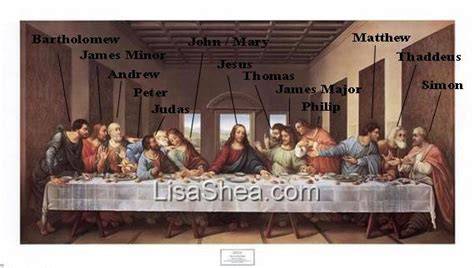
The Da Vinci Code claims that the figure seated at Jesus’ right hand in Leonardo da Vinci’s famous mural is Mary Magdalene rather than John the Beloved. The novel interprets the figure’s position, appearance, and the V-shaped space between Jesus and the disciple as clues to the supposed Holy Grail and Jesus’ bloodline.
No serious art historian argues that Leonardo’s Last Supper depicts Mary Magdalene as the Grail or as Jesus’ wife. The figure beside Jesus is traditionally identified as John, shown as youthful and somewhat effeminate in accordance with the tradition that he was young enough to outlive the other disciples.
A comparison with Leonardo’s painting of John the Baptist shows how similar conventions of appearance can be used to identify the figure. The figure’s delicacy and youthful features do not make the person Mary Magdalene.
The mural depicts the moment after Jesus announces that one of the disciples will betray him. The apostles react with shock, denial, questioning, and alarm. Their gestures and groupings form part of Leonardo’s dramatic composition.
Peter is not “leaning menacingly” toward Mary, because the figure beside Jesus is John. Nor is Peter “slicing his blade-like hand across her neck.” Peter and John lean toward one another as close confidants. The short sword in Peter’s right hand refers to the later scene in the Garden of Gethsemane when Peter cuts off a slave’s ear.
Leonardo’s painting cannot establish that Mary Magdalene was Jesus’ wife, that she was the mother of his children, or that a royal bloodline descended from them. The interpretation depends on the novel’s fictional framework rather than on the historical or artistic evidence.
What Dan Brown changed and what he overlooked
The Da Vinci Code challenges the traditional understanding of Mary Magdalene’s identity, but it replaces one unsupported image with another. It rejects the prostitute legend while offering a wife-and-mother narrative for which there is little evidence.
Some elements of the novel reflect speculation by modern biblical scholars. A small amount is grounded in the highly unorthodox portrayal of Mary Magdalene found in Gnostic texts. Much of the rest is Dan Brown’s own creation.
The novel cites the Gospel of Philip, the Gospel of Mary, and other early Christian writings, but it does not take their portrayal of Mary seriously enough. These texts present her as a disciple with unusual spiritual insight, a teacher whose authority challenges Peter, and a person who may represent a rival model of Christian leadership.
Instead of emphasizing Mary’s intellectual and spiritual authority, the novel turns her into a biological link in a royal genealogy. The book’s “Holy Vessel” is not primarily the woman who understands the teachings of Jesus; it is the woman who carries his child.
The result is an irony at the heart of the novel. It attacks the Catholic Church for reducing Mary Magdalene to a sexual stereotype, yet it reduces her in another way by making her historical importance depend on marriage, motherhood, and descent.
Why The Da Vinci Code became so influential
The global popularity of The Da Vinci Code is difficult to overstate. The book sold more than forty million copies after 2003 and appeared in forty-four languages. It remained on the New York Times hardcover fiction bestseller list for more than 162 weeks.
Its success was not primarily the result of literary style. Even admirers of the book often do not focus on its characters or its prose. The novel’s power came from secrecy, “symbology,” tangled conspiracy, religious controversy, sex, hidden societies, bloodied corpses, self-flagellating albino monks, and a full-frontal assault on a powerful religious institution.
The book’s central conflict was framed as Brown against the Vatican, David against Goliath. It offered readers the pleasure of discovering that supposedly respectable religious history concealed a dramatic alternative story.
Its commercial success also came from smuggling serious historical claims across the border into literary fiction. Readers unfamiliar with ancient sources and unable to evaluate historical arguments could reasonably wonder whether parts of the novel, particularly the claims about Mary, might be true.
The novel’s popularity generated widespread interest in Jesus, Mary Magdalene, Christian origins, the formation of the biblical canon, Gnostic writings, and the relationship between institutional religion and historical memory. It also encouraged many readers to confuse the existence of alternative ancient texts with the truth of the novel’s specific conclusions.
Jesus good, church bad?
Dan Brown does not attack Jesus himself. His Jesus is a noble hero, a victim of early Catholic distortion and identity theft. Brown’s principal target is the church, especially what has been described as status-quo, male-dominated, power-oriented, and cover-up-prone organized Christianity.
This reflects a widespread modern Western sentiment: Jesus good, church bad. Many people admire Jesus as a holy man, sage, or heroic figure while criticizing the church for bureaucracy, inflexible traditions, hypocrisy, patriarchal structures, abuse of power, or political and commercial entanglements.
When the world looks at Jesus, it often sees the best of humanity: a holy man, a sage, or a heroic figure associated with Gandhi and Martin Luther King Jr. At the same time, people notice when Jesus’ followers maneuver for power, silence women, betray children, neglect the poor, resort to violence, or support commercial interests that damage the planet.
Even when the historical claims of The Da Vinci Code miss their mark, the public’s embrace of the novel reveals social and spiritual discontent. Christians cannot simply dismiss the book’s popularity and return to an unexamined confidence in orthodox theology.
The novel’s success may be understood as an invitation to examine the church’s historical treatment of women, its relationship to power, and its continuing relevance to people who admire Jesus but distrust organized religion.
Mary Magdalene beyond the conspiracy narrative
Mary Magdalene does not need a royal bloodline to be historically important. She does not need to be Jesus’ wife or the mother of his children in order to matter. The canonical Gospels already give her a central role in the story of Jesus’ death, burial, and resurrection.
The non-canonical texts add another dimension. They show that some early Christians understood Mary as an authoritative disciple, visionary, interpreter, and teacher. They preserve memories of disputes in which Peter challenges Mary and other disciples defend her spiritual knowledge.
These writings do not prove that Mary and Jesus were married. They do demonstrate that early Christianity contained competing traditions about women, authority, revelation, and the meaning of discipleship.
The more historically responsible portrait of Mary Magdalene is therefore neither the repentant prostitute of later tradition nor the dynastic mother of The Da Vinci Code. She is a woman remembered as a committed follower of Jesus, a supporter of his ministry, a witness to his execution and burial, the first witness of the resurrection, and-in some early Christian traditions-a leader whose authority challenged the emerging male hierarchy.
Scientists Just Sequenced Mary Magdalene’s DNA — What They Found Inside Her Body Is Shocking
The fiction of The Da Vinci Code remains entertaining because it turns questions about Christian origins into a conspiracy thriller. Its historical claims, however, must be treated with caution. The surviving evidence supports Mary Magdalene’s importance as a disciple and religious authority far more strongly than it supports the idea that she was Jesus’ wife, the mother of his children, or the bearer of a hidden royal bloodline.