Matthew chapter 11 KJV presents Jesus as the promised Christ through His works: “The blind receive their sight, and the lame walk, the lepers are cleansed, and the deaf hear, the dead are raised up, and the poor have the gospel preached to them.” The chapter also records Jesus’ testimony concerning John the Baptist, His rebuke of cities that refused to repent, and His gracious invitation: “Come unto me, all ye that labour and are heavy laden, and I will give you rest.”
The chapter moves from questions about Christ’s identity to a declaration of His authority and character. Jesus identifies John as the messenger who prepared His way, warns those who witnessed His mighty works without repentance, and reveals that the Father is known through the Son.
| Passage | Main subject |
|---|---|
| Matthew 11:1 | Jesus teaches and preaches in their cities |
| Matthew 11:2-6 | John the Baptist asks whether Jesus is the coming One |
| Matthew 11:7-15 | Jesus’ testimony concerning John |
| Matthew 11:16-19 | The generation compared with children in the marketplaces |
| Matthew 11:20-24 | The unrepenting cities |
| Matthew 11:25-27 | The Father revealed through the Son |
| Matthew 11:28-30 | Christ’s invitation to the weary and heavy laden |
Matthew 11:1-6 - John the Baptist asks about Christ
And it came to pass, when Jesus had made an end of commanding his twelve disciples, he departed thence to teach and to preach in their cities. Now when John had heard in the prison the works of Christ, he sent two of his disciples.
And said unto him, Art thou he that should come, or do we look for another? Jesus answered and said unto them, Go and shew John again those things which ye do hear and see.
The question comes from John the Baptist, who is in prison and has heard about “the works of Christ.” Rather than answering with a simple title, Jesus directs John’s disciples to report what they hear and see.
The blind receive their sight, and the lame walk, the lepers are cleansed, and the deaf hear, the dead are raised up, and the poor have the gospel preached to them. And blessed is he, whosoever shall not be offended in me.
Jesus’ answer identifies His ministry with the works associated with God’s saving purposes. His answer includes physical restoration, cleansing, resurrection, and the preaching of the gospel to the poor. The final statement also calls for faith that will not stumble because of Christ.
Matthew’s main purpose is to prove to his Jewish readers that Jesus is their Messiah.He does this primarily by showing how Jesus in his life and ministry fulfilled the OT Scriptures. Although all the Gospel writers quote the OT, Matthew includes nine proof texts unique to his Gospel (1:22-23; 2:15; 2:17-18; 2:23; 4:14-16; 8:17; 12:17-21; 13:35; 27:9-10) to drive home his basic theme: Jesus is the fulfillment of the OT predictions of the Messiah.
Matthew 11 therefore presents the works of Jesus as evidence of His messianic identity. The answer given to John also corresponds to Matthew’s wider emphasis on the fulfillment of the Old Testament promises.
Matthew 11:7-15 - Jesus’ tribute to John the Baptist
And as they departed, Jesus began to say unto the multitudes concerning John, What went ye out into the wilderness to see? A reed shaken with the wind?
But what went ye out for to see? A man clothed in soft raiment? behold, they that wear soft clothing are in kings' houses. But what went ye out for to see? A prophet? yea, I say unto you, and more than a prophet.
Jesus’ questions reject the idea that John was weak, unstable, or concerned with royal luxury. John was not a reed shaken by changing circumstances, and he was not a man dressed in the soft clothing found in kings’ houses. He was a prophet, and more than a prophet.
For this is he, of whom it is written, Behold, I send my messenger before thy face, which shall prepare thy way before thee.
John’s role was established by prophecy: he was the messenger sent before Christ to prepare His way. Matthew connects the ministry of John with the prophetic expectation that precedes the arrival of the Lord’s appointed messenger.
Verily I say unto you, Among them that are born of women there hath not risen a greater than John the Baptist: notwithstanding he that is least in the kingdom of heaven is greater than he.
Jesus gives John an exceptionally high commendation. At the same time, He distinguishes John’s place from the position of the least person in the kingdom of heaven. The statement emphasizes both John’s greatness as the prophetic forerunner and the surpassing greatness of the kingdom that Christ brings.
And from the days of John the Baptist until now the kingdom of heaven suffereth violence, and the violent take it by force. For all the prophets and the law prophesied until John.
And if ye will receive it, this is Elias, which was for to come. He that hath ears to hear, let him hear.
John stands at the turning point between the prophetic testimony of the law and the prophets and the arrival of the kingdom announced by Christ. Jesus identifies John with the promised Elijah in the sense presented by His mission and calls His hearers to listen carefully and receive what is being declared.
The whole Gospel is woven around five great discourses: (1) chs. 5-7; (2) ch. 10; (3) ch. 13; (4) ch. 18; (5) chs.24-25.That this is deliberate is clear from the refrain that concludes each discourse: "When Jesus had finished saying these things," or similar words (7:28; 11:1; 13:53; 19:1; 26:1).
Matthew 11:1 follows the discourse in chapter 10: “And it came to pass, when Jesus had made an end of commanding his twelve disciples.” The narrative then continues with Jesus teaching and preaching in the cities, while the chapter develops the response to His ministry.
Matthew 11:16-19 - A generation that would not respond
But whereunto shall I liken this generation? It is like unto children sitting in the markets, and calling unto their fellows.
And saying, We have piped unto you, and ye have not danced; we have mourned unto you, and ye have not lamented.
Jesus compares the generation to children in the marketplaces who complain that others have not responded appropriately to either music for dancing or a song of mourning. The image describes people who reject every form of summons, whether joyful or solemn.
For John came neither eating nor drinking, and they say, He hath a devil. The Son of man came eating and drinking, and they say, Behold a man gluttonous, and a winebibber, a friend of publicans and sinners.
John’s austere manner was rejected, and Jesus’ welcoming association with others was also rejected. The criticism changed according to the messenger, but the unwillingness to respond remained the same.
But wisdom is justified of her children.
The deeds produced by true wisdom ultimately vindicate it. The contrast between John and Jesus shows that the problem was not the manner of the messenger but the refusal of the hearers to receive the message.
Matthew 11:20-24 - The unrepenting cities
Then began he to upbraid the cities wherein most of his mighty works were done, because they repented not.
Jesus’ rebuke is directed toward cities that had witnessed many of His mighty works but had not repented. The issue is not a lack of evidence or a lack of exposure to His ministry; the cities had seen His works and still refused to turn.
Woe unto thee, Chorazin! woe unto thee, Bethsaida! for if the mighty works, which were done in you, had been done in Tyre and Sidon, they would have repented long ago in sackcloth and ashes.
But I say unto you, It shall be more tolerable for Tyre and Sidon at the day of judgment, than for you.
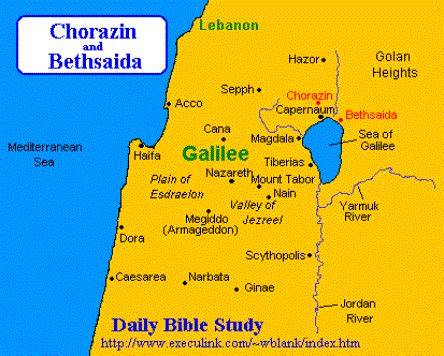
Chorazin and Bethsaida are contrasted with Tyre and Sidon. Jesus declares that the pagan cities would have responded with repentance if they had seen the same mighty works. Sackcloth and ashes represent the depth of the repentance that Jesus says would have occurred.
And thou, Capernaum, which art exalted unto heaven, shalt be brought down to hell: for if the mighty works, which have been done in thee, had been done in Sodom, it would have remained until this day.
But I say unto you, That it shall be more tolerable for the land of Sodom in the day of judgment, than for thee.
Capernaum is described as exalted because of the extraordinary privilege it received through Jesus’ ministry. Its failure to repent brings a severe warning. Jesus compares its accountability with that of Sodom and declares that the judgment will be more tolerable for Sodom than for the city that witnessed His works without repentance.
Matthew’s presentation of judgment is connected with the response to revealed truth. The cities are not condemned merely for having heard a report about Jesus; they are rebuked because His mighty works were done among them and they did not repent.
Matthew 11:25-27 - The Father revealed in the Son
At that time Jesus answered and said, I thank thee, O Father, Lord of heaven and earth, because thou hast hid these things from the wise and prudent, and hast revealed them unto babes.
Even so, Father: for so it seemed good in thy sight.
After speaking about the cities that rejected His works, Jesus turns to the Father in thanksgiving. The things of God are not received through human wisdom and intellectual pride alone. They are revealed to those represented as “babes,” emphasizing humility and dependence.
All things are delivered unto me of my Father: and no man knoweth the Son, but the Father; neither knoweth any man the Father, save the Son, and he to whomsoever the Son will reveal him.
This passage presents the unique relationship between the Father and the Son. The Son possesses authority received from the Father, and the Father is known through the Son and through those to whom the Son reveals Him.
Matthew’s Gospel emphasizes Jesus’ authority and His identity as the Messiah. It also gives a universal outlook: although Matthew’s Gospel is Jewish, it has a universal outlook.
The knowledge of the Father offered through the Son is therefore central to the chapter’s movement. Matthew 11 begins with a question about whether Jesus is the One who should come and reaches its theological center in the Son’s unique knowledge of the Father.
Matthew 11:28-30 - Christ’s invitation to the weary
Come unto me, all ye that labour and are heavy laden, and I will give you rest.
This is a direct invitation from Jesus to all who labor and are heavy laden. The promise is not merely instruction about rest but the personal promise, “I will give you rest.”
Take my yoke upon you, and learn of me; for I am meek and lowly in heart: and ye shall find rest unto your souls.
Jesus calls people to come to Him, take His yoke, and learn from Him. His authority is joined to meekness and lowliness of heart. The result is rest for the soul.
For my yoke is easy, and my burden is light.
The final verse explains the character of Christ’s yoke and burden. Jesus does not describe discipleship as the absence of obedience; He calls people to take His yoke and learn from Him. Yet the yoke is easy and the burden is light because it is received from the gentle and humble Savior.
| Theme | Matthew 11 KJV emphasis |
|---|---|
| Christ’s identity | His works answer John’s question about “he that should come” |
| John’s ministry | John is a prophet and more than a prophet |
| Prophetic fulfillment | John is the messenger who prepares Christ’s way |
| Human response | The generation rejects both John and the Son of man |
| Repentance | The cities are rebuked because they repented not |
| Divine revelation | The Father is revealed through the Son |
| Rest for the soul | Jesus invites the laboring and heavy laden to come to Him |
The place of Matthew 11 in the Gospel
Jesus' Ministry in Galilee (4:12 -- 14:12). The Beginning of the Galilean Campaign (4:12-25). The Sermon on the Mount (chs. 5-7). A Collection of Miracles (chs. 8-9). The Commissioning of the 12 Apostles (ch. 10). Ministry throughout Galilee (chs. 11-12).
Matthew 11 belongs to the section describing Jesus’ ministry in Galilee and follows the commissioning of the twelve apostles. Jesus has finished commanding His disciples, but His own teaching and preaching continue in the cities.
The narrative sections, in each case, appropriately lead up to the discourses. The Gospel has a fitting prologue (chs. 1-2) and a challenging epilogue (28:16-20).
Matthew’s arrangement places the chapter within a larger pattern of teaching, preaching, miracles, responses, and opposition. Matthew 11 brings these elements together through John’s question, Jesus’ works, the reaction of the cities, and the invitation to come to Him.
Key KJV phrases in Matthew 11
- “Art thou he that should come, or do we look for another?” - John’s question about the identity of Jesus.
- “Go and shew John again those things which ye do hear and see.” - Jesus’ answer through the evidence of His works.
- “And blessed is he, whosoever shall not be offended in me.” - A call to remain faithful to Christ.
- “A prophet? yea, I say unto you, and more than a prophet.” - Jesus’ testimony concerning John.
- “Because they repented not.” - The reason for the rebuke of the cities.
- “All things are delivered unto me of my Father.” - The authority and unique relationship of the Son.
- “Come unto me, all ye that labour and are heavy laden.” - Christ’s invitation to the weary.
- “For my yoke is easy, and my burden is light.” - The character of life under Christ’s teaching.
Matthew chapter 11 KJV therefore holds together the evidence of Jesus’ messianic works, the prophetic importance of John the Baptist, the responsibility of those who witness divine revelation, the uniqueness of the Son’s relationship with the Father, and the promise of rest to those who come to Christ.