The four Advent candles in the Catholic Church represent the four Sundays of Advent and symbolize hope, peace, joy, and love as Christians prepare for the birth of Jesus Christ. Three candles are traditionally purple, while the third candle is rose-colored and is lit on Gaudete Sunday.
Each week, one additional candle is lit, so the growing light represents the increasing anticipation of Christ’s coming. Some Advent wreaths also include a fifth, central white candle called the Christ Candle, which is lit on Christmas Eve or Christmas Day to symbolize Jesus, the Light of the World.
What Advent Means in the Catholic Church
Advent comes from the Latin “ad + venire,” which means, essentially, “to come to” or “to come toward.” “Ad + venire” is the root of the Latin “adventus,” which means “arrival.”
So Advent is the season of arrival: the arrival of Christ in our hearts, in the world, and into God’s extraordinary plan for our salvation. Advent is the time in which we prepare for Christmas, the memorial of Jesus Christ being born into the world.
Advent is a season in the Church’s life intended to renew the experience of waiting and longing for the Messiah. Though Christ has already come into the world, the Church invites us to renew our desire for the Lord more deeply in our lives and to renew our desire for Christ’s triumphant second coming into the world.
Preparations are practical, like decorating trees and gift giving, but they’re also intended to be spiritual. During Advent, we’re invited to enter more frequently into silence, into prayer and reflection, into Scripture, and into the sacramental life of the Church - all to prepare for celebrating Christmas.
The Church’s feasts and celebrations run on a yearlong cycle, which we call the “liturgical year.” The “liturgical year” starts on the first Sunday of Advent.
Advent starts four Sundays before Christmas. But because Christmas is on a fixed date and could fall on different days of the week, Advent can be as short as three weeks and a day or as long as four weeks.
What Is an Advent Wreath?
The Advent wreath is one of the most symbolic traditions for the season of Advent. With its colorful candles lit on each of the four weeks of Advent, the wreath is a reminder of the hope and joy coming.
The Catholic Advent wreath is a cherished tradition observed during the weeks leading up to Christmas. The Advent wreath serves as a spiritual compass on our journey in preparation for the nativity of our Lord.
Advent wreaths are not exclusive to churches; many families and individuals have an Advent wreath at home and observe the tradition of lighting the candles for each Sunday. In parishes, Advent wreaths are placed anywhere on the altar, on a side table, or even hung from the ceiling.
In the home, you might place your Advent wreath on an entry or dining table or another location where you, your family, and your guests can enjoy the wreath during the Advent season.
The Symbolism of the Advent Wreath
The Circular Shape
The circular shape of the wreath represents God’s eternal love - without beginning or end. The circular shape of the Advent wreath symbolizes God’s infinite love for us - it is never-ending, just like the true Light of the World, Jesus, who leads us into eternal life with Him.
It also represents eternal life which becomes ours through faith in Jesus Christ. The circular nature of the Advent wreath, similar to a wedding ring or band, is further meant to reflect the unending love of Christ and eternal life offered through salvation.
The Evergreen Branches
The evergreen branches signify hope and everlasting life. Evergreen branches, which do not lose their leaves in winter, represent the everlasting life found in Christ.
They are a symbol of hope and renewal, pointing to the promise of eternal life through Jesus. The materials of the Advent wreath similarly lead us to reflect on the everlasting nature of God; traditionally, Advent wreaths have been made of evergreen leaves, such as pine or fir, which maintain their green color beyond the season in which they are collected.
The Growing Light
Lighting the candles each week is a simple but powerful way to mark time during Advent, especially in homes, dorms, and small-group settings. Each week, an additional candle is lit to symbolize the increasing anticipation and preparation for the arrival of Jesus.
The light from the candles represents the light of Christ coming into the world. Lighting candles as we prepare for Christmas reminds us that Christ is the light of the world.
Advent candles readily demonstrate the strong contrast between darkness and light, which is an important biblical image. Jesus referred to himself as the “Light of the World” that dispels the darkness of sin: “I am the light of the world. Whoever follows me will never walk in darkness but will have the light of life” (John 8:12).
As the Messiah's “Advent” or “coming” draws nearer another candle is lit, with each candle dispelling the darkness a little more. Thus, the Advent wreath helps us to spiritually contemplate the great drama of salvation history that surrounds the birth of God Incarnate, who comes to redeem the human race and make all things new (Rev. 21:5).
It also reminds us that, as Christians, we're meant to shine the light of Christ in this world. As Jesus tells us, You are the light of the world . let your light shine before others, so that they may see your good works and give glory to your Father in heaven. (Matthew 5:14-16)
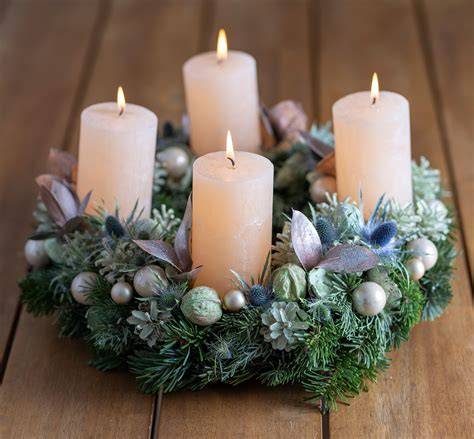
Why Are There Four Advent Candles?
There are four candles on the Advent wreath. Three are purple and lit on the first, second, and fourth Sundays of Advent. The pink candle is lit on the third Sunday of Advent, which we call Gaudete Sunday.
The four Advent wreath candles are the hallmark feature of the Advent wreath: three purple and one rose-colored. Each represents a special virtue that God prompts us to cultivate during the Roman Catholic Advent season.
The four candles of Advent represent the four Sundays of Advent, and they respectively symbolize hope, peace, joy, and love.
Each candle represents 1,000 years. Added together, the four candles symbolize the 4,000 years that humanity waited for the world's Savior-from Adam and Eve to Jesus, whose birth was foretold in the Old Testament.
Advent Candle Colors
The color of these candles can vary, but it is common for the first, second, and fourth candles to be purple, while the third is rose-colored, red, or a pinkish hue. In some cases, all the candles are red, blue, or white.
| Advent candle | Traditional color | Theme | Traditional name |
|---|---|---|---|
| First candle | Purple | Hope | Prophecy Candle |
| Second candle | Purple | Peace | Bethlehem Candle |
| Third candle | Rose or pink | Joy | Shepherd’s Candle |
| Fourth candle | Purple | Love | Angel’s Candle |
| Central candle, when present | White | Christ | Christ Candle |
Why Are Three Candles Purple?
Violet is a liturgical color that is used to signify a time of prayer, penance, and sacrifice and is used during Advent and Lent. Purple is the primary color associated with Advent.
Within the Catholic Church it symbolizes penance, preparation, and sacrifice. Advent, also called “little Lent,” is the season where we spiritually wait in our “darkness” with hopeful expectation for our promised redemption, just as the whole world did before Christ’s birth, and just as the whole world does now as we eagerly await his promised return.
The three purple candles are sometimes said to represent prayer, fasting, and almsgiving - the three spiritual disciplines that are key to a fruitful Advent.
Why Is the Third Candle Rose-Colored?
The third Sunday of Advent is called Gaudete Sunday, from the Latin word “rejoice.” The rose-colored candle reminds us that Christ’s coming is near and that joy - not anxiety - is the true mark of a heart prepared for Him.
Gaudete is a word that means “rejoice,” and we rejoice on Gaudete Sunday because we are halfway through Advent. Rose is a liturgical color that is used to signify joy, so we light the single pink candle on the third Sunday of Advent.
On that Sunday, in addition to the pink candle, the priest wears a pink vestment, which he might refer to as “rose.” In a departure from the usual purple vestments, priests wear a rose-colored one at this Sunday’s Mass, and rose, or pink, is also the color of the Shepherd’s Candle.
The Four Advent Candles and Their Meanings
The First Candle: Hope
The first candle is purple, representing hope. It reminds us of the unwavering hope we hold within us as we await the arrival of our savior.
The first Sunday of Advent begins with hope - the longing for the promised Messiah. This candle reminds us that God keeps His promises and that Christ is our ultimate hope, even when the world feels dark or uncertain.
Also known as the “Prophecy Candle” in memory of the prophets, particularly Isaiah, who prophesied the birth of Christ, it symbolizes the anticipation felt in awaiting the coming Messiah.
The first candle, the Hope Candle, symbolizes the hope of God's people as they awaited the arrival of the Messiah, who would bring salvation, redemption, and the fulfillment of God's promises.
It represents the hope that Jesus' birth would bring light to a world shrouded in darkness and despair. The first candle harkens us back to Isaiah’s foretelling of the birth of Christ and all of the promises God gave us in the Old Testament that would be fulfilled by the birth of Jesus.
Sometimes called the “Prophecy Candle,” the first candle points to the long-expected Savior. The first candle also leads us to anticipate the birth of Christ and celebrate the beginning of a new liturgical season.
Purple is a liturgical color that symbolizes penance, preparation, and royalty. It serves as a reminder of the need for repentance and readiness for the coming of the Messiah, who is the King of Kings.
During the lighting of the first candle, it is common to read scriptures and passages from the Bible that emphasize the theme of hope, such as prophecies from the Old Testament about the coming of the Messiah, like Isaiah 9:2-7 or Isaiah 60:1-3.
The lighting of the Hope Candle in the Advent wreath is an opportunity for individuals and families to reflect on the concept of hope in their own lives. It is a time to consider the hope found in the promise of salvation through Jesus and how that hope can bring joy and comfort during challenging times.
The first Sunday of Advent symbolizes Hope with the “Prophet’s Candle” reminding us that Jesus is coming.
Prayer for the First Candle
“O God, as we light the first candle of this Advent wreath, we open our hearts in hope. May the light of this candle remind us of the hope we have in you. May it inspire us to prepare our hearts and minds for the coming of your Son, Jesus Christ, our hope and our Savior. Amen.”
The Second Candle: Peace
The second candle is also purple, signifying peace. It calls us to seek inner peace and also to spread peace to those around us.
The second candle represents peace - not just the absence of conflict, but the deep, abiding peace that comes from trusting God. It calls us to prepare the way of the Lord by creating space for peace in our hearts and relationships.
Also known as the “Bethlehem Candle,” the second Advent candle reminds us of Mary and Joseph’s journey from Nazareth to Bethlehem before Mary gave birth to Jesus.
The Peace Candle symbolizes the peace that Jesus Christ brings to the world. It represents the fulfillment of the Old Testament prophecies of a Messiah who would be the Prince of Peace (Isaiah 9:6).
It reminds us that through the birth of Jesus, humanity can find reconciliation with God and experience inner peace. Building on the meaning of the Prophecy Candle, this second candle recalls that after all of the division, destruction, and dispersion of the kingdom in the Old Testament, there might finally be peace on Earth - Jesus is coming, and so is his Kingdom of Peace.
The second Sunday of Advent symbolizes Faith with the purple Bethlehem Candle, reminding us of Mary and Joseph’s journey to the city where Jesus would be born.
Sometimes the second week's candle is used to symbolize faith. The second week of Advent also invites Christians to reflect on their lives and focus on becoming better-versions-of-themselves in preparation for Jesus’ coming.
During the lighting of the Peace Candle, appropriate Bible verses that emphasize peace and reconciliation may be read, such as Isaiah 9:6, Luke 2:14, or John 14:27.
Prayer for the Second Candle
“Gracious God, as we light the second candle of this Advent wreath, we seek your peace. In a world filled with turmoil, may the light of this candle remind us of the peace that only you can bring. Help us to be instruments of your peace in our homes, communities, and the world. Amen.”
The Third Candle: Joy
The third candle is rose-colored, embodying joy. Lit on Gaudete Sunday, it serves as a reminder to rejoice that the coming of Christ is near.
The third Sunday of Advent is called Gaudete Sunday, from the Latin word “rejoice.” The third candle of Advent symbolizes Joy.
The third candle is pink and represents joy. This candle is pink because the rose color represents joy, also known as the “Shepherd’s Candle.”
The third Sunday of Advent is meant to remind us of the world's joy at the birth of Jesus and that the faithful have arrived at the midpoint of Advent. The third week of Advent is often known as “Gaudete Sunday,” derived from the Latin word “gaudete,” which means “rejoice.”
It is a time of rejoicing and heightened anticipation as Christmas draws nearer. On this third Sunday of Advent, which the Church calls “Gaudete Sunday,” meaning rejoice or praise, we light the third candle and rejoice like the shepherds.
The Joy Candle represents the joy that filled the hearts of the shepherds who received the news of Jesus' birth from the angels. It signifies the happiness and excitement of the world as it receives the long-awaited Messiah.
The third candle takes us back to the joyful anticipation of the shepherds who journeyed to see Jesus in Bethlehem, even before the wise men. The rose-colored candle reminds us that Christ’s coming is near and that joy - not anxiety - is the true mark of a heart prepared for Him.
For this reason, the third candle of Advent is called the “Shepherd’s Candle,” and its color is pink, the liturgical color for joy.
During the lighting of the Joy Candle, passages from the Bible that emphasize joy and rejoicing may be read, such as Luke 2:10-11, which describes the angelic announcement to the shepherds.
Some people have the custom of throwing Gaudete parties, and this is also a day on which Christmas carolers may begin caroling door to door.
Prayer for the Third Candle
“Loving God, as we light the third candle of this Advent wreath, we rejoice in your presence. May the light of this candle fill our hearts with the joy of your salvation. Help us to share this joy with others, spreading your love and happiness to all we encounter. Amen.”
The Fourth Candle: Love
The fourth candle, purple like the first two, represents love. It symbolizes the boundless love of God, which we are called to share with others.
The final candle symbolizes love - the love of God made visible in the Incarnation. As we approach Christmas, this candle invites us to reflect on the perfect love that entered the world in Christ, born in a humble manger.
The fourth candle of Advent represents Love, the ultimate love of God that He might send His only Son for us. Called the “Angel’s Candle,” the fourth candle is lit the Sunday before Christmas, and it is the color purple.
It reminds us of the angels' message: “Peace on Earth, Good Will Toward Men” (Luke 2:14). The fourth Sunday of Advent emphasizes the incomparable peace that our Divine Savior brings (see Isa. 9:6; John 14:27), and which the purple Angel’s Candle heralds (see Luke 2:13-14).
During this final week of Advent we rejoice in the endless love that God has for us, which is made apparent in the birth of his Son. We reflect on the good news of God's love brought to us from the angel Gabriel.
During the lighting of the Love Candle, passages from the Bible that emphasize love, such as John 3:16-17 or 1 John 4:9-11, may be read. These verses highlight God's love for humanity and the call for believers to love one another.
Prayer for the Fourth Candle
“Heavenly Father, as we light the fourth candle of this Advent wreath, we are reminded of your boundless love. May the light of this candle shine forth as a symbol of the love you have shown us through your Son, Jesus Christ. Fill our hearts with your love, and help us to love one another as you have loved us. Amen.”
The Optional Fifth Candle: The Christ Candle
Some Advent wreaths include a fifth candle, placed in the center. This white candle is lit on Christmas Eve or Christmas Day to celebrate the birth of Jesus - the Light of the World who fulfills every Advent longing.
A fifth central white candle, the Christ candle, is sometimes lit on Christmas Day to represent the life of Christ. When added to the Advent wreath, this candle is typically white and larger than the other candles and is placed in the center of the wreath.
The central Christ Candle symbolizes purity and the birth of Jesus, the Light of the World. Any large white candle can be used for the Christ candle. The idea is to decorate it with symbols of Jesus.
The candle can be lit on Christmas Eve to show that the Light of the World has arrived. Then you can continue to light the Christ candle throughout the year at Sunday dinner, reminding you and your family that we await the Second Coming of Jesus, as well as for celebrating now his birth and Resurrection.
The Names of the Advent Candles
The names given to the candles can vary among Catholic homes, parishes, and devotional traditions. The first candle is commonly called the Prophecy Candle, the second the Bethlehem Candle, the third the Shepherd’s Candle, and the fourth the Angel’s Candle.
| Candle | Alternative name | Meaning |
|---|---|---|
| First candle | Prophecy Candle | Hope and the prophecies of Christ’s coming |
| Second candle | Bethlehem Candle | Peace and Mary and Joseph’s journey |
| Third candle | Shepherd’s Candle | Joy and the shepherds’ rejoicing |
| Fourth candle | Angel’s Candle | Love and the angels’ message |
Traditionally, each of the four Advent candles have a deeper meaning which is depicted in the lovely Four Weeks of Advent Pewter Wreath: The 1st Sunday of Advent symbolizes Hope with the “Prophet’s Candle” reminding us that Jesus is coming.
The 2nd Sunday of Advent symbolizes Faith with the “Bethlehem Candle” reminding us of Mary and Joseph’s journey to Bethlehem. The 3rd Sunday of Advent symbolizes Joy with the “Shepherd’s Candle” reminding us of the Joy the world experienced at the coming birth of Jesus.
The 4th Sunday of Advent symbolizes Peace with the “Angel’s Candle” reminding us of the message of the angels: “Peace on Earth, Good Will Toward Men.”
How the Advent Candle Meanings Are Used in Prayer
During Advent, Catholics traditionally light the wreath at the start of their prayers, using it as a focal point for meditation on the season’s meaning.
Set aside a specific time each week to light the Advent wreath candles and pray, either before or after dinner or as part of your existing prayer routine. Once you have taken a moment to enter into prayer, contemplate the significance of each candle’s theme.
You can also incorporate specific Catholic Advent wreath prayers during this time, including the Blessing of the Advent Wreath, Advent reflections or that Sunday’s Scripture readings.
In most traditions, the lighting of the four advent candles, or multiple candles, is meant to be done as a family and will often be used to reflect on the hope, faith, joy, peace, light, and purity that came into the world with the gift of the Messiah.
Families will typically light the candle together, often encouraging children to participate in the celebration. Many modern churches light an Advent candle during Sunday services to prepare for Christmas as a church family.
A Catholic Blessing of the Advent Wreath
Pray this blessing from the United States Conference of Catholic Bishops the night before or on the first Sunday of Advent in your home.
- Make the Sign of the Cross.
- Say, “Our help is in the name of the Lord, who made heaven and earth.”
- Then, read Scripture from the Book of Isaiah.
The USCCB points us toward Isaiah 9, Isaiah 63, or Isaiah 64.
“Lord our God, we praise you for your Son, Jesus Christ: He is Emmanuel, the hope of the peoples, He is the wisdom that teaches and guides us, He is the Savior of every nation. Lord God, let your blessing come upon us as we light the candles of this wreath. May the wreath and its light be a sign of Christ’s promise to bring us salvation. May He come quickly and not delay. We ask this through Christ our Lord. Amen.”
A Simple Weekly Prayer
Here is one prayer given for the First Sunday of Advent in the same book just mentioned, The Essential Advent and Christmas Handbook:
Parent: Lord, you are the light of our world. Children: O Come, O Come, Emmanuel.
Parent: O gracious God of promise, we prepare to worship together as we await the fulfillment of your wondrous plan. Help us to grow as we hear your Word and live in your love. Children: O Come, O Come, Emmanuel.
Parent: May the light of your love always shine in our hearts. Children: Amen.
How to Use Advent Candles at Home
You don’t need to be at home for Advent to make it meaningful. Whether you’re in a dorm, an apartment, or a mission post, there are simple ways to make the Advent candles part of your prayer life.
- Set up a small wreath with battery candles or tealights if open flames aren’t allowed.
- Light one candle each week and read the Sunday Gospel or a reflection together.
- Pray as a community: “Come, Lord Jesus.”
- Reflect on the theme - hope, peace, joy, or love - and how it applies to your mission, relationships, and prayer.
- Add music or Scripture: Sing “O Come, O Come, Emmanuel” or read Isaiah’s prophecies of the Messiah.
Each person or family might approach lighting Advent candles in a different way, which is totally okay. Some families will let different members light a candle each week and say a prayer.
What matters most is that the candles remind you of the overflowing hope, peace, joy, and love that the birth of Jesus means for each of us.
Additional Symbolism in the Wreath
You can festively decorate your Advent Wreath with other natural materials that traditionally carry their own Christian symbolism.
The use of evergreens reminds us of our eternal life with Christ; pointy holly leaves and berries represents the crown of thorns from the Passion of Jesus and his Precious Blood; and pine cones symbolize Christ’s Resurrection.
Holly leaves can be prickly and, therefore, used to represent the crown of thorns placed on Jesus’s head during his crucifixion. Berries, which are typically red, also point to Christ’s sacrifice and the bloodshed for sins.
Pinecones, seeds, and nuts are also placed within the wreath as a symbol and promise of new life. Together, the elements of the Advent wreath reflect the new life and eternal salvation offered through the death and resurrection of Jesus Christ, who we now celebrate.
The History of the Advent Wreath
The Catholic Church has been using Advent wreaths since the Middle Ages. The origin of the Advent wreath has been traced back to Germany, though the exact dates are unknown.
The origin of the Advent wreath dates back to pre-Christian Germanic cultures, where lighting candles during the winter solstice honored the return of the light. Historians have suggested that pre-Christian Germanic peoples would light candles around wreaths in the dark winter months in anticipation of the warmer, lighter months in springtime.
It is definitely true that Germanic people were lighting up candle wreaths in wintertime long before the Gospel arrived in their homeland. They did so because candle wreaths in winter are beautiful and warm.
This tradition likely evolved into an “Advent wreath” at some point during the Middle Ages, transforming the pagan tradition into a Christian one. Christians adopted this practice in the Middle Ages to mark the season of Advent.
That a Christian symbol emerged from that tradition is an indication that the Gospel can be expressed through the language, customs, and symbols of cultures that come to believe that Christ Jesus is Lord.
By 1600, both Catholics and Lutherans had more formal practices surrounding the Advent wreath. Ultimately, the Advent wreath tradition spread beyond Germany and into other areas of the world, namely throughout the western Church.
The 1839 Advent Wreath Tradition
As the story goes, in 1839, a Lutheran minister working at a children’s mission in Germany created a wreath out of the wheel of a cart.
The minister placed 20 small red candles out of the wheel's outer ring and four larger white candles inside the ring, lighting the red candles on weekdays and the four white candles on Sundays as a way for the children to count down the days until Christmas.
Advent wreaths were eventually fashioned out of evergreens, twisted together in a circle to symbolize continuous life across the seasons, from the death of winter to the new life of spring.
Naturally, this earthly symbolism also points to the spiritual symbolism of newness and the promise of eternal life and salvation offered through the sacrifice of Jesus Christ (John 3:16).
Why the Advent Candles Matter
Each week, as the light grows brighter, we’re reminded that Christ’s coming is near. The darkness doesn’t last forever - hope, peace, joy, and love increase as we move closer to the birth of Jesus.
For students and missionaries, Advent candles are a simple but profound reminder that God is still at work in the waiting. The light grows - not because we make it happen, but because He comes to us.
Human history spanned long ages shrouded in the darkness of sin before our prophesied Savior would finally make his appearance to free us from its dominion. The Advent wreath helps us to spiritually contemplate the great drama of salvation history that surrounds the birth of God Incarnate, who comes to redeem the human race and make all things new.
In Advent, we prepare our homes and churches as we joyfully anticipate His arrival, and the light also gets brighter as we near Christmas day, the day on which the Light of the World was born.
Advent is a journey towards Bethlehem. May we let ourselves be drawn by the light of God made man.
✝️😇 What's An Advent Wreath And Why Is It Important?
During Advent, we prepare for His coming - He who brought Light into the darkness - for four weeks, represented by the four candles around the Advent wreath.
Jesus said, “I am the light of the world; he who follows me will not walk in darkness, but will have the light of life.” There is plenty of darkness in this world. It seems to get closer every day.
How we decide to deal with the darkness in our lives, in the world, and in our own souls is a life-defining decision. Jesus is the light of the world…and he calls us to bring his light to the world.