Our Lady of Mount Carmel basilicas and churches embody a Catholic devotion rooted in Mount Carmel, the Prophet Elijah, the Carmelite Order and centuries of Marian faith. Their importance is expressed through worship, the Brown Scapular, artistic traditions, historic buildings and the communities that have gathered under Mary’s protection.
The most architecturally distinctive example described here is the Basilica of Our Lady of Mount Carmel in Valletta, Malta, while the historic church in Denver demonstrates how the same devotion became the cultural and spiritual center of an Italian-American community. Together, these buildings show how Our Lady of Mount Carmel has shaped religious life, architecture, migration history and local identity.
Origins of the devotion to Our Lady of Mount Carmel
The story of Our Lady of Mount Carmel begins with the Prophet Elijah on Mount Carmel in present-day Israel. It was here that Elijah won a miraculous victory over the prophets of Baal, demonstrating the power of the one true God (1 Kings 18:20-40). This site would later become associated with Christian hermits in the 12th century, who dedicated the first chapel to the Blessed Virgin Mary.
Thus, Mount Carmel became a symbol of Marian devotion, rooted in biblical history and nurtured through Christian tradition. The Order of the Brothers of Our Lady of Mount Carmel, commonly known as the Carmelites, formally emerged in the 12th century among these hermits.
The Catholic Church entrusts the Carmelites with preserving the Marian devotion associated with Mount Carmel, which is expressed most vividly through the Brown Scapular. Legend tells us of a pivotal moment in 1251 when Saint Simon Stock received the Scapular from the Virgin Mary, a visible sign of her protection and a call to holiness.
As a sacramental, the Scapular serves not only as a symbol of devotion to Our Lady but also as a constant reminder to lead a life honoring Jesus Christ. By partaking in the Scapular devotion, Catholics worldwide join an unbroken chain of faith, stretching back to the very inception of the Church.
The Feast of Our Lady of Mount Carmel
The Catholic Church celebrates the Feast of Our Lady of Mount Carmel on July 16 each year. This day invites the faithful to reflect on the purity and love of the Virgin Mary while renewing their own dedication to Christian life.
It emerges as a day steeped in gratitude and devotion, commemorating the unity formed under the mantle of Our Lady-like a spiritual anchorage that steadies the storm-tossed soul. The origins of this feast can be traced back to a 14th-century event where the Carmelites, sailing to France, were caught in tumultuous weather.
Invoking Mary's name, they found the seas calmed-a miracle that solidified July 16 as a day of remembrance and celebration in honor of Our Lady's intercession. The miracles attributed to Our Lady of Mount Carmel abound like stars in a night sky, illuminating the paths of many who seek her intercession.
The Carmelite tradition and the Brown Scapular
Legend tells us of a pivotal moment in 1251 when Saint Simon Stock received the Scapular from the Virgin Mary, a visible sign of her protection and a call to holiness. Acknowledging this profound history, Pope Sixtus V officially approved the Brigitine Formula of the Scapular, reinforcing its spiritual significance to Catholics.
Pope Leo XIII was a staunch supporter of the Scapular devotion, recognizing its role in fostering holiness and Christian virtue. This papal seal of endorsement doesn't just indicate approval; it is a testament to how deeply entrenched Marian devotion is within the fabric of Catholicism.
The painting's artist and origins are unknown, but it is believed to date back to at least the late 16th or early 17th centuries and some attribute it to Filippo Paladini. The painting depicts the Virgin Mary holding the infant Jesus and the brown scapular, which is a symbol of the Carmelite Order.
The Basilica of Our Lady of Mount Carmel in Valletta
The Basilica of Our Lady of Mount Carmel, located in Valletta, is a significant symbol of the island's religious and architectural legacy. This Catholic basilica, belonging to the Carmelite order, honors Our Lady of Mount Carmel and occupies a prominent position within Valletta's UNESCO World Heritage Site, emphasizing its importance among the city's numerous churches.
The current Basilica of Our Lady of Mount Carmel constructed in Limestone in neoclassic style, was built between 1958 and 1981 on the site of a previous church severely damaged during World War II. Built on the site of a 16th-century church destroyed during World War II, the present-day basilica was constructed between 1958 and 1981, following the design of Maltese architect Joseph Damato.
A church was first constructed on the site in 1566 by the Carmelite Order, a Roman Catholic order for men and women, which probably had its origin in the Middle East in the 12th century. The church was built on land given to the order by the Knight Hospitaller shortly after the city's founding in 1566.
Between the 16th and 18th centuries, numerous Hospitaller knights donated money, property, or artworks to the Carmelite friars, and one such knight, Girolamo de Fosses, paid for the construction of a chapel dedicated to Our Lady of Pilar within the church.
The church and the Knights Hospitaller
The church was patronised by the Hospitaller knights from the German langue (an administrative division) who were based nearby and did not have their own dedicated church. That church was constructed in 1566 by the Carmelite Order on land given to it by the Knight Hospitaller shortly after the city's founding in 1566 and was used by the knights from the German langue.
A new façade was constructed in 1852 and a number of internal alterations were also made at that time. The church's altarpiece was crowned on 15 July 1881, and on 6 April 1886, the church was consecrated.
It was given the status of minor basilica on 13 May 1895 by Pope Leo XIII who was pope between 1878-1903. This is marked by the umbraculum, which is a historic piece of the papal regalia and insignia, resembling an umbrella, with yellow and red panels.
This was once used daily to provide shade for the pope. This can be seen at the far end of the nave on the left side of the high altar. The church of Our Lady of Mount Carmel is listed on the National Inventory of the Cultural Property of the Maltese Islands.
World War II and reconstruction
On 4 March 1942, during World War II, the church was bombed and suffered serious damage causing the loss of several artistic and historic objects, although much of the church's contents survived.
It was decided by the Carmelite friars to demolish the ruined building and replace it with a new church and to incorporate many of the previous churchs items into the new building. The current church, the Basilica of Our Lady of Mount Carmel, was constructed between 1958 and 1981 on the same site.
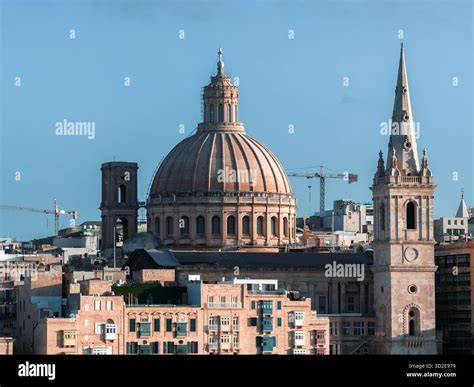
The reconstruction preserved the site's Carmelite identity while creating a new architectural landmark for Valletta. The church's dome, intended to surpass the height of the nearby Anglican Saint Paul's Pro-Cathedral bell tower, reflects a competitive aspect in its architectural ambition, contributing to Valletta's recognizable skyline.
Architecture of the Valletta basilica
Constructed in Limestone in neoclassic style, the church has a large, 42 m (138 ft) high oval dome. The 20th-century reconstruction adopts Neoclassical architecture, featuring an impressive oval dome that dominates the skyline.
Internally, the church has an interior with a length of 150 ft (46 m) and a width of 50 ft (15 m), with a wide nave. Around the perimeter are several lateral chapels with a total of ten altars and columns of red marble.
At the eastern end of the nave is the high altar made of white marble and decorated with gold leaf. It is surrounded by a balustrade made of gilded bronze. Inside, red marble columns add to the grandeur and solemnity of the space.
A niche with a statue of Our Lady of Mount Carmel is located on the church's exterior, at the corner of Old Theatre and Old Mint Streets. The statue was sculpted by Salvatore Dimech in 1855.
Originally, the 16th-century church had a wide nave, lateral chapels, a modest dome, and a bell tower adorned with frescoes. The current building therefore combines the historical memory of the earlier church with the monumental scale of the postwar basilica.
The dome and Valletta’s skyline
The church's dome, intended to surpass the height of the nearby Anglican Saint Paul's Pro-Cathedral bell tower, reflects a competitive aspect in its architectural ambition, contributing to Valletta's recognizable skyline. The impressive oval dome is both a visual landmark and an architectural expression of the basilica's prominence within the city.
The Basilica of Our Lady of Mount Carmel occupies a prominent position within Valletta's UNESCO World Heritage Site, emphasizing its importance among the city's numerous churches. Its limestone construction and Neoclassical form connect it to Malta's broader architectural heritage.
Artworks and devotional objects
Dedicated to Our Lady of Mount Carmel, the altar features a painting of Our Lady of Mount Carmel, created by the Maltese artist Giuseppe Calì. The painting's artist and origins are unknown, but it is believed to date back to at least the late 16th or early 17th centuries and some attribute it to Filippo Paladini.
The painting depicts the Virgin Mary holding the infant Jesus and the brown scapular, which is a symbol of the Carmelite Order. Some sources state that the work was acquired by the Carmelites from Sicily at the time of the first church's construction.
The painting has undergone restorations, by Paul Cuschieri in 1856, Samwel Bugeja in 1978, and Godwin Cutajar in the 21st century. The restoration history reflects the continuing care given to the basilica's religious and artistic heritage.
A wooden statue located within a niche is of Our Lady of Mount Carmel. This was sculpted in Naples and stands on a silver pedestal designed by Abram Gatt. This was restored by Publius Magro in the 21st century.
The interior also contains several statues. Also contained within the church are several tombstones which survived the destruction of the church in World War II and were fixed to the walls when it was reconstructed.
These include several tombs of Hospitaller knights. The church also contains “Beato Franco” by Maria de Dominici from the 1670s, adding to its artistic and spiritual treasures.
Our Lady of Mount Carmel Church in Denver
Our Lady of Mount Carmel Church, also known as Mount Carmel Italian Catholic Church, was built between 1899 and 1904. Designed by architect Frederick W. Paroth and constructed by contractor Frank Kirchoff, the church became a defining landmark of North Denver's Italian community.
The red and cream-colored brick Romanesque Revival church dominates the surrounding neighborhood, long acting as the ethnic enclave of Italian tradition. The building was listed as a Denver Landmark on August 29, 1977.
On April 3, 2017, the National Park Service designated Our Lady of Mount Carmel Catholic Church (built in 1904) to the National Register of Historic Places for its architectural and historical significance.
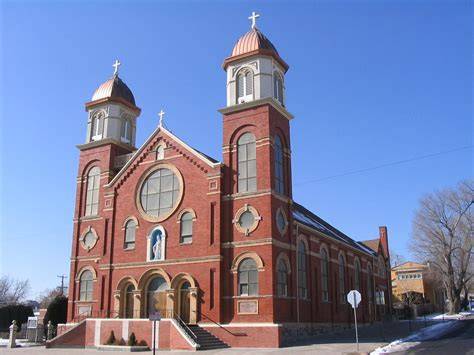
The large brick church, dominated by twin square towers with copper domes surmounted by white crosses and defined by a larger-than-life statue or Our lady of Mount Carmel, is “a fine example of the Romanesque Revival (architectural) style” that swept the United States in the late 19th century.
Romanesque Revival façade
Twin square towers dominate the two-and-a-half-story symmetrical red and cream-colored brick church façade with copper domes surmounted by white crosses. The rose window is reminiscent of an eight-petaled flower and is surrounded by cream-colored brick.
The central niche, flanked by two compass-head windows accented with cream-colored brick voussoirs (the wedge-shaped pieces forming a vault or arch) above a cream-colored brick string course, prominently features a white marble statue of Our Lady of Carmel housed in a Roman arch flanked by simple pilasters with capitals.
The niche is accented in white, in contrast to the cream and red of the rest of the façade, with a painted blue background for the statue (National Register of Historic Places Nomination Form). The central Roman-arch entrance is slightly larger than those flanking, which are divided from each other with simple pilasters with capitals.
Each features archivolts of compound arches. The main entrance or façade faces east, as is traditional in the Catholic faith, with the high altar thus at the west. The façade brick is laid in common bond.
The gable end features a large-scale dogtooth pattern, also known as nebule molding, and a central arched vent with a cream-colored voussoir and underlying cream-colored brick stringcourse.
The bell Maria del Carmelina
The 1000-pound bell, known as Maria del Caramelina, in the south tower rings even today: “Former city councilman Ernie Marranzino, whose family has lived in the house behind the church since the 1890s, calls Maria the ‘heartbeat’ of North Denver. ‘That bell regulates life here the way church bells did in the old country.’” (National Register of Historic Places Nomination Form)
Its sound represented more than a religious announcement. The bell was North Denver’s “heartbeat,” one immigrant son remembered regulating life in Denver “the way church bells did in the old country.”
Frederick W. Paroth and the church’s design
Architect Frederick William Paroth received his architectural training in Germany, arriving in the United States in 1882 and settling in Denver in 1889 at age 29. Paroth lived up to the claim he placed on his letterhead-”Fred W. Paroth, Architect and Superintendent…Catholic Institutions a Specialty.”
His first documented project was the two story brick and stone St. Elizabeth’s School in 1890 in Denver. In 1891, he was the architect and builder of St. Elizabeth’s Monastery and in 1896 was credited as the “builder” of St. Elizabeth’s Church in the Gothic Revival style with Romanesque influences.
St. Elizabeth’s Church and Monastery, on the Auraria campus in downtown Denver, is on the National Register of Historic Places and is also a designated Denver Landmark.
Denver’s Frederick William Paroth designed the new Our lady of Mount Carmel Church, Frank Kirchoff supervised its construction, and, on December 19, 1904, Bishop Nicholas Matz of the Archdiocese of Denver celebrated its Dedication Mass.
Romanesque architecture and Catholic meaning
In its architectural form - its domes, arches, elaborate murals and statuary, symmetrical bulk and majestic presence - Our Lady of Mount Carmel tells a story extending to ancient Rome. In the first decades after the death of Christ, practitioners of the early Catholic Church added the “Roman Arch” to the small scale of the ancient Greek Temple, allowing grand spaces to be spanned in a material reflection of the Church’s grand sweep; this same arch spans Our Lady of Mount Carmel’s entrance and defines its naves.
Upon the fourth century transfer of the seat of the Roman Empire from Rome to Byzantium, the dome entered Catholic architectural vernacular; we see echoes of Byzantium in Our Lady of Mount Carmel’s copper-topped domes.
By the 12th century, as the darkness of Europe’s Middle Ages lifted, church construction resumed in what became known as the Romanesque tradition: a conscious modeling of the grand public structures of ancient Rome and the early Church.
The Romanesque tradition is replete with iconography: with murals and statues that testify to God’s presence on earth and with the elaborate gilt embellishment that honors St. John’s directives that the “tower of Jerusalem shall be built up of jewels” (Roman Breviary, Reformed).
The interior of Our Lady of Mount Carmel is a jewel box. Finally, Catholic immigrant communities across the United States manifested their connection to the Old World, to Rome, and to the first Church with their revival of the Romanesque tradition, modified to incorporate local building materials: a modern Denver “accent” to an older, larger story.
This ancient story and the more-local and more-modern “brick city” accent are read in the architectural lines, the interior iconography, the doomed towers, the uplifted crosses, and the brick construction of Our lady of Mount Carmel Church.
The Italian-American community of North Denver
Why do you think Italian immigrants to Denver in the late 19th and early 20th centuries would have wanted to maintain their own familiar traditions? The area comprising Little Italy historically is now known as Highlands. It comprised the area between Broadway and Zuni Street and 46th and 32nd Avenues.
Settlement in this ethnic enclave was largely self-organized, but also spoke to historic discrimination experienced by the Italian-American community early in Colorado’s history: “Public intolerance toward the Italian population was harsh, particularly during economic recessions.
Arriving in Denver to work on the railroad and in the mines, the Italians were poorly paid, given menial jobs and often subjected to layoffs when cheaper labor was available.” (National Register of Historic Places Nomination Form)
Until the 1960’s, when Denver’s Italian Americans began their exodus from North Denver to the suburbs, the voice of the parish was exclusively Italian and the parishioners almost exclusively descended from southern Italy: the Mezzogiorno or “the land that time forgot.”
The braccianti, those defined by their strong braccia, strong arms, arrived first, seeking pane e lavoro, bread and work. They settled in “The Bottoms” along the South Platte River near the bustle of Union Station and the stench of the Stockyards and dedicated their first years in America to securing the funds to retrieve their parents, siblings, wives, and children from the poverty, overcrowding, limited life expectancy, and natural disasters that had long plagued southern Italy.
Mother Frances Cabrini - the Italian born founder of the Missionary Sisters of the Sacred Heart, first American to be canonized, an early patron of The Mount Carmel School and Queen of Heaven Orphanage, called to Denver to bring “the holy joys” to “our poor emigrants”- wrote that the hard work involved in building Denver and the American Wets “the hardest labour is reserved for the Italian worker” (Voyages (1906) qtd. In Cabrinian Colorado Missions, 9).
The Italian workers said simply “America è icci,” “this is America,” America is here” holding up their work-stained hands (qtd. In Gambino, Blood of my Blood, 84). Our Lady of Mount Carmel Church is a spectacular crowning testament to this hard work.
Founding of the parish church
The southern Italians had left an old country in which church and state were indistinguishable. The Catholic Church was the preeminent institution in their lives. Saints’ days and feast days marked the passage of a year.
Church rituals - births, baptisms, first communions, confirmations, graduations, marriages, funerals-marked the milestones of a life. The laws and rituals of the Church guided their lives and their decisions. The immigrants did not relinquish this hold when they became American.
The first wave of Italian immigrants to North Denver found only the Irish-Catholic Saint Patrick’s Church, where priests did not speak their language and were unfamiliar with the uniquely Italian liturgy. This first wave organized in 1891 as the Mount Carmel Society, under the leadership of Father Mariano Felice Lepore, and devoted their considerable energy and less-considerable money to construction of a neighborhood church.
Dedicated on Palm Sunday in 189, this simple wood church burned down only four years later. The Denver Times reported that all of Little Italy mourned: “ ‘Santo Rocco mio; Madonna mia; che disgrazia’” (August 27, 1898).
And as surely as they mourned, they rebuilt more solidly, more substantially, of fire-proof brick and plaster - a church that would endure at the center of their and their American descendants’ lives.
The 1904 dedication
Denver’s Frederick William Paroth designed the new Our lady of Mount Carmel Church, Frank Kirchoff supervised its construction, and, on December 19, 1904, Bishop Nicholas Matz of the Archdiocese of Denver celebrated its Dedication Mass.
Bishop Matz anointed the high altar with holy oil and intoned, in communion with its congregants, the ancient antiphon of the Feast of Dedication: “Open wide the doors and gates. Lift high the ancient portals. How lovely is your dwelling place, O Lord.”
Prior to the high Mass, he joined his “singing, flag-waving, flower-carrying” parishioners in a celebratory parade through the streets of Little Italy. In the words of historian Thomas Noel, it was “a bright, sunny ‘Italian’ day.”
The church as the center of community life
By 1900, over 3,000 Italian immigrants lived in North Denver. Our Lady of Mount Carmel Church and its numerous satellite social and educational services became the emotional and geographic center of this community.
An entire generation of Denver’s Italian immigrants never learned to drive - they had no need. Everything they needed was in North Denver: their jobs, schools, businesses, ballparks, social organizations, parochial schools, and - at the geographic, cultural, and emotional heart of this community of faith and blood - their church.
Parishioners report their membership in the church’ s fraternal organizations, their hard work in support of the church festivals and bazaars, their baptism and marriage in the church where their parents and their parents’ parents were baptized and marries (Zahler, Italy in Colorado, passim).
It was there here that Denver’s Italian Americans saw the history of their community manifested most clearly. One third -generation parishioner remembers that “the immigrant women wore black, prayed the rosary aloud, and responded to the invocations in Italian.
The second-generation, born in America, wore colors and pill-box hats, prayed more quietly, and responded to the invocations in English”. (Daly, Bellezza di Mamma, 77). And yet, they prayed together - and continue to pray together.
Our Lady of Mount Carmel Church and its numerous satellite social and educational services became the emotional and geographic center of this community. Its bell, fondly christened “Maria del Carmelina” by parishioners, could be heard throughout the neighborhood.
Continuity, immigration and changing neighborhoods
“First, second, third, and even fourth generations of families are parishioners; the parish is a maze of interrelated people whose lives have been all been closely associated”. This continuity and active participation belies rapid changes in the neighborhood.
The streets surrounding Our Lady of Mount Carmel are less Italian these days. Many of the descendants of the first generation of Italian immigrants have moved to the suburbs, replaced most recently by a younger and more ethnically diverse population.
The parish has adjusted. The old families continue to be dedicated Mount Carmel parishioners, commuting from the suburbs to Mass, supporting all church functions and activities, and welcoming the new residents of old North Denver to the congregation.
As the neighborhood changes, the church remains constant. Inclusion on the National Register of Historic Places honors both the inert rock and the human hearts that have made Our Lady of Mount Carmel the centerpiece of a community for over 100 years.
Miracles and spiritual significance
One of the most remarkable accounts comes from August 15, 1953, known as "The Miraculous Escapade of Chile." During this time, thirty miners were trapped underground following a catastrophic landslide.
With limited air and seemingly no hope of rescue, the miners turned to prayer, invoking Our Lady of Mount Carmel. In a twist of divine providence, all were safely rescued days later, their faithful prayers answered.
This devotional dedication bears witness to the profound impact Our Lady of Mount Carmel has had on the faithful. It highlights how Mary's motherly care engenders a powerful comfort and assurance that she is forever our advocate, interceding for us in heaven.
In the Catholic Church, each devotion is a flowerward path leading closer to Christ. Our Lady of Mount Carmel, with its rich historical background and series of miracles, stands as a beacon of hope and comfort.
It calls on believers to clothe themselves in humility and obedience, allowing their souls to mirror the purity of Mary. As Catholics, when we look towards Our Lady, we're reminded of the humility of Christ, born of a virgin.
The Bible records Mary’s unwavering faith; through her 'Yes', Jesus entered the world, igniting a new covenant. Thus, through devotion to Our Lady of Mount Carmel, we are invited to make room in our hearts for miracles-big or small.
Our Lady of Mount Carmel Basilica in Campinas
The Basilica of Our Lady of Mount Carmel is a significant Catholic church located in the city of Campinas, state of São Paulo, Brazil. This magnificent temple is dedicated to Our Lady of Mount Carmel, reflecting the special veneration of the Virgin Mary in the Catholic tradition, and is one of the key religious attractions of the region.
As an important spiritual center, the Basilica plays a significant role in the religious life of Campinas. It serves not only as a place for daily prayers and services but also attracts pilgrims and believers seeking peace and spiritual support.
In addition to its deep religious significance, the Basilica of Our Lady of Mount Carmel is of great interest to tourists who enjoy architecture and history. Like many other Carmelite churches in Brazil, it likely possesses unique architectural features and is an important cultural site reflecting the rich heritage of the city and the country.
Beyond the spiritual aspect, a visit to the basilica provides an opportunity to touch history. Often in such places, you can find information boards describing the construction phases and significant events associated with the temple.
If guided tours are available, it is an excellent chance to learn more about the basilica's role in the cultural heritage of Campinas. Without a doubt, the Basilica of Our Lady of Mount Carmel is an important point on the map of tourist routes dedicated to the religious and historical landmarks of the region.
Historical context of Campinas
The Basilica of Our Lady of Mount Carmel in Campinas is an important religious and historical site whose history is likely closely linked to the activities of the Carmelite Order in Brazil.
While specific details about the founding date and original construction of this particular basilica may not be as widely known, Carmelite churches in the country have a rich heritage dating back to the colonial period.
The Carmelite Order played a significant role in the religious and cultural life of colonial Brazil, establishing monasteries and churches in many cities. These structures often became centers of spiritual life and architectural landmarks.
It can be assumed that the Basilica of Our Lady of Mount Carmel in Campinas also arose through the efforts of this order, seeking to strengthen the Catholic faith and serve the local population.
To understand the possible historical context and architectural style of the basilica in Campinas, one can look at examples of other Carmelite churches in Brazil. For instance, the Old Cathedral of Rio de Janeiro (Our Lady of Mount Carmel), built in the second half of the 18th century, showcases a Neo-Baroque style with Rococo interior elements.
It is possible that the basilica in Campinas also reflects the architectural trends of its time, perhaps with characteristic Baroque or Neoclassical features common during its construction period.
Visiting the Campinas basilica
Visiting the Basilica of Our Lady of Mount Carmel in Campinas, you can immerse yourself in an atmosphere of spirituality and tranquility. Here you can participate in services and find time for prayer and personal reflection.
Special attention is drawn to the temple's majestic architecture and its rich interior. Like many Catholic churches in Brazil, the basilica likely houses valuable works of religious art, including sculptures and icons that tell biblical stories and reflect deep faith.
To visit the Basilica of Our Lady of Mount Carmel in Campinas, most visitors usually need about 1-2 hours. This time is generally sufficient to appreciate the temple's architectural features, examine its interior, including altars, stained glass windows, and paintings, as well as soak in the atmosphere of this significant religious structure.
If you plan more than just a quick look and want to study the basilica's history in more detail, take photos, or spend some time in quiet reflection, it is worth setting aside a little more time. A visit may also take longer if you happen to attend a service or a special event held at the basilica.
The Basilica of Our Lady of Mount Carmel is located in the city of Campinas, in the state of São Paulo, Brazil. If you are arriving from abroad or a distant region of Brazil, the most convenient option is to fly into Viracopos International Airport (VCP), which serves Campinas.
You can also reach the city by bus or car, for example, from São Paulo, which is approximately 100 kilometers away. After arriving in Campinas, you can reach the Basilica of Our Lady of Mount Carmel in various ways.
The city has a public transport system, and you can check the bus routes that go to or pass near the basilica. A more comfortable, though more expensive, option would be a taxi ride.
If you are staying in central Campinas and enjoy walking, you may be able to reach the basilica on foot, allowing you to get a better feel for the city. Overall, the Basilica of Our Lady of Mount Carmel is one of the key landmarks in Campinas, and the allotted time will be enough for a complete introduction without rushing, allowing you to enjoy its beauty and spiritual significance.
Comparing the major examples
| Church or basilica | Location | Main historical period | Architectural character | Distinctive significance |
|---|---|---|---|---|
| Basilica of Our Lady of Mount Carmel | Valletta, Malta | Original church constructed in 1566; present basilica constructed between 1958 and 1981 | Limestone Neoclassical architecture with a 42 m (138 ft) high oval dome | Carmelite heritage, Hospitaller connections, postwar reconstruction and Valletta skyline |
| Our Lady of Mount Carmel Church | Denver, Colorado | Built between 1899 and 1904 | Romanesque Revival red and cream-colored brick with twin square towers and copper domes | Center of North Denver’s Italian-American community and historic immigration heritage |
| Basilica of Our Lady of Mount Carmel | Campinas, São Paulo | Specific founding date is not widely known in the supplied material | Architectural details require further confirmation | Religious, historical and cultural landmark connected with Carmelite heritage in Brazil |
Why these buildings matter
The architectural grandeur surrounding St. Peter's Basilica might inspire awe, but it is the application of living veneration-the spiritual heartbeat-that reverberates across Christendom. Our Lady of Mount Carmel churches demonstrate this relationship between built form and living devotion.
In Valletta, the basilica represents the continuity of a Carmelite presence established soon after the city's founding, the patronage of the Hospitaller knights, the preservation of artistic treasures and the rebuilding of a sacred landmark after wartime destruction.
In Denver, the church expresses the determination of Italian immigrants to preserve familiar language, liturgy, feast days, social relationships and family traditions in a new country. Its Romanesque Revival architecture gives permanent form to the history of faith, immigration and community endurance.
In Campinas, the basilica remains an important spiritual center and a significant religious and historical site. Its role combines worship, personal reflection, architectural interest and the cultural heritage associated with the Carmelite Order in Brazil.
May we, like the wise men who followed the star, continue journeying toward our ever-loving Savior with eyes fixed upon Heaven. With each prayer offered in devotion to Our Lady of Mount Carmel, the rich history of the Catholic Church can inspire and fortify us in our journey of faith.