Our Lady of the Snows is a Marian title associated with a miraculous snowfall on Rome’s Esquiline Hill on August 5 during the fourth century. According to the longstanding legend, the snowfall marked the place where a church dedicated to the Virgin Mary was to be built; that church is now the Papal Basilica of Santa Maria Maggiore, or Saint Mary Major.
The feast of Our Lady of the Snows is celebrated on August 5. It commemorates the snowfall traditionally dated to 352 or 358 AD and connects history, faith, pilgrimage, Marian devotion, and the symbolism of snow as a sign of purity, grace, renewal, and divine guidance.
The legend of the miraculous snowfall
In the year 352, during the pontificate of Pope Liberius, a pious and wealthy Roman couple without heirs made a vow to donate all their earthly possessions to the church and to the Virgin Mary. There lived in the Eternal City a nobleman, John and his childless wife, blessed with much of this world’s goods. They chose the Mother of God as the heir to their fortune and prayed that she might make known to them how to do this.
According to legend, Our Lady appeared in a dream on the night between 4 and 5 August 364 to Pope Liberius (352-366), or, according to another tradition, to the Roman patrician John, who would then report the dream to the Pope. In both cases, the Virgin asked that a Basilica be erected in her name and announced that, to indicate the exact place, she would send snow.
Aware of their offering, Mary appeared in a dream to them, telling them that she wanted a church built in her honor and that the exact site for this church would be found covered with snow. Fr. Immacolato Acquali of the Franciscan Friars of the Immaculate explains, “They asked for a miracle to our Lady, and during the night our Lady appeared in a dream to John, the husband. She told him that in the morning, in a place in the city of Rome, they would spot the presence of snow, and they had to build a new church dedicated to Our Lady. That is exactly what happened.”
In answer, the Virgin Mother during the night of August 5, appeared to John and his wife and also to the Holy Father, Pope Liberius, directing them to build a church in her honor on the crown of the Esquiline Hill. The sign? “Snow will cover the crest of the hill.”
Snow rarely falls in Rome, but the flakes fell silently during that night, blanketing the peak of the historic Esquiline Hill. In the morning the news quickly spread and crowds gathered to throng up the hill and behold the white splendor. The snow had fallen in a particular pattern, showing the outline of the future church.
The snow had fallen in a particular pattern, showing the exact outline of the future church. The people rushed to stake off the outline before the snow melted. When it became known that the snow was a sign from Mary Most Holy, the people spontaneously added another to her long list of titles, “Our Lady of the Snows.”
Different dates in the tradition
Over the centuries, details of the origins of Our Lady of the Snows have become blurred. Anyone who has played the game ‘telephone’ has witnessed first hand how easily words can unintentionally change. Though there may be some conflicting facts when researching the story, the basic details remain unchanged - a miracle occurred on August 5th.
Some accounts date the snowfall to August 5, 352, during the pontificate of Pope Liberius. Other accounts give the year as 358, while another tradition mentions 364. The feast itself is consistently associated with August 5 and with the snowfall on the Esquiline Hill.
According to one tradition, a church to honor Mary was built on the hill in 358 A.D. According to another account, the present church was built under Pope Celestine I in the next century. He consecrated it on August 5, 434, to the Virgin Mary, after the Council of Ephesus affirmed Mary as Mother of God.
From the Liberian Basilica to Saint Mary Major
The first church built on the site was known as the Liberian Basilica. Here, the Liberian Basilica was first built, on the remains of which Sixtus III had the Basilica of Santa Maria Maggiore, dedicated to the Virgin, erected.
The church built there is now known as Saint Mary Major. The church built by John and his wife, restored and enlarged at various times was known by different names: the Basilica of Liberius, Saint Mary of the Crib because it enshrines relics of Christ’s Crib; lastly, Saint Mary Major, to distinguish it from the many other Roman churches dedicated to the Mother of God; Major, means Greater.
Mary Major’s history dates back to the fourth century, when a church was constructed on its present site under the direction of Pope Liberius. While the original church lasted only about 100 years, work commenced on the current edifice in the fifth century. Today, much of it remains intact - although it has been amended and enlarged at several junctures.
The present church was built under Pope Celestine I in the next century. He consecrated it on August 5, 434, to the Virgin Mary, after the Council of Ephesus affirmed Mary as Mother of God.
| Element | Traditional association |
|---|---|
| Feast day | August 5 |
| Miraculous sign | Snowfall on Rome’s Esquiline Hill |
| Roman basilica | Santa Maria Maggiore, or Saint Mary Major |
| Earlier name | Basilica of Liberius |
| Another title | Saint Mary of the Crib |
| Traditional pope connected with the story | Pope Liberius (352-366) |
Why the basilica is called Our Lady of the Snows
Santa Maria Maggiore is dedicated to the Virgin of the Snow to commemorate the miracle that occurred on 5 August. This event is deeply rooted in the Christian tradition and has given rise to one of the most heartfelt and celebrated Marian festivals.
On August 5, the faithful of Rome and pilgrims commemorate Our Lady of the Snows at the Marian Basilica of Saint Mary Major. The Basilica of St. Mary Major is the largest church dedicated to Mary in Rome and one of the most ancient shrines honoring the Mother of God.
This miracle prompted people to also call the basilica Our Lady of the Snows. It is one of the four basilicas in which the pilgrims to Rome must pray in order to gain the indulgences of the Holy Year.
The Church of Our Lady of the Snow, in Latin, Sancta Maria ad Nives, is one of the papal basilicas, or those fundamental churches that house a papal altar, where only the Pope or a few other high-ranking priests are permitted to celebrate the Eucharist.
Saint Mary Major as a historic Marian church
Saint Mary Major is widely believed to be the most important church dedicated to Mary in Western Christendom. It is also one of the most ancient shrines honoring the Mother of God.
With its imposing architecture and artistic treasures, the Basilica underwent various restoration interventions over the centuries, becoming enriched with works of art. Even today, it remains one of the most important symbols of Marian faith and devotion worldwide.
The Papal Basilica of Santa Maria Maggiore, situated in Rome, is a remarkable example of early Christian architecture. Its construction began, as we have seen, under the pontificate of Pope Liberius, but the basilica has undergone numerous modifications and extensions over the centuries.
Mosaics and architecture
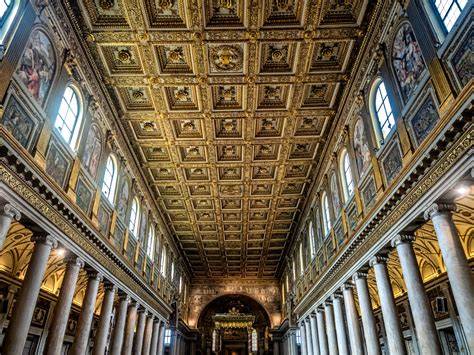
Santa Maria Maggiore is famous, among other things, for its mosaics, dating back to the period of its construction. These mosaics run high along the central nave, both right and left.
Initially, there were 42 panels, but only 27 survived (12 on the left and 15 on the right), while the others were destroyed in the eighteenth century, and in some cases, they were replaced by frescoes. The boxes represent stories from the Old Testament.
Other precious mosaics adorn the triumphal arch that delineates the apse, representing scenes from the life of Jesus. The famous sculptor Gian Lorenzo Bernini is also buried in the Basilica of Santa Maria Maggiore.
The Holy Crib
Under the papal altar rest five pieces of sycamore from the manger in Bethlehem, along with the cloths in which tradition holds Jesus’ small body was wrapped. This has earned the basilica another name, Saint Mary of the Crib.
The basilica is also home to a few remnants of the humble crib in which Christ was laid at His birth. These pieces of the manger were carried to Rome by Christians fleeing the Muslim conquest of the Holy Land in the 7th century.
To this day they are preserved in a silver reliquary resembling an ordinary manger, upon which lies an image of the Infant Jesus. The Holy Crib is the object of particular devotion and veneration during the liturgical ceremonies of Christmas eve and Midnight Mass.
On Christmas morning there is a procession in honor of the Holy Crib of the Infant Jesus, which culminates in the exposition of the sacred relic on the high altar.
The icon of Salus Populi Romani
Another venerable treasure is the icon of Our Lady under the invocation of Salus Populi Romani, meaning “health (or salvation) of the Roman people.” This miraculous icon has been carried in processions around Rome on many occasions.
In 593 Pope Saint Gregory the Great had the icon carried in public procession through the streets of Rome, praying for an end to the Black Plague. Pope Saint Pius V followed his example in 1571 to pray for victory during the Battle of Lepanto, as did Pope Gregory XVI in 1837 to pray for the end of the cholera epidemic.
At every instance, Our Lady answered the prayers of her faithful. After the celebration of the Mass and Second Vespers of the feast, the Holy Father has always had a special affection for the Marian icon of Salus Populi Romani in the Basilica.
There is an image revered as Our Lady of the Snows, which is believed to have been produced by St. Luke the Apostle. Picture this: Our Lady and St. Luke meet regularly so that the physician turned evangelist may capture the story of the Gospel through her maternal eyes.
As if in response to an angelic suggestion, Saint Luke asks Our Lady, “May I paint your image?” Full of grace and humility, she responds in the affirmative, only adding, “I have saved a canvas just for this purpose. It is a slab of wood recovered from the table whereon My Son established the Holy Eucharist the day before He died.”
And that is the story of the origin of the icon found in the Basilica of Saint Mary Major in Rome. What a confluence of graces!
The annual celebration on August 5
Our Lady of the Snow is commemorated on 5 August, marked by a spectacular snowfall on the square of the Papal Basilica of Santa Maria Maggiore, dedicated to her. This is how the cult was born.
Every year, on August 5, the festival of Our Lady of the Snow is celebrated with a solemn Mass in honour of the Virgin Mary. This anniversary, which commemorates the miracle of snow, attracts tourists from all over the world.
In the square in front of the Basilica of Santa Maria Maggiore, a show of sounds and lights is organised, followed by an artificial snowfall that recalls the miraculous one that occurred in 358 AD. In ancient times, white rose petals were used as a symbol of snowflakes.
In honor of Our Lady of the Snows, every year on August 5th, a Mass takes place in the basilica of St. Mary Major in Rome and white flower petals are dropped from the ceiling. In the evening, the snowfall is recreated in the piazza outside the church.
To this day, the legend is commemorated with a shower of white rose petals from the ceiling dome. Tens of thousands gather to honor Our Lady of the Snows with a devotion that has never cooled among her people.
The liturgical meaning of August 5
The optional memorial of the Dedication of St. Mary Major, celebrated on Aug. 5, recalls the importance of Mary in the life of the church. But it also calls to mind the Marian title of “Our Lady of the Snows.”
Our Lady of the Snows is therefore celebrated on 5 August to commemorate the famous miracle of the snowfall on the Esquiline. Every year, on August 5, the festival of Our Lady of the Snow is celebrated with a solemn Mass in honour of the Virgin Mary.
According to some traditions, 5 August is also remembered as the birthday of Our Lady. The Nativity of the Virgin is officially celebrated on 8 September, although this date is purely conventional, since there are no precise indications on the date of Mary’s birth.
The choice of 8 September coincides with the dedication feast of St. Anne’s Basilica in Jerusalem, built in the fourth century AD on the site where Mary’s parents’ house is believed to have stood. However, other traditions coincide with the birthday of Our Lady on different dates, including August 5, the feast day of Our Lady of the Snow.
The symbolism of snow
Most fitting do we call Mary, Our Lady of the Snows. The white blanket of that August night symbolizes Mary, pure as the driven snow; her blessings and graces, numerous and varied as the falling snowflakes.
Science tells us that every snowflake is different in form and make-up: size, outline, structure, ornamentation, are all without limit, infinite in wondrous beauty, startling complexity, perfect symmetry as they fleet, dancing down from the sky. What a wonderful figure of the blessings Mary obtains for us!
Snow changes the face of the earth, painting even a field of mud with a white coat. The grace of God won through prayer to Mary, also changes the face of the earth.
Snow preserves the heat of the earth, protects vegetation, supplies moisture with slow effectiveness. Grace serves similar purposes: it preserves the warmth of God’s love in our hearts; it protects the soul from the chill of temptation and sin; it nourishes the soul with new life.
Mary, grace, and hope
The festival of Our Lady of the Snow is not only an opportunity to remember the miracle, but also a moment of spiritual reflection for the faithful, on the role of the Virgin Mary as a mediator of divine Grace, a symbol of purity and renewal, just like the snow from which she took the Marian title of Our Lady of the Snow, precisely.
Its popularity reiterates Mary’s status as a beacon of hope for Christians who turn to her in times of trial, perhaps when it seems that a miracle is needed and when it looks like all hope is lost. Through Mary’s mediation, recourse to God’s mercy is sought when it appears that there’s no way - embodied in the legend of the miraculous snowfall in the Roman summer.
Those who honor Mary under the title of Our Lady of the Snows, or any other title, are asking Mary to beg God to make a way out of no way, to bring his grace into their lives no matter the circumstances, and to find peace and happiness in the will of God.
Those who honor Mary seek, and hopefully find, what she had in her heart some 2,000 years ago when she said “yes” to the Lord’s plan as a young peasant girl. What those who pray to Mary long for and receive is the hope that inspires the daring, intrepid missionaries who spread the Gospel with confidence that she will intercede for them.
The devotion beyond Rome
There are millions of people living in lands of ice and snow who have not yet come to the knowledge of Mary and her Divine Son. We might ask that with the actual snowflakes, she shower down upon them the graces of the true Faith.
In particular, may that land where snow falls long and heavily, Russia, come to share in a fall of graces through prayer to her whom we honor on August fifth as “Our Lady of the Snows.”
Devotion to Mary under the title of Our Lady of the Snows is primarily fostered in the United States in Belleville, Illinois - just across the Mississippi River from St. Louis - at the National Shrine of Our Lady of the Snows under the direction of the congregation of the Missionary Oblates of Mary Immaculate.
The National Shrine in Belleville
The construction of this shrine seems fitting and appropriate to have been started and operated by missionaries since they understand, perhaps more than anyone, the importance and need to implore Mary’s aid amid often difficult and seemingly impossible circumstances.
The Missionary Oblates of Mary Immaculate congregation was founded by French bishop St. Eugene De Mazenod in 1816. The founder placed his new missionary order under Mary’s maternal protection and care.
The Oblates came to North America not long after their founding, and they are known for their work in remote locations throughout the continent. The Our Lady of Snows shrine in Belleville traces its origins back to the 1940s, inspired by German Oblate Father Paul Schulte.
Father Paul Schulte and the shrine’s origins
Known as “The Flying Priest,” Father Schulte was a pilot and had the distinction of being the first priest to celebrate Mass while airborne - in the Zeppelin airship Hindenburg just a year before its explosion.
Father Schulte put his talent as a pilot to work delivering medical supplies to Oblate missions, typically near the Arctic Circle. He once risked death himself while carrying out a lifesaving medical mission to rescue a brother Oblate priest who was on the brink of death.
Flying through extreme weather, Father Schulte credited the success of his heroic ministry to Our Lady of the Snows - to whom he already had devotion and reportedly “when he was afraid of an imminent crash during a snowstorm, he promised Our Lady to spread her devotion under that title if she came to his aid and saved him in this emergency.”
He did just that after his transfer to the Oblate’s now-closed St. Henry Preparatory Seminary in Belleville, alma mater of Chicago’s late Cardinal Francis E. George, who was also with the Oblates.
Father Schulte was sent there during World War II because he was German and some suspected him of being a Nazi spy. He was ordered not to travel and was kept under FBI surveillance. This gave him the opportunity to deliver on his promise to Mary.
In Belleville, Father Schulte commissioned an image of Our Lady of the Snows to be painted, which depicts Mary and the child Jesus surrounded by the aura of the Northern Lights, under which is found a missionary and an airplane making a sick call to an Inuit mission. It remains at the shrine in Belleville today.
A perpetual novena was established in 1943 in honor of Our Lady of the Snows, and as devotion to her grew, the Oblates inaugurated construction of a shrine to honor her in 1958. The shrine, one of the largest outdoor shrines in the United States, is a place of pilgrimage, attracting around 350,000 visitors annually.
As with all its counterparts, the shrine is primarily a place of prayer, conversion and healing - particularly through encounters with Mary’s son in the sacraments.
The basilica, the Jubilee, and the Holy Door
Each of the papal basilicas also has a Holy Door that is opened on the occasion of the Jubilee. The opening of the Holy Door is a central event of the Jubilee and marks the beginning of the period of grace and mercy that it represents.
St. Mary Major is one of only four basilicas that hold the title of “major basilica” and are known as patriarchal cathedrals in memory of the first centers of the Church. These four major basilicas are distinguished by their having a holy door - traditionally an entrance portal that is normally sealed by mortar and cement from the inside so that it cannot be opened.
They are ceremoniously opened during Jubilee years designated by the Pope, for pilgrims who enter through those doors may piously gain the plenary indulgences attached with the Jubilee year celebrations.
The opening of the Holy Door of St. Peter’s Basilica, which for the 2025 Jubilee will take place on 24 December 2024, officially marks the beginning of the Holy Year. Walking through the Holy Door invites the faithful to conversion and to receive the grace of forgiveness.
The enduring importance of the legend
The legend has not necessarily stood the test of time. No mention is made of anything supernatural behind St. Mary Major’s construction before the year 1000. Whether the legend is true or not, devotion to Mary under the title Our Lady of the Snows has endured.
Several basilicas, shrines and churches are named in honor of this title throughout the world. For over 1,600 years, pilgrims have continued to flock to Rome.
“What was true 1700 years ago is still true today,” Fr. Immacolato says. “The importance of the Blessed Virgin Mary in the history of the church and in the history of salvation, because when there are hardships, when there are difficulties, when there are trials, crosses, big problems, going to Mary asking for her help, is still what the true believer does even today.”
Ultimately, those who turn to Mary are turning to her son - as has been clear since the earliest days of Marian devotion. Mary makes Jesus present to the world.
And she teaches us to glorify him with our thoughts, words and deeds as members of his mystical body, the church.