Russell M. Nelson was called to the Quorum of the Twelve Apostles in April 1984, after President Spencer W. Kimball received direction to call Nelson and Dallin H. Oaks to fill vacancies in the quorum. Nelson was sustained during the Saturday morning session of general conference on April 7, 1984, and ordained an Apostle and set apart as a member of the Quorum of the Twelve Apostles on April 12.
For Nelson, the call brought an immediate transition from a distinguished career as a heart surgeon and medical researcher to full-time service as a special witness of Jesus Christ. “In one short moment,” he said, “the focus of the last 40 years in medicine and surgery was changed to devote the rest of my life in full-time service to my Lord and Savior, Jesus Christ.”
The circumstances surrounding the call
On January 11, 1983, Elder LeGrand Richards of the Quorum of the Twelve Apostles passed away. With April general conference less than three months away, members looked forward to the calling of a new apostle.
The call of a man to fill a vacancy in the Quorum of the Twelve Apostles is the responsibility and prerogative of the president of the Church. Only he has the authority to receive revelation about whom the Lord has prepared and selected for that high and holy calling.
During the months preceding conference, President Spencer W. Kimball’s health had become increasingly frail and his memory spotty. To the disappointment of many, the April 1983 general conference came and went without a call to the Twelve announced.
As the October 1983 general conference approached, speculation again mounted that this time, surely, the vacancy in the Twelve would be filled. But again, there was disappointment. No one was called. Conference came and went for a second time with an empty seat in the quorum.
Then on January 11, 1984, a year to the day after the passing of Elder Richards, Elder Mark E. Petersen of the Twelve passed away. Now there were two vacancies in the Twelve, and, if anything, the situation was more critical.
President Kimball’s health had deteriorated even further, and his mind was less dependable. To make matters worse, those privy to the situation knew President Kimball was in no condition to receive the revelation to extend such calls. One of those persons was Dr. Nelson.
For months, President Gordon B. Hinckley, the only healthy member of the First Presidency at the time, had left standing instructions with President Kimball’s caregivers that if the prophet’s mind ever cleared, they were to call him immediately, regardless of the hour.
Month after month passed with no call. From time to time, President Hinckley looked in on President Kimball, but an opportunity to discuss such a spiritually sensitive topic as calls to the Twelve never presented itself.
Then, at about 2:30 a.m. on the Wednesday morning prior to the April 1984 general conference, the phone rang at President Hinckley’s home. President Kimball was alert and wanted to talk to him.
President Hinckley rushed downtown to President Kimball’s suite in the Hotel Utah, where the issue of vacancies in the Twelve was raised. President Kimball said simply, “Call Nelson and Oaks to the Quorum of the Twelve, in that order.”
President Hinckley extends the call
Two days later, on Friday morning, President Hinckley summoned Dr. Nelson from the regional representatives’ seminar that was in progress. He asked Russell just one question: “Is your life in order?”
When Russell responded that it was, President Hinckley replied, “Good, because tomorrow we’re presenting your name to be sustained as one of the Twelve Apostles.”
With that, President Hinckley embraced the stunned Russell M. Nelson, and both men wept. “You have permission to go home and tell your wife,” President Hinckley said.
On the morning of April 6, 1984, Russell M. Nelson was making rounds at the hospital he worked at as a doctor when he was summoned to the phone. D. Arthur Haycock, the secretary of Church President Spencer W. Kimball, asked him to come by the office of the First Presidency.
“Of course, I’ll be happy to - but where is it?” he replied. It wasn’t long before he would become more than familiar with the Church Administration Building and the offices within.
Reeling from the call, Russell drove straight home, anxious for the comfort of his wife. When he walked in the door, though, he was greeted by the eerie silence of an empty house-something unusual in the busy Nelson household. Dantzel was shopping.
So he paced the floor and tried to sort through the questions, uncertainties, an overwhelming sense of inadequacy racing through his mind and heart.
This call meant the end of his life as Dr. Nelson. After decades of healing hearts by cutting into them, he would now try to heal them a different way.
After daily appealing to the Lord to help him make the thousands of life-and-death decisions he’d made, Russell would now appeal to Him daily to help him be a different kind of instrument in His hands.
But there were a lot of unanswered questions: What about the operations he had already committed to do? What about a stint as a visiting professor in China he was supposed to undertake the following month? What did this mean for his family, and how would they respond? Was he spiritually ready for this?
The immediate answer to that last question felt like a decided no, and yet he couldn’t deny what he had felt when President Hinckley extended the call.
Dantzel Nelson’s response
Finally, when Dantzel returned home, he said simply, “Honey, you’d better sit down.” When he told her he had been called to fill a vacancy in the Quorum of the Twelve Apostles, her instant response brought him to the verge of tears: “I know of no one more worthy than you!”
“Of all the people who knew my imperfections,” Russell said, “she knew them better than anybody. So for her to respond as she did meant everything to me. As she had done so many times before, she calmed my heart that day.”
His wife, Dantzel, had supported him throughout his responsibilities in the Church and his profession. Their family included ten children, and their home was central to Nelson’s response to the new calling.
To my dear Dantzel, I acknowledge my debt, as well as my eternal love. She is the fountain from whom flows the nourishing love in our home.
Her sacrifices to bring our ten wonderful children into this world, teaching and training them, while always supporting me without a murmur through my responsibilities in the Church and in my profession, are monumental.
We love our eight sons-in-law as our own, and are so grateful for an unbroken string of temple marriages that link them to us forever. For those precious grandchildren already here and for the others on the way, we express our gratitude.
The announcement in general conference
Saturday of April conference of 1984 has been circled on our calendar for many years, for that date was targeted as the first time in my life that our only son would be old enough to attend general priesthood meeting with me.
Last night, that long awaited goal became a reality. Brothers and sisters, little did we know that on that day my name would be presented as a member of the Council of the Twelve.
Since we didn’t know, our children didn’t know either. Our married daughters telephoned us between sessions. One who was expecting a baby, said, “Daddy, I was so shocked by that announcement-I think I am going into labor.”
That she did. So, President Hinckley, your announcement from the First Presidency should get credit at least for “an assist.” Our twenty-second grandchild arrived safely last evening!
The announcement came as a surprise to then-Elder Nelson and his family, and the phone began ringing frequently in between conference sessions.
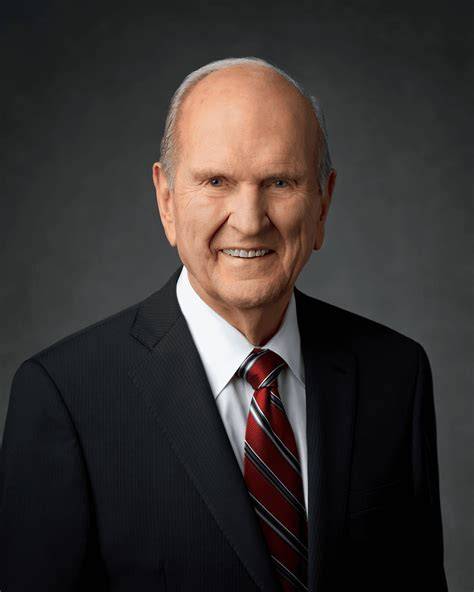
During the Saturday morning session of general conference, Russell Marion Nelson and Dallin Harris Oaks were sustained as members of the Quorum of the Twelve Apostles.
Ordination and apostolic responsibility
On April 7, 1984, Russell M. Nelson was ordained an apostle and set apart as a member of the Quorum of the Twelve Apostles. In an interview with the Church News in 2015, President Nelson said that there was no way to describe that experience of being called as an Apostle.
“It is the most sacred thing that can happen to a man in this life,” he said. “It is life-changing, yes. But, hopefully, he, in turn, will be able to change the lives of many other people toward the Lord. This is what we do. We are servants of the Lord.”
In accepting this call, knowing that challenges, charges, and keys will be conferred and that buffetings will likewise come, I commit my effort, my energy, and my all.
Now, I understand fully that the call to the Holy Apostleship is one of witness to the world of the divinity of the Lord Jesus the Christ.
I know that salvation is centered in Him! Said the angel to King Benjamin: “Salvation was, and is, and is to come, in and through the atoning blood of Christ, the Lord Omnipotent.”
The Prophet Joseph Smith was asked, “What are the fundamental principles of your religion?” He answered: “The fundamental principles of our religion are the testimony of the Apostles and Prophets, concerning Jesus Christ, that He died, was buried, and rose again the third day, and ascended into heaven; and all other things which pertain to our religion are only appendages to it.”
The creation of the earth and all that dwell therein, the necessary fall that enabled man to be, and the atonement of the Lord are three fundamental components of God’s eternal plan.
Without that atoning sacrifice, there would be neither immortality nor eternal life. His message is the restored gospel of Jesus Christ; and it is administered by the Church that bears His name.
He directs the affairs of His church by the power of the priesthood and by revelation through prophets who proclaim His doctrine to all people of the world.
Nelson’s first apostolic address
A wide array of feelings has flashed through my heart since I heard the call that will change my life. The first feeling is that of personal inadequacy.
That feeling is intensified as I think of the incomparable power of Elders LeGrand Richards and Mark E. Petersen, whose absence we keenly sense. They were, to me, dear friends as well as esteemed leaders.
Then, as I look about and see the strength of those more qualified and able than I, I truly am humbled by this calling.
Fortunately, these feelings are blanketed by feelings of faith, for I know the words of Nephi are true: “I will go and do the things which the Lord hath commanded, for I know that the Lord giveth no commandments unto the children of men, save he shall prepare a way for them that they may accomplish the thing which he commandeth them.”
I have implicit faith in the Lord and in His prophets. I have learned not to put question marks but to use exclamation points when calls are issued through inspired channels of priesthood government.
About twenty years ago, two members of the Quorum of the Twelve were assigned to select a new president of the Bonneville stake in which we lived. They were Elders Spencer W. Kimball and LeGrand Richards.
That call they extended to me. Now, I am to be ordained an Apostle under the hand of President Spencer W. Kimball, to fill a chair vacated by the passing of Elder LeGrand Richards.
Feelings of commitment well up from the depths of my soul. My sweetheart, Dantzel, and I first made those covenants in the temple of the Lord over thirty-eight years ago, to consecrate our lives to the service of the Lord.
Today, I reaffirm that promise, to give all I have to the building of the kingdom of God on the earth.
Feelings of gratitude emerge as I acknowledge the goodness of my parents, and of all eight of my pioneer great-grandparents who were converted to the Church in the populous nations of Europe.
All eight of them ultimately immigrated to the little town of Ephraim, Utah. I know they are watching the events of this day from their celestial windows.
From surgery to spiritual service
While nominally I come to you from the science of surgery and its mother of medicine, in a truer sense, I have been forged from the stern discipline of law-not the laws of men, as mastered by our brethren of the legal profession, but the eternal and unchanging laws of our Divine Creator.
The surgeon soon learns the incontrovertibility of divine law. He knows that hopes and wishes are sometimes simply powerless sham.
Desired blessings come only by obedience to divine law, and in no other way. My lifetime thus far has been focused on learning those laws.
Only as the laws are known, and then obeyed, can the blessings we desire be earned. To this extent, there will be little difference for me in the activities of the past and those of the future.
The endless laws of the Lord are the doctrines taught by His Apostles. I am grateful to my colleagues in the medical profession who have permitted me to assist them in the care of their patients and who now will continue to care for them.
Their selfless service satisfies the two great commandments, to love God and neighbor. They have learned that one loves best who serves best.
Prior to his call as a General Authority, Dr. Nelson was an internationally renowned surgeon and medical researcher. His professional work included the positions of research professor of surgery and director of the Thoracic Surgery Residency at the University of Utah and chairman of the Division of Thoracic Surgery at LDS Hospital in Salt Lake City.
He also served as president of the Society for Vascular Surgery, a director of the American Board of Thoracic Surgery, chairman of the Council on Cardiovascular Surgery for the American Heart Association, and president of the Utah State Medical Association.
Author of numerous publications and chapters in medical textbooks, President Nelson lectured and visited professionally throughout the United States and in many other nations prior to his call as a General Authority.
A testimony centered on Jesus Christ
I sustain the servants of the Lord, from Isaiah and Ezekiel to Joseph Smith and Spencer W. Kimball. For their confidence in me, I am deeply appreciative.
To them and all mankind they serve, I express my love. Now, I understand fully that the call to the Holy Apostleship is one of witness to the world of the divinity of the Lord Jesus the Christ.
The testimony that I bear is but an echo of the resounding testimonies of the eighty-four who previously have received this call to the Twelve since the spring of 1820.
I know that God the Father and the Son appeared to usher in this last great dispensation of eternal truth.
I testify that we are of the house of Israel, specifically of the lineage of Joseph, bearing the birthright and charged with the irrevocable responsibility to prepare the world for the second coming of the Savior.
Then, numberless multitudes among every nation, kindred, tongue, and people will eventually join in proclaiming that Jesus is the Christ, the Son of the living God.
So I solemnly testify in the name of Jesus Christ, amen.
The meaning of the calling to Nelson
In accepting this call, knowing that challenges, charges, and keys will be conferred and that buffetings will likewise come, I commit my effort, my energy, and my all.
Apostolic service, as Nelson described it, required more than a change in occupation. It required a complete consecration of his life and a willingness to be directed by revelation.
He had already spent decades serving in the Church. He served as stake president of the Bonneville Stake from 1964 to June 1971, when he was called as Sunday School General President.
Prior to his call to the Quorum of the Twelve Apostles, he was serving as a regional representative assigned to the Kearns Utah Region. He had previously served as the regional representative for Brigham Young University.
During some of his first years as an Apostle, he served as an adviser to the Young Women organization and supported the development of the Young Women values and Personal Progress program.
Sister Ardeth G. Kapp, Young Women general president at the time, wrote: “I learned from him the value of counseling together. He would ask significant questions and then listen and coach with encouragement.”
Service in the Quorum of the Twelve
He would serve as a member of the Quorum of the Twelve Apostles for 34 years.
During this time, he fulfilled many assignments, including serving on the Church Board of Education, supervising the Church in Africa and Eastern Europe and dedicating or rededicating two temples.
Following the deaths of three senior Apostles in 2015 - President Boyd K. Packer, Elder L. Tom Perry and Elder Richard G. Scott - President Nelson was called and sustained as president of the Quorum of the Twelve Apostles.
Following this call, he reflected on the support he had received from other members of the quorum over the previous 31 years, noting his interactions with Elder Bruce R. McConkie in particular.
“Occasionally, I would have an idea I wanted to discuss or had a question. I would knock on his door, and he was always gracious, always warmly welcoming.”
The other Apostles were equally compassionate and willing to share, President Nelson said. “We learned from one another. That continues.”
“Even now, as I’m sitting in the quorum president’s chair, I go to my meetings early so I can learn from my Brethren. It’s not a matter of seniority. It’s a matter of spirit-to-spirit communication.”
“It’s a glorious fringe benefit of this call to have the companionship of fellow Apostles and be taught by them.”
From Apostle to president of the Church
Russell M. Nelson was sustained and set apart as the 17th president and prophet of The Church of Jesus Christ of Latter-day Saints on Sunday, January 14, 2018, in the upper room of the Salt Lake Temple.
Prior to his service as head of the Church, President Nelson served as President of the Quorum of the Twelve Apostles from July 15, 2015, until his call as the Church’s leader.
He has served as a member of the Quorum of the Twelve since April 7, 1984.
| Event | Date |
|---|---|
| President Kimball directed that Nelson and Oaks be called | January 1984 |
| Nelson was presented for sustaining | April 7, 1984 |
| Nelson was ordained an Apostle and set apart | April 12, 1984 |
| Nelson became President of the Quorum of the Twelve Apostles | July 15, 2015 |
| Nelson was sustained as president and prophet of the Church | January 14, 2018 |