Tom Harpur’s The Pagan Christ argues that the central elements of the Jesus story were present in pagan mythology long before the Gospels were written, most fully in the Egyptian myths of Horus and Osiris. Harpur maintains that the original Christian narratives were spiritual myths and allegories rather than biographies of a literal man named Jesus of Nazareth.
For Harpur, Christianity was later transformed into a literalist religion when institutionalized churches recast the ancient Christ myth as historical fact. He believes that recovering the symbolic and mystical meaning of Christ can restore an inclusive form of Christianity in which the “Christ within” represents the divine potential present in every human being.
Tom Harpur and the purpose of The Pagan Christ
For forty years, scholar and religious commentator Tom Harpur challenged church orthodoxy and guided thousands of readers on subjects as controversial as the true nature of Christ and life after death. Now, in his most radical and groundbreaking work, Harpur digs deep into the origins of Christianity.
Tom Harpur was a columnist for the Toronto Star, Rhodes scholar, former Anglican priest, and professor of Greek and the New Testament, and was an internationally renowned writer on religious and ethical issues. He was the author of ten bestselling books, including For Christ’s Sake and The Pagan Christ. He hosted numerous radio and television programs, including Life After Death, a ten-part series based on his bestselling book of the same name. He passed away in 2017.
When someone like this challenges the existence of the historical Jesus and champions Gnosticism, people take notice. Harpur’s one of Canada’s most respected and well-known Christian thinkers. He’s a former Anglican priest, and he was a professor of the New Testament at the University of Toronto from 1964 to 1971.
A Rhodes Scholar, he’s done post-graduate work in the early Fathers of the Church at Oxford under some of the world’s foremost academics. He’s covered ethical and spiritual matters for The Toronto Star for the past 30 years, he’s regularly appeared on Canada’s major radio and television networks, and he’s written numerous best-selling religious books.
The central thesis: Christianity as a pagan Christ myth
Tom Harpur’s starting point for this book is not terribly shocking: many of the elements of the story of Jesus, as told in the Gospels, share commonalities with the stories of pagan gods - gods who come to earth in human form, who suffer and die, who rise again.
Some Christians might say that these stories were “pagan prophecies” of Jesus; others might suggest that all these images are part of a collective unconscious, a store of archetypal stories we all draw on.
But Harpur takes his thesis much further, indeed to a point where the majority of Christians would strongly disagree with him. Basing his theories largely on the work of three 19th and 20th century scholars, the most important to his theme being Alvin Boyd Kuhn, Harpur argues that every single element of the Jesus “myth” was already present in pagan myth, most fully realized in the Egyptian myths of Horus and Osiris.
The Pagan Christ draws upon the research of such scholars as Alvin Boyd Kuhn to argue that Christianity’s central myths were formulated in Egypt many thousands of years before the Gospels were written. Harpur argues that the Jesus narrative is simply one more variation on this archetypal theme.
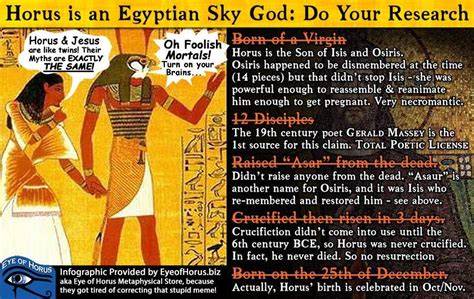
Egyptian religion, Horus, and the Gospel narrative
Long before the advent of Jesus Christ, the Egyptians and other peoples believed in the coming of a messiah, a virgin birth, a madonna and her child, and the incarnation of the spirit in flesh.
Harpur focuses on Horus, a mythical figure whose miraculous birth was heralded by a star in the east; who was baptized by someone who was later decapitated; who had twelve followers; who walked on water, cast out demons, and healed the sick; who was transfigured on a mountain; who was crucified between two thieves, buried in a tomb, and resurrected.
Horus was known as the KRST or “anointed one,” as well as the “good shepherd,” “the lamb of God,” “the bread of life,” “the son of man,” “the Word,” and the “fisher.”
The legend of Horus resurfaced in the myths of later saviors, like Tammuz, Adonis, Mithras, Dionysus, Krishna, and Buddha. After enumerating all the alleged similarities between the Jesus story and the stories of pagan gods, Harpur says that the only original thing about Christianity is that it’s the only religion that ever imagined or taught that all these things actually happened to a literal human man.
| Figure or tradition | Role in Harpur’s argument |
|---|---|
| Horus | The Egyptian Christ figure whose myth contains many elements later associated with Jesus. |
| Osiris | One of the central Egyptian myths through which Harpur explains the Christian Christ pattern. |
| Tammuz, Adonis, Mithras, Dionysus, Krishna, and Buddha | Later savior figures whose myths are presented as variations on an archetypal theme. |
| Jesus | The figure Harpur interprets as a later, Jewishly inflected version of the ancient Christ myth. |
Myth and allegory rather than biography
Harpur argues that the original gospels were not intended to be biographies about a literal man named Jesus of Nazareth, who, he suggests, probably never existed at all - leaning heavily here on Earl Doherty’s controversial work - but were versions of the ancient Christ myths written with a Jewish slant.
Harpur goes on to argue that this myth was never intended to be taken as a literal story about a supernatural person named Horus; instead, Horus symbolizes humanity itself.
By representing both our divine and our human natures, Horus is Everyman and Everywoman; his story is the Gnostic story of human consciousness. By deconstructing the evidence for the historical Jesus, Harpur backs up his assertion that the Jesus narrative is simply one more variation on this archetypal theme.
“To take the Gospels literally as history or biography is to utterly miss their inner spiritual meaning.”
The defining feature of traditional Christianity is its literal treatment of this allegorical pagan tradition. Harpur writes that the early Christian story most likely began as a kind of spiritual drama, together with a “sayings” source based on Egyptian material, and was later turned into a form of history in which the Christ of the myth became a flesh-and-blood person identified with Jesus, or Yeshua, of Nazareth.
The transformation of Christianity into literalism
Then, in the third century, institutionalized Christianity, wanting to make the faith more appealing to the ignorant masses, dumbed down the spiritual and gnostic message of the Christ-myth into a real, literal story - thus losing everything of value in the original myths.
What had begun as a universal belief system built on myth and allegory was transformed, by the third and fourth centuries A.D., into a ritualistic institution based on a literal interpretation of myths and symbols.
While the early Christian church accepted these ancient truths as the very basis of Christianity, it disavowed their origins. Harpur argues that the Christian tradition took over almost completely the myths and teachings of its Egyptian predecessors, mediated in many cases by the Mystery Religions and by Judaism in its many forms.
He further argues that early Christians did everything in their power, through forgery and other fraud, book burning, character assassination, and murder itself, to destroy the crucial evidence of what had happened.
The power of the millennia-old Christ mythos to transform the whole of humanity was all but destroyed in the literalist adulation of “a presumptive Galilean paragon.” Centuries of darkness were to follow.
Harpur suggests that it’s time the darkness gave way to the dawn, for religious literalism to be put aside in favor of the revelatory power of spiritual allegory.
Gnosticism and the divine spark
An old and esoteric religious tradition, Gnosticism proclaims that human souls are incarnate expressions of the Godhead. According to the Gnostic account, at birth each of us emerges from eternity to become a finite, embodied, and separate consciousness.
In Harpur’s words: “The vitalizing item of ancient knowledge was the prime datum that man is himself, in his real being, a spark of divine fire struck off like the flint flash from the Eternal Rock of Being, and buried in the flesh of body to support its existence with an unquenchable radiant energy.”
“On this indestructible fire the organism and its functions were ‘suspended,’ as the Greek Orphic theology phrased it, and all their modes and activities were the expression of this ultimate divine principle of spiritual intelligence, energizing in matter.”
During our incarnation, we forget our cosmic origins and suffer within a state of existential amnesia that Gnosticism hopes to remedy. Valentinus, a second century Gnostic, expressed this best when he wrote, “What liberates is the knowledge of who we were, what we became; where we were, whereinto we have been thrown; whereto we speed, wherefrom we are redeemed; what birth is, and what rebirth.”
To the Gnostics, each of us is a slumbering Christ.
Gnostic Christianity and its historical survival
Gnostic Christianity was the first “heresy” to be persecuted by the Church. Gnostic writings were destroyed, while Gnostic teachers were often killed.
Despite this, Gnosticism has survived as the most powerful subterranean spiritual current in Western culture. It can be found among the troubadours in thirteenth-century France, and in the Renaissance hermeticism of John Dee and Giordano Bruno.
It appears in the poetry of William Blake and the philosophies of Georg Hegel and Karl Marx. As a staple of Freemasonry it framed the thoughts of America’s founding fathers.
It informed Carl Jung and Aldous Huxley, as well as the 1960s counterculture and the makers of The Matrix trilogy.

Christ within and spiritual awakening
Perhaps surprisingly, Harpur, a former Anglican priest, finds these revelations not faith-destroying but faith-affirming. The gnostic, mystical, highly spiritual Christ-myth that he finds in Egyptian and other pagan sources, and which he believes is at the core of “true” Christianity, is, for him, more positive and affirming than the idea of a divine/human Savior.
His message is that the real Incarnation is a spiritual awakening within each one of us; he uses Paul’s words about “Christ in you” and “having the mind of Christ” to support his belief that Paul taught this kind of Christianity, without any reference to a literal Jesus.
Harpur argues that Horus symbolizes humanity itself. By representing both our divine and our human natures, Horus is Everyman and Everywoman; his story is the Gnostic story of human consciousness.
The meaning of the Christ within all of us is therefore central to Harpur’s interpretation of Christianity. Christ is not primarily an external Savior descending into history, but an image of the divine consciousness that can awaken within human beings.
Universalism and religious pluralism
This kind of Christianity, Harpur argues, makes true pluralism and universalism possible as it includes the “Christ-image” within all religions, as opposed to the exclusive “Jesus is the only way to salvation” message of traditional Christianity.
At a time of religious extremism, Tom Harpur reveals the virtue of a cosmic faith based on ancient truths that the modern church has renounced. His message is clear: Our blind faith in literalism is killing Christianity.
Only with a return to an inclusive religion where Christ lives within each of us will we gain a true understanding of who we are and who we are intended to become.
Harpur’s interpretation does not simply replace one historical figure with another. It presents Christ as a universal image that can appear across religious traditions and express the spiritual possibility shared by humanity.
Harpur’s critique of traditional Christianity
There’s plenty to critique and nitpick at in Harpur’s reliance on a handful of writers whose work is so far outside the mainstream of Biblical studies.
There’s also plenty to be annoyed by in his insistence that all these parallels between Christianity and paganism will be “shocking” to Christian readers and that we’ll be horrified by the idea of a gigantic Church cover-up in third century.
If Tom Harpur thinks painting the church of Constantine as evil manipulators perverting the original truth of Scripture is something new and shocking, he needs to go to an Adventist prophecy seminar sometime.
A book like this is certain to incite controversy, and The Pagan Christ has had its share, much of which has been unfair. It takes courage for someone with Harpur’s background to promote such views.
He may well have opened himself up to devastating slander and professional marginalization. If so, he’ll be in good company. Gnosticism is forever persecuted and forever precious.
Literal Jesus and the uniqueness of Christianity
After enumerating all the alleged similarities between the Jesus story and the stories of pagan gods, Harpur says that the only original thing about Christianity is that it’s the only religion that ever imagined or taught that all these things actually happened to a literal human man.
Traditional Christians might reply when confronted with these parallels that the only unique thing about Christianity is that one time in history, these things did happen to a literal human man.
That belief obviously strains Tom Harpur’s credulity; it also seems to him like a coarse, almost tacky belief, literalism for stupid people, as opposed to the loftier, more spiritual gnosticism of his universal Christ.
Harpur’s argument therefore depends on a decisive choice between two interpretations of the same religious material: Christianity as the literal record of events involving a historical Jesus, or Christianity as the symbolic expression of an older and universal myth.
Belief, interpretation, and the desire for a Savior
In the end, I always come back to the fact that so much of our belief is driven by what we want to believe. I know there are the exceptions; I’ve talked to people who seem to be driven to believe, or disbelief, almost in spite of themselves.
But most of us, I think, select theories that are comfortable to us and congruent with what we want to believe.
Tom Harpur likes the work of Alvin Boyd Kuhn because it meshes with what seems instinctively right to him: that humanity does not need an external Savior to come and rescue us, that we have the power within ourselves to be our own christs, our own saviors.
Likewise, I reject his findings not so much on the basis that I think they’re untrue, although I do: I recognize lots of parallels between Christianity and pagan myths, but I think many of the SHOCKING!! Jesus/Osiris parallels Harpur points to are on the level of the SHOCKING!! parallels between Abraham Lincoln and John F. Kennedy.
I reject them because I don’t believe humans are capable of saving themselves. I want to believe in a Savior; I want to believe in a literal Jesus of Nazareth who was completely human while also being the Son of God, however incredible that may seem.
I recognize that to some extent I believe what I choose to believe; I hope Tom Harpur recognizes that too.
Spiritual imagination and resistance to fundamentalism
The Pagan Christ reminds us that beneath our political and economic systems, beneath both culture and character, lies the spiritual imagination.
This is the faculty that connects the mundane periphery of our existence to its sacred core, the faculty that informs our deepest yearnings and illuminates our ethical pathways.
The American abolitionists knew this, as did Mahatma Gandhi and Martin Luther King Jr. Unfortunately, the social justice and environmental activists of the modern age have largely abandoned the spiritual imagination, allowing it to be captured by apocalyptic fundamentalists like Pat Robertson and Mel Gibson.
If we want to challenge fundamentalism, it’s not enough to point out its many hypocrisies and flaws; we have to take the battle straight to the heart of the spiritual imagination.
On this terrain, visionary allegory of the kind Harpur recommends may be the only virtue powerful enough to triumph over dogmatic literalism.
Harpur isn’t the only religious scholar to come to this conclusion. In Omens of Millennium, Harold Bloom wrote that the cruelties of neo-conservatism “might well provoke a large-scale Gnosticism of the insulted and injured, rising up to affirm and defend the divine spark in themselves.”
Given the increasing popularity of books like The Pagan Christ, perhaps the rebellion has finally begun.
Structure and subjects of the book
The book examines the ancient Egyptian roots of Christianity, the real meaning of the Bible, the key to whether Jesus really existed, the re-mythologizing of Christianity, the meaning of the Christ within all of us and the need to understand myth and allegory.
- Discovery: A Bible Story I'd Never Heard Before
- Setting the Stage: Myths Aren't Fairy Tales
- Christianity before Christianity: Where It All Began
- The Greatest Cover-up of All Time: How a Spiritual Christianity Became a Literalist Christianism
- It Was All Written Before-in Egypt
- Convincing the Sceptics
- The Bible-History or Myth? The End of Fundamentalism
- Seeing the Gospels with New Eyes: Sublime Myth Is Not Biography
- Was There a Jesus of History?
- The Only Way Ahead: Cosmic Christianity
The appendices include background on three experts on mythology, religion, and ancient Egypt, more similarities between the Egyptian Christ, Horus, and Jesus, and two strange passages.
Publication details
| Detail | Information |
|---|---|
| Author | Tom Harpur |
| Title | The Pagan Christ: Recovering the Lost Light |
| Publisher | Thomas Allen |
| Publication date | 2005 |
| Language | English |
| Binding | Paperback |
| Number of pages | 296 |
| ISBN-10 | 0887621953 |
| ISBN-13 | 9780887621956 |
| Rating | 3.77 out of 5 stars |
After more than 52 weeks on the Toronto Star's bestseller list and 43 weeks on The Globe and Mail's bestseller list, Tom Harpur's groundbreaking book, The Pagan Christ, became available in paperback.
This new edition includes the twenty-page discussion guide, with more than 100 questions, to help facilitate a deeper, chapter-by-chapter analysis and more profound understanding of the findings and arguments found in the book.
With a new introduction by Tom Harpur, this paperback edition sheds further light on what has become one of the most talked about books of the new millennium.