Saint Philomena is recognized as the patron saint of infants, babies, purity, youth, the ill, and-in general-for those seeking assistance with difficult or impossible cases. She is also considered the patroness and protectress of newlyweds, virgins, children, and people praying for healing, motherhood, or protection.
Saint Philomena is a virgin martyr and one of the early Christian saints. Although very little is known about her life, Saint Philomena has become a powerful intercessor for those in need, especially for the healing of illnesses and for the protection of children.
Saint Philomena’s Patronages
| Patronage | Why devotees turn to her |
|---|---|
| Infants and babies | She is invoked for the protection and care of children. |
| Youth | Her example is associated with faithfulness, courage, and purity from a young age. |
| Purity and virgins | According to tradition, she made a vow of perpetual virginity and remained faithful to it. |
| The ill | Many healings have been attributed to her intercession, particularly after her relics were transferred to Mugnano. |
| Lost, difficult, and impossible causes | She became known as “the Wonder-Worker” because of the many favors attributed to her intercession. |
| Newlyweds and women seeking motherhood | She is considered the patroness and protectress of newlyweds and has often been invoked by women praying for the gift of motherhood. |
Who Was Saint Philomena?
Little is known about the life of St. Philomena. However, it is believed she was a Greek princess who became a virgin martyr and died at 13-years-old. Philomena-which means “daughter of light”-was a Greek princess who lived on the Island of Corfu during the fourth century.
When Philomena was about 13 years old, her parents, who were of Greek royalty, were called to Rome because the Emperor Diocletian wanted to inflict war on the Island. Having seen Philomena’s beauty and having been impressed with her manners, Diocletian asked for her hand in marriage as a sort of peace treaty.
Her parents accepted the offer, but because Philomena had vowed her virginity to God, she refused the marriage proposal. In an attempt to get Philomena to marry the Emperor, her parents brought her to Diocletian, who tried to win her favor. But, she still refused his hand in marriage.
According to Mother Luisa di Gesù, Philomena was a Greek princess whose parents converted to Christianity. When Philomena was 13-years-old, she took a vow of consecrated virginity. After her father took his family to Rome to make peace, Emperor Diocletian fell in love with Philomena.
Philomena’s Martyrdom According to Tradition
As a result of Philomena’s refusal, Diocletian put her in jail and ordered her to be executed. While in jail, she had a vision of the Virgin Mary, who warned her about her fate, but promised heavenly glory and protection when she endured tortures.
From that point on, there is very little documented about Philomena’s life. What is known about her has been passed down through the centuries by word of mouth. According to the story, she was subjected to several attempts on her life before she was finally decapitated.
Apparently, after nearly 40 days in prison, Philomena was tied to a post, flogged, and left to die in her jail cell. But angels appeared from heaven and healed her wounds with a miraculous balm.
So, the Emperor then ordered to have her drowned with an anchor tied to her neck. That attempt to kill her was also unsuccessful-angels returned her back to dry land completely unharmed.
Later, she was ordered to be killed by archers. But, as she was shot, the arrows returned upon the bowmen and killed them instead. Accused of witchcraft, Philomena was finally decapitated and died in Rome, Italy on August 10.
According to the story, her death came on a Friday at three in the afternoon, the same as Jesus. Finally, the Emperor had Philomena beheaded.
The Discovery of Her Tomb and Relics
Devotion to Saint Philomena, and all the questions surrounding her identity, have their origin at Rome on 25 May 1802, during excavations in the Catacombs of Priscilla on the Via Salaria, when the bones of a young girl of thirteen were discovered in a vial containing a liquid believed to be the blood of the Saint.
Remains of a young lady were discovered in May 1802 at the Catacombs of Priscilla on the Via Salaria Nova with three tiles reading “Peace be to you, Philomena.” An inscription on her grave reads, Pax Tecum Filumena, which means “Peace be with you, Philomena.”
The space was closed by three terracotta tiles on which was inscribed the words LUMENA / PAX TE / CUM FI. It was believed that the tiles had been inadvertently inverted, so that the inscription should have read: PAX TECUM FILUMENA, that is, “Peace be with you, Philomena.”
The different images that were inscribed on the tiles-including a palm branch and a lance-were enough to attribute the bones within the tomb to a Christian martyr of the early ages. At the time, it was believed that the greater part of the remains found in the Catacombs came from the persecutions of the first centuries of the Christian era.
The Symbols Associated with Saint Philomena
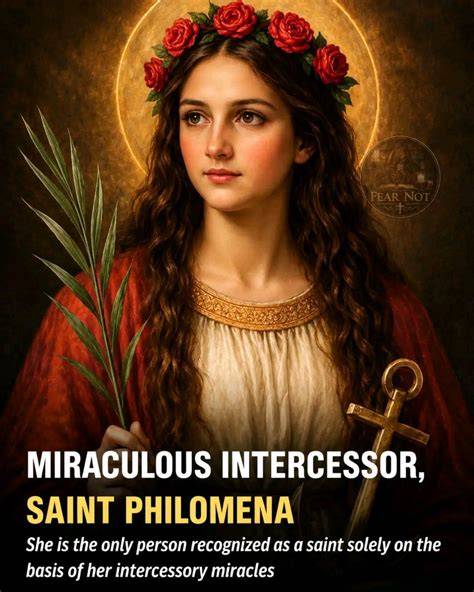
Two anchors, three arrows, a palm symbol of martyrdom, and a flower were found on the tiles in her tomb, interpreted as symbols of her martyrdom. The tomb’s tiles displayed symbols, including arrows, a palm branch, and an anchor, which some have associated with martyrdom.
An inscription containing the Latin words “pax tecum filumena,” transcribed as “peace be with you, Philomena,” was on the tomb. Also cut on the tomb were emblems of a lily and palm, to indicate virginity and martyrdom; an anchor; scourge; and three arrows pointing in opposite directions, one with a curved line, signifying fire.
Combined with the inscription, these symbols were thought to have symbolized the life of Philomena and the different tortures she endured in testimony of her faith and love of Jesus Christ. Saint Philomena is often depicted with a palm, symbolizing martyrdom, and an anchor, symbolizing hope.
The Story of Saint Philomena and the Historical Questions
All that is known about St. Philomena’s life comes from a Neapolitan nun’s vision. Sister Maria Luisa di Gesù claims St. Philomena came to her and told her she was the daughter of a Greek king who converted to Christianity.
It was precisely the account of Sr Maria Luisa that revealed the story of Philomena. She affirmed that the story of Philomena’s life was recounted through a revelation of the saint by the Saint herself.
According to the good sister, Philomena was a daughter of a Greek king who, along with his wife and family, converted to Christianity. At 13, Philomena consecrated herself to God and took a vow of perpetual virginity.
Around that time, the Roman Emperor Diocletian threatened war against her father. Her family was constrained to go to Rome to treat for peace. Seeing the beautiful young girl, the Emperor lusted after her. When she refused his advances, he subjected her to a series of tortures from which she was delivered by heavenly aid, until at last she was beheaded, and earned the palm of martyrdom.
Later historians would cast doubt on the version of events related by Sr Maria Luisa. They claimed that the absence of the word “martyr” on the tiles spoke against her martyrdom; and it was discovered that the ampule thought to be filled with her blood instead contained perfumes typically used in the burials of the first Christians.
Some suggested that the tiles covering her tomb had been re-used, and that the relics were not of Philomena at all. Scientists determined that the mortal remains belonged to a young maiden, and a tradition developed that she was a virgin martyr in the early Church, based on the reported private revelations of Mother Luisa di Gesù, a Dominican tertiary nun.
Although very little is known about her life, Saint Philomena has become a powerful intercessor for those in need. Although controversy sometimes surrounds the truth behind St. Philomena’s life and sainthood, many believers all around the world continue to see her as a miraculous saint.
Why Is Saint Philomena Associated with Miracles?
Devotion for Philomena began to spread once her bones were exhumed and miracles began to occur. Canon Francesco De Lucia of Mugnano del Cardinale received relics of St. Philomena and had them placed in the Church of Our Lady of Grace in Mugnano, Italy.
These were the relics that were later brought to the village of Mugnano del Cardinale, in Avellino, to the church dedicated to the Madonna delle Grazie, where they remain to this day. Here the first miracles were recorded by Father Francesco De Lucia, a priest of Nola, who had requested the relics from Rome.
Soon after her relics were enshrined, cancers were cured, wounds were healed and the Miracle of Mugnano, when Venerable Pauline Jaricot was cured of a severe heart issue overnight, were all attributed to St. Philomena.
Moved by what was happening, the Pope at that time, Leo XII, sent the original terracotta tiles to the shrine at Mugnano. It was in this context that the “Revelations” of Sr Maria Luisa de Gesù appeared, purporting to be a revelation of the life of Saint Philomena.
The popularity of this work helped spread devotion to the saint throughout Europe and America. Noted personalities, including the Ven. Pauline-Marie Jaricot, the foundress of the Society of the Propagation of the Faith and the Living Rosary Association; and the sainted Curé d’Ars, John Vianney, received complete healing from illnesses through the intercession of Saint Philomena, and became fervent devotees.
Other Saints began to venerate Philomena and attribute miracles in their lives to the young martyr, including St. John Marie Vianney and St. Peter Louis Marie Chanel. Because of her fruitful intercession, Philomena became known as “the Wonder-Worker” as well as the “Daughter of Light.”
Is Saint Philomena Formally Canonized?
In 1837, Pope Gregory XVI authorized a liturgical feast on August 11 and devotions in honor of Philomena, although she was never formally canonized, nor was her feast ever placed on the Church’s universal calendar, the General Roman Calendar.
Gregory apparently made this special exception because of the many miracles associated with Philomena’s spiritual aid, especially the 1835 healing of Pauline Jaricot, the founder of the Society of the Propagation of the Faith.
On account of these doubts, Philomena was removed from the calendar during the changes to the order of liturgical worship introduced in the wake of the Second Vatican Council during the 1960s. Because her name is not included in the Roman Martyrology, and because there isn’t historical evidence for her sanctity from the early Church, Pope St. John XXIII had Philomena’s feast removed from the Roman Missal in 1961.
Still-contrary to what some maintain-the pope did not forbid devotion to the saint, including offering a votive Mass to honor her using the Common of a Virgin Martyr. In addition, even though the Church has never formally canonized St. Philomena, devotion to her remains robust among the Catholic faithful.
Saint Philomena as a Patron of Children and Youth
Saint Philomena is the patron saint of infants, babies, and youth. Families, youth, and individuals encountering difficult challenges often turn to her for prayers.
Her example speaks sharply amidst a culture that treats unborn children as disposable, and which treats purity and sacrifice as antiquated and self-limiting. Her witness rebukes the notion that human value depends on age, place, or strength.
According to tradition, St. Philomena remained firm in her convictions from a young age and-even in the face of death-she did not succumb to the immoral demands of the powerful. Because of her faithfulness, the Lord continues to employ Philomena to inspire millions across the globe, including as a powerful patron saint for babies, expectant mothers, and those who defend human life at every stage.
Saint Philomena as a Patron of Purity and Virgins
Saint Philomena is a patron saint for purity of intention and body as she was martyred at a young age for refusing to give in to her vow of virginity, especially important for youth and for the times we are living in.
She is a patron saint for children, youth, and virgins. She is often depicted in her youth with a flower crown, a palm of martyrdom, arrows, or an anchor.
St. Philomena is the patron saint of infants, babies, purity, youth, the ill, and-in general-for those seeking assistance with difficult or impossible cases. Numerous Catholics seek her intercession, as many attribute blessings to her aid.
Saint Philomena and Difficult or Impossible Causes
Her reputation as a powerful helper rapidly spread when her relics reached Mugnano, and it endures today, including in parishes and shrines around the world which are named in honor of St. Philomena.
She is considered the patroness and protectress of newlyweds; and she has often given the joy of motherhood to women who had been sterile. To this day, Saint Philomena intercedes for many souls and the numerous faithful who visit her shrine to pray before her relics.
Her reputation as a miracle worker is central to the way many Catholics understand her patronage. If you need a miracle, Fr. Alar recommends: “Go to St. Philomena,” who has obtained from God many miracles.
Feast Day and Devotion
Her feast day is August 11. The feast day of Saint Philomena is celebrated on August 11.
Devotion remains. The “dear little saint” of the Curé d’Ars, as he called St. Philomena, was also found a devout client in Saint Pio of Pietrelcina, Padre Pio. He called her the “little princess of Paradise.”
Padre Pio said, “You can say that she was not called Philomena-but this saint has worked miracles, and it was not the name that did them!” To those who dared question her existence, he replied that doubts were the fruit of the demon.
Numerous popes and saints have invoked her intercession, including Pope St. Pius X, as well as the great priest confessors St. John Vianney and Padre Pio. Further, shrines, chapels, and parishes continue to honor her.
St.Philomena reveals her life to a nun and what she says is amazing
Prayers and Devotions to Saint Philomena
Devotees frequently recite the St. Philomena prayer, the St. Philomena novena, or offer simple daily invocations for her intercession. A parish family may pray a novena to St. Philomena annually from August 3-11, ending on her feast day.
Short daily prayer: “O Saint Philomena, virgin and martyr, pray for us that through thy powerful intercession, we may obtain that purity of mind and heart which leads to the perfect love of God. Amen.”
The traditional prayer directs: “O St. Philomena, virgin and martyr, powerful with God, pray for us in all our needs. Help us to love Christ with the purity and courage that filled your heart. Amen.”
Novena Prayer to Saint Philomena
“O faithful virgin and glorious martyr, Saint Philomena, who works so many miracles on behalf of the poor and sorrowful, have pity on me. Thou knowest the multitude and diversity of my needs. Behold me at thy feet, full of misery, but full of hope.
“I entreat thy charity, O great Saint! Graciously hear me and obtain from God a favorable answer to the request which I now humbly lay before thee. (Specify your petition.) I am firmly convinced that through the merits, through the scorn, the sufferings and the death thou didst endure, united to the merits of the Passion and Death of Jesus thy Spouse, I shall obtain what I ask of thee and in the joy of my heart I will bless God, who is admirable in His saints. Amen.”
Prayer for a Special Request
“Illustrious virgin and martyr, Saint Philomena, behold me kneeling in spirit before the throne on which it has pleased the Most Holy Trinity to place thee. Full of confidence in thy protection, I beseech thee to intercede for me with God.
“From the height of thy heavenly country, deign to cast a look upon thy humble servant. Spouse of Jesus Christ, console me in my troubles, strengthen me in temptations, protect me in the dangers which surround me on every side.
“Obtain all the graces necessary for me, especially (here mention your intention), and above all, assist me at my death. Amen.”
Other Devotions in Honor of Saint Philomena
“Hail, O Philomena, pearl of virgins, generous spouse of the King of Kings! Hail, flower of martyrs, living host of Christ! Refuse not the succor of thy prayer to those who invoke it, venerating thy merits.”
“Hail, O holy St. Philomena, whom I acknowledge after Mary as my advocate with thy Divine Spouse, intercede for me, now and the hour of my death. St. Philomena, beloved daughter of Jesus and Mary, pray for us who have recourse to thee. Amen.”
“Hail, O illustrious St. Philomena, who so courageously shed thy blood for Jesus Christ, I bless the Lord for all the graces He has bestowed upon thee, during thy life, and especially at thy death. I praise and glorify Him for the honor and power with which He has crowned thee, and beg thee to obtain for me, from God, the graces I ask through thy intercession. Amen.”
Pray three Our Fathers in honor of the three Divine Persons of the Blessed Trinity, in thanksgiving for all the graces bestowed on Saint Philomena and for all the favors that have been obtained through her intercession.
When Mother Mary Louisa of Jesus asked St. Philomena to teach her some devotion that would be acceptable to her, she heard an interior voice saying: “Recite the Creed three times: once for the perseverance of the just, once for the conversion of sinners, and a third time for the return of heretics and infidels to the Faith.”
St. Philomena, pray for us!