The Forty Holy Martyrs of Sebaste were Christian soldiers who suffered persecution under the Eastern Roman emperor Licinius in 320. They refused to sacrifice to pagan gods and were condemned to die from exposure on a frozen lake near Sebaste, in Lesser Armenia, the region of present-day Sivas in Turkey.
Their story became one of the most powerful examples of collective Christian faithfulness in late antiquity. The soldiers endured threats, promises of promotion, imprisonment, torture, extreme cold, and the temptation of a warm bath prepared on the shore. Their number was restored to forty when a guard, moved by their courage and by a vision of heavenly crowns, professed himself a Christian and joined them.
Who Were the Forty Martyrs of Sebaste?
The Forty Martyrs were Christians who suffered persecution under Emperor Licinius. In 320, forty young Christian Roman soldiers refused to sacrifice to idols and were tried before the tribunal at Sebaste, Cappadocia.
They were of different countries, but enrolled in the same troop; all in the flower of their age, comely, brave, and robust, and were become considerable for their services. St. Gregory of Nyssa and Procopius say they were of the Thundering Legion, so famous under Marcus Aurelius for the miraculous rain and victory obtained by their prayers.
This was the twelfth legion, and then quartered in Armenia. The soldiers were known as the XIIth Thundering or “Lightning” Legion and were widely known throughout the Christian world.
Through the intervention of a miraculous thunderstorm the Legion saved the Roman Army at a crucial moment and thus earned the name, the “Lightning” Legion. They were committed to the service of Christ and were also loyal members of the Army.
The names of the martyrs
The names of the forty martyrs are: Cyrion (or Quirio), Candidus, Domnus, Hesychius, Heraclius, Smaragdus, Eunocius (Or Eunicus), Valens, Vivianus, Claudius, Priscus, Theodulus, Eutychius, John, Xanthius, Helianus, Sisinius, Aglaius, Aetius, Flavius, Acacius, Ecdicius, Lysimachus, Alexander, Elias, Gorgonius, Theophilus, Dometian, Gaius, Leontius, Athanasius, Cyril, Sacerdon, Nicholas, Valerius, Philoctimon, Severian, Chudion, Aglaius, and Meliton.
Historical setting: Licinius and the persecution of Christians
In the year 313 Saint Constantine the Great issued an edict granting Christians religious freedom, and officially recognizing Christianity as equal with paganism under the law. But his co-ruler Licinius was a pagan, and he decided to stamp out Christianity in his part of the Empire.
In 320, Constantine, the Roman emperor of the West, pressured Licinius, the emperor of the East, to legalize Christianity in his region - and Licinius conceded. Later, however, fearing treason among the troops, Licinius broke his alliance and decided to eliminate Christianity from his territory.
After 316, the emperor Licinius decreed a persecution of Christians in the East. He threatened death if they failed to renounce their faith. As Licinius prepared his army to fight Constantine, he decided to remove Christians from his army, fearing mutiny.
Licinius ordered all soldiers in the Army to worship pagan gods under the threat of torture or death. He authorized Agricola, the commander of his forces in the Armenian town of Sebaste, to carry out his intentions.
Sebaste and the military authorities
Sebaste was a city in Lesser Armenia, in the eastern Roman Empire. The city is identified with present-day Sivas in Turkey. The Forty Martyrs suffered there under the Emperor Licinius in 320.
One of the military commanders of that time in the Armenian city of Sebaste was Agricola, a zealous champion of idolatry. Under his command was a company of forty Cappadocians, brave soldiers who had distinguished themselves in many battles.
Lysias was duke or general of the forces, and Agricola the governor of the province. The governor had signified to the army the orders of the emperor Licinius for all to sacrifice.
Upon learning of the edict, the members of the Legion appeared before Agricola, the local governor, and proclaimed their faith. Agricola used promises and threats in an unsuccessful attempt to get them to renounce their belief.
The soldiers refuse to sacrifice
When these Christian soldiers refused to offer sacrifice to the pagan gods, Agricola locked them up in prison. The soldiers occupied themselves with prayer and psalmody, and during the night they heard a voice saying, “Persevere until the end, then you shall be saved.”
On the following morning, the soldiers were again taken to Agricola. This time the pagan tried flattery. He began to praise their valor, their youth and strength, and once more he urged them to renounce Christ and thereby win themselves the respect and favor of their emperor.
In an attempt to force them to renounce their faith, Agricola announced to these men, “Either offer sacrifice to the gods and earn great honors, or, in the event of your disobedience, be stripped of your military rank and fall into disgrace.”
The governor first endeavoured to gain them by mild usage; as by representing to them the dishonour that would attend their refusal to do what was required, and by making them large promises of preferment and high favour with the emperor in case of compliance.
Finding these methods of gentleness ineffectual, he had recourse to threats, and these the most terrifying, if they continued disobedient to the emperor’s order, but all in vain.
To his promises they answered that he could give them nothing equal to what he would deprive them of; and to his threats, that his power only extended over their bodies which they had learned to despise when their souls were at stake.
Trial, imprisonment, and torture
Seven days later, the renowned judge Licius arrived at Sebaste and put the soldiers on trial. The saints steadfastly answered, “Take not only our military insignia, but also our lives, since nothing is more precious to us than Christ God.”
After some days, Lysias, their general, coming from Caesarea to Sebaste, they were re-examined, and no less generously rejected the large promises made them than they despised the torments they were threatened with.
The governor, finding them all resolute, caused them to be torn with whips, and their sides to be rent with iron hooks; after which they were loaded with chains, and committed to jail.
Licius then ordered his servants to stone the holy martyrs. But the stones missed the saints and returned to strike those who had thrown them. One stone thrown by Licius hit Agricola in the face, smashing his teeth.
The torturers realized that the saints were guarded by some invisible power. In prison, the soldiers spent the night in prayer and again they heard the voice of the Lord comforting them: “He who believes in me, though he die, yet shall he live (John 11:25). Be brave and fear not, for you shall obtain imperishable crowns.”
On the following day the judge repeated the interrogation in front of the torturer, but the soldiers remained unyielding.
The frozen lake and the warm bath
The governor, highly offended at their courage, and that liberty of speech with which they accosted him, devised an extraordinary kind of death, which, being slow and severe, he hoped would shake their constancy.
It was winter, and there was a severe frost. The cold in Armenia is very sharp, especially in March, and towards the end of winter, when the wind is north, as it then was, it being also at that time a severe frost.
Under the walls of the town stood a pond, which was frozen so hard that it would bear walking upon with safety. The judge ordered the saints to be exposed quite naked on the ice.
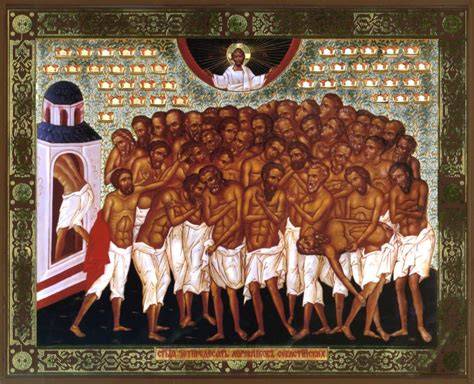
The soldiers were brought to a frozen lake near the city. There, they were told to strip off their clothing and stand in the middle of the frozen mass of ice. A guard watched over them while warm baths were set up along the shore, along with fires, blankets, clothing, and hot food and drink, in order to tempt them to turn their backs on Christ and sacrifice to the pagan idols.
A fire and warm baths were prepared at the edge of the lake, and they were told that they could come in from the ice and warm themselves if they turned away from Christianity.
In order to tempt them the more powerfully to renounce their faith, a warm bath was prepared at a small distance from the frozen pond, for any of this company to go to who were disposed to purchase their temporal ease and safety on that condition.
The martyrs’ courage and common prayer
The martyrs, on hearing their sentence, ran joyfully to the place, and without waiting to be stripped, undressed themselves, encouraging one another in the same manner as is usual among soldiers in military expeditions attended with hardships and dangers, saying that one bad night would purchase them a happy eternity.
The young men did not wait to be stripped, but removed their clothes themselves. The forty did not wait to be stripped, but undressed themselves, and encouraged one another in the ordeal.
They also made this their joint prayer: “Lord, we are forty who are engaged in this combat; grant that we may be forty crowned, and that not one be wanting to this sacred number.”
As the martyrs undressed, they prayed “Lord, to the number of 40 have we entered the arena, grant to all the crown. May no unit be lacking to the number which Thou hast chosen for a specific purpose.”
For three days and nights, the group endured. One account says that the martyrs endured three days and three nights this lingering death, which carried off their limbs one after another.
The Testament of the Forty Martyrs
All forty signed a will, drafted by St. Meletius, the youngest, that expressed their faith, unity, and courage:
When we by God’s grace and the common prayers of all shall furnish the strife set before us, and come to the rewards of the high calling, we desire that then this will of ours may be respected.
For although we come from different localities, we have chosen one and the same resting-place because we have set before ourselves one common strife for the prize. These things have seemed good to the Holy Spirit and have pleased us.
Therefore we, brothers in Christ, beseech our honored parents and relatives to have no grief or distress, but to respect the decision of our brotherly fellowship, and to consent heartily to our wishes, so that you may receive from our common Father the great recompense of obedience and of sharing in our sufferings.
We pray with our souls and with the Divine Spirit that we may all obtain the eternal good things of God and his kingdom, now and forever and ever. Amen.
The Testament is important because it presents the Forty Martyrs not merely as a group of individuals facing execution, but as a united Christian brotherhood. It emphasizes their common struggle, their shared resting-place, and their wish that their relatives respect the unity they maintained in death.
At the same time, the authenticity of the Testament has been debated for decades and has remained unresolved. Its central issue is the martyrs’ request not to disseminate their relics.
The document asks that the remains of the martyrs not be divided among different places. This request stands in tension with the later history of the cult of the Forty Martyrs, in which portions of their relics were collected, distributed, and honored in different Christian communities.
The soldier who abandoned the group
The guards in the mean time ceased not to persuade them to sacrifice, that by so doing they might be allowed to pass to the warm bath.
Though it is not easy to form a just idea of the bitter pain they must have undergone, of the whole number only one had the misfortune to be overcome. One young soldier decided to leave the group for the warmth of the baths, but the shock to his system killed him.
One of the soldiers could no longer bear the cold and ran to the shore. During the first hour of the night, when the cold had become unbearable, one of the soldiers made a dash for the bath-house, but no sooner had he stepped over the threshold, then he fell down dead.
This misfortune afflicted the martyrs; but they were quickly comforted by seeing his place and their number miraculously filled up.
The guard Aglaius joins the martyrs
One of the guards, seeing this disgrace, was inspired by the resolve of the remaining thirty-nine. When he was off-duty, he fell asleep by the fire and had a dream in which angels descended upon the soldiers on the lake and crowned them.
A guard watched the martyrs from the shore. Looking at the lake he saw that a radiant crown had appeared over the head of each martyr. He counted thirty-nine crowns and realized that the soldier who fled had lost his crown.
The guard, being struck with the celestial vision and the apostate’s desertion, was converted upon it. He threw off his clothes, proclaimed himself a Christian, and walked out to the group on the ice, bringing the number of martyrs back to forty.
During the third hour of the night, the Lord sent consolation to the martyrs. Suddenly there was light, the ice melted away, and the water in the lake became warm. All the guards were asleep, except for Aglaius, who was keeping watch.
Aglaius then woke up the other guards, took off his uniform and said to them, “I too am a Christian,” and he joined the martyrs.
Standing in the water he prayed, “Lord God, I believe in You, in Whom these soldiers believe. Add me to their number, and make me worthy to suffer with Your servants.” Then a fortieth crown appeared over his head.
Thus God heard their request, though in another manner than they imagined: “Which ought to make us adore the impenetrable secrets of his mercy and justice,” says St. Ephrem, “in this instance, no less than in the reprobation of Judas and the election of St. Matthias.”
The death of the soldiers
In the morning, the torturers saw with surprise that the martyrs were still alive, and their guard Aglaius was glorifying Christ together with them.
In the morning the judge ordered both those that were dead with the cold, and those that were still alive, to be laid on carriages, and cast into a fire.
They led the soldiers out of the water and broke their legs. During this horrible execution the mother of the youngest of the soldiers, Meliton, pleaded with her son to persevere until death.
In one account, the men, still alive, were taken back to the prison and tortured to death. Then their bones were crushed with sledgehammers.
One version of the story reports that all the men were frozen to death by morning. Another account, however, says that in the morning the men, still alive, were taken back to the prison and tortured to death.
Regardless of which version of the story is correct, the forty soldiers of Sebaste courageously refused to deny Christ.
Meliton and his mother
When the rest were thrown into a waggon to be carried to the pile, the youngest of them, whom the acts call Melito, was found alive; and the executioners, hoping he would change his resolution when he came to himself, left him behind.
Young Meliton was still breathing, and they left him on the ground. His mother then picked up her son, and on her own shoulders she carried him behind the cart.
His mother, a woman of mean condition, and a widow, but rich in faith and worthy to have a son a martyr, observing this false compassion, reproached the executioners.
When she came up to her son, whom she found quite frozen, not able to stir, and scarce breathing, he looked on her with languishing eyes, and made a little sign with his weak hand to comfort her.
She exhorted him to persevere to the end, and, fortified by the Holy Ghost, took him up, and put him with her own hands into the waggon with the rest of the martyrs, not only without shedding a tear, but with a countenance full of joy.
She said courageously: “Go, go, son, proceed to the end of this happy journey with thy companions, that thou mayest not be the last of them that shall present themselves before God.”
When Meliton drew his last breath, his mother put him on the cart with the bodies of his fellow sufferers.
The story of Meliton and his mother became an especially powerful image of Christian steadfastness. His mother does not attempt to preserve his earthly life at the cost of his faith, but encourages him to remain united with his fellow martyrs until death.
The burning of the bodies and the destruction of the relics
After three days the governor had the survivors’ limbs broken and their bodies burned. Officials hoped that young Meletius would save himself, but his mother herself lifted him onto the wagon, not wanting him to lose his prize.
The bodies of the saints were tossed in the fire, and their charred bones were thrown into the water, so that Christians would not gather them up.
The bodies were burned, and their ashes thrown into the river. In another account, the guards broke the bodies’ legs, threw them into the fire, and cast their ashes into the lake.
The governor had the ashes of the forty martyrs scattered into a river, but Christians secured some that became treasured relics, inspiring many throughout the Middle Ages.
Three days later the martyrs appeared in a dream to Saint Peter, Bishop of Sebaste, and commanded him to bury their remains. The bishop together with several clergy gathered up the relics of the glorious martyrs by night and buried them with honor.
It is said that for nights after the incident, a heavenly light shone over the water where the brave soldiers perished.
Relics and the development of their cult
The Christian community recovered some of the charred remains. The family of St. Basil the Great-whose parents and three siblings are all saints-were among those who helped to gather what remained of these martyrs.
Christians secretly carried off or purchased part of the bodies with money. Some of these precious relics were kept in Caesarea.
St. Basil says of the relics: “Like bulwarks, they are our protection against the inroads of enemies.” He adds that every one implored their succour, and that they raised up those that had fallen, strengthened the weak, and invigorated the fervour of the saints.
Saints Basil and Emmelia, the holy parents of St. Basil the Great, St. Gregory of Nyssa, St. Peter of Sebaste, and St. Macrina, procured a great share of these relics.
St. Emmelia put some of them in the church she built near Anneses, the village where they resided. The solemnity with which they were received was extraordinary, and they were honoured by miracles, as St. Gregory relates.
One of these was a miraculous cure wrought on a lame soldier, the truth of which he attests from his own knowledge, both of the fact and the person who published it.
He adds: “I buried the bodies of my parents by the relics of these holy martyrs, that in the resurrection they may rise with the encouragers of their faith; for I know they have great power with God, of which I have seen clear proofs and undoubted testimonies.”
Portions of their relics were also carried to Constantinople, and there honored with great veneration, as Sozomen and Procopius have recorded at large, with an account of several visions and miracles, which attended the veneration paid to them in that city.
St. Gaudentius, bishop of Brescia, writes in his sermon on these martyrs: “God gave me a share of these venerable relics, and granted me to found this church in their honor.”
He says that the two nieces of St. Basil, both abbesses, gave them to him as he passed by Caesarea, in a journey to Jerusalem; which venerable treasure they had received from their uncle.
The Testament and the problem of relic distribution
The Forty Martyrs’ request that their remains remain together is significant because the later cult developed through the circulation of relics. Portions of the martyrs’ remains were preserved in Caesarea, carried to Constantinople, brought to the West, and honored in churches dedicated to them.
The Testament is therefore closely connected with one of the central questions in the history of their cult: whether an early document really preserves the martyrs’ own words or reflects a later Christian concern about relics, burial, and collective identity.
The authenticity of the Testament has been discussed in modern scholarship for decades. Its authenticity has not been conclusively established, and the document has been argued to be spurious on the basis of its relationship to the later development of the cult of relics.
The central issue of the Testament is the martyrs’ request not to disseminate their relics. This request is difficult to reconcile with the earliest evidence for the widespread veneration and distribution of their remains.
The earliest sources relating to the cult of the Forty Martyrs include sermons by Basil of Caesarea and Gregory of Nyssa, accounts associated with Gaudentius of Brescia, and the historical narrative of Sozomen. These sources show that the martyrs’ relics were already being honored and circulated in the fourth and fifth centuries.
Gregory of Nyssa states: “We divided that dust and the relics from the furnace, and almost every land is blessed by these holy things.” This statement presents the relics as distributed among many Christian communities.
The evidence concerning the early cult therefore differs from the intention attributed to the Testament. The Testament asks for the martyrs to remain together, while the later evidence depicts their relics as divided and carried to different places.
Early Christian attitudes toward relics
The history of the Forty Martyrs belongs to a wider transformation in Christian attitudes toward the bodies of saints. The veneration of bodily remains became increasingly visible during the fourth century, although the practice developed gradually and was not uniform in every Christian community.
It was very rare, but not unprecedented, for early martyr narratives to preserve an individualized voice or first-person testimony. The Passio Perpetuae and the Martyrium Pionii provide comparable examples.
The beginning of the cult of relics involved questions about burial, bodily integrity, the division of remains, the movement of relics, and the relationship between a saint’s body and the sacred space in which it was honored.
Some early Christian texts express concern that the bodies of holy people should not be disturbed or divided. Other texts show that Christians collected, transferred, divided, and enshrined relics as a means of honoring the saints and seeking their intercession.
The cult of the Forty Martyrs reflects this broader development. Their remains were initially threatened with destruction, but Christians recovered portions of them and transformed the place of their death into a source of sacred memory.
Spread of devotion in East and West
Devotion to the Forty Martyrs soon spread throughout the world. In St. Basil’s city of Caesarea in Cappadocia, a basilica was built in their honor.
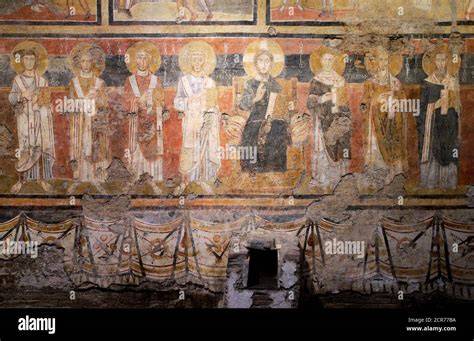
It is believed that St. Gaudentius introduced their cult and relics to the West. A chapel dedicated to them was discovered in 1901 in the Church of Santa Maria Antiqua in Rome with a representation dating from the sixth or seventh century depicting their martyrdom.
Santa Maria Antiqua is at the foot of the Palatine Hill in the Roman Forum. One of the frescoes in the chapel shows, of all things, a clothed Christ on the cross.
Portions of the relics were also carried to Constantinople and honored there with great veneration. Sozomen and Procopius recorded accounts of visions and miracles connected with their veneration in that city.
In the East, their cult became associated with the preaching of Basil of Caesarea, Gregory of Nyssa, Ephrem, and other Christian authors. In the West, the martyrs were remembered through sermons, churches, relics, liturgical texts, and representations of their death.
The Forty Martyrs in the preaching of Basil and Gregory of Nyssa
St. Basil of Caesarea preached on the Forty Martyrs and presented them as examples of courage, unity, and steadfastness. Their relics were described as a spiritual defense and as a source of strength for Christians.
Gregory of Nyssa also preached about the Forty Martyrs and connected their memory with the resurrection, the power of their relics, and the unity of the group in life and death.
Gregory’s statement that the dust and relics from the furnace had been divided and that almost every land was blessed by them is especially important for understanding the development of their cult.
The sermons of Basil and Gregory demonstrate that the martyrs were not remembered only as victims of an ancient persecution. They were active participants in the spiritual life of the Church, intercessors whose memory was tied to churches, relics, miracles, and communal prayer.
Historical memory and hagiographic development
The account of the Forty Martyrs is well-documented historically, and inspired great faithfulness in the ancient Church.
The earliest narratives and later homilies do not present exactly the same details. Some accounts describe the martyrs as standing in the water, while others describe them as exposed on the ice. Some emphasize death by freezing, while others describe the breaking of their limbs and the burning of their bodies.
The acts, and the greater part of the writers of their lives, suppose they were to stand in the very water. But this is a circumstance which later scholars correct from St. Basil and St. Gregory of Nyssa.
One version of the story reports that all the men were frozen to death by morning. Another account says that in the morning the men, still alive, were taken back to the prison and tortured to death.
These differences do not alter the central significance of the narrative. In every version, the soldiers refuse to deny Christ, endure a deliberately designed ordeal, and die as a united group whose number is restored through the conversion of a guard.
The story developed through sermons, passiones, liturgical commemorations, accounts of relics, and visual representations. Its enduring form reflects both the memory of a group of soldiers executed in Sebaste and the theological themes that later Christian communities found in their death.
The meaning of the number forty
The number forty is central to the identity of the martyrs. The soldiers prayed that all forty would receive crowns and that no one would be missing from the sacred number.
When one soldier abandoned the group, his departure appeared to threaten the completeness of their witness. The conversion of the guard restored the number and became a sign that the martyrs’ unity was preserved.
The number forty also gives the group a collective identity. Although the soldiers came from different places, they chose one common struggle and one common resting-place.
For although we come from different localities, we have chosen one and the same resting-place because we have set before ourselves one common strife for the prize.
The significance of the number therefore lies not only in arithmetic completeness, but also in the unity of the soldiers’ confession, suffering, prayer, and burial.
Unity in faith and brotherhood
The Forty Martyrs were remembered as a single body even though they were individual soldiers with different backgrounds and names.
The Testament emphasizes that they came from different localities but were united by one struggle. Their unity was not based on nationality, family, or military origin, but on their common confession of Christ.
In the Passio of these martyrs, there is information that their bodies were burned after death. The Testament and later accounts also place considerable emphasis on what should happen to their remains.
The martyrs’ collective identity continued after death through shared commemoration, common relics, churches dedicated to the whole group, and liturgical texts that addressed them as a single body.
Liturgical commemoration
The Forty Martyrs of Sebaste are commemorated on March 9. Some calendars and older references give March 10 as the feast day.
The Eastern churches celebrate the Feast of the Forty Martyrs of Sebaste with these words: “Leaving all soldiery of the world you, the forty trialbearers of the Lord, have cleaved to the Heavenly Master; for, passing through fire and water, O blessed ones, you have justly received glory from heaven and a multitude of crowns.”
Troparion - Tone 1
Let us honor those noble soldiers of the Master of all, for they were united by their faith as they passed through fire and water; and being enlisted by Christ, they entered into divine refreshment.
Now those pious warriors stand and intercede with Christ God for those who cry out: “Glory to Him Who strengthened you. Glory to Him Who crowned you. Glory to Him Who made you wondrous, O Forty Martyrs.”
Troparion - Tone 1
For the sake of the sufferings of Your Saints, which they endured for You, O Lord, we entreat You to heal all our infirmities, O Lover of mankind.
Kontakion - Tone 6
Leaving all earthly armies, you cleaved to the Master in Heaven, O Forty prize-winners of the Lord; for passing through fire and water, O blessed Martyrs, as is meet, you received glory from Heaven, and a multitude of crowns.
“Passing through fire and water”
The liturgical language of the feast draws together the principal elements of the martyrs’ story: military service, the frozen lake, fire, water, crowns, and heavenly glory.
The phrase “passing through fire and water” also expresses the transformation of suffering into spiritual victory. The soldiers passed through the literal elements of cold water and fire, but Christian worship interprets their experience as entry into divine refreshment.
Their military identity is not erased but reinterpreted. They leave the armies of the world and become soldiers of Christ, enlisted by the heavenly Master.
Their crowns symbolize perseverance, martyrdom, and the restoration of the sacred number forty. The crown first appears in the narrative through the vision of the guard and then becomes a central image in the liturgical commemoration.
The spiritual significance of the martyrs
The Forty Martyrs are remembered as examples of steadfastness when faith is placed under pressure. The story contrasts the temporary relief offered by the warm bath with the enduring reward promised to those who remain faithful to Christ.
Christian life means following Christ at all costs. While the world offers many “bath houses,” those with spiritual eyes can see them as fleeting pleasures that lead us away from the true joy of following Christ.
In the Forty Martyrs, the path toward true joy in Christ is one we tread together. The best way to encourage our young people to continue following Christ is if we bear our own crosses with joy and co-suffering love.
The young martyrs of Sebaste have fascinated many Christians because their idealism and brotherhood can invite people to consider seriously a commitment to Christ.
“Young people,” says journalist Paul Lauer, “have enough energy to climb tall mountains of faith, hope, and love. If all we offer them are little molehills, they’ll simply go elsewhere for their challenges.”
The story presents courage not as an isolated quality but as something strengthened by fellowship. The soldiers pray together, encourage one another, draft a common testament, endure the ordeal together, and seek to remain united even in burial.
“Stay in the Lake”: a modern interpretation
“Stay in the Lake” has become a modern expression based on the martyrs’ refusal to leave the frozen lake for the warm bath.
OYM believes that youth and young adult ministry needs to be a joint effort from clergy, parents, teachers, mentors, and peers. Christian life means following Christ at all costs.
The phrase emphasizes perseverance in the face of attractive but temporary alternatives. It also stresses that Christian endurance is communal rather than merely individual.
We must persevere - Stay in the Lake - together.
The modern application does not require a literal repetition of the martyrs’ ordeal. Instead, it interprets their story as a call to resist pressures that weaken Christian commitment and to support one another through difficulty.
The martyrs as an example of spiritual struggle
Though we are not all called to the trial of martyrdom, we are all bound daily to fight, and to conquer too.
By multiplied victories which we gain over our passions and spiritual enemies, by the exercise of meekness, patience, humility, purity, and all other virtues, we shall render our triumph complete, and attain to the crown of bliss.
The contrast between the martyrs and ordinary Christians is presented as a challenge to spiritual complacency. The martyrs faced public violence and death, while other Christians must confront sloth, distraction, attachment to earthly things, and the tyranny of the passions.
The eloquence of the greatest orators, and the wisdom of the philosophers were struck dumb: the very tyrants and judges stood amazed and were not able to find words to express their admiration, when they beheld the faith, the cheerfulness and constancy of the holy martyrs in their sufferings.
But what excuse shall we allege in the tremendous judgment, who, without meeting with such cruel persecution and torments, are so remiss and slothful in maintaining the spiritual life of our souls, and the charity of God?
The traditional interpretation therefore moves from the historical ordeal of the soldiers to the daily moral and spiritual struggles of Christians.
The martyrs and Christian intercession
The Forty Martyrs are honored not only as examples but also as intercessors. Their relics were regarded as sources of protection, healing, strength, and encouragement.
St. Basil described their relics as bulwarks against the inroads of enemies. Gregory of Nyssa connected the burial of his parents with the relics of the martyrs, hoping that they would rise with the encouragers of their faith.
The liturgical texts ask the martyrs to intercede with Christ for those who honor them. The martyrs are presented as standing before God and praying for Christians who face infirmity, weakness, temptation, and spiritual struggle.
Forty Martyrs of Sebaste, who froze to death on an ice-covered lake instead of renouncing your faith-pray for us!
Popular customs associated with March 9
There is a pious custom of baking “skylarks,” pastries shaped like skylarks, on this day, because people believed that birds sing at this time to announce the arrival of spring.
Forty “skylarks” are prepared in honor of the Forty Martyrs.
This custom connects the feast with the seasonal transition from winter to spring. The martyrs’ story is set in severe winter, while the birds and spring pastries express renewal, hope, and the movement from death toward life.
Visual memory of the Forty Martyrs
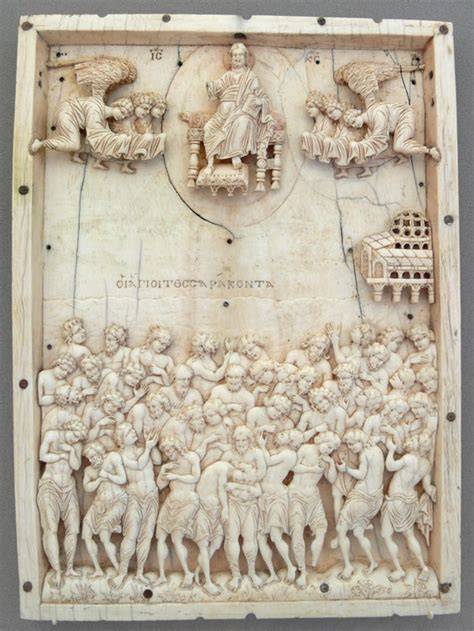
The death of the Forty Martyrs became an important subject in Christian art. A delicately carved ivory panel depicts the martyrs’ death.
A chapel dedicated to them was discovered in 1901 in the Church of Santa Maria Antiqua in Rome with a representation dating from the sixth or seventh century depicting their martyrdom.
The visual tradition commonly presents the soldiers together on the ice, emphasizing the unity of the group rather than the distinction between individual deaths.
Biblical and theological language
The narrative uses the language of Christian athletic and military struggle. The soldiers are described as completing the contest, reaching the prize of the heavenly calling, and receiving crowns.
Their language recalls the New Testament image of running a race, finishing a course, and enduring to the end. The story also connects martyrdom with resurrection and eternal life.
One biblical text associated with their witness is: “He who believes in me, though he die, yet shall he live” (John 11:25).
Another text expresses the meaning of perseverance: “But I do not account my life of any value nor as precious to myself, if only I may finish my course and the ministry that I received from the Lord Jesus, to testify to the gospel of the grace of God.” Acts 20:24
Their Testament refers to the “strife set before us” and to the “rewards of the high calling,” language that recalls the New Testament’s imagery of a race, contest, or athletic struggle.
Why the Forty Martyrs remain significant
The significance of the Forty Martyrs lies in the combination of historical memory, collective identity, martyrdom, relic veneration, liturgical prayer, and spiritual instruction.
They were soldiers who refused to separate public duty from religious conviction. Their military status could not persuade them to worship pagan gods, and threats against their rank could not overcome their loyalty to Christ.
They were a group of Christians who remained united even though they came from different places. Their shared death became a testimony that faith could create a community stronger than nationality, military hierarchy, and fear of death.
They demonstrated courage in a situation designed to produce gradual surrender. The frozen lake, the prolonged exposure, the guard, the fire, and the warm bath were all used to isolate the soldiers psychologically as well as physically.
Their relics became a visible sign of continuity between the martyrdom of the fourth century and the life of later Christian communities. Churches in Caesarea, Constantinople, Rome, and the West preserved their memory through relics, preaching, art, and worship.
Their story also illustrates the development of Christian attitudes toward relics. The Testament’s request that the relics not be disseminated contrasts with the later distribution and veneration of their remains, making the document important for the study of early Christian memory and the cult of saints.
Above all, the Forty Martyrs are remembered for refusing to exchange lasting faithfulness for temporary relief. Their story presents Christian courage as a common struggle, sustained by prayer, brotherhood, and hope in the resurrection.