The Basilica of the National Shrine of the Assumption of the Blessed Virgin Mary, also known as the Baltimore Basilica, is the first Roman Catholic cathedral built in the United States after the adoption of the Constitution. Constructed primarily between 1806 and 1821 according to designs by Benjamin Henry Latrobe, it remains one of the most significant religious and architectural landmarks in the country.
The Basilica combines American neoclassical architecture with Roman and Greek visual traditions, a historic crypt, a light-filled double-shell dome, important works of art, and a central role in the development of Catholic life in the United States. It is also a Minor Basilica, a national shrine, a National Historic Landmark, a Baltimore City historic landmark, and a co-cathedral.
Historical importance of the Baltimore Basilica
The Basilica was constructed between 1806-1863. The construction of the Basilica occurred in two campaigns: 1806 to 1810 and 1817 to 1821. It was then the only Roman Catholic cathedral in the United States, and it rivaled the U.S. Capitol in size, scale and architectural sophistication.
The Basilica of the National Shrine of the Assumption of the Blessed Virgin Mary in Baltimore, the first cathedral built in the United States, is turning 200 years old on May 31. The Basilica was blessed and opened for public Masses in 1821 by the third Archbishop of Baltimore. When the debts were paid in full for the construction, the Basilica was consecrated in 1876 by Archbishop James Roosevelt Bayley, the eighth Archbishop of Baltimore (and the nephew of St. Elizabeth Ann Seton).
Unlike the Capitol, however, the Basilica never suffered from fire or other major damage so that today it retains much of its original, Latrobe-designed, building fabric, including the exterior walls, dome, and planar interior surfaces. Latrobe’s building technology was very advanced for its time and much of it has survived at the Basilica.
John Carroll and the creation of the first American cathedral
The original plans to build it were initiated by the first Catholic bishop and archbishop in America, the Most Rev. John Carroll (1735-1815). He was a native-born American and a brother of a signer of the Constitution and a cousin of a signer of the Declaration of Independence.
Carroll, a scion of a wealthy Maryland family, was architecturally literate and culturally sophisticated. He understood that if the Catholic Church was to emerge as a major force in the rapidly developing nation, it needed an architectural symbol that was up to date and definitively American.
At that time when he served as the first ordinary of the first diocese in the nation, his territory encompassed all of the United States. Carroll's family was well-known in the area; they had been instrumental in the development of the colony of Maryland and the establishment of the city of Baltimore in 1729.
Baltimore was chosen because Maryland was one of the few regions of the 13 colonies that had a substantial Catholic population. Before the United States declared its independence in 1776, Catholics in America were under the ecclesiastical jurisdiction of the Apostolic Vicariate of the London District in England.
In 1784 Pope Pius VI set up the Prefecture Apostolic of the United States, encompassing the entirely of the new nation, with Baltimore as its city. In 1789 the same pope erected the Diocese of Baltimore. The following year, Carroll traveled to England where he was consecrated a bishop in a castle by a Benedictine bishop.
Upon his return, in the year 1800 the first native-born American citizen was ordained a priest in Baltimore at St. Peter’s Pro-Cathedral, built in 1770. To this day, the Archdiocese of Baltimore remains the premier or the first see in the United States, due to its prerogative of place.
At the same time, it curiously was never given “primatial” status by the Holy See. Because it is the oldest diocese in the U.S., the Archbishop of Baltimore has the right of precedence in the nation at liturgies and events with the bishops.
Benjamin Henry Latrobe and the architectural concept
The structure is considered one of the most prominent designs of the early American architect Benjamin Henry Latrobe (1764-1820), also called the “father of American architecture.” A native of England, Latrobe was a neoclassical architect who emigrated to the United States in 1796.
As one of the first formally trained architects in the new nation, he was hired by Thomas Jefferson, a founding father and third president, who asked him to design the new U.S. Capitol building. Latrobe is also credited with the design of the neoclassical portico of the White House in Washington, D.C., reflecting in some ways what he was to later create at the Baltimore cathedral with its classical Greek portico of columns.
Its architect, Benjamin H. Latrobe, was the most important architect at the time of its construction, having helped designed the U.S. Capitol. Upon the request of Bishop John Carroll, Latrobe presented two different plans for the cathedral.
Bishop Carroll chose Latrobe’s neoclassical architectural plan over a Gothic alternative, because he wanted to convey the message that the Catholic Church was a forward-thinking institution that would stay and participate in the building of America.
Carroll had a major influence on the design of the building. His skills were also essential in getting the building funded and constructed in accordance with Latrobe’s design. The Basilica embodies Latrobe’s evolving architectural ideas and represents the pinnacle of his architectural maturity.
The cathedral was completed after the architect's untimely death, the result of yellow fever contracted in Louisiana. Although Latrobe was the designer of the Cathedral, he received major assistance and support from Bishop John Carroll and President Thomas Jefferson.
Neoclassical exterior and urban setting
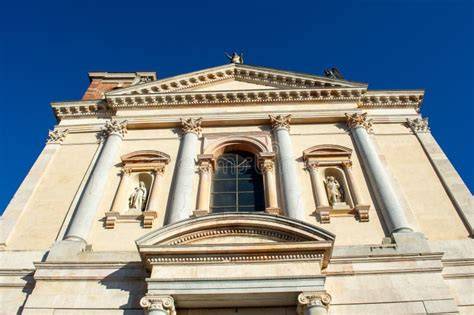
Above the scurry and tumult of a port city with early American roots, there is a majestic downtown space known as the Basilica of the National Shrine of the Assumption. Its herculean procession of Ionic columns gracing its front façade makes it a recognizable city landmark, richly evoking the embellishments of antiquity.
While the Basilica is a colossal bow to the ancient world with its serene and seemingly timeless exterior, the interior is equally beautiful, reflecting the best of Rome and Greece with the column, arch, and dome. As visitors enter they travel back in time to the first cathedral in the United States, built just after the promulgation of the U.S. Constitution.
For the Basilica, he arranged the columns in a double hexastyle pattern. When originally constructed on a hill overlooking the city of Baltimore, the Basilica with its massive dome was an icon visible for miles.
While the Baltimore Basilica resembles a Roman temple from the exterior, on its roof it has two curious spires or cylindrical towers with onion-shaped domes that hold two bells. These resemble the former spires that once graced the rooftop of the Pantheon in Rome, reflecting in some ways the symbolic Christianization of the pagan architecture of old, making the old architecture distinctly Christian, with bells to sound the hours of prayer.
The dome, skylights, and interior design
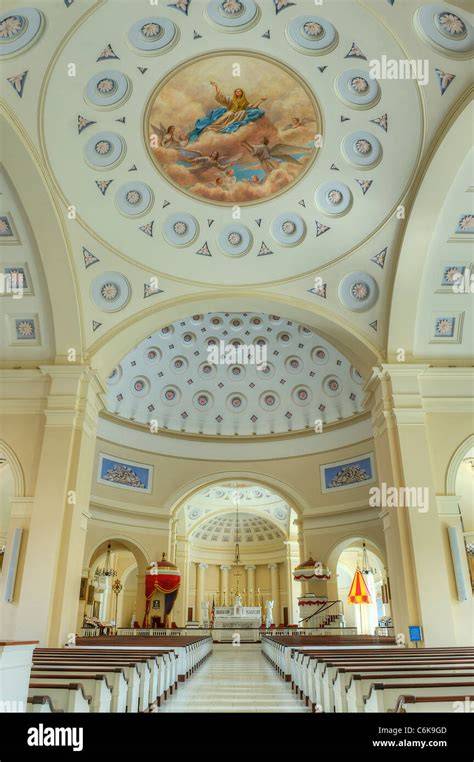
The interior design is occupied by a massive dome at the crossing of a Latin cross plan, adorned by grids of plaster rosettes. According to legend, Latrobe had originally planned for a typical masonry dome capped with a small lantern.
Thomas Jefferson himself mediated in a difference of opinion between Bishop Carroll and Latrobe - two men who had a very collaborative relationship overall. Jeffersonʼs proposal, inspired by his visit to Paris, was finally incorporated in the cathedral: a wooden double-shell sky-lit dome.
But it was Thomas Jefferson who suggested a wooden double-shell dome of a type pioneered by French master builder Philibert Delorme. This version had 24 half-visible skylights.
Thomas Jefferson’s influence included advice on the design of the dome, and skylights. The light-filled interior was in sharp contrast to the dark and cavernous recesses of many traditional cathedrals in Europe.
The architectural design of the Baltimore Basilica is a sight to behold. It is a three-aisled basilica with transept-like side portals. The crossing is covered by a wide, flat dome that is lit by indirect daylight, giving the building aspects of a central building.
This unique design contributes to the cathedral's grandeur and historical significance. The interior reflects a deliberate combination of classical forms, carefully controlled natural light, and the spatial organization of a Latin-cross church.
The main altar, chapels, windows, and works of art
The main altar was designed to be baroque in the style of southern Italy with two gradines and two different colored marbles with a unique acanthus flowering above the tabernacle, carved in Carrara stone, holding a golden altar crucifix that matches the six altar candlesticks.
In addition there is also a rare mix of American heritage architecture, with confessionals in American colonial style, with large mullioned windows that allow ample light with single-pane clear window panels.
The interior houses various works of precious art, including two paintings given by King Louis XVIII of France in 1821 just after the opening of the Basilica. In typical early nineteenth century heroic French style, the portraits depict the descent of Christ’s body from the cross as well as St. Louis IX burying his plague-stricken deceased troops in Tunisia during the Eighth Crusade, just before he, too, died in Carthage.
The Basilica and the development of American Catholicism
The cathedral hosted key events in the expansion of Catholicism in the United States. During plenary councils at the basilica in the 1800s, the Baltimore Catechism was commissioned, and the American Catholic school system was also planned there.
Over the years many great events were held at the cathedral, including all the first big ordinations and episcopal consecrations of most of the first American bishops to fill the ever- multiplying dioceses as the nation grew. Historically, the basilica held the record for many years as the place where the most number of ordinations in the country had been celebrated.
In addition, the site hosted the early meetings of bishops that helped shape the Catholic identity of the nation, including the seven Provincial Councils and three Plenary Councils. The famous Baltimore Catechism that catechized America came from the Third Plenary Council, which had been the largest meeting of bishops outside Rome since the Council of Trent.
In addition, the famous A Manual of Prayers for the use of the Catholic laity was prepared and enjoined by order of the Third Plenary Council of Baltimore and was approved in 1889 by James Cardinal Gibbons (this was the first American produced Latin-English missal for the lay faithful).
More than 30 bishops assigned to dioceses across the United States were ordained at the basilica. Blessed Michael McGivney, founder of the Knights of Columbus, was ordained at the basilica on Dec. 22, 1877.
The first ordination of an African-American priest on U.S. soil, Charles Randolph Uncles, SSJ (Nov. 8, 1859 - July 20, 1933), took place at the basilica in 1891.
Notable events and visitors
One of the most memorable liturgies held at the Basilica was the funeral Mass of Charles Carroll, the brother of Bishop Carroll, a signatory of the Declaration of Independence. He was the longest living person who signed the document, dying in 1832 some 56 years after the signing.
In 1862 during the American Civil War, the Union General Joseph Revere, a grandson of the Revolutionary War figure Paul Revere, formally converted to the Catholic Faith during the war and was baptized and received into the Faith in the Basilica, despite the ongoing hostilities. A week later he received his First Holy Communion and returned to the battlefield.
Cardinal Pacelli, the future Pope Pius XII, paid a quick visit to the Basilica on October 21, 1936. He arrived in Baltimore by train from Washington, D.C. and made a one-day visit to the area.
He was driven in a car to the Basilica where he knelt in prayer for several minutes before the main altar. He then visited the crypt to see the tomb of James Cardinal Gibbons, the second cardinal in American history, before driving north to visit St. Mary’s Seminary and University, the first Catholic seminary in the country.
He then drove back to Baltimore's beautiful Penn Station and departed by train to continue on his way to New York. Pope John Paul II visited the Basilica in 1995 (and previously in 1976 at Cardinal).
In 1996 Mother Teresa visited on her final visit to the United States. Other saints have visited, too, including St. John Neumann, the founder of the Catholic school system in America and Blessed Fr. Michael McGivney, founder of the Knights of Columbus, ordained at the Basilica in 1877.
The historic crypt
Nine of the fourteen deceased archbishops of Baltimore have been laid to rest in the basilicaʼs historic crypt. The crypt is located beneath the main altar, next to the Our Lady Seat of Wisdom chapel, and is accessible to the public.
The red galero hat of Cardinal Gibbons can still be seen, suspended since his death, a reminder to pray for the response of his soul. There is a story behind this custom that arose in Europe, urging the faithful to pray for reposed members of the College of Cardinals; the tradition being that the cardinals' hats are suspended in their cathedrals until their souls are eventually released from Purgatory, symbolized by when the hats decay after many years, falling in pieces to the floor.
From cathedral to basilica and co-cathedral
In 1937 Pope Pius XI gave to the cathedral the rank of Minor Basilica shortly after Cardinal Pacelli's visit and today it has the additional title of Co-Cathedral.
A new cathedral for Baltimore was later built and was completed in 1959, dedicated to Mary Our Queen with a much larger seating capacity for 2,000 faithful on the north end of Baltimore. In 1960 Cardinal Montini (future Pope Paul VI) made a special visit to admire the "modern" architecture, a popular trend in those years.
The Baltimore Basilica has been recognized for its historical and architectural significance.
| Recognition | Year |
|---|---|
| Minor Basilica | 1937 |
| National Historic Landmark | 1971 |
| Baltimore City historic landmark | 1975 |
| National shrine | 1993 |
On November 11, 1971, it was declared a National Historic Landmark. Further recognition came in 1993 when the United States Conference of Bishops declared it a national shrine. These designations highlight the cathedral's importance in the religious and cultural history of the United States.
Restoration and preservation
Between Nov. 2004 and Nov. 2006, the cathedral underwent a massive 32-month long restoration financed with private funds. It reopened in time for the 2006 USCCB meeting, which was held in Baltimore to mark the occasion.
An earthquake that shocked the East Coast on Aug. 23, 2011, generated about 1,000 linear feet of cracks in the basilica’s structure. A seven-month, $3 million restoration was completed on Easter Sunday 2012.
Visiting the Baltimore Basilica
The Basilica is 100% ADA compliant. There are wheelchair ramps to gain entry from the street level into the church, and elevators inside, so that all areas of the church are accessible, however, the Basilica does not have wheelchairs available for use.
The Basilica is located at North Charles Street 408, Baltimore. Its downtown location makes it convenient to combine a visit with other attractions connected with Baltimore's history and culture.
| Visitor detail | Information |
|---|---|
| Location | North Charles Street 408, Baltimore |
| Reservations | Required only for groups of 10 or more |
| Wednesday | 9:00 - 12:00 |
| Friday | 9:00 - 12:00 |
| Monday, Tuesday, Thursday, Saturday, Sunday | Closed |
Reservations are required only for groups of 10 or more. The published visitor information lists opening hours from 9:00 to 12:00 on Wednesday and Friday, with Monday, Tuesday, Thursday, Saturday, and Sunday listed as closed.
Visitors generally appreciate its neoclassical design and beautiful interior, particularly noting the dome and the play of light within the space. The basilica offers a peaceful atmosphere for reflection and prayer.
Many reviewers comment on its historical importance as the first Roman Catholic cathedral built in the United States. The guided tours, when available, are often praised for providing insightful historical context.
However, a few visitors note that without a guide, the experience can be somewhat limited as there's less explanatory information available. The basilica's location in downtown Baltimore is convenient for most, though parking can sometimes be a challenge.
Some visitors recommend combining a visit to the basilica with other nearby attractions for a fuller experience of Baltimore's history and culture. Overall, the Basilica of the National Shrine of the Assumption of the Blessed Virgin Mary is generally well-regarded for its historical significance, architectural beauty, and spiritual atmosphere, making it a worthwhile stop for those interested in religious history or architecture.