Adam Clarke (1762-1832) was a British Methodist theologian, preacher, and biblical commentator, best known for his monumental Commentary on the Holy Bible. His scholarship combined detailed study of biblical languages, history, geography, and culture with a strong commitment to Methodist theology, practical Christianity, and Christian service.
Clarke’s chief contribution remains his commentary on the Bible, an academic tour de force in its day and a work that continued to enjoy extensive circulation. His theology generally followed John Wesley on prevenient grace, universal justification, sanctification, assurance, and the responsible exercise of human freedom, while his distinctive teaching on the eternal Sonship of Christ generated one of the most important theological controversies within nineteenth-century Methodism.
Life and Methodist identity
Adam Clarke was born in Moybeg Kirley, County Londonderry, Ireland. His scholarly pursuits were deeply rooted in his unwavering faith and dedication to the Methodist movement, which he served with distinction throughout his life. Clarke was one of the successors of John Wesley and knew him in his old age.
Clarke’s life and work exemplify the fusion of intellectual rigor with a heartfelt commitment to faith and service, making him a revered figure in Christian scholarship and an inspiring example of devout scholarship. His enduring influence is evident not only in his written works but also in his impact on Methodist theology and the broader Christian community.
Major works
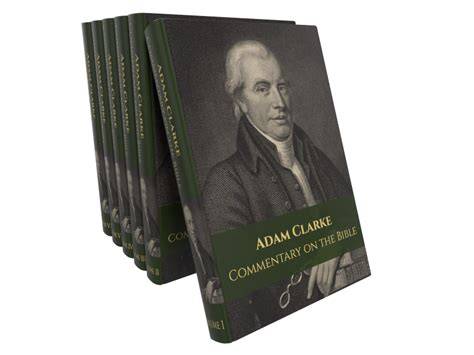
Clarke was a prolific writer, contributing to various fields of study, including theology, biblical languages, and history. He is chiefly remembered for writing a commentary on the Bible, published in eight volumes in Liverpool between 1810 and 1826, which long had an extensive circulation.
| Work | Publication details | Significance |
|---|---|---|
| Commentary on the Holy Bible | 8 vols., Liverpool, 1810-26 | Clarke’s chief contribution and most influential scholarly work |
| Biographical Dictionary | 6 vols., London | A major contribution to historical and biographical study |
| The Biographical Miscellany | 2 vols., 1806 | A supplement to the Biographical Dictionary |
| Miscellaneous Works | 13 vols., edited by J. Everett, London, 1836-37 | A collected edition of Clarke’s wider literary production |
| Christian Theology | Published posthumously in 1835 | A systematic and practical presentation of Clarke’s theological convictions |
| Wesleyana | 1840 | A companion volume to Clarke’s theological and Wesleyan writings |
Clarke’s biblical commentary
Clarke’s commentary meticulously covers the Old and New Testaments and stands as a testament to his vast knowledge of biblical languages, history, and cultures. His work is distinguished by its detailed analysis, exhaustive research, and the integration of historical context, which together offer readers a comprehensive understanding of the Scriptures.
Unlike many of his contemporaries, Clarke was not content with surface-level interpretation; he delved deeply into the etymology of words and the geographical and cultural backgrounds of biblical events, providing a rich tapestry of insights that has enriched Christian scholarship. His commentary long had an extensive circulation and is still widely used.
Clarke’s style is more stream-of-consciousness: he writes as if he’s preaching his heart out. Like in Wesley’s sermons, you see lots of exclamation points as he makes statements and pointed observations. Although there are perhaps hundreds of sentences in this book that use Biblical expressions, because he writes on the go, he doesn’t take the time to provide many Biblical proof texts, chapters and verses, but assumes the reader is already very familiar with the Bible.
Clarke’s limited use of detailed proof texts has been regarded as one of the weaker parts of the work, although it can be remedied by careful scholarship. His writing nevertheless combines academic investigation with the urgency of preaching, allowing the commentary to function not only as a reference work but also as an instrument of spiritual formation.
Clarke as a biblical theologian
As a theologian, Clarke taught that the Bible provides a complete interpretation of God’s will and nature. He considered Scripture itself a miracle of God’s grace, “which takes away the veil of darkness and ignorance.” With such an understanding, Clarke was first and foremost a Biblical theologian, often uneasy with purely systematic approaches to theology.
Clarke’s approach was systematic in scope but practical and revivalist in character. He did not waste time on speculative subjects. His theology was sound, practical, and driven by a holy life, while presenting anti-Calvinistic arguments throughout his work.
Scripture
Clarke regarded Scripture as authoritative, inspired by God, and sufficient for salvation. He did not waste time trying to prove the inerrancy of Scripture, but simply stated that it is authoritative, inspired by God, sufficient for salvation, and did not hesitate to say that dreams and visions played a role in the writing of the Bible.
For Clarke, Scripture was not merely a source of theological propositions. It was the means through which divine truth becomes accessible to human beings, removing the veil of darkness and ignorance and directing them toward salvation and holy living.
Doctrine of God
Clarke taught that God is love, but He also has other attributes: goodness, happiness, self-existence, reason, excellence, moral perfection, lordship, unity of the Trinity, justice, holiness, and benevolence. He understood benevolence as lovingkindness and charitability, an attribute that is inconsistent with the Calvinistic doctrines of limited atonement and double predestination.
Clarke taught that God is a Spirit, an immaterial substance; that God is eternal, omnipotent, omnipresent, and omniscient; and that God possesses all knowledge. He also held that God makes Himself seen, heard, and felt by dreams, visions, voices, and the presence of God in worship and prayer.
Clarke’s account of the Trinity included the Father, the Son, and the Holy Spirit. The unity of the Trinity could be illustrated by a shamrock. He also taught that there are degrees of the power and presence of the Holy Spirit.
Christology and the controversy over eternal Sonship
Perhaps Clarke’s most controversial position regarded the eternal Sonship of Jesus Christ. Clarke did not believe it Biblically faithful to affirm this doctrine, maintaining that prior to the Incarnation, Jesus was “unoriginated.” Otherwise, according to Clarke, Christ would be subordinate to God and therefore not fully divine.
This was important to Clarke because he felt that Christ’s divinity was crucial to understand the atonement. Clarke’s view was opposed by many Methodists, notably Richard Watson. Watson and his allies argued that Clarke’s position jeopardized the integrity of the doctrine of the Trinity.
Methodism rejected Clarke’s view in favor of the traditional orthodox perspective of Christology. Methodist theologians took Clarke’s statement that “the doctrine of the eternal Sonship must be false” to mean that he might be adopting a heretical view of Christ, perhaps something like Arianism.
Clarke’s wider argument, however, distinguished between the eternal existence of the Second Person of the Trinity and the language of Sonship. He maintained that the Trinity is eternal, comprised of the three separate but connected persons of the Father, the Logos, and the Holy Spirit; that the Second Person of the Trinity, known as the Logos, became incarnate in the person of Jesus Christ; and that the Second Person of the Trinity is God.
Clarke further held that when the Second Person became incarnate in Jesus, he was both human and divine, or “God manifested in the flesh.” Jesus’ human nature came from the Virgin Mary, but his divine nature was “uncreated and unbegotten”; because he is God, Clarke argued, the doctrine of the eternal Sonship must be false.
According to this interpretation, Clarke was stating that the Second Person of the Trinity has always existed while denying that the Second Person was “begotten” or “born” before the first century. The Second Person was fully divine and eternal in the past, but did not possess the nature that a son has to a father before the first century; once the Second Person entered history, he became incarnate in the person of Jesus and took on the nature of a Son of God.
Methodist theologians rejected Adam Clarke’s articulation of the Second Person and the Incarnation and required every Methodist preacher to side with John Wesley’s original articulation of the eternal Sonship in his Notes Upon the New Testament for Hebrews 1. Since Clarke’s Christian Theology was published after his and Wesley’s deaths, they were not able to discuss this, and the Methodist clergy remaining decided to side with Wesley’s original view: by some mystery, the Second Person was always in the form of a Son of God, even before he was incarnated in the first century.
Creation and human nature
Clarke taught that God made Adam, the first man, in the Garden of Eden; he was made in the image and likeness of God, not in the likeness of animals, monkeys, or any beast. Evolution was not part of his account, as this was before Darwin, and Christians actually believed in Genesis 1-3 without doubting.
Adam was originally very smart and righteous and had the capability of being physically immortal if he had eaten from the tree of life. The first occasion of backsliding was the fall of Adam and Eve in Genesis 3 when they were seduced by a demon-possessed snake.
Clarke made the observation that if “once saved, always saved” were true, then why would Adam have fallen? Adam was already in the state of salvation when God made him, but his freedom to resist God’s grace led to his downfall. This became an illustration of the Arminian doctrine of conditional security.
Arminian theology and grace
Clarke generally followed Wesley regarding the interpretation of God’s forgiving grace, prevenient grace, the offer of justification from God to all persons, sanctification, and assurance. His theology placed strong emphasis on the universal offer of divine grace and on the human response to that grace.
His understanding of grace was incompatible with limited atonement and double predestination. Divine benevolence, in Clarke’s account, means that God’s saving purpose is not restricted to a predetermined group while others are excluded from the possibility of salvation.
Repentance
In Clarke’s account of salvation, God’s Spirit grants people repentance. Repentance is a spirit of repentance: when a person has this spirit, he “feels deep anguish of soul, because he has sinned against God, unfitted himself for Heaven, and exposed his soul to Hell.” It is “a deep and alarming conviction, that thou art a fallen spirit, hast broken God’s laws, art under His curse, and in danger of Hell fire.”
The penitent confesses his sin to God, hates his sin, and makes up his mind that he wants to get it out of his life. He sees and admires the purity of the moral law of Scripture and looks upon his sin as something vile, impure, and shameful.
The first use of the law takes its effect in repentance: it is then that the Ten Commandments bring condemnation and the fear of Hell. Repentance therefore involves more than intellectual recognition of wrongdoing; it includes moral revulsion toward sin and a decisive desire to abandon it.
Faith, justification, and the atonement
The next stage is faith in the atoning blood of Jesus. Clarke taught justification by faith alone, but not salvation by faith alone, because repentance and sanctification are also needed for final salvation.
In justification, the convicted sinner feels like a convict, a criminal about to face a fiery prison sentence, and Jesus comes with His love to bail him out. The sinner trusts and believes in Jesus’ sacrifice on the cross and comes to believe that the record of his sins has been erased.
Justification is the imputation of God’s forgiveness of sins, but it is not the imputation of Jesus’ obedience to the moral law. Christians remain fully responsible to obey God’s law. Clarke’s position therefore joined confidence in Christ’s atoning work with a continuing obligation to holy obedience.
Faith in the cross can strengthen, weaken, or completely fizzle out. It is therefore necessary for Christians to do their part and strengthen and keep their faith as much as possible through obedience to Biblical commands, taking the Lord’s Supper, heartfelt prayer and contemplation, Christian fellowship, and good works such as evangelism and charity to the poor.
Regeneration and sanctification
Regeneration, or the incoming of the Holy Spirit into the Christian’s heart, is an empowerment to live a godly life of sanctification and to hunger and thirst after righteousness and so be filled.
Regeneration is evidenced by “love, joy, peace, forbearance, kindness, goodness, faithfulness, gentleness and self-control,” as the Holy Spirit regenerates or breathes new life, spirit, and emotion into the sinner’s heart, making a saint out of him.
Clarke taught entire sanctification, a characteristic Methodist doctrine. The teaching affirms that God’s sanctifying grace can transform the believer and produce a life characterized by holiness, love, and conformity to the will of God.
The witness of the Spirit and conditional adoption
The witness of the Spirit, or the spirit of adoption, is mentioned in Romans 8:15-16: “You received the spirit of adoption by whom we cry out, ‘Abba, Father.’ The Spirit Himself bears witness with our spirit that we are children of God.”
As justification also affords the believer a state of adoption into the family of God the Father, Scripture never insinuates that adoption cannot be cancelled or that persistent backsliders cannot be disinherited. The adoption remains conditional and remains in the choice of the child of God.
If the child runs away from God, he is a prodigal and will die in his sins if he persists; but if a prodigal returns to God, he will be forgiven and accepted once again. A child of God can be lost and found, dead or alive again, saved or unsaved, depending on the state of his life, his repentance, and his faith.
There is no basis in the Word of God that implies the doctrine of adoption contradicts the fear of Hell. Jesus said, “Fear Him who, after your body has been killed, has authority to throw you into Hell. Yes, I tell you, fear Him.”
Romans 8:15 says, “Ye have not received the spirit of bondage again to fear; but ye have received the Spirit of adoption, whereby we cry, Abba, Father.” This applies to people who are truly experiencing the Holy Spirit of adoption, and this can be seen in the larger context of Romans 8: a life of purity and righteousness from walking in the Spirit.
Such people do not live in constant terror of Hell, simply because their holy lives give them peace with God and comfort from the Holy Spirit. Those who rebel choose Hell.
Education and social reform
Clarke’s academic contributions were matched by his commitment to education and social reform. He advocated for the abolition of slavery and supported the education of the poor.
He was also a pioneering voice in the promotion of Sunday schools, which played a crucial role in improving literacy and religious education among the working class. His social commitments showed that theological scholarship, for Clarke, was inseparable from practical service to society.
Preaching and practical divinity
Clarke’s theological writing retained the tone and urgency of Methodist preaching. He wrote as if he were preaching his heart out, using pointed observations and emphatic statements rather than presenting theology as an abstract intellectual exercise.
His approach to doctrine was therefore both academic and devotional. He treated Scripture, God, humanity, salvation, sanctification, and Christian assurance as subjects that demanded intellectual seriousness and practical obedience.
His work Practical Divinity belongs to the Wesleyan tradition represented by his wider theological commitments. The combination of systematic structure, revivalist energy, and ethical seriousness made Clarke’s theology distinctive within nineteenth-century Protestant Christianity.
Influence and legacy
Clarke’s legacy extends beyond his commentary. He was a prolific writer in theology, biblical languages, history, biography, and practical religion. His commentary remains his chief contribution, but his other works demonstrate the breadth of his intellectual interests.
Adam Clarke remains a beacon of theological depth and spiritual insight, whose contributions continue to inspire and inform biblical studies. His work continues to represent a form of Christian scholarship in which historical research, linguistic analysis, doctrinal reflection, preaching, education, and social concern belong together.
His influence on Methodist theology was especially significant because he combined loyalty to the Wesleyan tradition with independent theological judgment. His views on grace, justification, sanctification, assurance, and human responsibility reinforced Arminian Methodist theology, while his Christological position provoked a lasting debate over the relationship between the Trinity, the Logos, the Incarnation, and the eternal Sonship of Christ.
Selected resources
- The Christian Prophet and His Work by Adam Clarke
- Christian Theology by Adam Clarke
- Commentary on the Bible by Adam Clarke
- Practical Divinity: Theology in the Wesleyan Tradition by Thomas Langford
- Adam Clarke, Controversialist: Wesleyanism and the Historic Faith by Ian Sellers
- When Adam Clarke Preached, People Listened: Studies in the Message and Method of Adam Clarke’s Preaching by Wesley Tracy
tags: #adam #clarke #theologian