The Anglican Communion is a worldwide family of churches united by shared history, common worship, episcopal structure, and a common commitment to Scripture, Tradition, and Reason. It consists of autonomous national and regional churches that govern themselves while remaining connected through prayer, consultation, mission, and fellowship.
The Communion brings together millions of people across more than 165 countries, worshipping in thousands of languages and cultures. Its churches share one faith while expressing it in very different contexts, seeking to follow Christ’s way of love, justice, and compassion.
What is the Anglican Communion?
The Anglican Communion is a worldwide family of churches. It’s the third-largest Christian communion globally, after the Roman Catholic Church and Eastern Orthodox churches. The communion consists of 42 independent national or regional churches, including the Church of England, the Episcopal Church (USA), the Anglican Church of Kenya, the Anglican Church of Southern Africa and many others.
Each church is autonomous, meaning they govern themselves, but united by shared history, liturgy, and episcopal structure. The result of this history is the Anglican Communion of the 21st century: a global family with an estimated 90 million members in over 165 countries.
It links 42 autonomous and interdependent national and regional churches, known as provinces. The Anglican Communion is one of the world’s largest Christian communities, uniting tens of millions of people across more than 165 countries.
We are a global family comprising 42 autonomous Member Churches (often referred to as Provinces) and five Extra-Provincial areas. While diverse in culture and context, we are bound together by shared history, common worship, and a unified commitment to God’s mission.
| Feature | Description |
|---|---|
| Churches | 42 autonomous national and regional churches |
| Geographical reach | Over 165 countries |
| Structure | Autonomous provinces and five Extra-Provincial areas |
| Shared identity | Common history, worship, episcopal structure, Scripture, Tradition, and Reason |
| Global coordination | Instruments of Communion and the Anglican Communion Office |
Anglican churches and Anglican identity
The Anglican Communion consists of the autocephalous national and regional churches historically in full communion with the See of Canterbury. Member churches exercise jurisdictional independence but share a common heritage concerning Anglican identity and commitment to scripture, tradition, and reason as sources of authority.
Most, but not all, member churches of the communion are the historic national or regional Anglican churches. Each national or regional church is fully independent, retaining its own legislative process and episcopal polity under the leadership of a local primate.
Because of their historical link to England, some of the member churches are known as “Anglican”, such as the Anglican Church of Canada. Others, for example the Church of Ireland and the Scottish Episcopal and American Episcopal churches, have official names that do not include “Anglican”.
Conversely, some churches that do use the name “Anglican” are not part of the communion. These have generally disaffiliated over disagreement with the progress and direction of the broader communion.
The Anglican Way
The story of Anglicanism is not the story of a single founder or a rigid confession of faith. It is the story of the ‘Anglican Way’ -a particular and historic expression of the Christian faith that seeks to be a faithful continuation of the ‘One, Holy, Catholic and Apostolic Church of Jesus Christ’.
This ‘Way’, which forms a core part of what Anglicans believe, was forged in the unique crucible of the English Reformation, establishing a distinctive approach to faith, worship, and mission that now connects a global family of churches.
For many adherents, Anglicanism represents a distinct form of Reformed Protestantism that emerged under the influence of the Reformer Thomas Cranmer; for others, it is a via media between two branches of Protestantism-Lutheranism and Calvinism; or for yet others, it is a denomination that is both Catholic and Reformed.
The Anglican Communion churches consider themselves to be part of the one, holy, catholic and apostolic church, with their liturgy based on the Book of Common Prayer. The traditional origins of Anglican doctrine are summarised in the Thirty-nine Articles (1571) and The Books of Homilies.
Scripture, Tradition, and Reason
Flowing from Hooker’s work is the classic Anglican theological method, often described as a ‘three-legged stool’. This is not a static formula but a dynamic and interactive method for discerning truth.
- Scripture: The Holy Scriptures are the ultimate standard of faith, containing all things necessary for salvation.
- Tradition: The wisdom of the Church passed down through the centuries-including the Creeds and the teachings of the early Church-is a vital resource that helps us faithfully interpret Scripture.
- Reason: The God-given faculty for critical thought allows us to interpret Scripture, learn from Tradition, and apply our faith to the challenges of our contemporary context.
This balanced method allows Anglicanism to be a thoughtful, non-fundamentalist, and contextually sensitive faith, providing the ‘software’ that enables a diverse global Communion to navigate complex issues over time, though not always without disagreement and debate.
Historical foundations
Ancient roots
The Anglican Communion grew out of the Church of England. This has its roots in the ancient Celtic churches of Ireland and Britain and in the mission of St. Augustine of Canterbury and his fellow monks from Rome, a mission that landed in Kent in 597 AD.
He and subsequent Archbishops of Canterbury, especially Theodore, played a major part in establishing Christianity in England. For nearly a thousand years, the church in England was an integral part of the Western Church in communion with Rome.
Canterbury Cathedral
When Augustine was sent to Kent in 597 AD by Pope Gregory the Great, he established his seat and the first cathedral. In the 1170s, the murder of Archbishop Thomas Becket transformed the cathedral into a major European pilgrimage site.
As Anglicanism spread around the world over the centuries, Canterbury Cathedral came to be seen by many Anglicans as a place of historic and symbolic significance.
The English Reformation
The English Reformation, initiated by Henry VIII in the 1530s, cut the ties of the Church in England with Rome, establishing the monarch as the Supreme Governor of the Church of England. It also shifted England toward Protestantism, causing lasting religious, political, and cultural change.
The Church of England, which until the 20th century included the Church in Wales, initially separated from the Roman Catholic Church in 1534 in the reign of Henry VIII, reunited briefly in 1555 under Mary I and then separated again in 1570 under Elizabeth I.
The Church of England has always thought of itself not as a new foundation but rather as a reformed continuation of the ancient “English Church” (Ecclesia Anglicana) and a reassertion of that church’s rights. As such it was a distinctly national phenomenon.
After a period of religious volatility, Queen Elizabeth I’s Religious Settlement (c. 1559) established a unified national church. It followed a path that has come to be known as the via media, or “middle way”, one of considering different points of view and finding pastoral and practical ways forward for church and nation.
It created a church that was both ‘Catholic and Reformed’ - one that retained the ancient, catholic order of bishops, priests, and deacons while embracing the Protestant Reformation’s emphasis on the supreme authority of Scripture.
This identity was given its intellectual foundation by the theologian Richard Hooker, who championed a balanced approach to authority.
The Scottish tradition
The Church of Scotland was formed as a separate church from the Roman Catholic Church as a result of the Scottish Reformation in 1560 and the later formation of the Scottish Episcopal Church began in 1582, in the reign of James VI, over disagreements about the role of bishops.
The Book of Common Prayer
Archbishop Thomas Cranmer was a major theological architect of the era during the English Reformation. He crafted the Book of Common Prayer (1549, 1552), a revolutionary liturgy in the English language.
This embedded reformed theology-like the authority of Scripture and justification by faith-into the hearts and minds of the people through their weekly worship. This established a defining Anglican characteristic: finding unity through common prayer, or lex orandi, lex credendi (the law of prayer is the law of belief).
The Book of Common Prayer became a significant book to many Anglicans around the world. It has evolved into a global family of prayer books used in over 50 countries and 150 languages.
From the Church of England to a worldwide communion
Historically, sharing the faith and missionary activity have always been a distinctive feature of Christianity. In the “Great Commission” (Matthew 28: 18-20), Jesus instructed his followers to make disciples of all nations and this continues to be central calling on the global Church.
Like many Christian churches, Anglicanism became a worldwide communion through several interconnected processes. During the sixteenth and twentieth centuries, the missionary work of the Church became intertwined with European exploration and colonial expansionism of the era.
Missionary endeavours
Anglican missionary societies established churches, schools, and hospitals in Africa, Asia, the Pacific, and the Americas. These efforts were complex: while missionaries often operated within colonial power structures, many also advocated for indigenous peoples and translated scriptures into local languages, inadvertently providing tools for both cultural preservation and transformation.
The Anglican Communion traces much of its growth to the older mission organisations of the Church of England such as the Society for Promoting Christian Knowledge, founded in 1698, the Society for the Propagation of the Gospel in Foreign Parts, founded in 1701, and the Church Missionary Society, founded in 1799.
Indigenous leadership and adaptation
Indigenous Christians often adapted Anglican traditions to their own cultural contexts, creating distinctly local expressions of faith. African, Asian, and Pacific Island Christians developed their own theological voices and eventually assumed leadership roles.
The colonial legacy
While Anglicanism provided community and spiritual meaning to millions, its spread often came at tremendous cost to indigenous cultures and was implicated in colonial oppression. An honest appraisal of this history requires acknowledging.
The post-colonial Anglican Communion
The mid-20th century brought a fundamental shift. Former colonial churches became autonomous provinces within the Anglican Communion, led by local bishops and clergy.
A crucial development in Anglican history was the evolution from mission dioceses, controlled by the Church of England, to fully self-governing (autonomous) churches. This was not merely a political necessity but a theological fulfilment of Anglicanism’s own principles of shared governance and local leadership through bishops.
The Episcopal Church in the USA, formed after the American Revolution, set the first precedent. This was followed by churches across the globe, especially in the mid-20th century, as they gained political independence and began to adapt their worship and life to their own cultural contexts.
Expansion beyond the British Isles
The Church of England was the established church not only in England, but in its trans-Oceanic colonies. Thus the only member churches of the present Anglican Communion existing by the mid-18th century were the Church of England, its closely linked sister church the Church of Ireland, and the Scottish Episcopal Church.
The oldest-surviving Anglican church building outside the British Isles is St Peter’s Church in St. George’s, Bermuda, established in 1612. This is also the oldest surviving non-Roman Catholic church in the New World.
The enormous expansion in the 18th and 19th centuries of the British Empire brought Anglicanism along with it. At first all these colonial churches were under the jurisdiction of the bishop of London.
After the American Revolution, the parishes in the newly independent United States found it necessary to break formally from a church whose supreme governor was, and remains, the British monarch. Thus they formed their own dioceses and national church, the Episcopal Church in the United States of America, in a mostly amicable separation.
In the colonies which remained linked to the crown, the Church of England began to appoint colonial bishops. In 1787, Charles Inglis, Bishop of Nova Scotia, was appointed with jurisdiction over all of British North America.
In 1814, a bishop of Calcutta was appointed. In 1824 the first bishop was sent to the West Indies. In 1836 Australia received its first Anglican bishop.
By 1840 there were still only ten colonial bishops in the Church of England; but this small beginning quickly facilitated the growth of Anglicanism around the world. In 1841, a “Colonial Bishoprics Council” was set up and soon many more dioceses were created.
In time bishops came to be appointed locally rather than from England and eventually national synods began to pass ecclesiastical legislation independent of England.
Member churches and provinces
The 42 member churches of the Anglican Communion are autonomous national or regional churches. They retain their own structures, laws, worship practices, and leadership while participating in the wider life of the Communion.
Examples include the Church of England, the Episcopal Church in the United States, the Anglican Church of Canada, the Church of Ireland, the Scottish Episcopal Church, the Anglican Church of Kenya, and the Anglican Church of Southern Africa.
The Anglican Communion is not governed as a single worldwide denomination. Its provinces exercise jurisdictional independence, and no central authority has binding legal power over all member churches.
Most members of the churches of the Anglican Communion live in the Anglosphere: a group of dozens of countries and regions that are predominantly English-speaking, often former British colonies or territories, many of which still voluntarily associate as members of the Commonwealth.
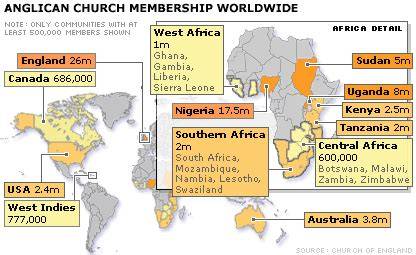
A defining feature of the modern Communion is the dramatic demographic shift of its centre of gravity. The vast majority of active Anglicans now live in the Global South, particularly in sub-Saharan Africa, a reality that shapes the Communion’s priorities and conversations.
How the Anglican Communion is held together
The Anglican Communion has no central government or single figure with binding legal authority. Instead, unity is sought through a set of relational and consultative bodies known as the Instruments of Communion.
Their purpose is to convene the leaders and people of the Communion for prayer, counsel, and fellowship, fostering the ‘bonds of affection’ that are the glue of our global family.
The Archbishop of Canterbury
The Archbishop of Canterbury is one of the ‘instruments’ of the Anglican Communion, which also includes the Anglican Consultative Council, the Primates’ Meeting and the Lambeth Conference.
The Archbishop of Canterbury acts as a focus of unity, recognised as primus inter pares (“first among equals”), but without formal authority in Anglican provinces outside of the Church of England.
Internationally, the Archbishop of Canterbury serves as a focus of unity and has pastoral responsibilities in the Anglican Communion. Through visits, partnerships, and regular meetings with Anglican leaders, commissions, and networks, the Archbishop helps the Communion share wisdom, respond to crises, and grow together as a worldwide Church.
The Archbishop also represents the Communion on the international stage, meeting governments and global organisations on issues affecting Anglican communities. Much of the Communion is in places facing conflict, hardship or persecution, and part of this ministry is to offer pastoral support and stand alongside churches in these situations.
On 28 January 2026, Sarah Mullally, previously bishop of London, was elected as archbishop of Canterbury, becoming the first woman to hold the see and act as the “first among equals” within the Anglican Communion.
The Lambeth Conference
The Lambeth Conference is a gathering of bishops from across the Communion for prayer, study, and shared discernment, traditionally held every ten years.
A crucial step in the development of the modern communion was the idea of the Lambeth Conferences. These conferences demonstrated that the bishops of disparate churches could manifest the unity of the church in their episcopal collegiality despite the absence of universal legal ties.
Some bishops were initially reluctant to attend, fearing that the meeting would declare itself a council with power to legislate for the church; but it agreed to pass only advisory resolutions.
These Lambeth Conferences have been held roughly every ten years since 1878 and remain the most visible coming-together of the whole communion.
The Anglican Consultative Council
The Anglican Consultative Council (ACC) is the representative body of the Communion, uniquely including bishops, clergy, and laity in its membership.
The Anglican Communion Office supports and facilitates the Anglican Consultative Council, the Lambeth Conference, the Primates’ Meeting and the Archbishop of Canterbury.
The Primates’ Meeting
The Primates’ Meeting is an gathering of the senior archbishops and presiding bishops from each province for prayer and consultation.
The Anglican Communion Office
The Archbishop of Canterbury’s role in the Anglican Communion is supported by the Anglican Communion Office, the official secretariat of the Anglican Communion.
The Anglican Communion Office (ACO) is the official secretariat of the Anglican Communion - a worldwide network of Anglican churches, in over 165 countries. The ACO connects member churches, encourages global mission, fosters Christian unity, promotes ecumenism and amplifies Anglican advocacy.
The ACO facilitates theological dialogues among Anglican churches, and ecumenically, with Roman Catholic, Orthodox, Lutheran, and other Christian traditions. It provides the theological foundation that makes deeper unity possible-helping churches move from mere cooperation to actual reconciliation and potentially full communion.
Anglican mission in the world
The Anglican Way is not an end in itself. From its foundations, Anglicanism has understood itself as a part of the universal Church, with a mission that extends beyond its own boundaries.
The ultimate purpose of the Church is to participate in the mission of God (missio Dei). Missio Dei is Latin for ‘the Mission of God’. It refers to the belief that God is the primary agent of mission, actively working to reconcile, restore and redeem all of creation through Jesus Christ and the Holy Spirit.
Instead of the church having a mission, the church is an active participant in God’s mission. In the Anglican tradition, this idea is expressed through the Five Marks of Mission, which are widely adopted across the Communion as a framework for its work.
The Five Marks of Mission
- Tell: To proclaim the Good News of the Kingdom.
- Teach: To teach, baptise and nurture new believers.
- Tend: To respond to human need by loving service.
- Transform: To seek to transform unjust structures of society, to challenge violence of every kind and to pursue peace and reconciliation.
- Treasure: To strive to safeguard the integrity of creation, and sustain and renew the life of the earth.
Churches in the Communion work side by side in prayer, mission and service, seeking to share the hope of the gospel in the world.
Responding to global challenges
In a world shaped by global challenges - climate change, conflict, poverty, inequality - the Anglican Communion offers a model of shared humanity and cooperation.
The Archbishop’s role is to listen across cultures, strengthen connections and help the Church respond together to the needs of today’s world.
Anglican leaders contribute a distinctive voice in global councils, sharing insights and working collectively with other faiths on pressing humanitarian issues.
In regions of tension, the ACO works with partners to help address conflict and build collaboration in peacebuilding and reconciliation initiatives.
These relationships are not just about conversation. They lead to shared action on global challenges, helping to transform unjust structures and pursue peace and reconciliation.
Ecumenical relationships
A bridge between Christian traditions
Anglicans are deeply committed to building ecumenical relationships and working for the visible unity of the Church. Our unique identity as both ‘Catholic and Reformed’ allows Anglicanism to act as a ‘bridge church’, finding common ground with Roman Catholic and Orthodox churches as well as with Protestant traditions.
The Anglican Communion is actively engaged in formal dialogues with most of the world’s major Christian families. The ACO supports ecumenical conversations with other Christian denominations, including formal dialogues with partners such as the Roman Catholic, Orthodox, and Lutheran churches worldwide.
The Anglican Communion Office works to promote Christian unity, fostering visible communion both within the Anglican family and with other world communions.
Full communion relationships
Anglicans are in ‘full communion’ with bodies like the Old Catholic Churches of the Union of Utrecht and the Mar Thoma Syrian Church of Malabar, allowing them to share a common Eucharistic life.
The Church of North India and Church of South India are full members of the Anglican Communion.
The Iglesia Filipina Independiente is also fully in communion with all other churches in communion with the See of Canterbury. Additionally, IFI bishops attend Lambeth Conferences.
The Porvoo Agreement
The Common Statement of the Porvoo Agreement governs ecumenical relations among the Church of England, Scottish Episcopal Church, Church of Ireland, Church in Wales, the Evangelical-Lutheran Church of Estonia, the Evangelical-Lutheran Church of Finland, the Evangelical-Lutheran Church of Iceland, the Evangelical-Lutheran Church of Lithuania, the Church of Norway, the Church of Sweden, and the Church of Denmark.
The Anglican Church of Canada is in full communion with the Evangelical Lutheran Church in Canada. The Episcopal Church USA is in full communion with the Evangelical Lutheran Church in America; the Lutheran-Episcopal Coordinating Committee carries on the work of full reception of this agreement.
The Episcopal Church USA is also in full communion with the Northern Province and the Southern Province of the Moravian Church in North America. The Moravian-Episcopal Coordinating Committee encourages this relationship.
Anglican churches in full communion with the See of Canterbury
Churches that are “in full communion” with the See of Canterbury include bodies that are not culturally or denominationally Anglican. Most of the churches listed in this category are Old Catholic churches, with which the Anglican Communion entered into full communion by ratifying the Bonn Agreement of 1931.
A member Province or national church of the Anglican Communion can be in full communion with a non-Anglican national church, without having the entire Anglican Communion share that relationship.
- Old Catholic churches in Austria.
- Old Catholic churches in Germany.
- The Christian Catholic Church of Switzerland.
- The Old Catholic Church of Poland.
- The Iglesia Filipina Independiente.
- The Mar Thoma Syrian Church of India.
- The Old Catholic Church of the Mariavites.
- The Old Catholic Church of the Netherlands.
- Old Catholic churches in South Tyrol.
- Old Catholic churches in the Czech Republic.
- The Union of Utrecht of the Old Catholic Churches.
The Mar Thoma Church forms part of the ancient Syrian Church of Malabar. Being a Church resorted to the fundamental principles of the Reformation Movement for its reformatory efforts it has been widely acknowledged that it is a reformed Church.
Here we recognize an amicable blending of two characteristic tracts, namely, the eastern Church features and reformation ideals. This nature of the Church points to its uniqueness when compared to other Churches.
Disagreement and diversity within the Communion
Some effects of the Anglican Communion’s dispersed authority have been differences of opinion and conflicts arising over divergent practices and doctrine in the various parts of the communion.
Disputes that had been confined to the Church of England could be dealt with legislatively in that realm, but as the communion spread into new countries and territories and across disparate cultures, controversies sometimes multiplied and intensified.
These controversies have generally been of two types: liturgical and social.
Women’s ordination
Rapid social change and the dissipation of British cultural hegemony over its former colonies contributed to disputes over the role of women, and the parameters of marriage and divorce.
In the late 1970s, the Continuing Anglican movement produced a number of new church bodies in opposition to women’s ordination, prayer book changes, and the new understandings concerning marriage.
As of 2024, some provinces of the communion, representing approximately 3% of Anglicans worldwide, do not ordain women as deacons, priests, or bishops; two ordain women only as deacons, 16 ordain women as deacons and priests but not as bishops, and 22 provinces, representing about “two thirds of Anglicanism,” ordain women as deacons, priests, and bishops.
As of 2024, three provinces of the Anglican Communion-South East Asia, Papua New Guinea, and Melanesia-do not ordain women as deacons, priests, or bishops.
GAFCON Primates Council chairman Laurent Mbanda claimed a predominant reservation against women’s ordination to the episcopacy.
Relations between provinces
Many of the provinces in developed countries have continued to adopt more liberal stances on sexuality and other issues, resulting in a number of de facto schisms, such as the series of splits which led to the creation of the Anglican Church in North America.
Many churches are now in full communion with only some other church members of the Communion, but are not with others; however, most churches that have historically been members continue to claim to be part of the Anglican Communion.
On 20 February 2023, following the decision of the Church of England to allow priests to bless same-sex partnerships during regularly scheduled worship services, ten communion provinces and Anglican realignment churches formed into the new Global South Fellowship of Anglican Churches and released a statement stating that they had declared “impaired communion” with the Church of England and no longer recognised Justin Welby as “first among equals” among the bishops of the communion.
Changing global leadership
The Lambeth Conference of 1998 considered the issue of the theology of same-sex attraction in relation to human sexuality. At this 1998 conference, for the first time in centuries, the primates of churches in many developing regions-including some from Africa, Asia and Latin America-prevailed over the bishops of more prosperous countries, many from the US, Canada and the UK, who had supported a more progressive interpretation of Anglican doctrine.
Seen in this light, 1998 is a date that marked the shift from a West-dominated Christianity to one wherein the growing churches of “the two-thirds world” are predominant.
On 16 October 2025, the chairman of the Global Fellowship of Confessing Anglicans, Laurent Mbanda, declared the future creation of a “Global Anglican Communion” independent from the See of Canterbury but also asserted “[they] have not left the Anglican Communion; [they] are the Anglican Communion.”
Following the announcement, Mbanda stated that the announcement of the “Global Anglican Communion” was “closer to a rebrand than a new organization” and that they are reforming the existing Anglican Communion.
Bishops affiliated with GAFCON, in Kenya and Congo, responded that their provinces plan to remain a part of the existing structures of the Anglican Communion.
In December 2025, Mbanda released another letter restating his plan to remain in the Anglican Communion saying, “We will not walk with sin, but neither will we walk away from the Anglican Communion.”
On March 3-4, 2026, meeting in Abuja, GAFCON member churches confirmed their intention to remain a part of the Anglican Communion, rejecting the word “schism” and framing their efforts as a reorganization and “continuity.”
GAFCON had announced their plan to move forward with electing a “rival” primus inter pares to the Archbishop of Canterbury, with some member churches continuing to oppose the ordination of women as bishops.
On March 5, 2026, GAFCON decided not to elect a “rival” primus inter pares to the Archbishop of Canterbury, opting instead to elect a “Global Anglican Council.”
Walking together in the Anglican Communion
The Anglican Communion Office fosters collaboration in mission and ministry with other Christian denominations, to grow learning, peer support, resource sharing and encouragement.
The Anglican Inter Faith Commission helps to foster understanding and friendship between Anglicans and people from different faith traditions across the globe.
The ACO facilitates theological dialogues among Anglican churches, and ecumenically, with Roman Catholic, Orthodox, Lutheran, and other Christian traditions.
Stewarding formal dialogues and ecumenical relationships, assisting the work of key Inter-Anglican and Inter Faith commissions, developing theological resources to inform the Communion, convening leaders for prayer, learning, and collaboration, and gathering research to support churches in their local contexts are central parts of this work.
The Nairobi-Cairo Proposals
A key example of this work is The Nairobi-Cairo Proposals, which address structures and decision-making in the Anglican Communion. Developed by IASCUFO, they explore new ways for Anglicans to walk together.
This paper offers two principal proposals for the Communion to consider. The first suggests an updated definition of the Anglican Communion to reflect the maturing of its member churches.
The second proposes broadening leadership responsibilities across the Instruments of Communion, aiming to diversify how they are convened and chaired.
These proposals will be discussed at the Anglican Consultative Council in 2026.