A bridal bouquet with a rosary can be both a beautiful wedding accessory and a deeply meaningful symbol of faith. For many Catholic brides, wrapping a rosary around the bouquet invites Our Lady’s presence into the ceremony, while the flowers, charms, heirlooms, and family details can express the bride’s personal story.
Your bridal bouquet is more than just flowers-it’s an accessory, a keepsake, and a meaningful part of your wedding day story. From walking down the aisle to close-up portraits, it will be by your side for many of the most photographed moments of the day. Including a rosary wrapped around your bouquet is a beautiful and meaningful tradition for many Catholic brides.
What a Rosary-Wrapped Bridal Bouquet Means
A rosary in a bridal bouquet can represent prayer, Mary’s intercession, trust in God, and the bride’s desire to begin married life with faith at the center. On your wedding day, it nestles beautifully in your bouquet, inviting Our Lady’s presence into your ceremony.
Through the preservation of your flowers into rosary beads not only do you get to admire your beautiful flowers forever, you also get to use them to pray. To Jesus through Mary Saint Louis Marie deMontfort.
Through Mary’s Bouquet your flowers can become something very profound. By turning your flowers into a rosary, you are creating a bouquet for Mary.
How to Attach a Rosary to Your Bridal Bouquet
If this is something you’d like, be sure to communicate it with your florist in advance. Florists have the experience and materials to secure it properly so it looks elegant and stays in place throughout the day.
You can drop the rosary off with them ahead of time, or ask them to secure it during drop off. If you plan to wrap it yourself, ask your florist for extra floral pins.
Compact & Versatile: Lightweight and easy to secure with floral pins or ribbon for the ceremony, then clip-and-carry for everyday life. (Just let your florist know and they can easily help you secure it for beauty and comfort.)
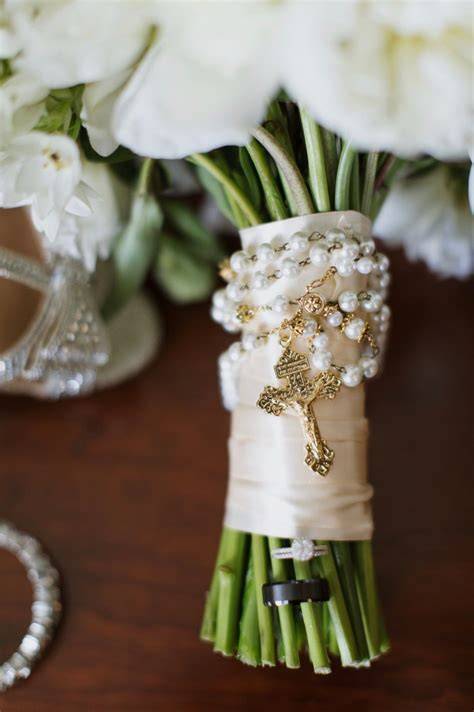
Ways to Display the Rosary
- Wrap the rosary around the stems of the bouquet.
- Secure a single-decade rosary to the handle with floral pins.
- Attach a rosary with ribbon for a softer, more traditional look.
- Place the crucifix or medal where it can be seen in photographs.
- Clip a travel-style rosary to the bouquet so it can be carried after the ceremony.
Built to Travel: A large, secure gold-plated lobster clasp makes it easy to clip to a bouquet, bag, or keyring - so Mary's grace is always within reach.
You may also want to consider removing the rosary after the ceremony; that way there is no chance that it can be lost during portraits.
When to Remove the Rosary
A rosary may be attached for the ceremony and then removed before portraits or the reception. You may also want to consider removing the rosary after the ceremony; that way there is no chance that it can be lost during portraits.
If its a rosary you bought specifically for your wedding, have your priest bless it while you sign the marriage license, and then entrust the rosary to your maid of honor!
Choosing Flowers with Marian Meaning
The thought that living things speak a language, drawing our attention to the Father’s creativity, precision, and beauty, is a profound one. If the language of flowers appeals to you, consider incorporating blossoms that signify Our Lady--the purest, most radiant bride--into your selections.
Lilies
Many images of the Annunciation depict the angel Gabriel presenting Mary with a lily as he invites her to shelter and bear from her womb the Word made flesh. Saint Joseph, Mary’s beloved spouse, is also frequently shown with the lily.
Both of these connections emphasize Our Lady’s purity and chastity--her perfect integration of body and soul. The lily of the valley flower, in particular, is also known as “Our Lady’s tears,” said to have blossomed from the tears Mary shed at the foot of the cross.
Even on the joyful day of a wedding feast, these flowers are a delicate, fragrant reminder that marriage calls us to embrace both agony and ecstasy. Consider, as well, that the lily is mentioned several times in the Song of Songs, a source of beauty among thorns and an element within “a garden closed:” an meditation on what it is to be a bride.
Bold, sculptural star and Easter lilies are well-suited to spring weddings or minimalist brides, while tiger lilies and lily of the valley are a great fit for summer celebrations and bohemian or rustic tastes.
Roses
The ancient prayer of the Litany of Loreto calls upon the intercession of the Holy Trinity and of Our Lady under various titles, including Mary as the “Mystical Rose.”
Why the rose? Popularly considered the crowning, most beautiful of all flowers, Our Lady has been described by Saint Brigid as “beautiful to the sight, and tender to the touch, and yet it grows among thorns, inimical to the beauty and tenderness. The Virgin may suitably be called a blooming rose. Just as the gentle rose is placed among thorns, So this gentle Virgin was surrounded by sorrow.”
As with the lily, the symbolism of roses invites spouses to consider the good times and bad, the easy and the crosses, which they entrust to one another in their marriage vows. Roses convey a classic sensibility and, in addition to the Mystical Rose devotion, call to mind Our Lady’s gift of roses to Saint Juan Diego at Guadalupe.
Marigolds and Calendula
As prayer gardens grew more prevalent in medieval monastic settings, the faithful frequently reclaimed pagan epithets for plants and flowers by giving them religious names.
Marigolds or calendula flowers (variations on a similar species) are now traditionally known as “Mary’s gold,” intended to invoke Our Lady’s heavenly queenship and radiance, the “woman clothed with the sun” in Revelation who triumphs over the grasp of evil and destruction.
Available in warm tones of red, gold, and orange, marigolds are beautifully suited to fall weddings, and can also be found in year-round friendly white.
Blue Flowers
Choosing blue, the color most frequently associated with Our Lady, for your wedding florals offers an array of choices and shades to complement your wedding colors, season, and style.
Consider hydrangea, hyacinth, iris, bluebells, or wildflowers.
Personalizing a Rosary Bridal Bouquet
Your bouquet should reflect you. This is your chance to add sentimental touches and personal meaning. Choose your favorite flowers, colors, or textures-even if they’re not traditionally “bridal.”
Another lovely way to personalize your bouquet is by attaching charms, lockets, or small keepsakes. Whether it’s a photo of a loved one, a meaningful symbol, or a family heirloom, these details make your bouquet truly one of a kind.
- Design the bouquet after your mother’s wedding bouquet.
- Include herbs or flowers from a grandmother’s garden.
- Wrap the stems with a grandfather’s tie.
- Add rosemary for texture and family significance.
- Attach a locket, medal, charm, or photograph.
- Use a family heirloom as part of the bouquet wrap.
Hong’s wedding bouquet was designed after her mother’s wedding bouquet (photo from Amber Victoria Photography).
Becky’s wedding bouquet featured mint from her grandmother’s garden in England (photo from Colette Lucille Photography).
The stem of Anna’s bouquet was wrapped with her grandfather’s tie.
Jenn’s bouquet was filled with rosemary; both for texture and because it was her grandmother’s name (photography from Rebecca Shehorn).
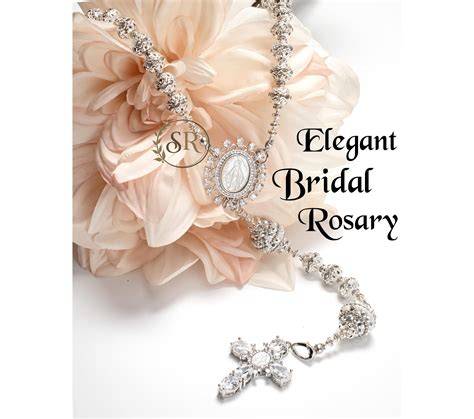
Choosing a Rosary Style
A full rosary, a single-decade rosary, or a compact travel rosary can all work with a bridal bouquet. The best choice depends on how prominently you want the rosary displayed, how you plan to secure it, and whether you want to continue carrying it after the wedding.
Full Rosary
A full rosary can be wrapped around the bouquet handle or arranged so that the crucifix hangs visibly beside the flowers. It can later become a prayer keepsake or be preserved with flowers from the bouquet.
Single-Decade Rosary
The Traveler's Style was designed for the bride who wants her faith to travel with her. On your wedding day, it nestles beautifully in your bouquet, inviting Our Lady's presence into your ceremony.
After the celebration, the lobster clasp makes it effortless to clip to a purse, travel bag, or diaper bag - wherever life takes you. It's a rosary that grows with your marriage, becoming a cherished companion through every joy, challenge, and ordinary grace-filled moment.
Rosary with a Clasp
A secure clasp can make the rosary easier to attach to the bouquet and carry afterward. A large, secure gold-plated lobster clasp makes it easy to clip to a bouquet, bag, or keyring.
Color and Material Ideas
Rosary beads can complement the bouquet’s flowers or provide a meaningful contrast. White pearls, blue beads, crystal accents, gold-plated details, and a silver-toned crucifix can each create a different visual effect.
Something Blue Wedding Rosary: Pearl and Aquamarine.
The finest Austrian pearls and crystals combine to create the perfect mix of bling and understated elegance.
| Element | Design idea |
|---|---|
| Centerpiece | Miraculous Medal, made in Italy 7/8” |
| Crucifix | Made in Italy 1.75" |
| Hail Mary beads | 6mm white Austrian crystal core pearls |
| Our Father beads | 8mm Aquamarine Austrian crystals |
| Spacer beads | Super sparkly Austrian crystals |
| Disc | Stainless Steel, mirror finish on front, brushed finish on back |
| Beading wire | 49 strands, strong & flexible |
| Length | Top to bottom approximately 17” |
The Mary's Grace Bouquet Rosary (Traveler's Style) features 10 translucent sky-blue faceted glass Hail Mary beads and 1 white pearl Our Father bead.
Gold-Plated Accents: Includes a stunning gold-plated Fleur de Lis crucifix and a small decorative gold-plated Miraculous Medal charm, both made in Italy.
Symbolic and Practical: A meaningful new rosary to begin your marriage - and a faithful companion for every chapter that follows.
Making the Bouquet a Priority
If there’s one floral element worth prioritizing in your budget, it’s your bridal bouquet. It will appear in almost every photo you’re in, from ceremony shots to portraits and detail images.
A well-designed, high-quality bouquet elevates the overall look of your wedding and photographs beautifully. If you’re looking to balance your budget, consider cutting costs elsewhere.
Bridesmaids’ bouquets can be simpler or smaller, and groomsmen boutonnieres don’t need to be overly elaborate. Shifting funds toward your bouquet ensures the flowers most visible throughout the day truly shine.
Preserving the Bouquet and Rosary
Your bridal bouquet doesn’t have to be something you enjoy for just one day. Preserving your bouquet is a wonderful way to keep a tangible piece of your wedding long after the celebration is over.
There are several beautiful preservation options to choose from, depending on your style and how you’d like to remember the day. Bouquets can be professionally pressed and framed as artwork, allowing you to display your flowers in your home.
Some florists and preservation artists also transform flowers into jewelry, such as necklaces or rings, or incorporate petals into rosaries for a meaningful keepsake. Planning ahead ensures your bouquet is handled properly right after the wedding so it can be preserved at its best.
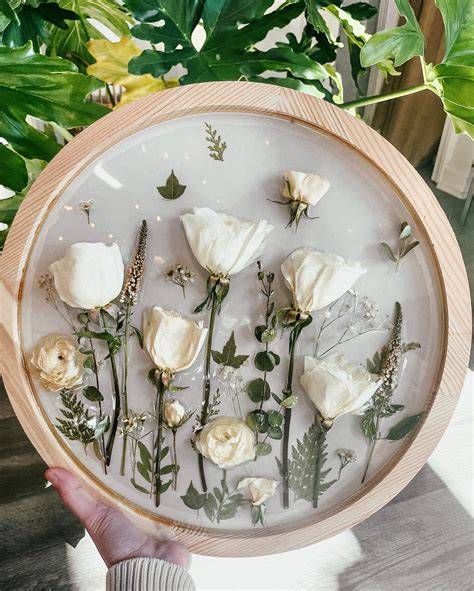
Rosary Made from Bouquet Flowers
People make truly incredible art out of preserved flowers and I love the idea of preservation using clear resin. I, however, do not use the resin to create traditional blocks or coasters. Instead, I create small beads out of the resin and your flowers and turn them into a rosary.
Your flowers are dried and then placed into bead molds with resin. The resin your petals are incased in is skin safe and light weight.
All the beads are then linked together by hand and paired with a matching center piece and crucifix. Through the crystal-clear beads, you will be able to see your petals and hold them in you hands forever.
Since this a delicate and time-consuming process, it takes over ten hours of labor to create a rosary.
How Many Flowers Are Needed
I use about six flowers for a full rosary. If you have a variety of flowers that you would like in the beads you can always send more!
When to Send the Flowers
As soon as possible! The fresher your flowers are when I receive them the better the colors will turn out in the beads.
Colors and shapes do change with preservation, however the fresher they are the more similar they will be to the original.
If you are a bride to be, I highly suggest having someone else ship your flowers! Designate someone to ship your bouquet for you directly after your wedding! This way the flowers will still be fresh when I receive them and you do not have to worry about it right after your wedding.
Using Dried, Silk, or Artificial Flowers
Your flowers are never too old or too dry! The nice thing about previously dried flowers is that you can see the color that the beads will be before you send the flowers to me.
Air dried flowers often turn darker or more yellow/brown. These colors are perfectly natural and will stay the same throughout the bead making process.
Yes! I can work with any flowers real or fake. I can also work with objects occasionally depending on size, including ribbon or fabric and small plastic pieces.
Rosary Preservation Timeline
Depending on the amount of orders and the tediousness of the process, it may take anywhere from two to six months to complete your order.
It takes me between 3-7 months to complete an order.
If we are unable to take your order that month and you still wish to have a rosary made, we will send you detailed instructions on how to dry your own flowers. Or, we can dry your flowers for you, and your order will be placed on our waitlist until the next available opening.
Caring for the Rosary
To keep your beads looking beautiful keep them out of direct sunlight and UV light. Direct exposure for long periods of time can yellow your resin beads faster.
To keep your crystal-clear beads in the same condition for years to come store them in a dark, dry place when not in use. You can wipe them off with a clean cloth if they appear dirty.
Avoid getting completely wet. Beads are water resistant, however if water seeps in to the preserved flowers (through small holes in resin) they could brown.
To maintain its beauty, gently wipe the rosary with a soft cloth after use. Avoid prolonged exposure to moisture to preserve the gold-plated accents.
The silver-plated parts will tarnish over time. A soft polishing cloth will help restore the luster.
Practical Considerations
These are rosary beads, not a necklace. They are meant to be held in the hand or hung.
The rosary should be used under adult supervision and contains small parts. Choking hazard for children under 3.
Our photo centerpieces on our photo rosaries are not waterproof.
Ideas for the Wedding Day
- Ask the florist to secure the rosary during bouquet delivery.
- Use floral pins or ribbon that complement the bouquet wrap.
- Keep the crucifix visible for detail photographs.
- Ask a priest to bless a wedding-specific rosary.
- Entrust the rosary to the maid of honor after the ceremony.
- Remove it before portraits if the rosary could be lost.
- Designate someone to send the flowers for preservation immediately after the wedding.
- Choose blue beads or flowers as a meaningful “something blue.”
It's a rosary that grows with your marriage, becoming a cherished companion through every joy, challenge, and ordinary grace-filled moment.