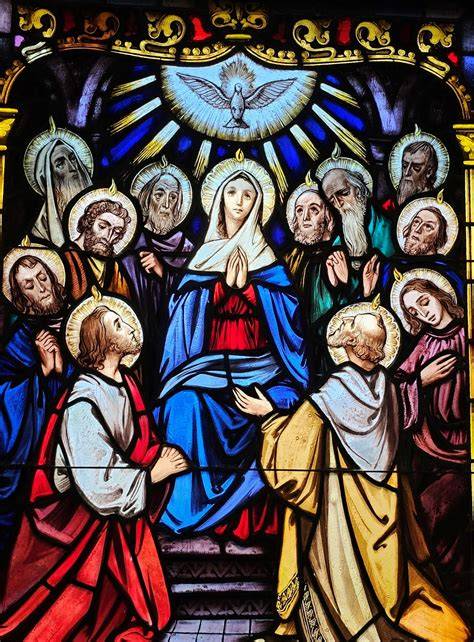
June 9 is chiefly associated with Saint Ephrem the Syrian, a deacon, hymnographer, preacher, theologian, and Doctor of the Church who is remembered as “the Harp of the Holy Spirit.” The day also commemorates Saints Primus and Felician, Saint Columba of Iona, Blessed Anna Maria Taigi, Saint José de Anchieta, Blessed Luigi Boccardo, Saint Baithen of Iona, Blessed Arnulf of Velseca, Blessed Joseph Imbert, Blessed Henry the Shoemaker, and Saint Pelagia of Antioch.
The June 9 calendar also includes the Feast of Our Lady of Grace in some places. The Immaculate Heart of Mary is sometimes associated with June celebrations, but its current Roman Catholic observance is the Saturday immediately after the Solemnity of the Sacred Heart of Jesus, traditionally described as the third Saturday after Pentecost.
Saint Ephrem the Syrian
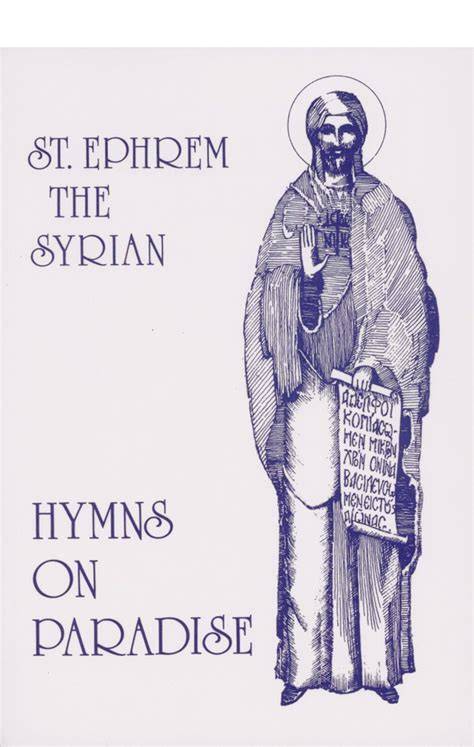
Saint Ephrem of Syria is the principal saint celebrated on June 9. He is also known as Ephrem of Edessa, Ephrem the Syrian, Ephraem, Ephraim, Ephraem Syrus, the Deacon of Edessa, the Harp of the Holy Spirit, Jefrem Sirin, and the Sun of the Syrians.
Ephrem was born around 306 at Nisibis, Mesopotamia, in modern Syria. He may have been the son of a pagan priest. He was brought to the faith by Saint James of Nisibis and was baptized at the age of 18.
While yet a young man he betook himself to the holy bishop James, by whom he was baptized, and he soon made such progress in holiness and learning as to be appointed master in the school of Nisibis in Mesopotamia. After the death of the bishop James, Nisibis was captured by the Persians, and Ephrem went to Edessa, where he settled first among the monks in the mountains.
He helped to evangelize Nisibis, Mesopotamia, and may have attended the Council of Nicaea in 325. He was a deacon, preacher, commentator on Scripture, and teacher, and he founded a theological school in Edessa.
Later, to avoid the company of those who flocked to him, he adopted the eremitical life. He was made deacon of the church of Edessa, but refused the priesthood out of humility.
Teacher, preacher, and hymnographer
Ephrem was a continuous learner who passionately studied every nook and cranny of the Catholic faith. He even studied the art of music to write hymns, and earned himself the nickname, “The Harp of the Spirit.”
Ephrem studied the Gospels in the original language of Jesus: Aramaic. He wrote extensive commentaries on the nature of Jesus and the Holy Trinity before it was solidified into doctrine. He preached on a vast variety of topics, and paid particular attention to Genesis, Exodus, the Acts of the Apostles, and Paul’s letters.
He wrote homilies, hymns and poetry. He helped introduce the use of hymns in public worship. He fought Gnosticism and Arianism by his writings, including poems and hymns.
He founded a theological school in Edessa. He wrote many books in the Syrian tongue, almost all of which have been translated into Greek. Saint Jerome bears witness that he attained such fame that his writings were read publicly in the churches after the reading from the Holy Scriptures.
To this day, 400 of his hymns are still used in churches all around the world. He composed a poem in praise of the Blessed Virgin Mary and the saints for which he was called by the Syrians “the Harp of the Holy Ghost.”
The Church celebrates the Optional Memorial of St. Ephrem, Deacon (306-373), called “the Harp of the Holy Spirit.” Ephrem is the great classic Doctor of the Syrian church.
As deacon at Edessa, he vigorously combated the heresies of his time, and to do so more effectively wrote poems and hymns about the mysteries of Christ, the Blessed Virgin and the saints. He had a great devotion to Our Lady.
He was a commentator on Scripture and a preacher as well as a poet, and has left a considerable number of works, which were translated into other Eastern languages as well as into Greek and Latin.
Spiritual teaching
Saint Ephrem loved to study the faith. Dynamic Catholics are continuous learners. They see themselves as students of Jesus and his Church, and proactively make an effort to allow his teachings to form them.
Highly engaged Catholics read Catholic books, listen to Catholic audiobooks, watch videos about the faith, and turn on to Catholic podcasts and movies. They go on retreats more regularly than most Catholics and attend spiritual events and conferences.
And even though they tend to know more about the faith than most people, they have a position of humility, which is a critical element of the second sign.
If they disagree with a Church teaching, they approach the issue in this way: “Why does the Church teach what she teaches? It is unlikely that I know better than two thousand years of the best Catholic theologians and philosophers. What am I missing?”
From this perspective they explore what the Church teaches to further understand God's way, eager to discover the truth. The second sign is all about continuous learning, the daily discipline of exploring the way of Jesus and the genius of Catholicism.
Prayer and writings of Saint Ephrem
“Virtues are formed by prayer. Prayer preserves temperance. Prayer suppresses anger. Prayer prevents emotions of pride and envy. Prayer draws into the soul the Holy Spirit, and raises man to Heaven.”
“Remember me, you heirs of God, you brethren of Christ; supplicate the Savior earnestly for me, that I may be freed through Christ from him that fights against me day by day.”
“You victorious martyrs who endured torments gladly for the sake of the God and Savior, you who have boldness of speech toward the Lord himself, you saints, intercede for us who are timid and sinful men, full of sloth, that the grace of Christ may come upon us, and enlighten the hearts of all of us that so we may love him.”
“Lord, shed upon our darkened souls the brilliant light of your wisdom so that we may be enlightened and serve you with renewed purity.”
“Sunrise marks the hour for men to begin their toil, but in our souls, Lord, prepare a dwelling for the day that will never end. Through our unremitting zeal for you. Lord, set upon us the sign of your day that is not measured by the sun.”
“In your sacrament we daily embrace you and receive you into our bodies; make us worthy to experience the resurrection for which we hope. Teach us to find our joy in your favor!”
“Savior, your crucifixion marked the end of your mortal life; teach us to crucify ourselves and make way for our life in the Spirit.”
The Remarkable Journey: Life of Saint Ephrem the Syrian
Death, patronage, and symbols
Saint Ephrem died on 9 June 373 at Edessa, in modern Iraq, of natural causes. His tomb is in an Armenian monastery, Der Serkis, west of Edessa.
| Category | Information |
|---|---|
| Feast day | June 9 |
| Birth | c.306 at Nisibis, Mesopotamia |
| Death | 9 June 373 at Edessa |
| Titles | Deacon of Edessa; Harp of the Holy Spirit; Doctor of the Church |
| Patronage | Spiritual directors; spiritual leaders |
| Representations | Hermit sitting on a column; deacon's vestments and thurible; man composing hymns with a lyre; man in a cave with a book; man with a cross on his brow, pointing upwards; man with Saint Basil the Great; vine and scroll |
He was proclaimed a Doctor of the Church in 1920. Pope Benedict XV, at the instance of many Cardinals of the Holy Roman Church, patriarchs, archbishops, bishops, abbots and religious communities, declared him by a decree of the Sacred Congregation of Rites to be a Doctor of the Universal Church.
Saint Columba of Iona
Saint Columba of Iona, also known as the Apostle of the Picts and the Apostle to Scotland, is another major saint remembered on June 9. He is also known as Coim, Colmcille, Colum, Columbkill, Columbkille, Columbus, Columcille, Columkill, and Combs.
Saint Columba was born to the Irish royalty, the son of Fedhlimidh and Eithne of the Ui Neill clan. He was a bard, miracle worker, monk at Moville, spiritual student of Saint Finnian, priest, itinerant preacher, and teacher throughout Ireland and Scotland.
Born in Ireland, in Donegal in the year 521, he was of the blood royal, and might indeed have become High King of Ireland had he not chosen to be a priest.
He was brought up in the company of many saints at the school of Saint Finian of Clonard. Being an ordained priest, and having founded many churches in Ireland, he went to Scotland with twelve companions, and there converted many of the northern Picts to the faith of Christ.
Mission to Scotland and foundation of Iona
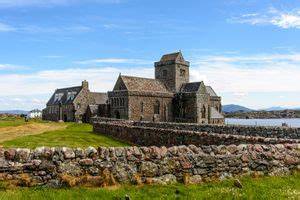
Columba travelled to Scotland in 563. He was exiled to Iona on Whitsun Eve, where he founded a monastic community and served as its abbot for twelve years.
He and the monks of Iona, including Saint Baithen of Iona and Saint Eochod, then evangelized the Picts, converting many, including King Brude. He attended the Council of Drumceat in 575.
With twelve companions he founded his monastery on Iona in the year 563. These Celtic monks lived in communities of separate cells, but Columba and his companions combined their contemplative life with extraordinary missionary activity.
Amongst his many accomplishments, Columba was a splendid sailor. He sailed far amongst the islands and traveled deep inland, making converts and founding little churches. In Ireland he had already, it is said, founded a hundred churches.
His monastery at Iona became the nursery of saints and apostles. He also evangelized the northern English.
Character, writings, and death
Columba was a poet as well as a man of action. Some of his poems in both Latin and Gaelic have come down to us, and they reveal him as a man very sensitive to the beauty of his surroundings, as well as always, in Saint Adamnan’s phrase, “gladdened in his inmost heart by the joy of the Holy Spirit.”
Legend says he wrote 300 books. Of all the Celtic saints in Scotland, Columba's life is much the best documented, because manuscripts of his life, written by Saint Adamnan, one of his early successors as abbot of Iona, have survived.
Devoted even from boyhood to the Christian novitiate and the study of philosophy, preserving by God's favour integrity of body and purity of soul, he showed himself, though placed on earth, ready for the life of heaven; for he was angelic in aspect, refined in speech, holy in work, excellent in ability, great in counsel.
Living as an island soldier for thirty-four years, he could not pass even the space of a single hour without applying himself to prayer, or to reading, or to writing or some kind of work.
Also by day and by night, without any intermission, he was so occupied with unwearying labours of fasts and vigils that the burden of each several work seemed beyond the strength of man. And with all this he was loving to everyone, his holy face ever showed gladness, and he was happy in his inmost heart with the joy of the Holy Spirit.
Saint Columba died on 9 June 597 at Iona, Scotland, and was buried there. His relics were translated to Dunkeld, Scotland, in 849.
He died on June 9, 597 at the foot of the altar at Iona while blessing his people, and was buried, like Saint Brigid, beside Saint Patrick at Downpatrick in Ulster.
| Category | Information |
|---|---|
| Birth | 7 December 521 at Garton, County Donegal, Ireland |
| Death | 9 June 597 at Iona, Scotland |
| Mission | Evangelization of the Picts, Scotland, and northern England |
| Foundation | Monastic community at Iona |
| Patronage | Against floods; bookbinders; poets; Ireland; Scotland; 5 dioceses, 2 cities |
| Additional memorials | 6 January as one of the Twelve Apostles of Ireland; 17 June translation of relics |
Saints Primus and Felician
Saints Primus and Felician are Roman martyrs commemorated on June 9. They were brothers who were tortured and martyred for their faith during the persecutions of Diocletian.
At an advanced age the brothers Primus and Felician were beheaded at Nomentum, or Mentana. According to the legendary Acts of their martyrdom, they were thrown into prison by Diocletian.
Felician was separated from his brother and subjected to cruel tortures. Then the magistrate called for Primus.
“See,” he said, “your brother has acted much more wisely than you; he listened to the emperor's wishes and now enjoys the greatest honor with him. If you follow his example, like consideration and favor will be shown you.”
Primus retorted: “What has happened to my brother, an angel has told me. Oh, that I, even as I am one in mind and heart with him, may not be separated from him in death!”
Both were then thrown to the lions, but the beasts crouched at their feet, fawning with head and tail. Of the twelve thousand persons who witnessed this marvel, five hundred together with their families embraced the faith.
Finally the two brothers were beheaded. They died in 286 on the Via Nomentana in Rome, Italy. Their relics are in the church of Saint Stephen on Mount Celio.
The Roman Martyrology commemorates Saints Primus and Felician as two Roman martyrs of the Via Nomentana. Their relics, transferred in the seventh century within the city, are at present in the church of Saint Stephen on the Coelian.
Their representations show Saint Felician nailed to a tree and Saint Primus forced to swallow molten lead. Their relics are located in Rome in the Basilica of Saint Stephen in the Round on the Caelian Hill.
Blessed Anna Maria Taigi
Blessed Anna Maria Taigi, also known as Anne Marie Taigi, Anna Maria Gesualda Antonia Taigi, and Anne Marie Gianetti, is commemorated on June 9.
She was born on 29 May 1769 at Siena, Italy, as Anne Marie Gianetti. Her father was a pharmacist in Siena, Italy, but his business went bankrupt when Anna Marie was five years old.
The family moved to Rome, Italy, in search of work, but Luigi could only find a job as a household servant. Anne was married on 7 January 1789 to Dominico Taigi, a butler to the noble family of Chigi.
She was married for 48 years and was the mother of seven children, two of whom died very young. Anne Marie was always very concerned about her dress and appearance, far more than would be expected of a working-class mother.
Life at home was not always peaceful. Dominico could be ill-tempered and caustic, and Anne was known to have had an adulterous affair with an older man.
But one day while at prayer at Saint Peter's Cathedral, she felt a sudden strong inspiration to ignore the things of this world. She began to live a more austere life and to listen to the Spirit.
Prayer, service, and mystical gifts
She became a Trinitarian tertiary. She found holy spiritual directors, gave all she could to the poor, visited the sick, and counselled many of the patients at the hospital of San Giacomo of the Incurables.
She worked hard to evangelize her own family, changing her husband's demeanor, and they all regularly assembled in a small personal chapel to pray together.
As the years went on and Anne Marie devoted herself more and more to prayer, she began to receive mystical gifts, including prophecy and clairvoyance. She sometimes went into ecstasies and received heavenly and prophetic visions.
Her simple presence had a powerful effect on many, and she helped with many conversions. She became a counsellor to cardinals, royalty, and three popes.
Because of her charismatic gifts and her lack of concern about worldly matters, Anne was often the topic of gossip and slander, but she was the recipient of public veneration soon after her death, and her Cause for beatification began in 1863.
She died on 9 June 1837 at Rome, Italy, of natural causes. Her body was incorrupt, her remains were transferred several times, and she was interred at Saint Crisogono Church in Trastevere, Rome.
She was beatified on 30 May 1920 by Pope Benedict XV. Her patronage is victims of verbal spouse abuse.
Saint José de Anchieta
Saint José de Anchieta, also known as the Apostle of Brazil, Giuseppe de Anchieta, Jose Anchieta, and Joseph Anchieta, is commemorated on June 9.
He was born on 19 March 1534 at San Cristobal de la Laguna, Tenerife, Canary Islands, Spain. He was the son of a wealthy and prominent family and was possibly related to Saint Ignatius of Loyola.
He was educated in Portugal and joined the Jesuits in 1551 at the age of 17. He became a missionary to Brazil, arriving on 13 July 1553.
He is the National Apostle of Brazil and was co-founder of the cities of Sao Paulo and Rio de Janeiro. In his youth he dislocated his spine. When he joined the Jesuits, he was sent to Brazil for its mild climate in the hope that his back would improve.
It never did, and he was in constant pain for the 44 years he worked in the Americas. He and the Jesuit Emanuel Nóbrega arrived at Piratininga on the feast of Saint Paul and so named the mission Sao Paulo.
Missionary and writer
In 1553 he first met the Tupi Indians who lived on the outskirts of the settlement. As he was adept at languages, Joseph soon learned theirs.
For two decades Joseph worked on a grammar and dictionary used by Portuguese settlers and missionaries. Joseph was later held hostage for five months by the Tamoyo tribe, during which time he occupied himself by composing a Latin poem in honour of the Blessed Virgin.
Since he had no writing supplies, he wrote in wet sand and memorized the verses. When he again reached Sao Vicente he committed all 4,172 lines to paper.
Joseph converted the Maramomis tribe and composed plays for his students to perform, writing them in Latin, Spanish, Portuguese, and Tupi.
Because his dramas were the first written in Brazil, Joseph is known as the Father of Brazilian national literature. He became Jesuit provincial in 1577.
In letters to his fellow missionaries, he warned that burning desire was not enough: “You must come with a bag-full of virtues.”
He died on 9 June 1597 at Reritigba, now Anchieta, Brazil, of natural causes. He was canonized on 3 April 2014 by Pope Francis through equipollent canonization. His representation includes birds.
Blessed Luigi Boccardo
Blessed Luigi Boccardo, known as the Apostle of Merciful Love, is commemorated on June 9.
He was one of ten children and the brother and godson of Blessed Giovanni Maria Boccardo. He was educated by the Barnabites, entered the seminary in 1875, and was ordained in 1884 in the Archdiocese of Turin, Italy.
He served as assistant priest to his brother, vice-rector and spiritual director at the Consolata College, professor and spiritual director of seminarians, and director of religious schools and religious education in his diocese.
He visited prisoners and spent hours in the confessional at the Shrine of the Consolata. On the death of his brother, he was appointed superior of the Poor Daughters of San Gaetano in 1913.
He became director of an institute for the blind in 1919 and preached retreats. He promoted the building of a shrine to Jesus Christ, King and Priest.
He founded the Sisters of Jesus the King, a contemplative branch of the Poor Daughters of San Gaetano, in 1932.
He was born on 9 August 1861 in Moncalieri, Turin, Italy, and died on 9 June 1936 at Turin, Italy, of natural causes.
He was beatified on 14 April 2007 by Pope Benedict XVI. The recognition was celebrated by Cardinal José Saraiva Martins in the Church of the Holy Countenance in Turin, Italy, at 3:30 p.m. on Saturday, 14 April 2007.
Saint Baithen of Iona
Saint Baithen of Iona, also known as Baithen Mor, Baithen the Great, Baithin, Comin, and Cominus, was born to a noble Irish family, the son of Brenaron.
He was a monk and abbot of Tiree Island, Scotland. He was the spiritual student of Saint Columba and part of Columba’s mission to Britain in 563. He may have been Columba’s cousin.
When Columba died, Baithen was immediately chosen abbot to replace him and continue his work. He wrote a biography of Columba, which was used by Saint Adamnan, but the work itself is lost.
When Saint Baithen ate, before each bite he recited the prayer “Deus in adjutorium meum intende.” When he worked the fields with the monks, he held up one hand to Heaven, beseeching God, while with the other hand he gathered the corn.
He was a wise counsellor, and his advice was sought by many Irish saints. He was the spiritual teacher of Saint Fintan Munni.
He was born in Ireland in 536 and died around 599 of natural causes.
Other saints and blesseds commemorated on June 9
Blessed Arnulf of Velseca
Blessed Arnulf of Velseca was a Premonstratensian monk and lector at the Saint Cornelius monastery in Ninove, in modern Belgium.
He worked as a shoemaker at the monastery. He enjoyed the work as it kept his hands busy while his mind was on the things of heaven.
He made trips to all the neighboring parishes on Sundays and feasts to distribute alms to the poor.
He was born in the 12th century in the area of modern Belgium and died after fracturing his skull when he fell off a ladder while putting up a ladder for an Ascension procession in 1221 at the Saint Cornelius monastery in Ninove, in modern Flanders, Belgium.
Blessed Joseph Imbert
Blessed Joseph Imbert was a Jesuit priest and Vicar Apostolic of Moulins, France.
He was imprisoned on a ship during the anti-Catholic persecutions of the French Revolution and left to die. He was one of the Martyrs of the Hulks of Rochefort.
He was born around 1720 in Marseilles, Bouches-du-Rhône, France, and died on 9 June 1794 aboard the prison ship Deux-Associés in Rochefort, Charente-Maritime, France.
He was beatified on 1 October 1995 by Pope John Paul II.
Blessed Henry the Shoemaker
Blessed Henry the Shoemaker, also known as Der Gute Heinrich, Heinrich Bucke, Henry Michael Bucke, and Henry the Good, was a shoemaker.
He moved to Paris, France, in 1645, where, with the help of Baron de Renti, he founded the Confraternity of Saints Crispin and Crispinian, also known as Freres Cordonniers, for the spiritual development of his fellow cobblers.
Though he was considered a beatus, there is no evidence of a public cultus for Henry. He was born in Luxembourg and died in 1666.
Saint Pelagia of Antioch
Saint Pelagia of Antioch is also listed among the saints commemorated on June 9.
Our Lady of Grace and June 9
Our Lady of Grace is another of the several titles by which Augustinians have traditionally venerated the Blessed Virgin. In fact, it is the oldest among these.
From the moment that she received the angel’s greeting and gave her consent to God’s invitation to become the mother of the Word made flesh, Mary became the bearer of Grace in this world.
This title of “Our Lady of Grace” is the oldest with which the Order has shown veneration to Mary. The General Chapter of 1284 prescribed the daily recitation or chant of the “Benedicta Tu” precisely in honour of Our Lady of Grace.
The antiphon “Ave Regina Caelorum,” also dating back to the 13th century, is in honour of this same title as well.
A confraternity with the title “Lady of Grace” was established at least as early as 1401 in Augustinian friaries of Spain and Portugal and, over the subsequent one hundred years, had extended widely throughout the Order.
New friaries under this title began to be established in Italy and Latin America. In 1807 Pope Pius VII, at the request of Venerable Joseph Menochio, Papal Sacristan and Confessor to the Pope, granted the Order the right to celebrate this Feast on 1 June, or 9 June in some places.
The Virgin Mary, greeted by the angel as “full of grace,” became, from that moment, the Mother of Grace. As Mother of the one and only Mediator Jesus, she is Mother of the Author of Grace and dispenser of Grace.
Our Lady of Grace, pray for us!
The Immaculate Heart of Mary
The Immaculate Heart of Mary is a devotional name used to refer to the interior life of the Blessed Virgin Mary, her joys and sorrows, her virtues and hidden perfections and, above all, her virginal love for God the Father, her maternal love for her son Jesus and her compassionate love for all people.
Pope Pius XII instituted the feast of the Immaculate Heart of Mary in 1944 to be celebrated on 22 August, coinciding with the traditional octave day of the Assumption.
In 1969, Pope Paul VI moved the celebration of the Immaculate Heart of Mary to the Saturday immediately after the Solemnity of the Sacred Heart of Jesus. This means in practice that it is now held on the third Saturday after Pentecost.
Historically, devotion to the Heart of Mary grew up in parallel but at a lesser intensity than devotion to the Heart of Jesus, only starting to become more prominent during the time of Saint John Eudes.
Saint John Eudes and the development of the devotion
John Eudes was born in 1601 in Normandy, France. He entered the Congregation of the Oratory of France, founded in 1611 by Cardinal de Berulle, and was ordained to the priesthood on December 20, 1625.
Saint John brought people to love Christ and the Virgin Mary by speaking tirelessly about their Hearts, the sign of the love God shows for us and the communion to which we are called.
To offer them liturgical worship, he composed Masses and Offices in their honour and had the first Feast of the Holy Heart of Mary celebrated on 8 February 1648 at Autun, France, and the Feast of the Heart of Jesus celebrated on 20 October 1672.
He died on August 19, 1680, and was canonised by Pope Pius XI on May 31, 1925.
Nevertheless, it was not until after the Apparitions at Rue du Bac concerning the “Miraculous Medal” made to Catherine Labouré in 1830 and the establishment of a society dedicated to the Immaculate Heart of Mary at the Church of Our Lady of Victories in Paris in 1836 that this particular devotion became really well known.
Since then devotion to the Immaculate Heart of Mary has gradually grown more widespread in the Church, particularly since the apparitions at Fatima.
Meaning of the devotion
The main difference between the devotions to the Hearts of Jesus and Mary is that the one concerned with Jesus emphasises His divine heart as being full of love for mankind, but with this love for the most part being ignored or rejected, while devotion to Mary’s heart is essentially concerned with the love that her heart has for Jesus, for God.
Therefore, it is not an end in itself, so the love of her heart is meant to be a model for the way we should love God.
The fact that her heart is immaculate, that is sinless, means that she is the only fully human person who is able to really love God in the way that He should be loved.
Honouring Mary’s Immaculate Heart is really just another way of honouring Mary as the person who was chosen to be the Mother of God, recognising her extraordinary holiness and the immense love she bestowed on Jesus as His mother, the person who was called to share in and co-operate in His redemptive sufferings.
The aim of the devotion is to unite mankind to God through Mary’s heart, and this process involves the ideas of consecration and reparation.
A person is consecrated to Mary’s Immaculate Heart as a way of being completely devoted to God. This involves a total gift of self, something only ultimately possible with reference to God, but Mary is our intermediary in this process of consecration.
Because of the strong analogy between Jesus and Mary, the consecration to Mary’s Immaculate Heart is closely linked to the consecration to Jesus’ Sacred Heart, although it is subordinate and dependent on it.
That is, although the act of consecration is ultimately addressed to God, it is an act that is made through Mary. And so we pray through Mary, through her Immaculate Heart, and we ask to learn true love.
Papal consecrations
The whole world has been repeatedly consecrated to the Immaculate Heart of Mary by different popes:
- Pius XII, 31 October 1942
- Paul VI, 21 November 1964
- John Paul II, 13 May 1982
- John Paul II together with all the bishops of the world, 25 March 1984
- Francis, 13 October 2013
Immaculate Heart of Mary, pray for us!
June 9 in the wider liturgical calendar
June 9 is part of a month containing several important feasts, memorials, and commemorations.
| Date | Feast or memorial |
|---|---|
| June 1 | Saint Justin Martyr |
| June 2 | Saints Marcellinus and Peter |
| June 3 | Saint Charles Lwanga and Companions |
| June 4 | Saint Elizabeth Hesselblad |
| June 5 | Saint Boniface |
| June 6 | Saint Norbert |
| June 7 | Corpus Christi |
| June 9 | Saint Ephrem |
| June 11 | Saint Barnabas |
| June 12 | Most Sacred Heart of Jesus, Blessed Hildegard Burjan, Blessed Joseph Stanek, and Blessed Joseph Jankowski |
| June 13 | Immaculate Heart of Mary and Saint Anthony of Padua |
| June 15 | Most Holy Trinity |
| June 17 | Saint Albert Chmielowski |
| June 19 | Saint Romuald |
| June 21 | Saint Aloysius Gonzaga |
| June 22 | Saint Paulinus of Nola, Saint Thomas More, and Saint John Fisher |
| June 23 | Saint Etheldreda |
| June 24 | Nativity of Saint John the Baptist |
| June 26 | Saint Josemaria Escriva |
| June 27 | Saint Cyril of Alexandria |
| June 28 | Saint Irenaeus |
| June 29 | Saints Peter and Paul |
| June 30 | Blessed Ramon Llull and the First Martyrs of the Holy Roman Church |
Mass readings and liturgical notes for June 9
The Mass readings for June 9, 2025, include the Memorial of the Blessed Virgin Mary, Mother of the Church, and the Optional Memorial of Saint Ephrem.
The collect for the Memorial of the Blessed Virgin Mary, Mother of the Church, is:
“O God, Father of mercies, whose Only Begotten Son, as he hung upon the Cross, chose the Blessed Virgin Mary, his Mother, to be our Mother also, grant, we pray, that with her loving help your Church may be more fruitful day by day, and, exulting in the holiness of her children, may draw to her embrace all the families of the peoples. Through our Lord Jesus Christ, your Son, who lives and reigns with you in the unity of the Holy Spirit, God, for ever and ever.”
The collect for the Optional Memorial of Saint Ephrem is:
“Pour into our hearts O Lord, we pray, the Holy Spirit, at whose prompting the Deacon Saint Ephrem exulted in singing of your mysteries and from whom he received the strength to serve you alone. Through our Lord Jesus Christ, your Son, who lives and reigns with you in the unity of the Holy Spirit, God, for ever and ever.”
Mary, Mother of the Church
In 2018 Pope Francis decreed that the ancient devotion to the Blessed Virgin Mary, under the title of Mother of the Church, be inserted into the Roman Calendar. The liturgical celebration, B. Mariæ Virginis, Ecclesiæ Matris, is celebrated annually as a Memorial on the day after Pentecost.
From the decree: “This celebration will help us to remember that growth in the Christian life must be anchored to the Mystery of the Cross, to the oblation of Christ in the Eucharistic Banquet and to the Mother of the Redeemer and Mother of the Redeemed, the Virgin who makes her offering to God.”
In 1964, Saint Paul VI, at the conclusion of the Third Session of the Second Vatican Council, declared the Blessed Virgin Mary as “Mother of the Church,” that is to say, of all Christian people, the faithful as well as the pastors, who call her the most loving Mother.
It was not until February 11, 2018, that the Congregation for Divine Worship and the Discipline of the Sacraments inscribed a new obligatory Memorial of the Blessed Virgin Mary as Mother of the Church into the General Roman Calendar.
This memorial is celebrated every year on the Monday after Pentecost, which is appropriate as Mary was also present in that room for the birthday of the Church.
By issuing the Decree on the celebration of the feast of Mary, Mother of the Church, Pope Francis wishes to promote this devotion in order to “encourage the growth of the maternal sense of the Church in the pastors, religious and faithful, as well as a growth of genuine Marian piety.”
The decree reflects on the history of Marian theology in the Church’s liturgical tradition and the writings of the Church Fathers. It says Saint Augustine and Pope Saint Leo the Great both reflected on the Virgin Mary’s importance in the mystery of Christ.
“In fact the former [Saint Augustine] says that Mary is the mother of the members of Christ, because with charity she cooperated in the rebirth of the faithful into the Church, while the latter [Saint Leo the Great] says that the birth of the Head is also the birth of the body, thus indicating that Mary is at once Mother of Christ, the Son of God, and mother of the members of his Mystical Body, which is the Church.”
The decree says these reflections are a result of the “divine motherhood of Mary and from her intimate union in the work of the Redeemer.” Scripture depicts Mary at the foot of the Cross (cf. Jn 19:25).
There she became the Mother of the Church when she “accepted her Son’s testament of love and welcomed all people in the person of the beloved disciple as sons and daughters to be reborn unto life eternal.”