The seventh book of the Bible is the Book of Judges. It records Israel’s history after the death of Joshua and before the establishment of kingship. During this period, Israel was led by regional, political, and military leaders called judges, whom God raised up to deliver the people from oppression.
The Book of Judges is a sobering account of Israel’s repeated rebellion, oppression, repentance, deliverance, and renewed failure. Its central message is that human beings repeatedly turn away from God, yet God remains faithful and gracious in rescuing his people.
What Is the Book of Judges About?
The Book of Judges begins with the death of Joshua and tells the story of Israel’s total failure. Before they had any kings, the tribes of Israel were ruled by judges. Don’t think of a courtroom here, because these were regional, political, and military leaders, more like tribal chieftains.
The book’s name comes from the types of leaders Israel had in this period. It is the history of the judges, or saviours, whom God raised up to rule and deliver an oppressed people. Here Israel’s history is set in the shadows and the record tells of Israel’s repeated departures from the living God, and the national decay of the people not merely for forty years but over 300 years.
It is often called, “The Book of Failure”. The book has value as a sobering exploration of the human condition, but it ultimately points forward to God’s grace in sending a king who will rescue his people.
Historical Setting
In the previous book, Joshua finally led the tribes of Israel into the promised land, calling on them to be faithful to their covenant with God by obeying the commands of the Torah and being an example to other nations.
The opening section of Judges begins with the tribes of Israel in their territories within the promised land. While Joshua defeated some key Canaanite towns, there was still a lot of land to be taken and a lot of Canaanites still living in those areas.
The Book of Judges has an historical value linking with Joshua (Jud. 1:1 to 3:6). Its events occupy the period between the conquest of the land and the rise of kingship in Israel.
The Structure of the Book
There’s a large introduction in chapters 1-2 that sets the stage for Israel’s failure as they don’t drive out the remaining Canaanites like they were told to. The large, main section of the book (Judg. 3-16) has stories of the growing corruption of Israel’s judges.
The concluding section (Judg. 17-21) is really disturbing and shows the corruption of the people of Israel as a whole. The book therefore moves from Israel’s incomplete settlement of the land, through the repeated stories of the judges, to the nation’s religious, moral, and political collapse.
| Section | Chapters | Main emphasis |
|---|---|---|
| Introduction | 1-2 | Israel’s compromise and moral failure in the promised land |
| Main history | 3-16 | Israel’s judges, oppression, deliverance, and increasing corruption |
| Appendix | 17-21 | Idolatry, immorality, civil conflict, and national anarchy |
Israel’s Failure in the Promised Land
Chapter 1 gives a long list of Canaanite groups that Israel failed to drive out from the land. Now remember, the whole point of driving out the Canaanites was to avoid the influence of their moral corruption and the worship of their gods through child sacrifice.
God had called Israel to be a holy people, but that did not happen. Chapter 2 describes how Israel simply moved in alongside the Canaanites and began to adopt all their cultural and religious practices.
The Book unlike others has a double commencement (Chapter 2:69; chapter 1:1-2). Why? God’s order, His people are first seen in independence and then in declension.
The Cycle of Rebellion and Deliverance
Then, right there in chapter 2, the story stops, and for nearly a whole chapter the narrator gives us an overview of everything that’s about to happen in the rest of the book.
This part of Israel’s history was a series of cycles moving in a downward spiral. Israel would become like the Canaanites and would sin against God. God would then allow them to be conquered and oppressed by the Canaanites.
Eventually, the Israelites would see the error of their ways and repent, and God would raise up a deliverer, a judge, from among Israel who would defeat the enemy and bring an era of peace. Sooner or later, Israel would sin again, and it would start all over.
This cycle provides the literary design and flow of the next section of the book and is repeated for each of the six main judges whose stories are told here.
| Stage | Description |
|---|---|
| Sin | Israel became like the Canaanites and sinned against God. |
| Servitude | God allowed Israel to be conquered and oppressed. |
| Supplication | The Israelites saw the error of their ways and cried to God. |
| Salvation | God raised up a deliverer who defeated the enemy. |
| Rest | The land experienced an era of peace before the cycle began again. |
The message of the Book is written in the minor key and strikes the dominant notes of rebellion, relapse, retribution, repentance and rest. Another has put it, sin, servitude, supplication and salvation (2:11-19).
Summary: Sin, Punishment, Deliverance. (Rom 6:23, Gal. 6:71 Ps. 103:8).
The Judges of Israel
The stories of the first three judges, Othniel, Ehud, and Deborah, are epic adventures that are extremely bloody. Either the judges themselves or the people helping them defeat their enemies and deliver the people of Israel.
The stories about the next three judges are longer and focus on their character flaws, which only get progressively worse.
| Judge or group of judges | Oppressor or crisis | Recorded result |
|---|---|---|
| Othniel | Mesopotamia | 40 years peace |
| Ehud and Shamgar | Moabite, Ammonites, Amalekites; Philistines | 80 years peace |
| Deborah and Barak | Canaanites | 40 years peace |
| Gideon | Midianites | 40 years peace |
| Tola and Jair | Usurpation of Abimelech | 45 years |
| Jephthah, Ibzan, Elon, and Abdon | Ammonites | 31 years peace |
| Samson | Philistines | 20 years peace |
It is a compilation of the history of thirteen judges: Othniel, Ehud, Shamgar, Deborah-Barak, Gideon, Abimelech, To-la, Jair, Jephthah, Ibzan, Elon, Abdon, Samson. Some include, Eli the Priest-Judge, and Samuel, the Prophet-Judge making 15 in all.
The chief of the judges were - Othniel, Ehud, Deborah, Gideon, Jephthah and Samson.
Othniel, Ehud, Shamgar, and Deborah
The stories of the first three judges, Othniel, Ehud, and Deborah, are epic adventures that are extremely bloody. Either the judges themselves or the people helping them defeat their enemies and deliver the people of Israel.
The Book records one of the greatest battle songs in the world (Ch. 5). It contains the first record in history of a woman, as Leader of a Nation (ch. 4).
Gideon and the Three Hundred Men
Gideon (Judg. 6-9) starts out well enough. He’s a coward of a man, but he comes to trust that God can save Israel through him.
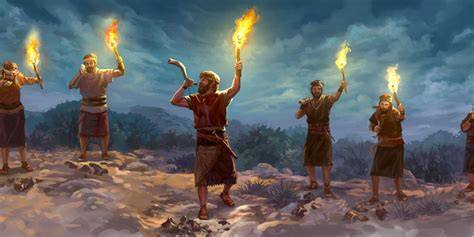
He defeats a huge army of Midianites with only 300 men carrying nothing but torches and clay pots.
Early in the morning, Jerub-Baal (that is, Gideon) and all his men camped at the spring of Harod. The camp of Midian was north of them in the valley near the hill of Moreh.
The Lord said to Gideon, “You have too many men. I cannot deliver Midian into their hands, or Israel would boast against me, ‘My own strength has saved me.’”
Now announce to the army, ‘Anyone who trembles with fear may turn back and leave Mount Gilead.’” So twenty-two thousand men left, while ten thousand remained.
But the Lord said to Gideon, “There are still too many men. Take them down to the water, and I will thin them out for you there. If I say, ‘This one shall go with you,’ he shall go; but if I say, ‘This one shall not go with you,’ he shall not go.”
So Gideon took the men down to the water. There the Lord told him, “Separate those who lap the water with their tongues as a dog laps from those who kneel down to drink.”
Three hundred of them drank from cupped hands, lapping like dogs. All the rest got down on their knees to drink.
The Lord said to Gideon, “With the three hundred men that lapped I will save you and give the Midianites into your hands. Let all the others go home.”
So Gideon sent the rest of the Israelites home but kept the three hundred, who took over the provisions and trumpets of the others. Now the camp of Midian lay below him in the valley.
During that night the Lord said to Gideon, “Get up, go down against the camp, because I am going to give it into your hands. If you are afraid to attack, go down to the camp with your servant Purah and listen to what they are saying. Afterward, you will be encouraged to attack the camp.”
So he and Purah his servant went down to the outposts of the camp. The Midianites, the Amalekites and all the other eastern peoples had settled in the valley, thick as locusts. Their camels could no more be counted than the sand on the seashore.
Gideon arrived just as a man was telling a friend his dream. “I had a dream,” he was saying. “A round loaf of barley bread came tumbling into the Midianite camp. It struck the tent with such force that the tent overturned and collapsed.”
His friend responded, “This can be nothing other than the sword of Gideon son of Joash, the Israelite. God has given the Midianites and the whole camp into his hands.”
When Gideon heard the dream and its interpretation, he bowed down and worshiped. He returned to the camp of Israel and called out, “Get up! The Lord has given the Midianite camp into your hands.”
Dividing the three hundred men into three companies, he placed trumpets and empty jars in the hands of all of them, with torches inside.
“Watch me,” he told them. “Follow my lead. When I get to the edge of the camp, do exactly as I do. When I and all who are with me blow our trumpets, then from all around the camp blow yours and shout, ‘For the Lord and for Gideon.’”
Gideon and the hundred men with him reached the edge of the camp at the beginning of the middle watch, just after they had changed the guard. They blew their trumpets and broke the jars that were in their hands.
The three companies blew the trumpets and smashed the jars. Grasping the torches in their left hands and holding in their right hands the trumpets they were to blow, they shouted, “A sword for the Lord and for Gideon!”
While each man held his position around the camp, all the Midianites ran, crying out as they fled.
When the three hundred trumpets sounded, the Lord caused the men throughout the camp to turn on each other with their swords. The army fled to Beth Shittah toward Zererah as far as the border of Abel Meholah near Tabbath.
Israelites from Naphtali, Asher and all Manasseh were called out, and they pursued the Midianites.
Gideon sent messengers throughout the hill country of Ephraim, saying, “Come down against the Midianites and seize the waters of the Jordan ahead of them as far as Beth Barah.” So all the men of Ephraim were called out and they seized the waters of the Jordan as far as Beth Barah.
They also captured two of the Midianite leaders, Oreb and Zeeb. They killed Oreb at the rock of Oreb, and Zeeb at the winepress of Zeeb. They pursued the Midianites and brought the heads of Oreb and Zeeb to Gideon, who was by the Jordan.
Gideon’s Decline
Gideon has a nasty temper, however, and murders several of his fellow Israelites for not helping him in battle.
To make matters worse, he also makes an idol from the gold he won in a battle, and after he dies, all of Israel worships it as a god, and the cycle begins once again.
The story of Gideon therefore illustrates both deliverance and decline: God gives victory through a greatly reduced army, but the deliverer himself later contributes to Israel’s idolatry and instability.
Jephthah
The next main judge is Jephthah (Judg. 10-12), who’s something of a mafia thug living in the hills. When things got really bad for Israel, the elders came to him begging for his leadership.
Jephthah actually proved to be a very effective leader, as he won lots of battles against the Ammonites.
But in the end, he was so unfamiliar with the God of Israel that he treated him like a Canaanite deity and vowed to sacrifice his daughter if he won the battle.
This tragic story shows just how far Israel has fallen. They no longer know the character of their own God, which leads to murder and false worship.
Samson
The last judge, Samson (Judg. 13-16), is by far the worst. His life began full of promise, but he had no regard for the God of Israel, and he was promiscuous, violent, and arrogant.
He brutally won strategic victories over the Philistines, but only at the expense of his integrity. His life comes to an end in a violent rush of mass murder.
You’ll notice a repeated theme here where, at key moments, God’s Spirit empowers each of these judges to accomplish great acts of deliverance.
The fact that God uses these people does not mean he endorses all or any of their choices. God is committed to saving his people, but all he has to work with are these corrupt leaders. And work with them he does.
This whole section of the book of Judges shows just how bad things have become. You can no longer tell the Israelites and the Canaanites apart-and that’s just the leaders.
Israel’s Religious, Moral, and Political Collapse
The final section, on the other hand, shows Israel as a whole hitting rock bottom. There are two tragic stories here, in chapters 17-18 and 19-21, that are not for the faint of heart.
They are structured by a key phrase that gets repeated four times: “In those days, Israel had no king and everyone did what was right in their own eyes” (Judg. 17:6; Judg. 18:1; Judg. 19:1, and 21:25).
Micah’s Idolatry and Dan’s Violence
The first story is about an Israelite named Micah who builds a private temple to an idol. This temple is then plundered by a private army sent from the tribe of Dan.
The soldiers from Dan steal everything, but much worse, they burn the peaceful city of Laish to the ground, murdering all its inhabitants.
This is horrifying; when Israel forgets its God, might makes right.
Sexual Abuse, Violence, and Civil War
The next story is even worse-a shocking tale of sexual abuse and violence, leading to Israel’s first civil war.
It’s very disturbing, and that’s the point. These stories serve as a warning.
Israel’s descent into self-destruction is a result of turning away from the God who saved them from slavery in Egypt. Now they need to be delivered again, but this time from themselves.
The Repeated Statement About Israel’s King
The only glimmer of hope is found in this repeated line from the last section, which also forms the last sentence of the book: “Israel has no king” (Judg. 21:25).
The statement explains the book’s emphasis on disorder and also prepares for the following books to tell the origins of the family of King David, the book of Ruth, as well as the origins of kingship itself in Israel, Samuel.
The Main Themes of Judges
Human Failure
It shows the perverseness and proneness of the human heart to wander from God. While the Book faithfully declares the sad results of apostasy, it also tells out the matchless grace of God in restoration.
The Book of Judges is one of the saddest books in the Bible. Its history shows Israel’s repeated departures from the living God and the national decay of the people.
God’s Faithfulness
Man’s failure is met by the faithfulness of God. The repeated pattern of Israel’s sin and God’s deliverance shows that God remains committed to saving his people even when their leaders and society are deeply corrupt.
The stories of the judges do not present them as flawless heroes. The fact that God uses these people does not mean he endorses all or any of their choices.
Decline and Apostasy
The Book has an historical value linking with Joshua (Jud. 1:1 to 3:6). The history of the judges follows in chapters 3:7 to 16:31, and an appendix reveals the awful spiritual condition and more declension of the times in chapters 17-21.
There are seven apostasies -seven servitudes - seven cries to God - seven deliverances.
The Need for a Righteous King
The book ultimately points forward to God’s grace in sending a king who will rescue his people. The repeated statement that Israel had no king sets the stage for the following books to tell the origins of kingship itself in Israel.
Judges Compared with Joshua
Joshua was a Book of victory. Judges is a Book of defeat.
Joshua treats of the heavenlies, but Judges of the earthlies. Joshua records the conquest of seven nations in seven years. Judges speaks of seven apostasies, seven oppressions, and seven deliverances.
Joshua teaches us faith and courage: Judges, unbelief and discouragement. Joshua is the Book of progress, Judges the Book of decline.
Joshua thrills with the song of freedom, Judges travails with the sob of bondage. Joshua abounds with life in the Spirit, Judges acknowledges the life of the flesh.
Outline of the Book
1. Rebellion
Israel in dependence and defeat (1-3:6). Israel in declension (2-3). The rebuke of the Angel (2:1-5). The death of Joshua recalled (2:6-10). Summary of the period (2:11-23). Summary of the enemies (3:1-6).
2. Retribution and Revival
The history of Israel’s servitude, the raising up of a saviour, and the period of sequel and rest is recorded in chapters 3:7-16:31.
3. Rejection
Chapters 17-21 form the concluding section. The religious life of the nation is marked by idolatry in chapters 17-18. The home life of the nation is marked by immorality in chapters 19-21. The political life of the nation is marked by anarchy in chapters 20-21.
Why the Book of Judges Matters
The Book of Judges is disturbing and violent. It tells the tragic tale of Israel’s moral corruption, bad leadership, and how they became no different than the Canaanites themselves.
However, this sad story is also meant to generate hope for the future, which you can see illustrated in the book’s design.
These stories serve as a warning. Israel’s descent into self-destruction is a result of turning away from the God who saved them from slavery in Egypt.
The book also presents the matchless grace of God in restoration. God is committed to saving his people, but all he has to work with are these corrupt leaders. And work with them he does.
The book of Judges has value as a sobering exploration of the human condition, but it ultimately points forward to God’s grace in sending a king who will rescue his people.