Holy Saturday is the day between Good Friday and Easter Sunday. It is a continuation of the sorrow of Good Friday, when Christians of all traditions remember the disciples’ hopelessness in the wake of Jesus’s death on the cross; when they are unsure whether to believe that he will rise from the dead, as he said he would. For Christians today, Holy Saturday also looks forward to the knowledge of the resurrection of Jesus on Easter Day.
Holy Saturday is a quiet and meaningful time for prayer, reflection, patience, hope, and spiritual renewal before Easter Sunday. It is a day of gloom and darkness, but we know the gloom or darkness eventually gives way to joy. We know that our Savior has been resurrected. The tomb could not contain him.
What Is Holy Saturday?
‘Holy Saturday’ is also referred to as ‘Low Saturday’ (referring to ceasing of celebration) and sometimes ‘Easter Eve’. Holy Saturday is the day between Good Friday and Easter Day. It falls between Good Friday and Easter Sunday, making it a meaningful time for prayer, reflection, patience, hope, and spiritual renewal.
Sandwiched between the stark drama of Good Friday and the glory of the Easter Vigil, Holy Saturday is often in danger of being skipped over. For many of us, it will be a busy day- perhaps a typical Saturday, or perhaps hectic with preparation for the Easter Vigil. It might feel like a little gap to return to normality in the midst of the Triduum. But it’s not.
Why Is Holy Saturday Significant?
The day following the Crucifixion was the Jewish Sabbath, a day given to God, when no work could be done. It was Saturday, what we know as Holy Saturday - part of the Paschal Triduum. The grief-stricken followers of Christ must have risen that day in a confused state, still staggered by the events of Friday.
How could the one they called the Messiah be dead? How could this happen? In the original pause between death and life, the disciples were apprehensive about what the future might bring and whether they could continue to have faith in the man they had been following, who now lay in a tomb.
It is important to acknowledge here too that on Holy Saturday, God was dead. Christ didn’t simply pass out, go into a coma, or having a faint heartbeat still ticking away somewhere. To believe that is to negate the Resurrection. He was dead.
Holy Saturday allows us to feel something very human- it goes to the depth of who we are- just as Christ lay in the depths of the earth. It is a day of quiet suffering, waiting, and trust before the celebration of new life.
The Tomb and the Guard
Only in Matthew’s Gospel is there a mention about events that took place on the Sabbath, Holy Saturday. On the day following the Crucifixion, the Jews (Pharisees) went to Pilate and asked him to post a guard at the tomb of Jesus (cf. 27:63-65).
They said to Pilate: “Sir, we remember that this imposter while still alive said, ‘After three days I will rise up.’ Give orders, then, that the grave be secured until the third day, lest his disciples come and steal him and say to the people, ‘He has risen from the dead.’ This last imposter would be worse than the first.”
Pilate agreed, and a guard or guards stood at the tomb. It is ironic that Christ’s enemies thought he would rise from the dead but his friends seemed less sure.
“After the sabbath, as the first day of the week was dawning, Mary Magdalene and the other Mary came to see the tomb. And behold there was a great earthquake; for the angel of the Lord descended from heaven, approached, rolled back the stone and sat upon it. His appearance was like lightning and his clothing was white as snow. The guards were shaken with fear of him and became like dead men” (Mt 28:1-4).
The angel tells the women that “he is not here but has been raised just as he said” (Mt 28:6). The guards go to the chief priests, report the situation and are bribed to say that “his disciples came by night and stole him while we were asleep” (28:13).
How they could have known who stole the body while they slept reveals their lie. While the Jews celebrated the Sabbath and the Romans slept at the tomb, Jesus was performing a miracle.
“He Descended into Hell”
In addition to our varied emotions, there is something else happening on Holy Saturday - something that some of us overlook or don’t fully comprehend - something not mentioned in the Scriptures: “He descended into hell.” The quote is from the Apostles Creed - an article of faith that every Catholic is expected to believe.
Jesus descended into hell, where he, despite being crucified, dead and buried, performed another miracle: “love penetrated hell” (Pope Benedict XVI, May 2, 2010).
Church Fathers and others have explained that “hell” as used in the Apostles Creed does not refer to the place of eternal damnation or Gehenna. No, the place to which Jesus descended was “Sheol,” Hebrew for hell.
The Catechism of the Catholic Church says: “Scripture calls the abode of the dead, ‘hell’ - Sheol in Hebrew or Hades in Greek - because those who are there are deprived of the vision of God … Jesus did not descend into hell [Gehenna] to deliver the damned, nor to destroy the hell of damnation, but to free the just who had gone before Him [to Sheol]” (No. 633).
Jesus distinguishes Gehenna as the place “where ‘their worm does not die, and the fire is not quenched'” (Mk 9:48). Jesus did not descend to Gehenna.
Until the Crucifixion, the “just” from every era since the beginning of time had been waiting in Sheol to enter heaven; now, Jesus offers them eternal life in the presence of God.
Part of an ancient homily, prayed during the Liturgy of the Hours on Holy Saturday, reads: “I [Jesus] now by my own authority command all who are held in bondage to come forth, all who are in darkness to be enlightened, all who are sleeping to arise. I order you, O sleeper, to awake. I did not create you to be held prisoner in hell… Rise let us leave this place.”
Holy Saturday Traditions
Fasting and Prayer
In the early church, the day was marked by fasting and preparation. The Church is as it were at the Lord’s tomb, meditating on his passion and death, and on his descent into hell, and awaiting his resurrection with prayer and fasting.
Holy Saturday is a time given only to prepare for the Easter Vigil and, perhaps, bless the Easter bread. Holy Mother Church tells us that no Mass is permitted until the vigil, Communion can only be given to the dying, and marriage is forbidden.
It is highly recommended that on this day the Office of Readings and Morning Prayer be celebrated with participation of the people. Where this cannot be done, there should be celebration of the Word of God, or some act of devotion suited to the mystery celebrated this date.
The Easter Vigil
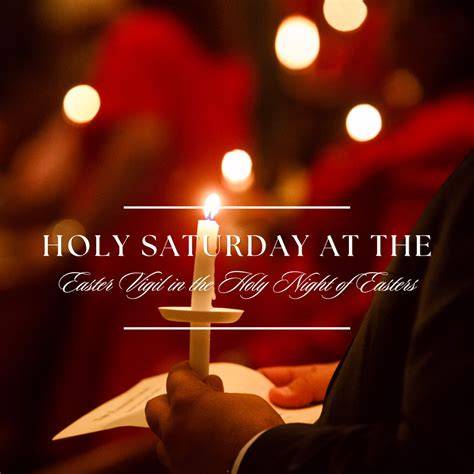
Many churches mark this day with an Easter Vigil after sunset on Holy Saturday, or sometimes early in the morning of Easter Day, with the lighting of candles representing the light of Christ.
Congregations often gather around a fire outside a darkened church, from which the Easter (Paschal) candle is lit and brought inside. This depiction of new life and light represents Jesus’s resurrection on the first Easter morning.
Parishioners then light their own candles from this main candle to symbolise their own coming into new life as followers of Jesus. The service then includes Old and New Testament readings which recount the history of salvation and prepare the congregation for the celebration of the resurrection.
Those new to the faith or those wishing to renew their baptismal vows can then be baptised, and to close the service, congregants share in the Eucharist.
Holy Saturday Solemn Easter Vigil – April 19, 2025
How the Vigil Developed
In Church history, the Easter Vigil did not always begin on Holy Saturday night. Near the fourth century, a Saturday nighttime vigil including the Service of Light, the Liturgy of the Word, Liturgy of Baptism and Liturgy of the Eucharist, lasting until midnight was indeed widely observed.
Beginning in the eighth century, the vigil started on Saturday afternoon, and in the 12th century, it was moved to begin on Holy Saturday morning. Pope Saint Pius V (r. 1566-72) issued a papal bull in 1566 forbidding any Mass to begin after noon; thus, observing the vigil on Holy Saturday morning was obligatory.
The daytime vigil celebrations were, in part, caused by the fact that Holy Saturday was a day of strict fasting, and people fasted until after they received holy Communion which, with a nighttime vigil, was late.
Celebrating the vigil rituals during daylight would seem strange to us today, and we are not alone with such thoughts. For example, in 1914, Father Herbert Thurston wrote in his book, “Lent and Holy Week,” that “it is difficult for us to persuade oneself on Saturday morning that the sun has already set, that our watch is nearly over, that more than 24 hours have elapsed since our Blessed Lord was laid in the tomb. That is, however, the effort of the imagination which the Church requires us to make.”
The timing took away from the symbolism associated with the Service of Light, and the holy events during darkness used to contemplate the resurrection of Jesus on Easter morning. In the 1950s, after a thousand years, the Church brought back the vigil to begin after darkness on Holy Saturday night.
Images and Devotional Practices
The image of Christ crucified or lying in the tomb, or the descent into hell, which mystery Holy Saturday recalls, as also an image of the Sorrowful Mother can be placed in the Church for the veneration of the faithful.
Find a moment to sit in a quiet place and accompany Our Lady through the day. In turn, she accompanies us in the Holy Saturdays of our own lives.
Holy Saturday as a Time of Waiting
I love Holy Saturday. Not because I enjoy it, exactly, but because it allows me to identify with a certain part of being human which is often overlooked. The part of being human that is about quietly suffering, when you’re all cried-out, when all the energy we had for resisting or complaining has been exhausted, and finally the pain has to become part of everyday life.
Everyone will know an experience in their life where they have lived through something that felt un-liveable, when the trauma and suffering were so acute that you survived on adrenaline until it was all over. Then you went home, closed the door, and all was quiet. You had to face the grief: The event itself is over, but the suffering is only just beginning.
I imagine that this is very similar to how the disciples and Mary felt the day after the Crucifixion. Numb, reeling, the pain like a bruise only just beginning to show.
We can all face Holy Saturdays in our lives- sometimes they’re borne from dramatic events, other times the slow-burning pain of daily life. They are times when there doesn’t seem to be a resolution to the pain, times when we’re waiting for it to be over, times when we’re struggling to see the point. We can wonder if it will ever be over.
Our Lady can be the key to understanding these times. She trusted God so implicitly that, though she did not understand why her son had to die, she trusted God that everything was in His hands.
That doesn’t mean that she felt any less the agony, but it gave her the strength to look into His eyes on the way to Calvary and in turn, give Him strength. It gave her the strength to stand at the foot of the Cross and watch Him die. It gave her the strength to accept His body in her arms. It gave her the strength to accept something she did not fully understand.
So on Holy Saturday, wait with Our Lady, who knew that the story could not end with the events of Good Friday. Holy Saturday did not last forever. After the tomb came the Resurrection.
Let us not be too hasty to skip to the glory of the Easter celebration- that will be joyful enough in its own time.
How to Wish Someone a Happy Holy Saturday
Happy Holy Saturday messages are thoughtful ways to share peace, faith, hope, and quiet reflection with family, friends, and loved ones before Easter Sunday. Choose a message that matches the person’s faith and the tone you want to convey.
Whether you are sending a text to family, posting a greeting on social media, or simply checking in with someone you love, the right words can make the day feel even more special.
Peaceful Holy Saturday Messages
- “May this Holy Saturday fill your heart with peace and quiet hope.”
- “Wishing you a peaceful and blessed Holy Saturday.”
- “May the stillness of Holy Saturday bring peace to your soul.”
- “May your Holy Saturday be filled with grace, patience, and peaceful thoughts.”
- “Sending peaceful thoughts and heartfelt blessings this Holy Saturday.”
- “May today bring you a moment to pause, breathe, pray, and find peace.”
- “Wishing you a quiet Holy Saturday filled with comfort and hope.”
- “May peace surround you and grace guide you this Holy Saturday.”
- “Let this Holy Saturday be a peaceful pause before the joy of Easter.”
- “May your heart rest in faith and your spirit remain peaceful today.”
- “Wishing you serenity, faith, and countless reasons to be hopeful this Holy Saturday.”
- “May the peace of Holy Saturday stay with you today and beyond.”
Heartfelt Holy Saturday Messages
- “May this Holy Saturday remind you that even in silence, hope is never lost.”
- “Wishing you a Holy Saturday filled with faith, comfort, and a hopeful heart.”
- “May God fill your heart with peace and strengthen your faith this Holy Saturday.”
- “On this Holy Saturday, may you find comfort in faith and courage in hope.”
- “May your heart be reminded today that difficult moments do not last forever.”
- “Sending you love, prayers, and peaceful thoughts this Holy Saturday.”
- “May this sacred day bring a renewed sense of faith and hope into your life.”
- “May your soul find rest, your heart find peace, and your faith grow stronger.”
- “Holy Saturday is a quiet reminder that hope can live even in the waiting.”
- “May the blessings of this Holy Saturday bring comfort wherever your heart needs it most.”
- “May your prayers be sincere, your heart be peaceful, and your hope remain strong.”
- “Wishing you a deeply meaningful Holy Saturday surrounded by faith, love, and peace.”
Short Holy Saturday Greetings
- “Blessed Holy Saturday to you and your family.”
- “Peace and blessings this Holy Saturday.”
- “Have a peaceful and blessed Holy Saturday.”
- “Wishing you faith, peace, and hope today.”
- “Happy and blessed Holy Saturday!”
- “May your Holy Saturday be peaceful and meaningful.”
- “Sending blessings your way this Holy Saturday.”
- “Faith, peace, and hope to you this Holy Saturday.”
- “Have a beautiful Holy Saturday filled with grace.”
- “May peace be with you this Holy Saturday.”
- “Blessings, prayers, and peace this Holy Saturday.”
- “Wishing you a peaceful path toward Easter joy.”
Holy Saturday Messages for Family
- “Wishing our beautiful family a peaceful and blessed Holy Saturday.”
- “May our family remain united in faith, love, and hope this Holy Saturday.”
- “May God bless our home with peace this Holy Saturday and always.”
- “Sending Holy Saturday blessings to the people who make my life brighter.”
- “May this Holy Saturday bring our family closer through faith and love.”
- “Wishing everyone in our family a peaceful day filled with prayer and hope.”
- “May our hearts be peaceful and our home be filled with blessings this Holy Saturday.”
- “Holy Saturday blessings to my wonderful family. May your hearts be filled with hope.”
- “May faith guide our family today and give us plenty of reasons to be grateful.”
- “Wishing my family a Holy Saturday filled with peaceful moments and loving memories.”
- “May God’s peace rest upon our family this Holy Saturday.”
- “Together in love, united in faith, and grateful for another Holy Saturday.”
Holy Saturday Messages for Friends
- “Wishing you a peaceful Holy Saturday, my friend. May your heart be full of hope.”
- “May this Holy Saturday bring you peace, happiness, and renewed faith.”
- “Sending you a little Holy Saturday reminder to pause, breathe, and appreciate life.”
- “Happy Holy Saturday, friend! May your day be calm, meaningful, and blessed.”
- “May your Holy Saturday be as peaceful as your favorite quiet morning.”
- “Praying that this Holy Saturday brings you comfort and plenty of hope.”
- “Friend, may faith keep your heart steady and hope keep your smile bright.”
- “Wishing you a beautiful Holy Saturday and an even brighter Easter ahead.”
- “May your prayers bring peace and your heart find every reason to smile.”
- “Sending friendship, prayers, and Holy Saturday blessings your way.”
- “Take a peaceful pause today, friend. You deserve a moment of grace.”
- “Happy Holy Saturday to a friend who always brings light into my life.”
Religious Holy Saturday Messages
- “May God bless you with peace, strength, and unwavering faith this Holy Saturday.”
- “May the grace of God surround you on this sacred Holy Saturday.”
- “May your heart remain faithful and your spirit remain hopeful as Easter approaches.”
- “May God guide your thoughts, bless your prayers, and fill your heart with peace.”
- “On this Holy Saturday, may your faith grow deeper and your hope shine brighter.”
- “May the Lord bless your home and everyone you hold dear this Holy Saturday.”
- “May God’s love give you comfort as you reflect on the meaning of this sacred day.”
- “May your Holy Saturday be filled with prayer, grace, patience, and hope.”
- “May the Lord strengthen your heart and renew your faith this Holy Saturday.”
- “May God’s peace fill every corner of your heart and home today.”
- “May this sacred Saturday draw you closer to God and prepare your heart for Easter joy.”
- “May the blessings of God remain with you and your family this Holy Saturday.”
Hopeful Holy Saturday Messages
- “Never lose hope. Holy Saturday reminds us that waiting can still lead to beautiful beginnings.”
- “May hope rise quietly in your heart this Holy Saturday.”
- “Whatever you are waiting for, may faith give you the patience to keep hoping.”
- “This Holy Saturday, may every quiet moment remind you that hope is still alive.”