The Vatican City-Italy border is an open international boundary inside Rome. Vatican City is an independent city-state completely surrounded by Italy, but visitors normally cross between the two countries without passport control, customs inspection or a visible border checkpoint.
The easiest place to cross from Italy into Vatican City is St. Peter’s Square. Visitors can walk into the square from Rome and are then officially inside Vatican City State. A second, more controlled entrance is the Vatican Museums entrance, where a valid ticket and airport-style security screening are required.
Where Is the Vatican City-Italy Border?
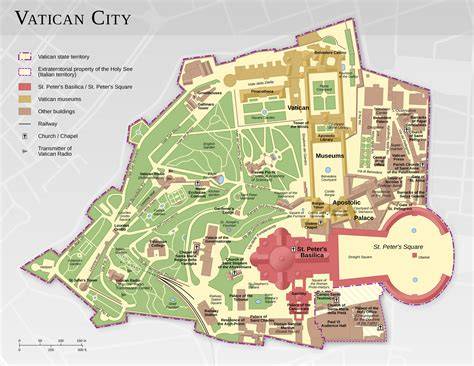
Vatican City is located entirely within the city limits of Rome, on the opposite side of the Tiber River from the Colosseum. The geography of Vatican City is unique due to the country’s position as an urban, landlocked enclave of Rome, Italy.
The Vatican is often cited an an example of an Enclave, a territory that is completely surrounded by the territory of one other state, in this case Italy. The Vatican border is the World’s shortest entire boundary, only 3.2 km.
With an area of 49 hectares it is the world’s smallest independent state. Vatican City is a nation of superlatives. It’s the smallest country in the world at 0.17 square miles (0.44 square km), and simultaneously home to the largest church in Christendom (St. Peter’s Basilica).
Why Does Vatican City Have a Border With Italy?
Vatican City was established as an independent state through the Lateran Treaty between the Holy See and the Kingdom of Italy in 1929. The tiny independent state of Vatican City is surrounded by walls that date from the 9th century, but it wasn’t until the Lateran Treaty was signed in 1929 that it officially gained its independent status as a separate country from Italy.
It was Fascist leader Benito Mussolini who signed the treaty to bring the Vatican City State into official existence in 1929. When the Lateran Treaty of 1929 that gave the state its form was being prepared, the boundaries of the proposed territory were influenced by the fact that much of it was all but enclosed by this loop.
For some tracts of the frontier, there was no wall, but the line of certain buildings supplied part of the boundary, and for a small part of the frontier a modern wall was constructed.
What Marks the Border?
Visitors today will barely recognize that they’re technically leaving Italy and entering another country, however, as there’s no passport checkpoint or border control. The country has open borders with Italy despite the fact that some of it is behind huge walls.
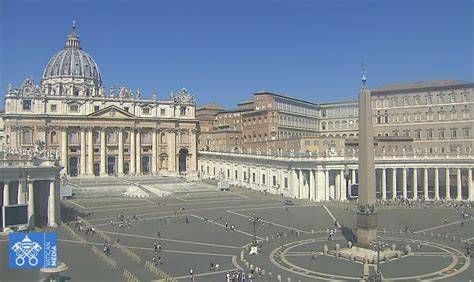
The territory includes St. Peter’s Square, distinguished from the territory of Italy only by a white line along the limit of the square, where it touches Piazza Pio XII. The columns and white lines marks the border.
The border is marked by white lines and there is a subtle change in the street paving, this area is clearly marked as being part of Vatican territory. Parts of the border can be noticed by fences.
St. Peter’s Square is reached through the Via della Conciliazione which runs from close to the Tiber to St. Peter’s. This grand approach was constructed by Benito Mussolini after the conclusion of the Lateran Treaty.
How to Cross From Italy Into Vatican City
The Vatican City is one of a few countries in the world without an airport or seaport, so the only way to enter the country is overland. Surprisingly there are no public buses or metro trains that cross the border and while cars and tour buses do enter the Vatican State, it is most likely you will cross the border on foot.
There are two Metro stations within a reasonable walking distance from Vatican City - Ottaviano-San Pietro and Cipro-Musei Vaticani - as well as several bus lines that stop nearby. It’s also easy to walk to Vatican City from, say, the Colosseum.
From Rome Metro to St. Peter’s Square
Head on the Rome Metro to either Cipro or Ottaviano San Pietro. Both are on Line A of the Rome Metro.
When you get out at Ottaviano San Pietro, head onto the main street Via Barletta, and from here you can walk south towards the Vatican City State.
The main entrance to Vatican City is through St. Peter’s Square, from which you can’t really even see the Vatican walls. Simply walk into St. Peter’s Square, which is in the Vatican City State. You have now left Italy and are officially in the Vatican City State.
Entry is free and there is no border control or bag check and there is no queue. However, it can get busy especially on Wednesday mornings when the Pope is doing a speech.
Crossing at St. Peter’s Square
It’s a huge square with lots of seats laid out in it. There is an actual thick bit of concrete at intervals that marks the border and you can tell where it is.
The brickwork is slightly different and one side has the Vatican City Post Office on it, the other side you’re clearly in Italy. The territory includes St. Peter’s Square, distinguished from the territory of Italy only by a white line along the limit of the square, where it touches Piazza Pio XII.
The foot border at St. Peter’s Square is probably the easiest way to cross into the Vatican City State. The main entrance is particularly convenient for visitors going to St. Peter’s Basilica or exploring the square.
Crossing at the Vatican Museums Entrance
Although the foot border at St. Peter’s Square is probably the easiest way to cross into the Vatican City State, I first entered the Vatican City at the Vatican Museums Entrance.
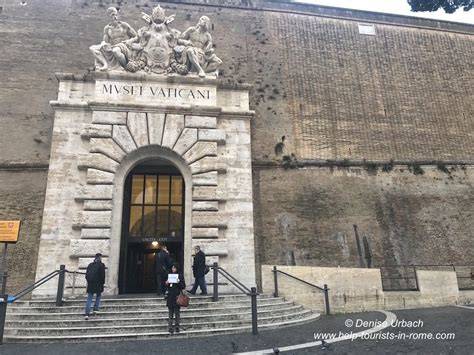
When entering the Vatican City through the Museums entrance, things are a bit more strict. Firstly the border is obviously a wall so clearly you can’e just dander through it. Everything through the other side of the wall is inside the Vatican City, the wall marks the border and things can’t be much more obvious than that.
However, you will need a ticket to get to the other side of the wall. Queues can be long, particularly in the high season, and the museums themselves are so vast that it’s easy to get overwhelmed without someone to point out the highlights.
Once you are through the arch, you will immediately have a ticket check, and have to go through a security check (the same as one in an airport). This is standard procedure.
Bottles of water, cameras and small bags are allowed in. Large bags, dangerous items (knives, inflammables etc.) and glass bottles will have to be left in and collected later.
Once you are through security and have your ticket checked, you are inside a big hall. You take the escalator up and you are now in the museum part of the Vatican City State.
Is There Passport Control at the Border?
There is no passport checkpoint or border control at the ordinary pedestrian entrance from Rome into St. Peter’s Square. Visitors generally move from Italy into Vatican City without stopping at an immigration booth.
If you are already legally allowed in Italy, then no visa is required or checked. No visa is needed to visit the Vatican City state if you are already legal in Italy.
Just make sure you have an Italian or Schengen Visa in advance. Entry requirements for Vatican City are therefore connected in practice with the legal requirements for entering Italy and the Schengen Area.
Do You Need a Separate Visa for Vatican City?
Vatican City does not require a separate tourist visa for visitors who are already legally permitted to enter Italy. If you are already legally allowed in Italy, then no visa is required or checked.
No visa is needed to visit the Vatican City state if you are already legal in Italy. Just make sure you have an Italian or Schengen Visa in advance.
Can You Enter Vatican City by Train?
The Vatican city also has 300 metres of a train line, thanks to the St. Peter’s Station. The train line is mostly used for freight and celebrities like the Pope so it is unlikely you will cross the border by train.
The Vatican City is one of a few countries in the world without an airport or seaport, so the only way to enter the country is overland. Cars and tour buses do enter the Vatican State, but most ordinary visitors cross the border on foot.
| Transport option | What to expect |
|---|---|
| Walking | The most likely way to cross the border |
| Metro | No public metro trains cross the border; Ottaviano-San Pietro and Cipro-Musei Vaticani are nearby |
| Bus | No public buses cross the border, although several bus lines stop nearby |
| Train | Vatican City has 300 metres of railway, mostly used for freight and celebrities like the Pope |
| Airport or seaport | Vatican City has neither an airport nor a seaport |
What Can You Visit After Crossing the Border?
And yet within this miniscule spot on the map lie two of Rome’s most popular tourist attractions - the Vatican Museums (which include the Sistine Chapel) and St. Peter’s Basilica.
There is one UNESCO World Heritage Site in Vatican City, which takes up the entirety of the city-state. Once you are through security and have your ticket checked, you are inside a big hall.
You can travel around the museums on your own, or join a tour and learn a lot and avoid the queues and hassle. The country is now yours to enjoy and for such a small country there is a lot to see and do.
It’s highly recommended to go on a guided tour of the Vatican Museums, particularly in the high season. The lines outside the museum entrance can be hours long if you don’t have a reserved entry ticket.
The main entrance to Vatican City is through St. Peter’s Square, while the Vatican Museums entrance is a separate, ticket-controlled route through the border wall.
How to Visit the Vatican in 2026 (Without Screwing It Up)
How Long Does It Take to Walk Around Vatican City?
If you decide to walk around the perimeter of the entire country, it shouldn’t take you more than a half-hour. The Vatican border is the World’s shortest entire boundary, only 3.2 km.
The small size of the state makes the boundary unusual: some sections are defined by walls, some by buildings, and the edge of St. Peter’s Square is marked mainly by paving, columns and white lines.
Is There a Border Dispute Between Italy and Vatican City?
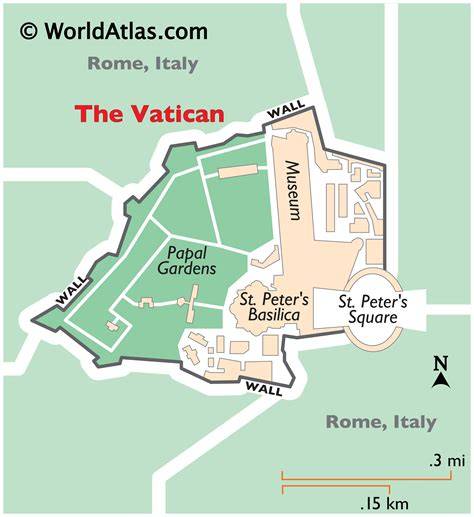
As noted earlier the Vatican has a very short international border (3.2 km long). The map also indicates a small section (60 metres long and 3 metres wide) in red which is an area of the border which is contested.
Italy contends that the Lateran Treaty stipulates that this is Italian territory, but the Vatican disputes this. The difference between both states has remained unresolved since 1932, when a mixed Italian-Vatican commission tasked with demarcating the border agreed to disagree.
As noted on the map above the contested border is the narrow area to the right of the red line, between the columns and the walls, Part of that area is occupied by a street seller. The top end of the area is where it narrows.
The border is marked by white lines and there is a subtle change in the street paving, this area is clearly marked as being part of Vatican territory. Speaking to the stall owner, he was certain the area belonged to the Vatican.
Vatican City’s Status as an Independent State
Vatican City, officially Vatican City State (Italian: Stato della Città del Vaticano;) is the Holy See’s independent city-state. The Vatican is the smallest sovereign state in the world.
Vatican City is governed as an absolute monarchy with the pope at its head. The Vatican City is recognised by the UN as an “observer state” rather than a country.
Vatican City is the smallest internationally recognised independent state in the world by area. The Vatican City State is the smallest internationally recognised independent state in the world by population.
Many people think it doesn’t really feel like a country but I personally count it on my official country list even though they don’t have a FIFA recognised international football team, nor are they on the UN list of 193 countries.
The Vatican City international football team is not recognised by FIFA or UEFA. They drew their first ever match 0-0 with San Marino in 1994. They have only ever scored 1 goal against a country which was in a 2-1 defeat to Monaco.
Vatican City and Its Extraterritorial Properties
Outside the Vatican City, thirteen buildings in Rome and Castel Gandolfo (the pope’s summer residence) enjoy extraterritorial rights. One building, the Paul VI Audience Hall, straddles the border, but its Italian portion has extraterritorial rights.
Another interesting element of the Vatican is the existence throughout Rome of extra territorial properties. These include many churches and other buildings of special significance that have been granted extraterritorial status by the Lateran Treaty without being part of the independent Vatican City.
Italy has agreed to exempt these areas from taxes and from obedience to the law of expropriation for public utilities: papal authorities are entrusted with internal police service. For postal and telegraphic service they are considered to belong to the Vatican.
Travel between these properties was seen as being on diplomatic business. These properties should not be confused with the continuous territory of Vatican City inside Rome.
Languages, Currency and Postal Services
Note that although Vatican City uses the euro currency and Italian is the national language, it has its own post office - Poste Vaticane.
The Vatican’s postal service is notoriously more reliable than Italy’s, so if you want to be more confident of postcards getting to their intended recipient, head to the Poste Vaticane offices to buy the stamps you need and send items on their way.
The currency of the Vatican City State used to be the Lira, but they converted to the Euro the same time as Italy did. You can get VCS stamps and coins.
The coins are really only for souvenir. Nobody spends them, though it is unlikely they will be rejected anywhere as they are genuine Euro coins. Postcards, fridge magnets and books are also readily available.
Can You Get a Vatican City Passport Stamp?
There is no place to buy a passport stamp in Vatican City, so your friends will just have to take your word for it that you were there. Visitors cannot normally obtain an official entry stamp in their passport.
I asked a lot of people in the Vatican City State if I could get my passport stamped, including my tour guide, some officials and workers in the Post Office and I was informed that I could NOT get my passport stamped in the country.
However if you post a postcard from the Vatican City State, the stamp on it is stamped with a Vatican City State stamp, so this is the nearest you might get.
Key Facts About the Vatican City-Italy Border
- Vatican City is an independent city-state completely surrounded by Italy.
- It is located entirely within Rome.
- The border is approximately 3.2 km long.
- The Lateran Treaty established Vatican City as an independent state in 1929.
- The easiest pedestrian crossing is through St. Peter’s Square.
- There is no ordinary passport control or customs checkpoint at St. Peter’s Square.
- The Vatican Museums entrance is separated from Italy by a wall.
- A ticket and security screening are required to enter the Vatican Museums.
- Vatican City has no airport or seaport.
- Vatican City has 300 metres of railway, mostly used for freight and special journeys.
- Vatican City uses the euro and has its own postal service.
- The state has no separate tourist visa requirement for people already legally admitted to Italy.
- Vatican City is recognised by the UN as an observer state.
Population and Other Facts
The Vatican City State has a population of 842. The majority of the Vatican City State’s 842 citizens live abroad.
For nearly 60 years during the 1800s and 1900s, Popes refused to leave the Vatican City State. The Vatican City State is 1/8th of the size of Central Park, New York City, USA.
The Residenzia Paolo VI is the only Hotel in the Vatican City State. Alcohol is legal in the Vatican City State for over 18s but there are no known breweries or distilleries in the country.
The Italian name for Vatican City is Città del Vaticano, and it’s pronounced chee|TAH del vah|tee|KAH|noh. There is no demonym for people or things from Vatican City, since no one is really “from” there.