Christianity is an Abrahamic monotheistic religion based on the Bible and the teachings of Jesus. At its centre is Jesus Christ, whom most Christian denominations generally understand as God the Son-the Logos incarnated-who ministered, suffered, and died on a cross, but rose from the dead for the salvation of humankind.
As a religion of peace, Christianity teaches reconciliation with God and other people, love of neighbour, forgiveness, mercy, and service. Its understanding of peace is not limited to the absence of war: it also concerns the restoration of human relationships, the care of the vulnerable, and the hope of redemption. Christianity is the world’s largest and most widespread religion, with over 2.3 billion followers, comprising around 28.8% of the world population.
What Christianity Is
Christianity is the major religion stemming from the life, teachings, and death of Jesus of Nazareth-the Christ, or the Anointed One of God-in the 1st century ce. It has become the largest of the world’s religions and, geographically, the most widely diffused of all faiths.
At its most basic, Christianity is the faith tradition that focuses on the figure of Jesus Christ. In this context, faith refers both to the believers’ act of trust and to the content of their faith. As a tradition, Christianity is more than a system of religious belief.
It also has generated a culture, a set of ideas and ways of life, practices, and artifacts that have been handed down from generation to generation since Jesus first became the object of faith. Christianity is thus both a living tradition of faith and the culture that the faith leaves behind.
The agent of Christianity is the church, the community of people who make up the body of believers. To say that Christianity “focuses” on Jesus Christ is to say that somehow it brings together its beliefs and practices and other traditions in reference to a historical figure.
Few Christians, however, would be content to keep this reference merely historical. Although their faith tradition is historical-i.e., they believe that transactions with the divine do not occur in the realm of timeless ideas but among ordinary humans through the ages-the vast majority of Christians focus their faith in Jesus Christ as someone who is also a present reality.
Jesus Christ in Christian Faith
The Gospels state that Jesus is the Son of God and rose from the dead after his crucifixion, whose coming as the messiah, or Christ, was prophesied in the Old Testament and chronicled in the New Testament. The name Jesus comes from Ancient Greek: Ἰησοῦς (Iēsous), probably from Hebrew/Aramaic: יֵשׁוּעַ (Yēšūaʿ).
Most Christian denominations generally hold in common the belief that Jesus is God the Son-the Logos incarnated-who ministered, suffered, and died on a cross, but rose from the dead for the salvation of humankind; this message is called the gospel, meaning the “good news”.
To say that Christianity focuses on Jesus is not merely to refer to a teacher from the past. Christians understand him as the central figure through whom God’s purposes for humanity are revealed and through whom salvation is accomplished.
They may include many other references in their tradition and thus may speak of “God” and “human nature” or of the “church” and the “world,” but they would not be called Christian if they did not bring their attentions first and last to Jesus Christ.
Christianity, Monotheism, and Salvation
Modern scholars have located the focus of this faith tradition in the context of monotheistic religions. Christianity addresses the historical figure of Jesus Christ against the background of, and while seeking to remain faithful to, the experience of one God.
It has consistently rejected polytheism and atheism. Christianity is classified as an Abrahamic and monotheistic religion, and its central beliefs are expressed through scripture, theology, worship, and the life of the church.
A second element of the faith tradition of Christianity, with rare exceptions, is a plan of salvation or redemption. That is to say, the believers in the church picture themselves as in a plight from which they need rescue.
For whatever reason, they have been distanced from God and need to be saved. Christianity is based on a particular experience or scheme directed to the act of saving-that is, of bringing or “buying back,” which is part of what redemption means, these creatures of God to their source in God.
The agent of that redemption is Jesus Christ. Whether Christians are engaged in being saved or redeemed on the one hand, or thinking and speaking about that redemption, its agent, and its meaning on the other, they are concentrating on the essence of their experience.
Christian Teachings About Peace
Christianity’s orientation toward peace is rooted in its understanding of God, salvation, and human responsibility. The faith tradition presents reconciliation as a central religious concern: human beings need restoration in their relationship with God, and this restoration should shape their relationships with one another.
Christian teaching connects faith with ways of life, practices, and artifacts that have been handed down from generation to generation. Peace therefore appears not only in theological statements but also in prayer, worship, moral conduct, community life, acts of mercy, and efforts to change the world.
Christians express their adherence to the tradition in their prayer life and church-building, in their quiet worship or their strenuous efforts to change the world. These different forms of religious life show that Christian peace may be contemplative, communal, charitable, missionary, or social in its expression.
The Christian understanding of peace is also connected with the gospel, the “good news” of salvation through Jesus Christ. Because the gospel is concerned with redemption, Christian peace is understood as a condition made possible by restored relationships rather than merely a political arrangement.
The Bible and Its Importance to Christians
Christianity is based on the Bible and the teachings of Jesus. The Bible consists of the Old Testament and the New Testament, and the biblical languages associated with it include Biblical Hebrew, Biblical Aramaic, and Biblical Greek.
The four canonical gospels of Matthew, Mark, Luke and John describe the life of Jesus and teachings as preserved in the early Christian tradition, with the Old Testament as the gospels’ respected background.
The Old Testament provides the scriptural background for the Christian understanding of God, creation, Israel, prophecy, law, and the anticipated messiah. The New Testament chronicles the life, death, and resurrection of Jesus and records the development of the early Christian community.
Scripture is important to Christians because it preserves the central narrative through which they understand God’s relationship with humanity, the identity and mission of Jesus Christ, the meaning of salvation, and the calling of the church.
The Church and Its Purpose
The church is the community of people who make up the body of believers. It is the agent of Christianity and serves as the social, spiritual, and institutional expression of the faith tradition.
The church brings together Christian beliefs, practices, and traditions in reference to Jesus Christ. Its life includes worship, prayer, instruction, the preservation of scripture and doctrine, communal relationships, and service.
Christian communities have expressed their faith through church-building, quiet worship, and strenuous efforts to change the world. The variety of these expressions reflects the thousands of separate churches, sects, and denominations that make up the modern Christian tradition.
The church also provides continuity across generations. Christianity is more than a system of religious belief because it has generated a culture, a set of ideas and ways of life, practices, and artifacts that have been handed down since Jesus first became the object of faith.
Common Christian Practices and Rituals
Christian practices vary among churches, regions, and denominations, but prayer and worship are central throughout the tradition. Christians may worship quietly or participate in highly expressive communal services, and they may organize their religious life around churches, clergy, scripture, sacraments, preaching, music, and service.
Early Christian identity included faith in Christ, baptism, and participation in his death and resurrection. Paul argued that Gentiles could participate in the promises of Israel through exclusive devotion to the God of Israel, faith in Christ, baptism, and participation in his death and resurrection, without full adherence to the Torah, including circumcision.
Christian practice also includes teaching and theological reflection. From the year 150, Christian teachers began to produce theological and apologetic works aimed at defending the faith. These authors are known as the Church Fathers, and the study of them is called patristics.
Prayer life and worship may be expressed through personal devotion and collective ceremonies. The tradition also includes practices associated with the sacraments, priesthood, monasticism, scripture, creeds, and liturgy.
Origins in First-Century Judaism
Christianity originated as a Jewish movement in Judaea during the 1st century AD, within the context of late Second Temple Judaism. The earliest followers of Jesus were Jews who understood his life, death and expected return through familiar Jewish apocalyptic and messianic frameworks.
They remained embedded in Jewish religious life and did not initially conceive of themselves as departing from Israel or founding a new faith. Following their conviction that Jesus had been raised from the dead, they established a community in Jerusalem that awaited Jesus’s return and eschatological renewal, seeking to spread this message throughout Israel and the Jewish diaspora.
Early Jewish Christianity maintained a high Christology alongside monotheism. This combination of devotion to Jesus and commitment to the one God became a defining feature of the emerging movement.
Early Jewish Christians referred to themselves as being of “The Way,” an expression possibly coming from Isaiah 40:3, “prepare the way of the Lord”. According to Acts 11:26, the term “Christian,” meaning “followers of Christ” and referring to Jesus’ disciples, was first used in the city of Antioch by the non-Jewish inhabitants there.
The earliest recorded use of the term “Christianity/Christianism” was by Ignatius of Antioch around 100 AD. The movement’s identity therefore developed through its relationship to Jesus, Jewish scripture, the early communities of believers, and its expansion beyond Judaea.
The Apostolic Age and the Expansion of the Movement
The earliest Christian community was led by the three Pillars of the Church, namely James the Just, Peter, and John. The disciples of Jesus spread their faith around the Eastern Mediterranean area, despite significant persecution.
Meanwhile, as the message about Jesus spread beyond Judea and Galilee into the broader Greco-Roman world, it increasingly attracted Gentile adherents, especially among “God-fearers”: non-Jews who were attracted to Judaism and participated in synagogal worship without fully converting.
This created a challenge for the movement’s Jewish religious outlook, which insisted on close observance of the Jewish commandments. Against this backdrop, Paul the Apostle, a Jew of the Pharisaic school who had initially persecuted the Jesus movement, became one of its most influential missionaries following his conversion.
Paul focused on spreading the message to non-Jews in the Eastern Mediterranean. He argued that Gentiles could participate in the promises of Israel through exclusive devotion to the God of Israel, faith in Christ, baptism, and participation in his death and resurrection, without full adherence to the Torah, including circumcision.
This had a formative effect on the emerging Christian identity as separate from Judaism. Over time, such developments contributed to the gradual differentiation between the Jesus movement and other Jewish communities, a process that resulted in the emergence of Christianity as a separate religion.
Early Christian Diversity and Debate
The formative period was followed by the early bishops, whom Christians consider the successors of Christ’s apostles. During this period, there was no unified Christian movement but rather multiple competing sects, which held radically different beliefs.
Christian authors began using the Greek term hairesis, meaning “school of thought”, to describe rival communities, which gave rise to the concept of heresy. The existence of disagreement shows that Christian history developed through debates about scripture, the nature of God, the identity of Christ, salvation, and the authority of different communities.
Notable early Fathers include Ignatius of Antioch, Polycarp, Justin Martyr, Irenaeus, Tertullian, Clement of Alexandria and Origen. Figures like Justin Martyr, Irenaeus, Tertullian, and Clement of Alexandria, often retrospectively referred to as “proto-orthodox”, insisted that there was one original apostolic teaching and that all rivals had deviated from it.
Valentinus, an Alexandrian teacher, developed a Gnostic theology in which Christ brought saving knowledge, or gnosis, that enabled believers to be redeemed from the material world. Marcion, from Sinope, drew a distinction between high, purely good god, father of Christ, and the lower, merely “just” god of Israel, who demanded sacrifice and procreation.
Marcion is also known to have assembled a collection of Christian texts, including his own gospel, and in doing so created one of the earliest known Christian scriptural canons. Justin Martyr, from Neapolis, disagreed with both, arguing the God of the Jewish scriptures was Christ himself before his incarnation.
Persecution and the Christian Commitment to Faith
Christianity occupied an unstable position within the Roman world. In antiquity, what moderns call “religion” was closely associated with ancestral traditions and embedded within other aspects of ethnic identity.
It is possible that Gentile Christians, having rejected their native gods, were perceived by their pagan neighbors as disrupting the relationship between the divine and the community, on which civic welfare depended. Early examples of persecution of Christians include the Acts of the Apostles, which portrays Saint Stephen as being killed by a mob in Jerusalem, while Paul writes that he himself had persecuted Christians prior to his vision of Christ.
Additionally, Tacitus wrote that Emperor Nero blamed Christians for the Great Fire of Rome in 64 AD. In the following centuries, Church Fathers recorded accusations that Christians were responsible for droughts, famines, and plagues.
Nevertheless, before the mid-3rd century, persecutions were often reactive, sporadic and local. This changed in 249, when the emperor Decius, who ruled the empire following a long period of instability, ordered all residents of the empire, except Jews, to perform a sacrifice to the Roman gods.
The Diocletianic Persecution beginning in 303 was particularly severe; Christians were accused of attracting demons that disrupted traditional cult practices and threatened public order, and were subjected to confiscations, destruction of buildings, expulsions, imprisonment, and demands for sacrifice.
The history of persecution is significant for Christian understandings of peace because it shaped the experience of communities that viewed faithfulness, endurance, and solidarity as religious virtues. It also demonstrates that Christianity developed in circumstances where believers were frequently a vulnerable minority.
Constantine, Nicaea, and the Imperial Church
The situation changed under Constantine, who granted imperial support to Christianity, though under his rule and that of his successors, forms deemed heretical were suppressed. Constantine was exposed to Christianity in his youth, and throughout his life his support for the religion grew, culminating in baptism on his deathbed.
During his reign, state-sanctioned persecution of Christians was ended with the Edict of Toleration in 311 and the Edict of Milan in 313. At that point, Christianity was still a minority belief, comprising perhaps only 5% of the Roman population.
Constantine was also instrumental in the convocation of the First Council of Nicaea in 325, which sought to address Arianism and formulated the Nicene Creed, which is still used by in Catholicism, Eastern Orthodoxy, Lutheranism, Anglicanism, and many other Protestant churches.
Nicaea was the first of a series of ecumenical councils, which formally defined critical elements of the theology of the Church, notably concerning Christology. On 27 February 380, Theodosius I, Gratian, and Valentinian II issued the Edict of Thessalonica establishing Nicene Christianity as the State church of the Roman Empire.
As soon as it became connected to the state, Christianity grew wealthy; the Church solicited donations from the rich and could now own land. The connection between Christianity and political power later became an important part of the religion’s complex history, because Christian ideals of peace existed alongside institutions that were increasingly connected with states and empires.
The Spread of Christianity Beyond the Roman World
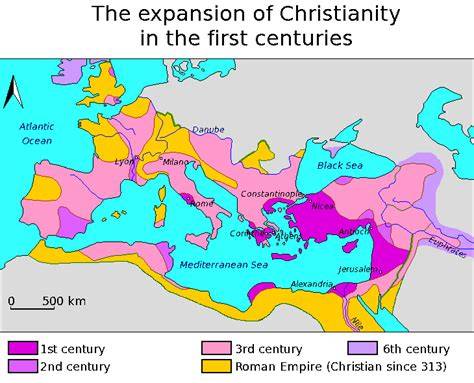
Christianity spread to Aramaic-speaking peoples along the Mediterranean coast and also to the inland parts of the Roman Empire and beyond that into the Parthian Empire and the later Sasanian Empire, including Mesopotamia, which was dominated at different times and to varying extents by these empires.
The presence of Christianity in Africa began in the middle of the 1st century in Egypt and by the end of the 2nd century in the region around Carthage. Mark the Evangelist is claimed to have started the Church of Alexandria in about 43 AD; various later churches claim this as their own legacy, including the Coptic Orthodox Church.
Important Africans who influenced the early development of Christianity include Tertullian, Clement of Alexandria, Origen of Alexandria, Cyprian, Athanasius, and Augustine of Hippo. Their work shows that Christianity developed through contributions from Africa, the Middle East, Europe, and the wider Mediterranean world.
Armenia was the first state to adopt Christianity as the state religion in the early 4th century AD. King Tiridates III made Christianity the state religion in Armenia in the early 4th century, making Armenia the first officially Christian state.
Major Branches of Christianity
The largest groups in Christianity are the Roman Catholic Church, the Eastern Orthodox churches, and the Protestant churches. The Oriental Orthodox churches constitute one of the oldest branches of the tradition but had been out of contact with Western Christianity and Eastern Orthodoxy from the middle of the 5th century until the late 20th century because of a dispute over Christology, the doctrine of Jesus Christ’s nature and significance.
| Branch or tradition | Estimated number of followers | Historical description |
|---|---|---|
| Catholicism | 1.3 billion people | The Roman Catholic Church is one of the three main branches of Christianity. |
| Protestantism | 800 million | Protestantism split into numerous denominations from the Catholic Church during the Reformation era (16th century). |
| Eastern Orthodoxy | 300 million | The Eastern Orthodox Church and the Catholic Church separated in the East-West Schism in 1054. |
| Oriental Orthodoxy | 60 million | The Oriental Orthodox churches constitute one of the oldest branches of the tradition. |
| Restorationism | 35 million | Restorationism is another prominent branch within the broader Christian world. |
Catholicism
The Roman Catholic Church is the largest Christian body and one of the three main branches of Christianity. Catholic Christianity preserves a worldwide institutional structure and belongs to the Western branch of the Christian tradition.
Eastern Orthodoxy
The Eastern Orthodox churches form one of the principal branches of Christianity. The Eastern Orthodox Church and the Catholic Church separated in the East-West Schism in 1054.
Oriental Orthodoxy
The Oriental Orthodox churches constitute one of the oldest branches of the tradition but had been out of contact with Western Christianity and Eastern Orthodoxy from the middle of the 5th century until the late 20th century because of a dispute over Christology.
The Church of the East did not accept the third and following ecumenical councils and is still separate today by its successors, the Assyrian Church of the East. The Church of the East and Oriental Orthodoxy both split over differences in Christology during the 5th century.
Protestantism
Protestantism split into numerous denominations from the Catholic Church during the Reformation era in the 16th century. It is not a single church but a broad family of churches and movements with diverse approaches to doctrine, worship, church government, and the interpretation of scripture.
Movements Across Denominational Boundaries
Significant movements within the broader Christian world and sometimes transcending denominational boundaries are Pentecostalism, Charismatic Christianity, Evangelicalism, and fundamentalism. In addition, there are numerous independent churches throughout the world.
Christianity remains culturally diverse in its Western and Eastern branches, and doctrinally diverse concerning justification and the nature of salvation, ecclesiology, ordination, and Christology. Smaller church communities number in the thousands.
Historical Divisions and Efforts Toward Unity
The complexity of Christianity is revealed by the thousands of separate churches, sects, and denominations that make up the modern Christian tradition. To project these separate bodies against the background of their development in the nations of the world is to suggest the bewildering variety.
Given such complexity, it is natural that throughout Christian history both those in the tradition and those surrounding it have made attempts at simplification. Two ways to do this have been to concentrate on the “essence” of the faith, and thus on the ideas that are integral to it, or to be concerned with the “identity” of the tradition, and thus on the boundaries of its historical experience.
Christianity’s divisions concern doctrine, church authority, ecclesiology, ordination, the nature of salvation, justification, and Christology. At the same time, Christians have pursued efforts toward unity, and ecumenism remains an important feature of the modern Christian world.
In Christianity, efforts toward unity, or ecumenism, are underway. These efforts seek greater understanding and cooperation among churches without erasing the historical and theological differences that have shaped the separate traditions.
Christianity’s Global Development
Following the Age of Discovery, from the 15th to the 17th century, Christianity expanded globally via missionary work, evangelism, immigration, and trade. Christianity played a prominent role in the development of Western civilization, particularly in Europe from late antiquity and the Middle Ages.
Its adherents, known as Christians, are estimated to make up a majority of the population in 120 countries and territories. Christianity remains culturally diverse in its Western and Eastern branches and is practiced in communities across every inhabited region of the world.
In the West, Christianity remains the dominant religion even with a decline in adherence, with about 70% of that population identifying as Christian. Christianity is growing in Africa and Asia, the world’s most populous continents.
Many Christians are still persecuted in some regions of the world, particularly where they are a minority, such as in the Middle East, North Africa, East Asia, and South Asia. The global history of Christianity therefore includes both large established churches and minority communities facing pressure, displacement, or violence.
The Entire History of Christianity Explained
Christianity and the Meaning of Peace
Christianity can be described as a religion of peace because its central religious themes include reconciliation, redemption, forgiveness, communal responsibility, and the restoration of humanity to God. These themes are connected with the Christian focus on Jesus Christ as the agent of salvation.
Peace in Christianity is expressed through the life of the church, the prayer of believers, worship, baptism, teaching, service, and the preservation of a tradition that has continued across the ages. It can also inspire efforts to change the world when Christians understand social action as a response to the gospel.
At the same time, Christian history includes persecution, disputes, institutional divisions, connections with imperial power, and conflicts among communities. The history of Christianity should therefore be understood as the history of a faith whose teachings about peace have been interpreted and practiced in diverse circumstances by different churches, societies, and generations.
Christianity is both a living tradition of faith and the culture that the faith leaves behind. Its enduring identity is formed by the relationship between its beliefs, its communities, its practices, and its continuing focus on Jesus Christ.