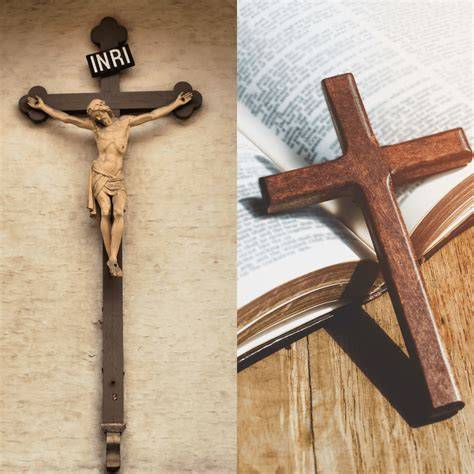
The main visual difference is simple: the Protestant cross is usually an empty cross, while the Catholic crucifix includes the body of Jesus Christ, known as the corpus, attached to it. Protestants commonly emphasize the empty cross as a sign that Jesus was resurrected and no longer remains on the cross, whereas Catholics emphasize the crucifix as a reminder of Christ’s suffering, death, and sacrifice for human salvation.
Neither symbol can be understood adequately by appearance alone. The empty cross highlights the risen and glorified Christ, while the crucifix makes Christ’s sacrificial death visible and keeps the Passion at the center of Christian meditation. Catholics and Protestants may therefore look at the same cross-shaped symbol while giving it different theological emphases.
The visual difference between a cross and a crucifix
The cross is an upright post with a crossbeam in the shape of a “T”. A crucifix is the same, but it has Christ’s body (corpus) attached to the cross.
The crucifix contains the image of Christ crucified hanging on the cross. The normal ‘cross’ one sees, particularly in the Bible Belt South, is simply as its name suggest: a cross.
| Symbol | What it depicts | Common emphasis |
|---|---|---|
| Empty cross | A cross without the body of Jesus | The Resurrection, Christ’s victory over death, and the risen Lord |
| Crucifix | The cross with Christ’s body attached to it | Christ’s Passion, suffering, death, sacrifice, and salvation |
The distinction is not absolute. Many Catholics display crosses in their home or wear crosses in jewelry. The cross is not wrong. Jesus did, indeed, die on the cross and then rose from the dead.
Granted there are many Anglican and “high” Lutherans and others that do not object to the crucifix or other Christian symbolism.
What the Protestant cross symbolizes
Protestants will argue the empty cross stands for the truth that Jesus was resurrected and did not stay on the cross. The empty cross reminds Christians that Christ has risen, conquered death, and now lives in glory.
When I seek hope, I turn to the empty cross to remind me that Jesus is no longer dead, but risen in victory over death, and that our God is the strongest force in the universe.
The simple Protestant cross does exemplify the message and does not violate the second commandment.
When I drive by any church and see a cross displayed I can not help but think of what He did for us and personally I am humble almost every time I see such.
What the Catholic crucifix symbolizes
Catholics display a crucifix which includes the body of Jesus (corpus) because it reminds us of the greatest gift of love ever given. An empty cross is a simplified, Christian symbol but doesn’t communicate the full story.
Jesus died for our sins, an act to which we return each and every time we witness the Holy Sacrifice of the Mass. At the moment of Consecration, we are transported, back in time, to the foot of the cross on Calvary.
The crucifix also serves as a compelling reminder to love as He loves and to take up our own cross to follow Him. Therefore, the crucifix is a fitting symbol of His death for our salvation.
He was crucified upon it, He died there, and He was taken down from it after death.
When I seek love, I turn to the crucifix to remind me that Jesus endured this horrible death simply because of his love for us, and that our God is the source of all love.
Death, Resurrection, and the “full story” of the Gospel
The central disagreement is not whether Jesus died on the cross or whether He rose from the dead. Christians who use either symbol affirm both events, although they may choose to emphasize one of them visually.
Protestants will argue the empty cross stands for the truth that Jesus was resurrected and did not stay on the cross. Catholics will debate that the body of Christ on the cross matters because it exemplifies his death for our sins.
A Protestant could look at this verse and declare that it supports their belief the cross is the proper way to go and that the crucifix is ignoring the resurrection of Jesus, or at a bare minimum it is forgetting it.
He was crucified upon it, He died there, and He was taken down from it after death. Yet it is the Risen Christ Who is with us always.
Perhaps a more suitable symbol of the resurrected Christ, then, is the empty tomb - He is no longer there, He has risen. Alleluia!
Together, they remind me that the strongest force in the universe is also the source of all love.
Biblical themes associated with the cross
“For Christ did not send me to baptize but to preach the gospel, and not with the wisdom of human eloquence, so that the cross of Christ might not be emptied of its meaning. The message of the cross is foolishness to those who are perishing, but to us who are being saved it is the power of God.” (I Corinthians 1:17-18)
St. Paul is writing to the church in Corinth and he speaks about the importance of recognizing and remembering the cross. He references the cross in such a way as to elevate it to a crucial part of being a Christian.
It is a sign of Christ’s victory over evil and sin. It is a reminder that Jesus won the battle for us and we have a way to receive forgiveness for our sins and to enter eternal life with him.
And so we continue to “…preach Christ crucified.” 1 Corinthians 1:23
One must also remember that in order to understand Scripture it is necessary to take the totality of Scripture’s teaching into proper context.
If we look at what Zechariah says about Jesus all the way back in the Old Testament then we will see that it is, indeed, the crucifix which is the greatest reminder.
“They shall look on him they have thrust through, and they shall mourn for him as one mourns for an only son, and they shall grieve over him as one grieves over a firstborn.” (Zec. 12:10)
Zechariah and St. Paul are not the only ones who highlight the importance of the crucifix.
The three principal Protestant objections to the crucifix
The first major objection of the Protestant regarding the crucifix (an image of Christ on the cross) is that Christ is no longer on the cross-He is risen.
My friend also challenged us when we first became Catholics, commenting, “We serve a risen Christ, not one that is still on the cross.”
The second objection is that Protestants see the image of Christ on the cross as a violation of the command to make no graven image. The Reformers were big on this.
The third objection is that they object to the Crucifix because it is Catholic and to condone or display the Crucifix is to make a statement in favor of Catholicism.
- Resurrection: Christ is risen and should not be represented as though He remains on the cross.
- Images: The body of Christ on the cross may be regarded as a violation of the prohibition against graven images.
- Identity: The crucifix is associated with Catholicism, whereas a bare cross may appear more broadly Christian.
Let me begin by defining “Protestant” as used in this article. First, it is used to describe the first Reformers who tore down crucifixes and crosses in the first years of the Reformation; and second, it refers to general American Evangelical-type Protestants.
Protestants now utilize plain crosses in their “churches,” on their walls, and around their necks, just as they have pictures of Jesus on their walls.
However, at the turn of the last century, the Protestant churches (excluding Lutheran) were still pretty much opposed to displaying of the cross, even the bare cross.
The bare cross was not in wide use until recently, though current Protestants don’t know their own history on the matter and that their predecessors opposed it as much as they did the Crucifix.
A bare cross seems to be generic, which is what most Protestants like-generic Christianity-with no history to criticize or Church to obey.
The objection based on the Resurrection
The first major objection of the Protestant regarding the crucifix (an image of Christ on the cross) is that Christ is no longer on the cross-He is risen.
As an Evangelical Protestant, I rejected the crucifix-Christ was no longer on the cross but had ascended to heaven.
My friend would ridicule the Catholic traditions. My friend also challenged us when we first became Catholics, commenting, “We serve a risen Christ, not one that is still on the cross.”
Unfortunately for them, since childhood my mother had valued her beautiful Christmas crèche scene. I asked the obvious: “Do you serve the risen Christ or one still in the manger?”
The comparison points to a distinction between depicting a moment in Christ’s earthly life and denying His present, risen existence. A manger scene does not mean that Christians believe Jesus remains in the manger, and a crucifix does not mean that Catholics believe Jesus remains dead.
The objection based on images and idols
Since the people in olden ages worshiped idols made of earthly materials [Endnote 1], God forbade the children of Israel to possess such “gods”.
“Then God spoke all these words, saying, “I am the Lord your God, who brought you out of the land of Egypt, out of the house of slavery. You shall have no other gods before Me. You shall not make for yourself an idol, or any likeness of what is in heaven above or on the earth beneath or in the water under the earth. You shall not worship them or serve them; for I, the Lord your God, am a jealous God’” (Ex 20:1-3).
Some Protestants therefore regard a crucifix as a forbidden religious image, especially when it is used as an object of devotion. Others distinguish between worshipping an image and using it as a reminder of the person and event represented.
I'm not happy with the empty cross either. No where in Scripture are we told to use that instument of execution as a focus point for worship.
There is no imperative in scripture for using the cross as a symbol. We speak of the cross, and what it means, as Paul did, but the symbol we are to use is the bread and wine of the Lord's Supper.
For this reason if the cross is to be used at all it should be used with extreme discretion, in order that it remains only a symbol.
This discretion would probably prevent it from used in a Church, or even to represent a Church.
Do Catholics worship the crucifix?
While neither the cross nor the crucifix are to be worshipped, they can both serve as vivid reminders of our core beliefs as Christians.
Bill, the cross is more than a vivid reminder, though non Catholics would agree with your statement. Catholics and Eastern Orthodox Christians do venerate the cross, though more generally a crucifix.
There is nothing wrong with this as it is enshrined in the Second Ecumenical Council of Nicea.
We are to venerate the cross most especially along with sacred ikons with a kiss, with lighted candles and with incense.
The crucifix is a sign of victory not just a terrible death endured by the Lord for the salvation of the world. By the cross Christ conquered sin and death.
If you are a Catholic you venerate the cross with a kiss on Good Friday during the Service.
It is common for Catholics to kiss the cross at the end of the rosary or in times.of despair or trouble.
If you are Easterner, Catholic or Orthodox you kiss the cross at the end of every Divine Liturgy.
The cross is more than a “vivid reminder” of the Faith.
Veneration and worship are not the same
I said nothing about veneration - only worship.
The disagreement partly concerns the meaning of an external act. A Protestant may fear that kissing, bowing before, lighting candles before, or otherwise honoring a crucifix turns the image into an idol. Catholics distinguish the honor shown to a sacred image from the worship owed to God alone.
As a former RC turned "rabid" protestant I see why you feel this way. Though I do not have a problem with a "generic" Jesus symbol hanging on a cross being displayed.
People can often focus on the visible cross portrayed, even with an empty cross, and imagine some form of deity is depicted by it.
For this reason it could be harmful. Besides, what does an visible portrayal of the cross teach that scripture cannot teach far better?
The crucifix and personal meditation
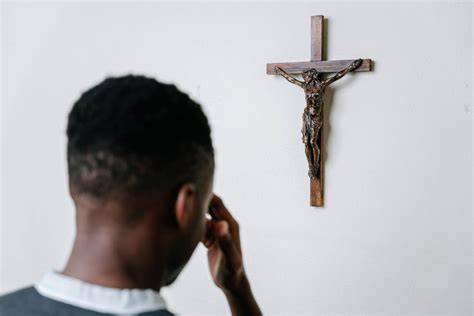
The best explanation of the distinguishment I believe to have found is that when I look upon the crucifix, I see Jesus. I am reminded of His sacrifice for me.
I am transported back to a time when, on a foreign hill, Jesus suffered and died for me before I was even thought about being born.
I gaze upon the agony in His face and am brought to tears. It should have been me.
When I, as a Protestant, looked upon a cross it was not the same result. I was reminded, indeed, that Jesus died for me.
It was, however, easier for the cross to become more of a jewelry piece than a tool of power for Christ to impart graces to draw us closer to Him.
It is during every Mass I find myself, in the quiet and prayerful moments of the liturgy, gazing at the crucifix and thanking the Lord (as tears many times fill my eyes) that I am so unworthy yet He deemed me valuable enough to suffer.
He understands my hurt, pain, and suffering because He endured it.
The crucifix, the Mass, and the Passion
Jesus died for our sins, an act to which we return each and every time we witness the Holy Sacrifice of the Mass.
At the moment of Consecration, we are transported, back in time, to the foot of the cross on Calvary.
We partake of the Body and Blood of Christ, as He instructed us to do on Holy Thursday, when He said, “Take and eat”.
The crucifix therefore helps connect the liturgy with the historical event of Christ’s Passion. It places the suffering and death of Jesus before the worshipper’s eyes while the Mass recalls the saving significance of that sacrifice.
The crucifix and the Christian call to discipleship
The crucifix also serves as a compelling reminder to love as He loves and to take up our own cross to follow Him.
The image is not intended merely to produce sadness. It can call Christians to imitate Christ’s self-giving love, perseverance, humility, forgiveness, and willingness to suffer for the good of others.
When I seek love, I turn to the crucifix to remind me that Jesus endured this horrible death simply because of his love for us, and that our God is the source of all love.
The empty cross and hope in Christ’s victory
The empty cross draws attention to what followed the Crucifixion. It presents the cross without the body of Jesus and thereby directs the viewer toward the Resurrection and Christ’s triumph over death.
When I seek hope, I turn to the empty cross to remind me that Jesus is no longer dead, but risen in victory over death, and that our God is the strongest force in the universe.
It is a sign of Christ’s victory over evil and sin. It is a reminder that Jesus won the battle for us and we have a way to receive forgiveness for our sins and to enter eternal life with him.
Perhaps a more suitable symbol of the resurrected Christ, then, is the empty tomb - He is no longer there, He has risen. Alleluia!
The crucifix and spiritual warfare
The empty cross also has never maintained or held a power over evil, demons, or Satan as much as the crucifix according to exorcists.
When an exorcism is performed, it is the crucifix and not the empty cross which is used to battle the demons and evil forces of hell.
Why? Scripture tells us why.
The crucifix is a sign of victory not just a terrible death endured by the Lord for the salvation of the world. By the cross Christ conquered sin and death.
These claims express a Catholic understanding of the crucifix as a sign connected with Christ’s victory through His Passion. Protestant Christians who reject sacramental symbolism may instead insist that no physical object possesses spiritual power in itself.
Historical and denominational differences
The difference between a Catholic crucifix and a Protestant cross is not a perfect division between every Catholic and every Protestant congregation. Christian traditions vary considerably.
Granted there are many Anglican and “high” Lutherans and others that do not object to the crucifix or other Christian symbolism.
Many Catholics display crosses in their home or wear crosses in jewelry.
As a Protestant I believed that it really did not matter if it was a crucifix or a cross.
I had seen a crucifix hanging on my grandmother’s wall my entire childhood. She was not Catholic. She was Methodist.
I had also worn a cross around my neck almost every day since I become Southern Baptist.
I believed they both stood for the same thing: Jesus’ crucifixion for our sins. I was wrong.
I was never uncomfortable with displaying a crucifix or at the sight of one. As I said, my grandmother always had one hanging in her home even though she was not Catholic.
Why the symbols can be used together
While neither the cross nor the crucifix are to be worshipped, they can both serve as vivid reminders of our core beliefs as Christians.
When I seek hope, I turn to the empty cross to remind me that Jesus is no longer dead, but risen in victory over death, and that our God is the strongest force in the universe.
When I seek love, I turn to the crucifix to remind me that Jesus endured this horrible death simply because of his love for us, and that our God is the source of all love.
Together, they remind me that the strongest force in the universe is also the source of all love.
The empty cross can direct attention to Christ’s Resurrection, while the crucifix can direct attention to His Passion. Used together, they can express the unity of the Christian message: Jesus truly suffered and died, and Jesus truly rose from the dead.
Why the distinction matters to Catholics and Protestants
Among the differences between Catholics and Protestants, is the use of the crucifix or cross.
Cradle Catholics sometimes take outward marks of our faith for granted because they have always been a part of our lives.
Although we are aware of Catholic sacramentals and symbols, can we truly say that we understand them?
What reply do we offer if we are questioned about a practice, devotion, sacramental, or belief?
It was Our Savior Jesus Christ on the cross, Who had died for our sins.
What more could I have shared with both of them?
The question reveals why the difference matters beyond decoration. A cross or crucifix can become an opportunity to explain the identity of Jesus, the reality of His death, the meaning of His sacrifice, the Resurrection, and the Christian call to follow Him.
Learning the meaning of Christian symbols
Many years ago, my Protestant boss habitually asked questions about Catholicism.
Although my answers were enough to satisfy his level of curiosity, I experienced an awakening to the fact that my base of knowledge had not continued to develop as I had matured.
Yes, the basic tenets of the Catholic faith were there, a surface awareness of the how and why.
However, there was a profound need to develop a deeper knowledge to care enough to hunger for details.
It has been said if one truly loves, he wants to intimately know the object of his affection.
This is true of worldly interests as well as those of a spiritual nature.
Holy Mother Church has certainly provided everything needed for Catholic Christians to blossom; the Bible, Catechism of the Catholic Church, writings of the Church Fathers, and the examples of great saints are just a few of the resources at our disposal.
What are we willing to do to nurture our faith life, allowing it to thrive? After all, we’re contemplating Eternity.
God so loved the world that He gave His only Son. What better illustration of true love is there on this earth?
So it comes back down to love. An unfettered love of God is crucial if our spiritual life is to mature because the eternal well-being of our souls relies on nurture and care.
Just as a garden requires continual effort, so does the soul.
Simply planting, watering, and then walking away results in a disorderly, abandoned garden.
Relying on childhood sacraments and our mere presence at Sunday Mass has similarly dissatisfying results.
To continue to grow in grace and love, our souls need careful tending.
The harvest we reap will then fill us with the Presence of God.
Key differences in meaning
- Form: The Protestant cross is generally empty; the Catholic crucifix includes the body of Christ.
- Primary emphasis: The empty cross emphasizes the Resurrection and Christ’s victory over death; the crucifix emphasizes Christ’s Passion and sacrificial death.
- Memory: The crucifix keeps the physical suffering and self-giving love of Jesus visibly before the believer; the empty cross points to the fact that Jesus no longer remains in the grave or on the cross.
- Images: Some Protestants object to the crucifix as a religious image or possible violation of the commandment against graven images.
- Veneration: Catholics distinguish veneration of a sacred image from worship, which belongs to God alone.
- Worship practice: Some Reformed Protestants prefer no cross or crucifix in worship and emphasize Scripture and the Lord’s Supper instead.
- Identity: The crucifix is strongly associated with Catholic and Eastern Christian traditions, while the bare cross is common among many Protestant traditions.
- Shared faith: Both symbols point to Jesus Christ, His death on the cross, and His Resurrection.
The cross is not wrong. Jesus did, indeed, die on the cross and then rose from the dead.
It is, however, lacking in the power the crucifix to change our lives, speak to our hearts, and defeat evil.
Let’s gaze upon the crucified Christ on the cross this Lent.
tags: #protestant #cross #vs #catholic #cross