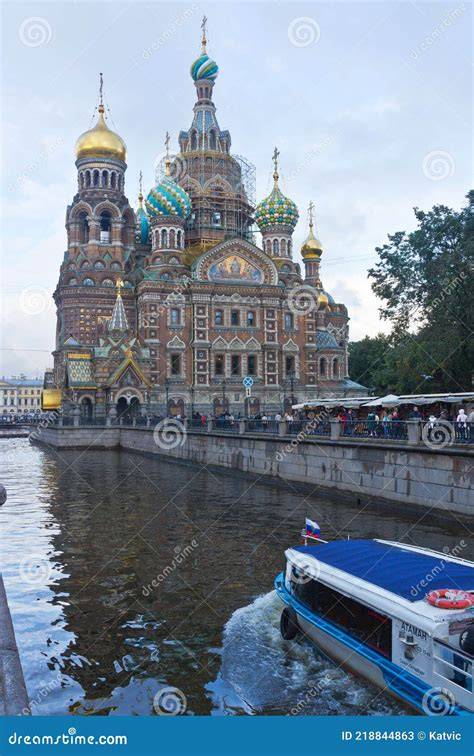
The Cathedral of the Resurrection of Jesus Christ, better known as the Church of the Resurrection of Christ or “The Saviour on the Spilled Blood,” is a memorial church in St Petersburg, Russia, built by Emperor Alexander III at the place where his father, Emperor Alexander II, was mortally wounded. It stands at 2a Kanal Griboyedova, beside the Griboyedov Canal, and is privately owned as part of the St. Issac’s Cathedral and Museum organization.
The cathedral was designed in the Neo-Russian style of the late nineteenth century, following Alexander III’s demand that the memorial be built in the purely Russian style of the seventeenth century. Its richly decorated exterior and interior are covered with mosaics, tiles, gilt, enameled brass, granite, brick, and fine marble, making it one of St Petersburg’s most distinctive architectural and artistic landmarks.
Why the cathedral is called “The Saviour on the Spilled Blood”
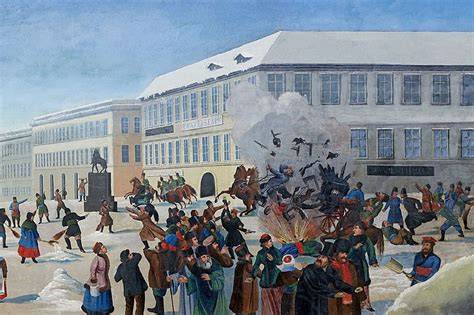
The Church of the Resurrection of Christ was built as a memorial to Emperor Alexander II, who was assassinated on March 13, 1881. Emperor Alexander III, who had succeeded to the throne, ordered the construction of a church on the place his father was murdered.
The church was built at the place where Alexander II was accosted with a bomb by the Narodnaya Volya revolutionary Ignaty Grinevitsky along the Griboyedov, formerly Catherine, Canal in St. Petersburg. The emperor was mortally wounded and died later on March 13 in the Winter Palace.
The name “The Saviour on the Spilled Blood” refers to the blood shed at the site of the assassination. The church also bears the official name Church of the Resurrection of Christ, proposed by Archimandrite Ignatius, who participated in the development of the winning design.
History of construction
Alexander III’s memorial project
Having specified that the memorial church be built in the purely Russian style of the seventeenth century, the winner of the competition was architect Alfred Alexandrovich Parland whose design was based on ideas provided by Archimandrite Ignatius (Malyshev), abbot of Holy Trinity-St. Sergius Lavra outside of Moscow, and who also proposed the name for the church: the Church of the Resurrection of Christ.
With the initial approval by Alexander III of the basic design on July 11, 1883, a ceremonial ground breaking was held on October 18, 1883. After the final plans were approved on May 1, 1887, construction began in earnest.
The church was formally consecrated on August 31, 1907, after a period of construction of twenty four years. As a memorial to Alexander II, the church did not function as a parish.
Building over the canal
The Resurrection church was built over the site of the assassination at 2a Kanal Griboyedova. As the site of the assassination was near the canal, incorporation of the site into the church required an extension of the building into the canal.
To assure the integrity of the church foundation, the old method of using a wooden foundation was rejected in favor of a concrete foundation, a technique new at the time. Also, a layer of clay was used to seal the foundation of the church against water penetration of the foundation.
The cathedral as a memorial
Requiem services were conducted in the memory of Alexander II, but no baptisms, weddings, or funerals were conducted in the Church of the Saviour on Spilled Blood (Храм Спаса на Крови).
The memorial character of the building is especially clear in its relationship with the assassination site. A dome capped, column-like bell tower that sits over the place where Alexander II was attacked is joined at the west end of the core building.
Under the bell tower, seven steps below the level of the floor and covered by a special canopy, are the remains of the street and the canal railings with the relics of the blood stains of the assassination.
Architecture and exterior design
Following Alexander III’s direction for a memorial church in the Russian style of the seventeenth century, Parland’s design followed the Neo-Russian trend for church design of the late nineteenth century.
The square core of the church is crowned by five cupolas, one in the center sits on the pointed roof with four larger onion-shaped cupolas at the corners. The church has three apses and one altar.
A dome capped, column-like bell tower that sits over the place where Alexander II was attacked is joined at the west end of the core building. As the west end of the church juts into the canal a central entrance on the west end could not be used.
Thus, entry to the church is gained through two porches on the north and south sides of the bell tower. The arrangement of the entrances reflects the unusual position of the building, whose western section occupies part of the former canal-side assassination site.
Materials and decorative colors
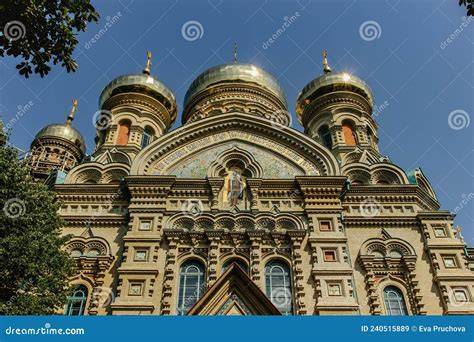
The décor of the church, both inside and outside, is a symphony of colors that delight the eye and done all in mosaics and tiles. The domes are covered in gilt and enameled sheets of brass.
Gilded brass is used extensively on the exterior, with gilt on the domes and zinc and brass on the porches, cornices, and pediments. A interplay of granite and brick with mosaics are present over whole exterior.
The combination of colored masonry, metalwork, and mosaic decoration gives the cathedral a highly elaborate appearance that contrasts with the surrounding urban architecture of St Petersburg.
Interior mosaics
The interior is an explosion of mosaics. The media of mosaics is used in all the icons with a floor of fine marble.
There are no paintings in the interior of the church, only mosaics. Most of the tessera work was done by the workshop of A. and V. Frolov.
The mosaics were designed by a corp of Russia’s best artists of the time. Their compositions cover the iconostasis, walls, vaults, and other interior surfaces with biblical scenes, Christological images, saints, and major events from Christian tradition.
Today, visitors are allowed to walk only in designated aisles. This protects the mosaic decoration and preserves the historic marble floor while allowing visitors to examine the interior program from controlled paths.
Artists and mosaic subjects
Victor Vasnetsov
Victor Vasnelsov's “The Mother of God and the Child” and “The Saviour” mosaic icons are on the iconostasis of the Church of the Resurrection of Christ.
Victor Vasnetsov created “The Saviour” and “The Mother of God and the Child” on the iconostasis.
Andrei Ryabushkin
- “The Healing of the Man with the Withered Hand”
- “Christ Walking of the Waves”
- “The Marriage at Cana.”
Nicolai Kharlamov
- “Christ the Pantocrator”
- “The Eucharist”
- “Christ in Glory”.
Mikhail Nesterov
- “The Ascension”
- “The Descent into Limbo”
- “The Holy Trinity” on the iconostasis.
Vassily Belyaev
- “The Entombment”
- “The Sermon on the Mount”
- “The Blessing of the Children”.
V. Pavlov
- “Christ Driving the Moneychangers from the Temple”.
Valerian Otmar
- “The Raising of the Son of the Widow of Nain”
- “The Angel Appearing to Joseph in a Dream”.
The cathedral after the Russian Revolution
After the revolution of 1917 the church remained open for services for a number of years, but looting and vandalism seriously damaged the building. On October 30, 1930, the government closed the church.
After it was closed, the building was used as a warehouse, but continued to deteriorate. Moves to demolish the building were brought forward a number of times.
- The first proposal to demolish the church was made in 1931, but was not carried out.
- Again in 1938 demolition was planned in 1941, but the Nazi invasion canceled that plan.
- In 1956, proposals were made to demolish the fast deteriorating building.
The siege of Leningrad
During the siege of Leningrad, as the city was known during its Soviet years, while it was used as a warehouse for vegetables, the church escaped serious damage other than from a shell that did not explode.
After the war, the church was used to store props for the Maly Opera Theater. In 1961, the shell was disarmed and removed.
Restoration and museum status
In July 1970, the director of the St. Issac’s Cathedral and Museum, G. P. Butikov, persuaded the government officials of the historic and artistic value of the church who accepted his recommendation and, on April 12, 1971, made the church a branch of the St. Issac’s Cathedral and Museum.
Initiation of planning for restoration of the Church of the Resurrection of Christ began immediately, planning for the restoration took until 1980 before the actual restoration work began.
On August 19, 1997, the first stage of restoration was completed and the Church of the Resurrection of Christ Museum was opened for visitors.
Church of Our Savior on the Spilled Blood
What visitors see inside
The most distinctive feature of the interior is the continuous mosaic decoration. Biblical scenes and icons replace conventional painted surfaces, while the marble floor provides a contrasting base beneath the dense, luminous mosaic work.
The iconostasis contains important works by Victor Vasnetsov and Mikhail Nesterov, while other sections display compositions by Andrei Ryabushkin, Nicolai Kharlamov, Vassily Belyaev, V. Pavlov, and Valerian Otmar.
Visitors are allowed to walk only in designated aisles. Under the bell tower, the preserved section of the street and canal railings marks the exact location associated with the assassination of Alexander II.
Names and institutional affiliation
The Church of the Resurrection of Christ is also known as “The Saviour on the Spilled Blood” and by other contractions on the theme of “On the Blood.”
The Church of the Resurrection of Christ (Russian: (Собор Воскресения Христова) is a church in St. Petersburg, Russia, that was built by Emperor Alexander III as a memorial to his assassinated father, Emperor Alexander II.
The church is privately owned and is part of the St. Issac’s Cathedral and Museum organization.