Magdalene institutions were religiously supervised refuges, asylums, retreats and laundries created to reform women regarded as “fallen” through religious discipline, unpaid labour and social separation. Although they were presented as places of protection, penance and rehabilitation, many became coercive institutions in which women and girls were confined, forced to work and subjected to psychological, physical and emotional abuse.
These institutions existed in Europe, North America and Australasia between the eighteenth and twentieth centuries. Their residents included women who worked as prostitutes or were considered vulnerable to prostitution, unmarried mothers, girls from impoverished families, survivors of sexual abuse, women with disabilities, women accused of sexual misconduct and people whom families, courts, police, social workers or religious authorities regarded as socially or morally troublesome.
Meaning and religious origins
Institutions with the name “Magdalene” or “Magdalen” were founded with the idea of reforming so-called “fallen women.” These were typically women who worked as prostitutes or who were vulnerable to turning to prostitution due to poverty. The institutions were named after St. Mary Magdalene, who appears in the Bible as one of Jesus Christ’s disciples.
In the 6th century she was misidentified as a prostitute by Pope Gregory I, and she was thereafter used as an example of a “fallen woman” who had been reformed by Christian faith. The asylums adopted the life of Mary Magdalene as their exemplum, described in the Christian tradition as a repentant prostitute who became one of the most notable followers of Jesus.
Christian tradition holds that penance should involve tasks characterised by humility and labour so that Divine forgiveness might be granted for sins. The Magdalene institutions run by Catholic orders in Ireland enshrined the assumption that women’s bodies and female sexuality cause “occasions of sin”, where a man might be likely to be enticed into committing sinful behaviour.
Hence, the work of the religious sisters in containing women who would promote potential vice considered was considered to be good social work by the patriarchal rulers who ran Ireland. The central religious idea was that a woman identified as sexually or morally “fallen” could become penitent through prayer, silence, obedience and work.
Early development in Europe and the English-speaking world
Magdalene laundries for fallen women date back to 12th century Europe. They were Catholic-run institutions to reform wayward women, known as Magdalens, through strict religious observance and unpaid work.
The first institution that could be classified as a Magdalene laundry was the Magdalen Hospital for the Reception of Penitent Prostitutes in the Whitechapel area of London, founded in 1758 by a wealthy merchant, Robert Dingley. It took in women under age 30, although its first admitted group were girls aged 9 to 14.
They were given moral instruction by a staff chaplain and were taught skills such as needlepoint. The laundry moved several times in ensuing decades. In Ireland the first Magdalene laundry was founded in Dublin in 1765 by Lady Arabella Denny, a philanthropist.
It was solely for young Protestant women who had worked as prostitutes or were destitute. They received two years of shelter and training, after which they were discharged to find employment as servants.
Prior to the twentieth century, they were run by religious orders or lay-managed philanthropic concerns often equipping women with training and references of good character to afford women the opportunity to earn a living after their rehabilitation work.
By the end of the 19th century, there were more than 300 Magdalene laundries in Britain and more than 40 in Ireland, with at least 19 in the Dublin area and 5 in Belfast. Similar institutions were founded in Australia, Canada, New Zealand, Sweden, and the United States.
Their patrons varied widely, ranging from Protestant clergy to Roman Catholic religious orders to charities such as the Salvation Army. Magdalene societies were also formed in U.S. cities with the mission of reforming “fallen women” or “wayward girls.”
The first of these societies came together in Philadelphia in 1800 under William White, an Episcopalian bishop. In 1808 the society opened a Magdalene asylum in the city.
Reformers often recruited the women and girls from impoverished neighborhoods or brothels, but many were brought to an institution by police or family, or were referred by a child welfare agency or by a court as an alternative to prison.
Depending on the institution, their stay could range from a few days or weeks to many years. Some laundries had barred windows and high surrounding walls that kept the women fully separated from society. The women were commonly called “Magdalenes” or “Maggies,” both of which are considered pejorative.
Philadelphia’s Magdalene asylum initially operated according to a strict discipline of prayer and labor. However, in time its focus shifted to preventing juvenile delinquency through education, and the asylum began admitting younger girls instead of adult women.
It eventually evolved into an organization that provided financial support to public high school students in need. By the 1960s and ’70s, Magdalene laundries in most countries were closed down, sold off to commercial laundries, or reformed under a different mission.
Three stated purposes: protection, reform and work
The Magdalene refuges, also known as retreats or asylums, had a three-pronged mission. One was based on the idea that for certain “fallen” women, the world was a dangerous place, and they needed protection.
Another was to help such women “to morally reform” in the presence of nuns, and through religion and prayer. Finally, refuges aimed to use “hard work” to help women gain “skills that they would then be able to [use] in the community”.
Women who entered were expected to stay for two years. In the earliest institutions, this period could be described as a combination of shelter, religious instruction, domestic training and preparation for employment.
In practice, however, the boundaries between voluntary refuge, moral rehabilitation, compulsory labour and detention became increasingly blurred. The stated goal of preparing women to return to society coexisted with systems that isolated them from society and often gave them little control over when or whether they could leave.
Rules of silence, prayer and obedience
To achieve its mission, the refuge had strict rules for the women who came through its doors. Archbishop John Bede Polding wrote “rules of observance”, which he modelled on those of Magdalene laundries across Europe, for another retreat in Pitt Street in the centre of Sydney.
Pitt Street was a setting “in which young women who had gone in the wrong direction and in some way morally or socially, could be put on a straight and narrow path.” The nuns at Tempe used the same rules of observance including a strict code of conduct.
They were expected to remain silent at many times during the day and also at night. This is actually a feature that was found in 19th-century penitentiaries.
By keeping silent, the inmates would dwell on their inner thoughts, and not be distracted by external matters. The rules framed the women’s commercial laundry work as “penitence”.
When women went in, they were in what was considered a depraved state, and then after they had been reformed, they were penitent women. Then they understood the error of their ways and they were sorry.
The regime treated silence not simply as a practical rule but as a spiritual discipline. It was intended to suppress conversation, discourage solidarity and direct the women toward private reflection, remorse and submission.
Who was confined in Magdalene institutions?
The category of “fallen woman” was broad and changed according to time, place and institutional policy. The women and girls who suffered in the Magdalene Laundries included those who were perceived to be “promiscuous”, unmarried mothers, the daughters of unmarried mothers, those who were considered a burden on their families or the State, those who had been sexually abused, or had grown up in the care of the Church and State.
Irish Magdalene laundries often admitted girls who were orphaned or abandoned by their families or whose families were financially unable to take care of them. Unwed women who had become pregnant might also be sent to a laundry as “penance” after giving birth, as could women accused of engaging in premarital or extramarital sex.
Laundries also admitted girls and women who were considered too flirtatious, who had been physically or sexually abused, who had a physical or developmental disability, and who had committed petty crimes as well as serious offenses such as infanticide.
Testimony collected by The Magdalene Oral History project reveals that girls and women incarcerated in the Magdalenes were frequently the victims of incest, sexual assault and rape, and only a minority had given birth outside wedlock. A few had intellectual disabilities, while others had committed minor crimes or were destitute.
Tempe’s records show that until the turn of the century, many were daughters of working-class Irishmen, and many struggled with addiction, or were homeless at a time when it was a crime. Just who laundries’ penitents were, and what those women had been through leading to up to becoming a Magdalen, was not often documented.
How women and girls were sent to the institutions
Women and girls were confined in the Magdalene Laundries through a variety of channels, including women and girls sent by the judicial system, including those committed informally or as a condition of probation, those held on remand, sent to the Laundries after release from prison sentences and those sent to the Laundries instead of Reformatory Schools.
Other routes included transfers from Industrial Schools and transfers from Mother and Baby Homes. Evidence was also discovered of girls who were sent to the laundries by social workers, members of the clergy, the Gardaí, hospitals, local authorities, County Councils and psychiatric hospitals.
Most worryingly of all, a whole group of girls appear to have been sent to the Laundries because they were the victims of abuse. It is true that some women and girls were committed to the laundries by non-State actors, including their families, or church groups, such as the Legion of Mary.
This happened for an array of reasons: they feared scandal related to unmarried motherhood and illegitimacy, sexual abuse, incest, domestic abuse, disability and mental illness. Families and religious authorities could therefore present confinement as protection, discipline or the prevention of scandal.
Although the State was not directly involved in incarcerating these women and girls, it failed to protect and defend their individual liberty and human rights, as they had a right to expect in a democratic State governed by the rule of law.
Magdalene institutions in Ireland after independence
Ireland’s War of Independence from British rule ended in 1921 and in the following year twenty-six of the island’s thirty-two counties established the Irish Free State. By 1922 Magdalene institutions elsewhere in Europe were adapting to social and legislative change, many modifying to focus on providing services for “unmarried mothers” and their “illegitimate children.”
However, in a newly independent Ireland, the ten remaining Magdalene institutions-all Catholic in ethos-were afforded a continued role in the newly established Republic. Irish patriots aimed to establish control in both symbolic and material terms.
Irish national discourse on morality and purity found key ground in debates on social reproduction and maternity, where it was maintained that while the British Empire was politically and financially more powerful, the fledgling Irish State would maintain moral supremacy.
After gaining independence from Britain in 1922, the new Irish Free State forged strong ties with the Roman Catholic Church, partly in an effort to create a nation that was not only defiantly postcolonial but triumphantly moral and Catholic.
In 1937 the church was given a “special position” in the country’s constitution, which also included an article that affirmed a woman’s ideal role and place was as a mother in a domestic setting. Socially this had the effect of casting a wider net for the types of women who could be considered “fallen.”
The Irish religious orders and locations
After 1922, the Magdalene Laundries were operated by four religious orders in ten different locations around Ireland: the Sisters of Mercy, the Sisters of Our Lady of Charity, the Sisters of Charity, and the Good Shepherd Sisters.
| Religious order | Magdalene institutions |
|---|---|
| The Order of Our Lady of Charity of Refuge | High Park, Drumcondra and Seán McDermott Street in Dublin |
| The Sisters of the Good Shepherd | Cork city, Waterford, Limerick and New Ross, County Wexford |
| The Congregation of the Sisters of Mercy | Galway and Dún Laoghaire |
| The Sisters of Charity | Cork, Peacock Lane, and Dublin, Donnybrook |
The Irish Magdalene institutions, run by four Catholic religious orders, existed for most of the twentieth century, with the final institution closing in 1996. Four Catholic religious orders operated the laundries in Ireland after 1922.
The laundries were run in collaboration with the Irish government, although their day-to-day oversight was under the religious orders. Laundry women lived on the convent property with the overseeing religious order but in separate quarters from the nuns.
Conditions inside the institutions
Once inside the convents, girls and women were imprisoned behind locked doors, barred or unreachable windows and high walls, oftentimes with broken glass cemented at the apex. They were usually given no information as to when or whether they would be released.
Upon entry, their names were often changed and they were given an identification number. Many women recall being instructed not to speak about their home-place or family.
Their hair was cut and their clothes were taken away and replaced with a drab uniform. A rule of silence was imposed at almost all times in Magdalene Laundries and, in many women’s experiences, friendships were forbidden.
Correspondence with the outside was often intercepted or forbidden. Visits by friends or family were not encouraged and were monitored by nuns when they did occur.
Generally, their hair was shorn when they were brought into the institutions, and they were given a religious name and sometimes also a number, as the nuns sought to erase their former identity and identify the girls as “penitents.”
The Magdalene institutions therefore controlled several aspects of personal identity at once: names, clothing, hair, speech, movement, contact with relatives and access to the outside world. These measures reinforced dependence on the institution and weakened the residents’ connection to their previous lives.
Unpaid labour and commercial laundries
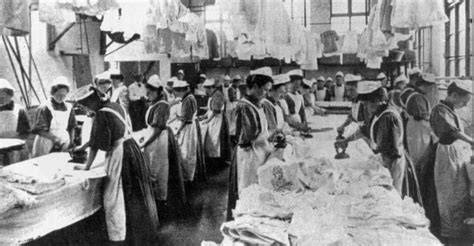
The girls and women were forced to work from morning until evening-washing, ironing or packing laundry, and sewing, embroidering or doing other manual labour. These Laundries were run on a commercial, for-profit basis, but the girls and women received no pay.
No contributions, or “stamps”, were paid on their behalf to statutory pension schemes. The laundry they washed came not only from members of the public, local businesses and religious institutions, but also from numerous government departments, the defence forces, public hospitals, public schools, prisons and other State entities.
The work could include laundry for the parliament, the Chief State Solicitor’s Office, the Office of Public Works, the Land Commission, CIE and Áras an Uachtaráin, the President’s Residence. The institutions therefore operated not merely as places of religious retreat but as businesses that depended on unpaid labour.
The rules framed the women’s commercial laundry work as “penitence”. In the institutional system, labour served two purposes at once: it was presented as a means of moral reform and it generated income through commercial services.
Daily routine and deprivation
The Magdalenes wore a uniform, woke daily about six in the morning, attended mass and worked without pay at laundry or needlework. The girls and women slept in cold dormitories with poor sanitation and hygiene, eating meagre food rations.
Survivors speak of constantly being under surveillance, being verbally insulted, feeling cold, having a poor diet and enduring humiliating and inadequate hygiene conditions. None of the girls received an education, and survivors dwell on this fact as determining their “loss of opportunity” in later life.
Friendships were forbidden, a code enforced by strict rules of silence and prayer between the inmates. Visitors were strongly discouraged and letters were censored or undelivered to the Magdalenes.
It was common for the girls and women to believe that they would die inside. Many did: comparison of electoral registers against grave records at the Donnybrook location shows that over half of the women on electoral registers between 1954 and 1964 died in that institution.
Punishments and control
Punishments for refusal to work included deprivation of meals, solitary confinement, physical abuse, forced kneeling for long periods or humiliation rituals, including shaving of hair. The living conditions and regime were harsh.
The girls and women were locked in, forced into hard labour and returned by police if they escaped. Punishments included solitary confinement and withholding of food.
Inmates were frequently disappeared without notice or explanation, potentially to another laundry, committed to a psychiatric hospital, or placed in another menial role within another Catholic religious institution.
Leaving a Magdalene institution of one’s own volition was difficult, if not impossible. Some women did try and escape, but escapees were frequently captured by the Irish police force and returned to the Magdalene and punished.
Escape, release and life after confinement
If girls or women escaped-perhaps in the back of a laundry van, out an open door at delivery or collection time, or by scaling the wall-they were often captured and returned by the local Gardaí. The nuns punished escapees, in many cases, by transferring them to a different Magdalene Laundry.
If and when a girl or woman was released, it was invariably without warning, without money and with only the clothes she was wearing. Some girls and women were given jobs in other institutions run by nuns; many fled abroad as soon as they could.
Some girls and women were taken out by very determined family members. Oral histories indicate that some women managed to leave the Magdalene institutions by consistently agitating for release.
Women who were confined for decades could become institutionalised over time and therefore become utterly dependent on the relevant convents and unfit to re-enter society unaided. Their lack of education, money, work experience outside the institution and family contact made independent life especially difficult.
The Tempe Magdalene Retreat in Australia
In 1890, on a patch of lawn in the Sydney suburb of Tempe, Cardinal Patrick Francis Moran made an announcement at the opening celebration of a new “retreat for fallen women”. The so-called “fallen women” included those who were pregnant outside of marriage, who’d had sex with someone other than their husbands, or who were sex workers.
The place where they would receive “the kiss of peace” was a newly opened Magdalene Retreat of the Catholic Church. “She has come to the door of the asylum clad in rags or faded garments, a living reality of shame and woe,” Cardinal Moran proclaimed.
“She is told to wipe out her sins by sorrow, to forget the past. [The women will] meekly submit themselves to be governed by a few religious Sisters ’til they become models of industry, docility and obedience.”
What he left out in this rousing speech were the shocking details of exactly how, in the Magdalene “retreat”, that process would play out. The refuge, and its Tempe estate, was owned by the Sisters of the Good Samaritan.

From 1887 to 1974 the Sisters operated a commercial laundry, a major source of its income, run by unpaid women and girls. The laundry at the Tempe retreat operated until 1974.
Magdalene retreats in Australia, just as this one in Dublin, sought to reform women such as those who were pregnant outside of marriage or who were sex workers. In the 19th century, the Catholic Church also established Magdalene laundries in every state in Australia.
Rules and work at Tempe
Archbishop John Bede Polding wrote “rules of observance”, which he modelled on those of Magdalene laundries across Europe, for another retreat in Pitt Street in the centre of Sydney. The nuns at Tempe used the same rules of observance including a strict code of conduct.
They were expected to remain silent at many times during the day and also at night. By keeping silent, the inmates would dwell on their inner thoughts, and not be distracted by external matters.
Women who entered were expected to stay for two years. Their work was described as part of the process by which a woman moved from a “depraved state” to the status of a penitent woman.
In 1890 a visitor to Tempe, while praising other aspects of the refuge, “regretted to notice an absence of books or means of wholesome recreation”. The comment provides an indication of how limited leisure, reading and educational opportunities could be within the institution.
May Gould’s account of Tempe
In 1906, a reporter from Protestant newspaper The Watchman interviewed a woman who had just left the refuge. Though a stoutly built woman, she looked worn and frightened, and appeared to have led a very hard life.
The woman was 25-year-old May Gould, who had just escaped from Tempe’s Magdalene retreat. The newspaper Ms Gould spoke with was the mouthpiece of the Australian Protestant Defence Association, a militant evangelical group of Christians on guard against Roman Catholic institutions and influence.
The story caused a sectarian dogfight that played out in the papers for weeks. Ms Gould tells the paper that before entering the retreat she was told “I could go out when I liked”, but says that proved not to be the case.
“After six weeks, I informed the Mother Superior that I desired to leave and she stated that it was an unheard-of thing,” she says in the article. “I fought against it and asked repeatedly to be let out. Each time I was refused, and I informed them I would escape at the first opportunity.”
Ms Gould says she learnt, after arriving, of “a laundry connected to the convent”. “I was compelled to work in the laundry from four o’clock in the morning until eight o’clock at night with only short intervals,” she says.
“I received no payment for the work done.” Ms Gould goes on to say children were also employed at the laundry. The nuns had no option but to take in “state” children who were wards of the state sent to Tempe by the newly formed Children’s Courts.
After the state children started arriving at Tempe, it had to become more secure and prison-like-with locks on the windows and doors, for example. “They [the nuns] were very cruel to the state children,” Ms Gould says.
“When I left there were about three children of about nine years of age who worked the same hours as myself. One little girl lost her arm trying to save a tablecloth belonging to the Hotel Australia.”
“She caught her arm and it was burnt and bruised to the elbow and had to be cut off and now it is stitched.” This account is a contemporary allegation reported in a sectarian newspaper dispute, but it was also described as containing details that independent and voluntary witnesses later corroborated.
Escape from Tempe and the dispute over credibility
Eventually, Ms Gould found her moment. “I escaped with two other inmates. Most of the nuns were in retreat, and by an oversight, the chapel was left open without the guards at the door. I saw my opportunity and ran out, the two other girls following me,” she says.
According to Catholic newspaper The Freeman’s Journal, Ms Gould’s story was the first negative allegation against the Magdalene retreat. The Catholic community was outraged by what it saw as yet another sectarian attack.
The Mother Superior at Tempe fought back and produced Ms Gould’s prison record for petty theft, which left her credibility in tatters. In the days following, The Watchman reported that Ms Gould’s statement was “false in several particulars”.
However, the newspaper also reported that “much that the woman said about Tempe we believe to be true in every respect, for it has since been corroborated by independent and voluntary witnesses”. What happened to Ms Gould later in life is unclear, but her story’s contested hidden history is a glimpse of a penitent.
Magdalene laundries and related institutions in Ireland
Magdalene laundries were part of a vast network of church-and-state institutions in 20th-century Ireland that included mother and baby homes and industrial schools. The former were institutions where unwed pregnant women lived and worked until their babies were born.
Their children were then boarded out to local farms and families, sent to live in industrial schools, a type of reformatory, or adopted, often to families outside Ireland. By the 1950s 1 out of 100 Irish citizens was confined in an institution.
Industrial Schools were separate, but related, institutions to the Magdalene Laundries. Until the late 1960s, thousands of young children were sent to Industrial Schools, which were financed by the Department of Education and operated by Religious Orders of the Catholic Church.
Initially established with the ethos to care for neglected, orphaned, and abandoned children, most children ended up at Industrial Schools because their families were living in poverty unable to care for them.
The Commission to Inquire into Child Abuse Report, also known as the Ryan Report, was published in 2009 and revealed that children lived in a climate of fear where physical, sexual, and emotional abuse was endemic between 1914 and 2000 in institutions funded and inspected by the Department of Education and run by a range of Catholic Orders.
Little is known about the specific history of St Dominick’s Industrial School for Girls in Waterford, as the Ryan Report only examined a small sample of institutions with the highest number of complaints, which was largely limited to boys’ schools. Thus, St Dominick’s Industrial School was not included in the report’s analysis.
Industrial Schools, poverty and detention
In the first half of the nineteenth century in Britain and in Ireland, there were several commissions and committees to investigate both the broad subject of poverty and the particular needs of poor children. The industrial school system was proposed as a solution.
This idea was based on a Continental model and, by the 1850s, Germany, Switzerland and Scandinavia had nearly a hundred institutions for criminal and destitute juveniles, whose achievements were well known in Ireland and Britain.
The thrust of the education provided in these schools, some of which were called “Farm Schools”, was in favour of practical training, which would equip the children for employment, rather than academic learning.
This approach fitted in well with the Victorian idea of utilitarian progress, and also helped to provide skills to fuel the Industrial Revolution. The motivation for these reforms has also been variously attributed to the desire to help the needy, or the need to control those whom the authorities viewed as a threat to the existing order.
Although reformatory schools were established first, industrial schools soon surpassed them, both in numbers of schools and of pupils. By 1875, there were 50 industrial schools, and the highest number of industrial schools was reached in 1898, when there were a total of 71 schools.
At its height, in 1898 the population in the industrial schools was 7,998 residents, compared with the 6,000 children in the same year in the considerably less salubrious conditions of the workhouses.
In 1882, over 70% of committal entries to industrial schools were made under the category of begging. Industrial schools therefore reflected the same broad institutional tendency as the Magdalene laundries: poverty, homelessness, family difficulty and perceived social disorder could be addressed through confinement rather than through social support in the community.
Industrial Schools in the twentieth century
In 1950, there were 3 Reformatories and 51 Industrial Schools in the country, all run by religious orders. Children were committed to these schools by the Metropolitan Children’s Court or the various District Courts.
In July 1950, there were 210 offenders, 172 boys and 38 girls, under detention in the three Reformatories in the country. They were between 13 and 17 years of age.
The 51 Industrial Schools were widely dispersed around Ireland, and varied a lot in size. The largest Industrial School for boys was in Artane, Dublin, where 776 children were detained in July 1950. The largest Industrial School for girls was Goldenbridge, Dublin, with 148 children.
In 1950, 6,000 children were under detention in such schools. Slightly more than half of these children were girls. During the year, the number of committals was 833, the number discharged was 994, and 31 children absconded.
Of the 833 children committed, over two-thirds were less than 10 years old, and most of the rest were under 14. Half were committed on the grounds of not having a settled place of abode or visible means of subsistence or having parents or guardians who did not exercise proper guardianship.
By 1960, the number under detention in Industrial Schools fell below 4,000, and it fell to 1,270 in 1970. The following year, the Reformatory and Industrial Schools were reclassified as Special Schools and Residential Homes.
There were 6 Special Schools and 27 Residential Homes. By 1998, the number of institutions-Special Schools for Young Offenders-was only six. The total number of children in detention was 127, of which 11 were girls.
Numbers confined in the Irish laundries
From the foundation of the Irish Free State in 1922 until 1996, at least 10,000 girls and women were imprisoned, forced to carry out unpaid labour and subjected to severe psychological and physical maltreatment in Ireland’s Magdalene Institutions.
Between 1922 and 1996, more than 10,000 women and girls were admitted to the laundries. The final Magdalene Laundry ceased operating on 25th October, 1996.
The “official” figure of 10,000 women and girls who were confined in the laundries is a significant under-estimate by the Report of the Inter-Departmental Committee to establish the facts of State involvement with the Magdalen Laundries, also known as the McAleese Report.
The Sisters of Mercy could not produce records for the Dun Laoghaire or Galway institutions and the Committee excluded girls and women who entered before 1922 and remained thereafter, referring to such women as “legacy” cases.
Numerous examples were brought to the Committee’s attention of women listed on the 1901 and 1911 censuses who died in Magdalene Laundries post-1922, some as late as 1961, 1967 and even 1985, in the care of the nuns after the closure of the Limerick institution.
It also emerged that many girls detained in “voluntary”, unregulated but State-funded, residential children’s and teenage institutions known as “Training Centres”, sometimes on the same grounds as Magdalene Laundries, were forced by the nuns to enter and work in the Laundries for some or all of their days.
State involvement and lack of regulation
Whatever the reasons why women and girls were sent to the Magdalene Laundries, the State had duties to all of the women and girls in the Laundries: to prevent them from being held against their will, not to exploit or benefit from their forced labour or servitude, and to care for these women and girls in terms of their rights to a safe workplace, to social welfare and, in terms of school-age girls, an education.
The State never regulated the Magdalene Laundries, despite its use of the institutions both as places of detention and care, its commercial dealings with them, its knowledge of the detention of young girls of school-going age, and its awareness that the girls and women were working for no pay.
The IDC noted that the commercial laundry premises were subject to the Factories Acts, and that Factories Inspectors visited the Laundries from 1957 onwards. According to the IDC’s report, however, the inspectors were concerned with machinery and factory premises only.
They did not question the age of the girls or the conditions under which the girls and women were forced to work and lived. Regulation therefore focused on industrial equipment rather than confinement, labour rights, education, physical safety, freedom of movement or the treatment of residents.
Death, burial and missing records
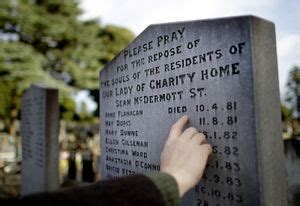
Many women died within the institutions. Comparison of electoral registers against grave records at the Donnybrook location shows that over half of the women on electoral registers between 1954 and 1964 died in that institution.
Research conducted for at least two institutions, High Park and Donnybrook in Dublin, indicates that approximately half of the girls and women who were incarcerated between 1954 and 1964 died behind the convent walls.
A burial plot for victims of the Magdalene laundries in Glasnevin Cemetery, Dublin, commemorates 155 women who had worked in a convent laundry and who had been buried in a mass grave on the convent’s property.
The limited availability of institutional records has made it difficult to establish the full number of women confined, transferred, released, disappeared, or buried in institutional grounds. The religious orders have not released Magdalene records for the twentieth century, even in redacted form.
Silenced testimony and historical evidence
It is difficult to find accounts of the penitents’ perspective of life at the laundries. It was easy to find out about the ideological premises and impacts of the enterprise, but it was hard to see what was going on on the ground.
Documented accounts are largely from the view of the Catholic Church. It is therefore very hard to establish who these women were, what actually happened to them after they left the institution, what that experience was like while they were there and what it was like to feel that sense of shame.
An inquiry that began in Ireland in 2011 exposed the enslavement of thousands of women and girls in the notorious Magdalene laundry system. In Australia, where there has been no such inquiry, there are some clues as to what life was like.
Oral histories have helped compensate for the absence of institutional records. Testimonies describe forced labour, locked doors, silence, hunger, punishment, lost education, disrupted family relationships and the fear of dying inside.
The history is also difficult because institutional authorities often produced records in administrative or religious language, while women’s own experiences were recorded much later, sometimes through contested newspaper reports, oral-history projects or survivor testimony.
Closure of the institutions
Changing mores eventually led to declines in the number of women admitted to the laundries. By the 1980s the religious orders began closing or selling off their laundries.
The last Magdalene laundry in Ireland, located on Seán McDermott Street in Dublin, closed down in October 1996. The last Magdalene Laundry ceased operating on 25th October, 1996.
It was another seven decades before the Tempe laundry finally closed, in 1974. In 1988 the Tempe property was sold, and the laundries and dormitories were demolished the following year.
By the 1960s and ’70s, Magdalene laundries in most countries were closed down, sold off to commercial laundries, or reformed under a different mission. Ireland was an exception, with some laundries remaining open until the 1990s.
Discovery of the Dublin mass grave and public response
In 1993 a scandal erupted when a mass grave of 155 women was exhumed on the property of a convent in Dublin that had run a laundry. The ensuing outrage brought attention to the conditions and history of the laundries and spawned a battle for restorative justice for the surviving women of the laundries.
In 2011 the advocacy group Justice for Magdalenes submitted a report to the United Nations Committee Against Torture in an effort to pressure the Irish government to initiate an inquiry into human rights abuses committed in the laundries and to gain redress for the institutions’ survivors.
Later that year the Irish government launched an investigation. In February 2013 the government released a report, known as the McAleese Report, which was criticized for taking only partial responsibility and downplaying the extent of abuse in the laundries.
Later that month Taoiseach, or Prime Minister, Enda Kenny issued a formal state apology to the laundries’ survivors. The Irish government ultimately paid compensation to more than 800 women.
The religious orders were criticized for declining to contribute to the fund. They also attracted anger for not allowing access to congregation archives for a full inquiry.
Survivors and restorative justice
In JFMR’s experience, Magdalene survivors and their family members fall into five main categories: firstly, those who have spoken out and demanded justice; secondly, those who continue to live in silence; thirdly, women who are still living in institutional settings under the control of religious orders; fourthly, those who died both inside and outside the laundry; and finally, the family members of women incarcerated in the laundries, including adopted people.
Survivors’ experiences show that the consequences did not end when a woman left the institution. The loss of education, wages, pension contributions, family contact, personal records and work opportunities affected later life.
Some women were released without warning, without money and with only the clothes they were wearing. Some were given jobs in other institutions run by nuns, while many fled abroad as soon as they could.
Restorative justice therefore involves more than a public apology or financial compensation. It also concerns access to records, recognition of forced labour and unlawful confinement, memorialisation, the recovery of names and family histories, and the right of survivors and their relatives to know what happened.
Memorialisation and continuing investigations
In 2022 a plan was approved to turn the Seán McDermott Street laundry in Dublin into a national site of remembrance and research dedicated to survivors of institutional abuse.
In 2025 a bill was introduced in Northern Ireland to launch an investigation into the country’s former Magdalene laundries, mother and baby homes, and workhouses and to create a compensation fund for survivors.
The history of Magdalene institutions remains connected to wider questions about gender, sexuality, poverty, institutional power, religious authority and the treatment of women and children by the State.
Surrounding the history of the Tempe institution are issues about the treatment of women that remain relevant. There are still very clear views about women, how they should act and how their sexuality should be expressed.
Women can still experience huge amounts of disadvantage on that basis. The stories of individual Magdalene women are lost, but there is still much to learn about the way society categorises and stereotypes women.
The history of Magdalene institutions demonstrates how a system described as penance and rehabilitation could become a system of confinement, unpaid labour and social erasure. Its legacy is preserved through survivor testimony, historical research, memorials, official investigations and continuing demands for accountability.
tags: #magdalene #institution #for #penance #and #rehabilitation