Charlotte Lutheran Church history is rooted in the arrival of Lutheran settlers in the Piedmont, the organization of St. Mark’s Lutheran Church in 1859, and the creation of Black Lutheran congregations that served Charlotte’s African American communities, including Mt. Zion Lutheran Church in Cherry in 1896.
Charlotte Lutheran congregations have combined biblical teaching, Lutheran worship, preaching, the sacraments, Christian education, music, and community service. Their activities have included Sunday schools, children’s ministries, mission work, poverty relief, housing initiatives, education programs, refugee assistance, and partnerships with other churches and civic organizations.
Early Lutheranism in the Charlotte Region
There had been Lutherans in the Piedmont area of North Carolina since the 1740s when settlement began as German Lutherans settled alongside German Reformed and Scotch-Irish Presbyterians who together made the long trek from Pennsylvania down through the Shenandoah Valley and the old trading paths to settle northeast and west of the Catawba River.
Most of the German Lutheran colonists were descendants of Palatine Germans who settled in Pennsylvania after the hard times of the Thirty Years War in Germany and emigrated south into North Carolina starting in the 1740s. German Lutheran settlers of the period mostly settled in what are now Gaston and Lincoln Counties to the west of Charlotte and what is now Cabarrus and Rowan Counties to the east of Charlotte, and for the most part the Scotch-Irish Presbyterians settled what is now Mecklenburg County.
Starting with Sugar Creek Presbyterian Church in 1757 the Scotch-Irish established seven other early Presbyterian congregations in rural areas around Charlotte, but the first church in the town of Charlotte was not established until town commissioners set aside a parcel of ground, now occupied by the First Presbyterian Church, to be used for a church and cemetery in 1815.
The town’s first church building was erected on this site by the citizens in 1819 and dedicated as a town church in 1823. The Presbyterians used the building regularly and organized their church there in August 1832. Methodists had a full time minister in Charlotte in 1833 and erected their first house of worship on Seventh Street in 1834. Baptists formally organized what became the First Baptist Church in Charlotte in June 1833. Episcopalians erected their first church in 1834 and Roman Catholics in 1851.
The Founding of St. Mark’s Lutheran Church
When Mecklenburg County became a new county in the 1760s there was some competition between German Lutherans living in what is now western Cabarrus County and Scotch-Irish Presbyterians from the Charlotte area as to where the new county seat for the new county would be, and the Scotch-Irish prevailed and the cross roads community of Charlottetown became the new county seat.
There was close cooperation between German Lutheran and German Reformed congregations in the area surrounding Charlotte and early Lutherans in Charlotte had a close relationship with Presbyterians, so it was very natural when Pastor G.D. Bernheim, Pastor of Old St. John’s Lutheran Church in Cabarrus County and head of the struggling Mt. Pleasant College, came to Charlotte the week of January 30, 1859 to solicit funds for the College that he met with a good reception.
Charlotte was a small town of about 1300 people at the time, but the people were devout and strongly committed to the gospel. Pastor Bernheim in reporting the founding of St. Mark’s writes:
I had no idea at the time of establishing a Lutheran Church here, it was business for our College that induced me to make the trip. I made my home during my stay with Mr. Martin Isenhour, residing 3 miles south of Charlotte, and, on account of the muddy roads, I walked on the railroad cross ties to town every day.
Mr. James Carson of this city has the honor of first suggesting the founding of this Lutheran Church, and it occurred on this wise; when I approached him for a donation for our College he replied: ‘I will give you nothing for the College, but if you start a Lutheran Church in Charlotte I will give $50 towards it.’
This suggestion struck me very forcibly and I reported it that night to my host Mr. Isenhour. He was surprised at Mr. Carson’s liberal offer and said: ‘I will give you $100 for the same purpose; do what you can when you go to town tomorrow and we may have at last a Lutheran Church in Charlotte, for which I have been anxiously waiting for the last 30 years, ever since I settled here.’
The next day I commenced canvassing the city for a Lutheran Church and proceeded remarkably well. Pastor Bernheim reports that in short order he had about $600 to start the new enterprise, bartered for the old Episcopal Church building, located on Trade Street, opposite the United States Mint, now the Federal Court House Building.
Later on the trustees of the congregation changed their minds and purchased the old Methodist Church on the corner of Seventh and College Streets for $600; they, the Methodists, reserving the right to worship in it every two weeks, when not in use by the Lutherans, until their new church edifice on Tryon Street was finished.
A week after coming to Charlotte, on Sunday January 30, 1859 Pastor Bernheim preached in the Presbyterian Church having invited all Lutherans in the vicinity of Charlotte to that service.
Pastor Bernheim continues:
We had a large congregation. Presbyterians and Lutherans worshipped together as suggested by the Presbyterians themselves who courteously offered us the use of their church for that Sunday.
On Monday evening January 31, 1859 pursuant to public announcement a meeting of Lutherans was held in the court house, and after an address and prayer our present Lutheran congregation was organized with 16 charter members.
On my return to Mt. Pleasant it became a matter of no small surprise that in so short a time of less than one week a Lutheran congregation was founded in Charlotte, a church edifice secured, and a call for a pastor extended.
But I must say that the time was opportune for the undertaking, the exact moment had come, two years later the Civil War broke out, and who can tell whether even in ten or twenty years afterwards an enterprise would have met with success.
The Lord prospered the undertaking from the beginning to the present time, although very many difficulties had to be overcome.
Shortly thereafter trustees were elected for the church property, the Lutheran Hymn book and Discipline were adopted and a call was extended to Rev. Alexander Phillippi from Wythe County, Virginia.
Pastor Phillippi accepted his first call to St. Mark’s and worked very faithfully for more than a year with considerable success at St. Mark’s. With war clouds looming, he left for his home in Virginia in 1860 to be with his own people if war started.
When war did break out, Pastor Phillippi served as a Chaplain in the Confederate Army of Northern Virginia until the Army surrendered at Appomattox, Virginia, and Pastor Phillippi was the longest serving Chaplain in the Army of Northern Virginia.
He returned to Wythe County, Virginia and organized several new Lutheran congregations there and was present at the 50th Anniversary Celebration of St. Mark’s in 1909.
St. Mark’s During the Civil War and Reconstruction
The congregation was without a pastor for a short period, but a call was extended to Pastor Bernheim and in the beginning of 1861 Dr. Bernheim came again to Charlotte, this time to become Pastor of the congregation he had organized.
The Rev. W.S. Bowman, a later Pastor of St. Mark’s writes of this time:
Now came years of confusion. The War was on to rage fiercer and fiercer for four years. Home religion was projected into the camp and field of blood. Fathers, husbands and sons went out to the firing line.
Church movements were suppressed by the cause of patriotic sacrifice, and the strenuous endeavor of scanty substance of food, clothing and shelter. These four years of labor by Dr. Bernheim were years of severe trials, and it was all he could do to fan the embers into feeble flame.
He shared in all the privations of the depleted flock, supporting himself with the labor of his hands. The War ended but the woes remained and were multiplied under the direful “reconstruction era”.
Pastor G.D. Bernheim has been called the Father of southern Lutheranism because of the many Lutheran congregations he helped found in the Carolinas during this period.
Pastor Bernheim’s father, of a distinguished Berlin Jewish family, educated to be a Rabbi, converted to the Christian faith and became a Lutheran minister and brought his family to Pennsylvania.
Paster Bernheim wrote many books including German Settlements and the Lutheran Church in the Carolinas (1872) and History of the Evangelical Lutheran Synod and Ministerium of North Carolina (1903).
Before this time the Lutheran Church in North Carolina was mostly in the rural areas and small towns of the Piedmont; but the founding of St. Mark’s, Charlotte marked a step forward for the Lutheran Church.
In his 1903 history Dr. Bernheim wrote that, the establishing of the new congregations in these two important cities of our state, Wilmington, 1858, and Charlotte, 1859, gave the Synod a prominence in the church at large and a spirit of progress which has been a blessing to it up to this time.
Lutherans from northwest Germany had been emigrating to the South through the ports of Wilmington and Charleston in considerable numbers from the 1820’s on and many had also settled in the Charlotte area augmenting the earliest influx of Lutheran settlers in the general area of 100 years before.
St. Mark’s Congregational Growth and Ministry
Pastor Nathan Aldrich accepted a call to St. Mark’s in 1865 and stayed as Pastor for nine years until 1874. During his ministry the church after a period of struggle became stronger and prospered and moved from Seventh and College Streets to a new church at 510 North Tryon Street.
Rev. A. L. Yount was supply pastor from 1874 until 1876 at which time the Rev. E.A. Wingard came to St. Mark’s and served until 1881.
Pastor Wingard was a young man just graduated from the Theological Seminary. Frail physically, he labored faithfully; but finally because of ill health, he resigned.
The congregation was served by a supply pastor, Rev. T.H. Strobecker, for a year before the Rev. T. Shannon Brown was called in 1882.
Pastor Brown served the congregation for eight years, a period in which the church continued to grow and prosper; and it was decided that a new and more adequate building was needed for the growing congregation.
Property was purchased at 416 N. Tryon Street, and the cornerstone for the new church building was laid on Reformation Sunday 1885. It was reported to be the most beautiful church in the North Carolina Synod at the time.
This was a period of great prosperity and growth for Charlotte during which Charlotte emerged as a major city of the New South.
Black Lutheran Churches in Charlotte
During the 1880s missionary work was inaugurated among the black population of North Carolina, and four black Lutheran congregations were organized served by four black Lutheran pastors.
In 1889 these four congregations asked to be formed into a separate synod of their own, and Rev. Brown served on the Synodical Committee to organize the new Synod which was organized in 1889 as the Alpha Synod of the Evangelical Lutheran Church.
The Charlotte congregation of the Alpha Synod erected a small frame church building on Luther Street which is still standing. In later years the Alpha Synod united with the Lutheran Church Missouri Synod.
Mt. Zion Lutheran Church in Cherry
Mt. Zion Lutheran Church was built about 1896 and served its parishioners until 1946, when it merged with another Lutheran church, but its original building still calls worshipers to service on Sundays.
The Mt. Zion Lutheran Church, erected about 1896, has continuously served as a religious center for the Cherry community, a black residential district developed in the 1890s and early 1900s by John Springs Myers and Mary Rawlinson Myers.
The Mt. Zion Lutheran Church was organized by William Philo Phifer, a leader in establishing black Lutheran churches in Charlotte and its environs.
The Mt. Zion Lutheran Church is the oldest structure still standing which has been used as a house of worship in the Cherry community.
The Mt. Zion Lutheran Church is a compelling local example of a simple Gothic Revival style church structure.
The Cherry Neighborhood
Although it is often assumed that the Cherry neighborhood was built as a housing area for servants of affluent Myers Park residents, it was in fact laid out as a “model Negro housing development” by John Springs Myers and Mary Rawlinson Myers in the 1890s and early 1900s.
Its purpose was to provide good, low-cost housing for black laborers and craft workers well before construction began on Myers Park in 1912 as one of the city’s fashionable streetcar suburbs.
Located about a mile from the center of town, Cherry, in the early days also called Cherryton or Cherrytown, is situated between The Elizabeth neighborhood on the north and Myers Park to the south.
The land that became Cherry and Myers Park was part of a 306-acre inheritance that John Springs Myers received in 1869 from his father.
Over the next twenty years, Myers built his holdings to over one thousand acres in the area south of town. He built a country house on the Providence Road about two miles south of town, and began to entertain the idea that his land could someday be used for a residential area with park-like landscaping.
An influential factor for the development of Cherry on part of this land was the Myers’ active membership in St. Peter’s Episcopal Church.
The church had a strong record of ministry to blacks in the city that included the founding of churches, a school and a hospital.
In addition, the Myers family itself was known for its interest in the welfare of the town’s black citizens, J. S. Myers’ father, N. V. R. Myers, had donated the land for Johnson C. Smith University after the Civil War.
In 1891, Cherry began when Jack Myers recorded a plat with house lots along three new streets located halfway between the city center and his farm cottage.
They were part of what is now Main, Cherry and Luther Streets, and the name “Cherry” apparently came from the cherry trees that used to grow on the surrounding hillsides.
During the next thirty-odd years, Myers continued to add tree-lined streets with small house lots, churches, a park and a school to the Cherry development, and it was carried on after the mid-1920s by their children.
It was quite successful in its purpose of providing good, low-cost rental or owner housing for the city’s black unskilled or semi-skilled workers.
Lots were sold for fifty dollars on easy terms, and by 1925, 198 of the 305 Cherry households, about sixty-five percent, were resident-owned.
The modern misconception about the neighborhood being a servants’ quarter arose after Myers Park was built starting in 1912, when indeed a number of servants of those families moved into Cherry.
William Philo Phifer
The story of Mt. Zion Lutheran Church in Cherry is closely connected to its founding pastor, William Philo Phifer.
After the Civil War, a number of Protestant denominations took steps to establish churches among freed blacks and to train black preachers and teachers to staff them and the schools that were often part of the church.
In 1868, the North Carolina Synod of the Lutheran Church licensed the first black Lutheran preacher in the state, Michael Coble of Alamance County, but he left to join the Methodist church in the 1870s.
Four more blacks were ordained during the 1880s to serve congregations in Concord, Charlotte, Burlington and Lexington.
Among these was William Philo Phifer, who is thought to have grown up on a Phifer plantation near Concord, NC.
Possibly educated in Baltimore, he was first licensed by the Maryland Synod October 7, 1888. The following year, he was received into the North Carolina Synod on August 28, which was followed by his ordination in Charlotte on April 20, 1890.
Mt. Zion’s Organization and Building
During the 1880s and early 90s, there was only one Lutheran Church in Charlotte belonging to the North Carolina Synod, St. Mark’s Evangelical Lutheran Church on Tryon Street.
Shortly after Phifer took up his work in Charlotte, ministry to black congregations in North Carolina was taken over by the Missionary Board of the Lutheran Synodical Conference of North America, which was headquartered in St. Louis.
Within three years of his ordination in Charlotte, Rev. Phifer had built a congregation of sufficient size that the Missionary Board bought property at “E” and 2nd Streets, now Alexander and 2nd, in the former black community of Brooklyn in Second Ward, in 1893, on which was built St. Paul’s Lutheran Church and school.
Three years later, in January, 1896, Phifer organized Mt. Zion Lutheran Church in the new black community of Cherry, and in November of that year the Missionary Board of the Lutheran Synodical Conference bought a lot on Davidson Street, later changed to Luther Street, for fifty dollars from the Myers, and built the present church building.
Since there were only thirty heads of household listed in Cherry by 1898, the church membership was small, and remained so throughout its subsequent years.
As was usually the case, a small school was also conducted by the church.
Mt. Zion was actually the second church in Cherry, the first being the Pleasant Hill Baptist Church, which bought the third lot sold in the neighborhood in 1892.
It was located on Luther Street near Providence Road, and still operates today from a new building at Banter and Baldwin Streets.
Phifer’s Later Ministry and Mt. Zion’s Continuity
In October, 1900, Rev. Phifer appears to have organized another congregation, the St. Mark’s (Colored) Lutheran Church in the Brooklyn area of Second Ward.
In a dispute with the Mission Board, Phifer left Mt. Zion to take over St. Mark’s, and the latter bought property for a new church building at Davidson and 3rd Streets with the backing of the North Carolina Synod in 1901.
Phifer gave up this post in 1904, when he took up a pastorale in Baltimore, Maryland, where he served until his death in 1911.
Mt. Zion continued to operate under the Mission Board until 1946, when it merged with the St. Paul’s Church to form St. Andrews, which was located on the site of the present downtown post offices.
At that time the Mt. Zion building was sold to a descendent of the Myers, Mrs. Harriette C. Dwelle.
After thirty years of ownership, Mrs. Dwelle sold it to the present owners, the Mt. Zion Church of God, Holiness, in 1976.
Since its construction around ninety years ago in the fledgling Cherry community, the Mt. Zion Church on Luther Street has been an intimate part of a unique Charlotte neighborhood, one that reflects the determination of both black and white leaders in the late nineteenth century to build a better world for its citizens.
Architectural Significance of Mt. Zion
The Mt. Zion Lutheran Church, now the Mt. Zion Church of God Holiness, is a simple Gothic Revival structure which was built in 1896.
The church is one of the oldest buildings in Cherry, an early black community, and one of the oldest surviving frame churches within the city of Charlotte.
Although simply executed, the structure is clearly influenced by the Gothic motifs popular at the turn of the century.
Gothic architecture, characterized by the pointed arch and, to a lesser extent, the flying buttress, vaulting rib and moulding, first evidenced itself in the rebuilding of St. Denis Abbey Church in France in the early twelfth century.
The style came to dominate medieval architecture, particularly religious building, from the twelfth to the sixteenth centuries.
The widespread use of the Gothic began to wane, partially in response to the popularity of the Renaissance style and also from the social and aesthetic effects of the Protestant Reformation and the Catholic Counter-Reformation.
But by the mid-eighteenth century, the seeds of the Gothic Revival were being sown in England; the movement achieved widespread popularity in Europe and the United States throughout the mid to late nineteenth century and into the early decades of the present century.
While the style was typically associated with ecclesiological architecture, Gothic Revival motifs were widely adapted to public buildings and even residential construction, from the humblest cottage to the grandest of mansions.
Charlotte’s First Presbyterian Church, begun ca. 1842, is Gothic Revival at its most high style.
The popularity of the style endured for many years in the Queen City.
Gothic motifs are strongly evident in three of the city’s finest late nineteenth century houses of worship, St. Peter’s Episcopal, 1892, on North Tryon Street, St. Peter’s Roman Catholic, 1893, on South Tryon Street and St. Mary’s Chapel, 1893, on Kings Drive.
In Dilworth, the sanctuary, ca. 1952, and flanking buildings of Covenant Presbyterian Church are arranged around a medieval-inspired courtyard.
Gothic arches are even prominently displayed in many of the area’s more modern church structures.
The style’s longstanding popularity was, in no small measure, due to its widespread adaptability.
Even less substantial congregations could incorporate Gothic motifs into the most simple meeting place.
Modest frame structures incorporating Gothic arched opening are to be found throughout black and white churches in both urban and rural areas of the Piedmont.
Mt. Zion Lutheran Church is a well-preserved example of a simply executed structure incorporating Gothic Revival motifs.
The one story structure is of frame construction and rises to a gabled roof.
Elevations are weatherboarded; plain cornerboards rise from the base.
Fenestration on the rectangular main block is symmetrically arranged.
Four/four sash, surmounted by a lances cap, are the primary glazing material.
Exterior openings are framed by plain surrounds.
A diminutive one-story entrance pavilion is centered on the front elevation and flanked on either side by a single lancet window.
Physical evidence indicates that the gable-roofed pavilion is a later addition although it is known to have been in existence by 1929.
Concrete stairs with wrought iron handrails lead to the double leaf six-panel entrance doors.
Rectangular wood cut shingles cover the entrance gable.
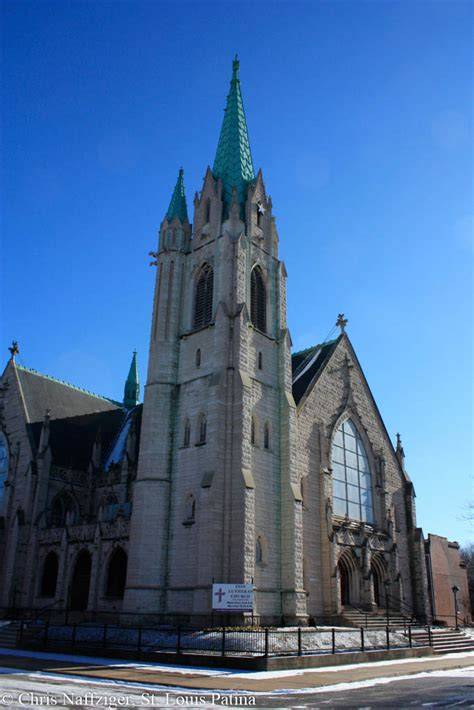
St. Mark’s Ministry, Youth, and Church Organizations
The Rev. W.S. Bowman, D.D. was pastor from 1890 to 1897. During his ministry the congregation grew in loyalty and devotion to the historic usages of Lutheranism.
It was during 1896 that the Rev. Charles P. King of Wythe County, Virginia founded Elizabeth College for Women on a campus at what is now Presbyterian Hospital.
After ill health forced Pastor Bowman’s retirement in 1897, Pastor King served as supply pastor to St. Mark’s during 1897 and 1898.
He also supplied the Alpha Synod Congregation on Luther Street located not far from the college.
Many students from Elizabeth College attended services at St. Mark’s.
In June 1898 the Rev. R. C. Holland, D.D. was called from St. Andrew’s in Charleston to serve as pastor, and he remained at St. Mark’s for the next ten years.
Dr. Holland was always vitally interested in the youth of the church; and under his guidance the Children’s Mission Band, later known as the Light Brigade was organized on January 11, 1907 and the Ladies Aid Society was organized with 19 members.
Dr. Holland was vitally interested in the home and foreign mission field, and the congregation supported this work.
In 1904 Dr. Holland was called by the United Synod of the South to become President of the Home and Foreign Mission Board.
With the advance and growth of the work at home and abroad, Dr. Holland resigned October 1, 1908 to devote his entire time to the work as Superintendent of Missions in the United Synod of the Lutheran Church in the South with headquarters in Charlotte.
Charlotte’s population in 1910 was 34,014, and it was the largest city in the Carolinas.
The Rev. Robert L. Patterson became pastor of St. Mark’s December 1, 1908 and he served the congregation until 1914.
It was during his pastorate that the congregation celebrated its 50th Anniversary; and during the anniversary celebration the Ladies Aid Society presented to the congregation a brass pulpit said to be the finest pulpit in the city at the time.
During the ministry of Dr. Patterson the Lutheran Brotherhood was organized and sponsored the 50th Anniversary celebration.
It was during Pastor Patterson’s ministry that a Sunday School was organized in the eastern part of Charlotte, and sessions were held in a storeroom on Central Avenue.
This formed the nucleus of Holy Trinity Lutheran Church which was organized in 1916 in which Rev. Patterson served as minister 1934-1936 and pastor Emeritus 1936-1944.
Christ Lutheran Church: A Later Charlotte Lutheran Congregation
On December 5th, 1954, in the bustling city of Charlotte, NC, 82 charter members began a mission church in a small building at Queens College, calling it Christ Lutheran Church.
This building still stands today as Dana Auditorium.
As they quickly grew out of the space, members decided to buy five acres of farm land on the corner of Providence and Fairview Road for $50,000.
After three years of construction, Christ Lutheran’s first sanctuary was dedicated on April 5, 1959.
The first of three expansions, Christ Lutheran began construction in 1972 and it was dedicated just one year later.
It still stands today as Christ Chapel.
As Christ Lutheran Church continued to grow, the congregation committed to creating a licensed childcare program offering full-day and half-day care with a Christian focus.
The church leadership, then led by Pastor David Misenheimer, felt deeply that a children’s ministry that provided full-day childcare was a community outreach opportunity that would connect children and families to Christ.
Christ Lutheran dedicated its current worship center, a state-of-the-art 55,000 square foot space, on May 19, 2013.
In 2017, Family of Faith Lutheran in Concord, North Carolina merged with Christ Lutheran Church.
The campus on Providence Road then became known as Christ Providence, and Family of Faith became known as Christ Concord.
Combined, the church became “Christ Lutheran Church.”
Officially formed just a few short weeks before the COVID 19 pandemic shut down traditional worship services, Christ Online became a thriving campus of Christ Lutheran evangelizing to not only those in the community but reaching far beyond the walls of the church.
Since then, the campus has reached across the globe and connected those unable to attend in person.
From 82 charter members in 1954 to over 3000 members today, CLC is a community in which people grow in faith and fellowship.
Lutheran Beliefs
Jesus’ suffering and death is the substitute for all people of all time.
He purchased and won forgiveness and eternal life for all.
Those who hear this Good News and believe it will have the eternal life that it offers.
God loves the people of the world, even though we are sinful, rebel against Him, and do not deserve His love.
The Bible is God’s inerrant, without error, Word, in which He reveals His Law, what is required of us to have a relationship with God, and His Gospel, what God has done through His Son, Jesus, for us so that we can have a relationship with Him.
Worship in Charlotte Lutheran Churches
Worship is the center from which the rest of our Christian life flows.
Inspiration, spiritual nourishment, participation in the sacraments, community belonging, intergenerational connections and intellectual challenge are all part of worship, but placing God first in genuine Spirit-filled worship is what we’re about.
If you would like to worship alongside others who are daily seeking to follow Jesus Christ, or if you just want to explore what Jesus might mean to you, please join us.
In all of our worship services, we hear God’s Word through music, scripture and the message and learn how His Word pertains to us in our 21st century lives.
Traditional and Blended Services
The Traditional Service follows the traditional liturgical style of the Lutheran Church.
Our traditional service includes music from the Lutheran liturgy as well as great hymns of the faith, led by organ and choir.
The Blended Service is our “family-friendly” worship service.
It is a wonderful combination of traditional and contemporary worship styles with a focus on intergenerational worship.
Children in Worship
Children are a vital part of our worship and we encourage them to participate.
Activity bags are available at the entryway which contain quiet Biblical activities suited for preschool and early elementary ages.
There is a Children’s Message in each service with a short message prepared just for them.
It will often involve use of props or activities to reinforce the Biblical message.
Elements of a Traditional Lutheran Service
A traditional Lutheran service can include announcements, congregational hymns, confession and repentance, scripture readings, a sermon, communion, and a benediction.
The readings of scripture followed the Lectionary schedule.
There was also a congregation memory verse that the church changes each month, an effective way to get congregants to memorize passages.
The sermon was the centerpiece of the service, where the pastor integrated all three readings from the lectionary into one theme.
Following communion, the pastor gave the benediction, and the sanctuary emptied out, most heading to the education wing for Sunday School.
In Lutheran worship, the liturgy can connect confession, forgiveness, scripture, preaching, music, and the sacrament into a unified service.
After the hymn, one of the pastors led the congregation in the liturgy of confession and repentance, capped with congregational singing of the Kyrie.
This was a sublime way to begin a service, bringing people into direct knowledge that they are forgiven before engaging in the rest of the liturgy.
The liturgy continued after singing the hymn “This is the Feast.”
When the congregants lined up in the aisle, they were called to the altar, twelve at a time, taking a small cup of grape juice up with them as they went.
They all knelt in unison, and the pastor led the Communion liturgy to those twelve together.
This fostered a sense of unity within the sacrament.
Community Activities and Outreach
Outreach has always been a significant part of life at Christ Church.
Under the direction of The Reverend Thom Blair, 25% of the total budget was designated for use outside the parish.
Many initiatives were launched over the years.
Matthew 25
Matthew 25, 1974-1976, raised $273,042 for anti-hunger and poverty programs, including prison ministry, mission trips to Costa Rica, El Salvador and Haiti, sponsoring a Vietnamese refugee family, and helping to start Crisis Assistance Ministry.
Jeremiah 29:7
Jeremiah 29:7, 1980, was composed of Christ Church, Myers Park Baptist, Moravian Little Church on the Lane, Myers Park United Methodist, St Mark’s Lutheran, Myers Park Presbyterian and Covenant Presbyterian.
This alliance helped establish Habitat for Humanity, Crisis Assistance Ministry and the Winter Shelter in our city.
St. Francis Fund
The St. Francis Fund, 1982-1993, raised $1 million for 50-plus causes including Christ the King, Habitat for Humanity and Crisis Assistance Ministry.
Seeds of Hope
Seeds of Hope, 1993-1998, raised $2 million for the Hope Triangle in Charlotte, Fund for World Relief and more.
Programs inside the Hope Triangle included Christ the King Chapel, Johnston YMCA, Habitat for Humanity and St. Francis Jobs.
Funds also helped establish Thompson Child Development Center.
One in the Spirit Campaign
The One in the Spirit Campaign, 2003-2008, raised $10.5 million, including $1.5 million for a partnership with Eastway Middle School, a literacy program through the Johnson YMCA, support for YWCA families in transition, and international mission.
Expanding Our Vision and Micah Initiative
Expanding Our Vision, 2007-2012, outlined specific goals and plans for each of our primary areas of ministry.
The Micah Initiative, 2008-2012, supported outreach with Rama Road Elementary, the Padlock Prevention program at Crisis Assistance Ministry, and mission work that included micro-financing.
Leap of Faith
Leap of Faith, 2012-2017, allocated $2 million for housing, education, poverty prevention and mission.
Funds also supported the establishment of HopeWay.
With Leap of Faith dollars helping pay off the mortgage, two houses next to the Church campus were purchased and renovated for four formerly homeless families.
Faith and Courage Initiative
The Faith and Courage Initiative, 2018-2023, established a new set of major priorities for the Church as the congregation celebrated its 75th anniversary.
Transforming Hearts
Transforming Hearts, 2023-, established a new set of major priorities for the Church as the congregation celebrated its 75th anniversary.
Christian Community and Participation
Charlotte Lutheran congregations have connected worship with Christian education, fellowship, service, and intergenerational relationships.
Sunday School has served both children and adults, while children’s messages, activity materials, childcare, and youth organizations have helped make congregational life accessible to families.
The historic record of St. Mark’s includes the Children’s Mission Band, later known as the Light Brigade, the Ladies Aid Society, the Lutheran Brotherhood, and a Sunday School established in the eastern part of Charlotte.
Modern congregational life includes worship, baptism, prayer, service, groups, Christian education, online participation, mission partnerships, and assistance for people facing poverty, homelessness, hunger, educational barriers, and displacement.
Some things can only multiply after we’re willing to release them.
This week we look at two ordinary images - someone sharing a cup of water, and a farmer planting seed - and find that they describe exactly how Christian community grows.
We refresh others because Christ has already refreshed us.
We keep planting because God is responsible for the harvest.
A community becomes genuinely refreshing when grace stops collecting in us and starts moving through us.