Some Calvinists hold positions commonly labeled “replacement theology,” but many reject that label. The answer depends on what is meant by both “Calvinism” and “replacement theology.” Calvinism is often used narrowly for monergism or the doctrines commonly summarized as the five points, while it is also used more broadly for the Reformed theological system, including covenant theology, ecclesiology, and eschatology.
Many Reformed and Presbyterian theologians affirm one unified people of God across both testaments and understand the Church as standing in covenant continuity with Old Testament believers. Dispensationalists frequently describe this position as replacement theology, whereas covenant theologians usually prefer terms such as “fulfillment theology,” “covenant continuity,” or “expansion.” They argue that the New Testament does not teach that the Church replaces Israel but that God’s promises reach their fulfillment in Christ and include believing Jews and Gentiles.
What Replacement Theology Means
Replacement theology refers to the interpretive framework claiming that the New Testament Church has permanently superseded ethnic Israel as God's chosen people, thereby inheriting the covenant promises originally given to Abraham's physical descendants. The position typically includes several interconnected assertions: that the Church now constitutes the "true Israel" or "spiritual Israel" of the New Testament; that Old Testament prophecies about Israel's restoration and blessing find their ultimate fulfillment in the Church rather than in any future plan for ethnic Israel; and that Israel's rejection of Jesus as Messiah resulted in God's rejection of Israel as a distinct covenant people.
The term remains controversial because many theologians who hold positions others label as “replacement theology” reject this terminology entirely. They prefer terms like “fulfillment theology” or simply “covenant theology,” arguing that the New Testament doesn't teach replacement but rather expansion and fulfillment. The debate often hinges on whether continuity between Israel and the Church constitutes “replacement” or “inclusion.” This semantic dispute reflects deeper disagreements about the nature of God's covenants and the relationship between Old and New Testament revelation.
Why the Definition Matters
The question of replacement theology touches the very heart of how we understand biblical covenants, God's faithfulness, and the unity of Scripture's redemptive story. The issue matters for pastors preparing sermons on Romans 9-11, seminary students studying covenant theology, and church members trying to understand what the Bible teaches about Israel.
Replacement theology encompasses a spectrum of views about Israel and the Church, from complete replacement to more nuanced positions on covenant continuity. The debate remains active: contemporary Reformed, covenant, and dispensational theologians continue to debate whether the New Testament teaches replacement, fulfillment, or distinction between Israel and the Church.
Historical Development of Supersessionist Thought
Learning about the origin of replacement theology requires tracing interpretive shifts across multiple centuries of church history. Elements of supersessionist interpretation appeared as early as the second century in writings by church fathers such as Justin Martyr and the author of the Epistle of Barnabas. Writing in contexts where the Church was increasingly Gentile and Judaism represented a rival interpretation of the Hebrew Scriptures, these early thinkers began articulating views that minimized ongoing theological significance for ethnic Israel.
Justin Martyr's Dialogue with Trypho argued that Christians are the true heirs of Scripture and covenant identity in Christ. The Epistle of Barnabas strongly allegorized Jewish law and covenant, presenting Christians as the intended audience of Scripture. By the time of Augustine in the fourth and fifth centuries, interpretations that spiritualized Old Testament promises to Israel and applied them to the Church had become widespread in Christian theology.
Throughout the medieval period, the dominant Christian interpretive tradition treated the Church as the new and true Israel. The Reformers, including Luther and Calvin, largely inherited and maintained this interpretive framework, though with important modifications. They rejected Roman Catholic ecclesiology while retaining the view that the Church constituted the people of God in continuity with, but not identical to, Old Testament Israel.
The interpretive approach wasn't called “replacement theology” in their era, but it contained elements modern critics identify as supersessionist. The term “replacement theology” gained prominence primarily in the twentieth century, used largely by dispensationalist and pro-Israel evangelical scholars to critique what they saw as the traditional Christian position.
The rise of dispensationalism in the nineteenth century, combined with the founding of the modern state of Israel in 1948, created new theological debates that brought older supersessionist assumptions into sharper focus and criticism. Elements of supersessionist thought emerged early in church history, though the terminology and systematic formulation developed over centuries.
Who Holds Views Called Replacement Theology?
Identifying who believes in replacement theology and who teaches replacement theology depends significantly on how strictly the term is defined. Many Reformed and Presbyterian theologians hold positions that critics label replacement theology, though these scholars typically reject the term as misleading.
They affirm covenant theology's framework, in which the Church stands in covenant continuity with Old Testament believers, constituting one people of God across both testaments. Prominent contemporary Reformed theologians have written extensively on this topic, defending what they view as biblical covenant theology against dispensationalist accusations of supersessionism.
Various strands within Lutheran, Anglican, and Methodist traditions have historically held positions that could be classified as forms of replacement theology, as has Roman Catholic teaching in certain respects. Many mainline Protestant denominations maintain interpretive approaches that view the Church as fulfilling Israel's role without affirming God's permanent rejection of ethnic Israel.
Post-Vatican II Catholic theology has nuanced its position, with a 2015 Vatican document affirming that God's covenant with Israel is “unrevoked.” This represents a significant shift from earlier supersessionist frameworks.
Who Explicitly Rejects Replacement Theology?
Dispensationalists and many contemporary evangelical scholars explicitly reject any form of replacement theology, maintaining sharp distinctions between Israel and the Church. Progressive dispensationalism and some newer covenant theology formulations attempt middle positions that avoid both complete replacement and complete separation.
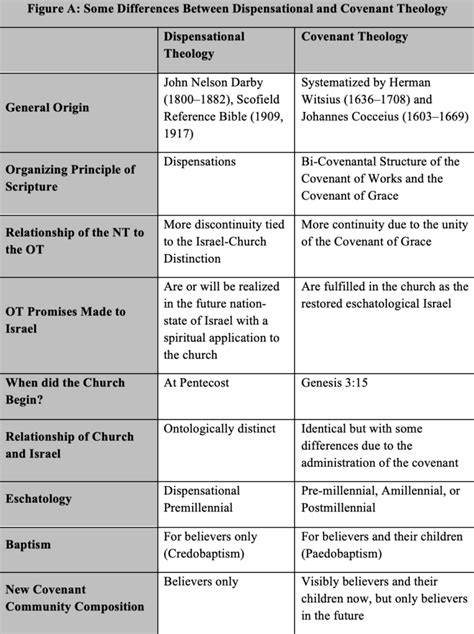
Dispensationalism maintains a consistent distinction between Israel and the Church as two separate peoples with distinct destinies. According to classic dispensational theology, the Church represents a parenthesis in God's plan for Israel. God will resume His program with national Israel in a future millennial kingdom where Old Testament promises find literal, physical fulfillment.
Dispensationalists insist this distinction honors the plain sense of Scripture and God's unconditional promises to Abraham. They argue that rejecting a future, distinct role for Israel can undermine the permanence of God's covenant commitments.
Calvinism, Covenant Theology, and the Question of Consistency
Whether Calvinism is inextricably tied to covenant theology depends on how Calvinism is defined. If it is simply a shorthand for monergism or even the five points, convinced dispensationalists with Calvinistic soteriology may regard themselves as fully Calvinistic without adopting covenant theology.
If Calvinism refers to the broader Reformed theological system, covenant theology has traditionally supplied an organizing framework for understanding sin, election, redemption, salvation, the Church, and the fulfillment of Scripture. Covenant theology is a comprehensive system for understanding Scripture's unity through the lens of divine covenants, typically the covenant of works and the covenant of grace.
One argument is that Calvinistic theology is closely connected to covenant theology because Christ is the “Messenger of the Covenant” who arrives and fulfills the requirements of the covenant for His chosen people. There is no discussion of Christ being the messenger of several covenants, depending on time and lineage; He is the only way that anyone, at any time, gets access to God, and no one can come to the Messenger of the Covenant unless the Father draws him.
From this perspective, dispensationalists have to reject the confessions in order to have their dichotomy of peoples. The disagreement therefore concerns more than the timing of Christ's return or the millennium. It includes the structure of redemption, the unity of God's people, and the way the biblical covenants relate to one another.
The Covenant Framework Behind Calvinistic Theology
The covenant framework connects several major doctrines within Reformed theology. The Covenant of Works explains humanity's original representative relationship with Adam, while the Covenant of Grace explains the historical outworking of salvation after the fall. The Covenant of Redemption explains the eternal purpose of the Father and the Son concerning the redemption of the elect.
Why are men totally depraved? Because Adam broke the Covenant of Works in the garden; being the representative for all humanity, depravity, also called spiritual death, was the punishment inflicted on all. The Covenant of Grace is the in-time outworking of the Covenant of Redemption, which is really the substance of election.
Salvation would be purchased by Christ the Son on behalf of those given to Christ in the Covenant of Redemption. Grace is irresistible because God the Father promised us to Christ the Son, once again, in the context of the Covenant of Redemption. Believers will persevere unto glory for the same reason.
The 1689 Baptist Confession expresses this covenantal structure in the following terms:
| Confession | Statement |
|---|---|
| 1689 Confession 7:2 | “Since humanity brought itself under the curse of the law by its fall, it pleased the Lord to make a covenant of grace. In this covenant he freely offers to sinners life and salvation through Jesus Christ. On their part he requires faith in him, that they may be saved, and promises to give his Holy Spirit to all who are ordained to eternal life, to make them willing and able to believe.” |
| 1689 Confession 7:3 | “This covenant is revealed in the gospel. It was revealed first of all to Adam in the promise of salvation through the seed of the woman. After that, it was revealed step by step until the full revelation of it was completed in the New Testament. This covenant is based on the eternal covenant transaction between the Father and the Son concerning the redemption of the elect. Only through the grace of this covenant have those saved from among the descendants of fallen Adam obtained life and blessed immortality. Humanity is now utterly incapable of being accepted by God on the same terms on which Adam was accepted in his state of innocence.” |
Reformed theology uses this framework to connect the Pactum Salutis, Historia Salutis, and Ordo Salutis. The covenant structure is therefore presented as a solid foundation for Calvinistic theology rather than as a secondary doctrine limited to eschatology.
Early Baptists and Covenantal Theology
The relationship between Calvinism and covenant theology cannot be reduced to a contrast between Reformed paedobaptists and dispensational Baptists. During the Puritan era, Baptist convictions were solid, and in their debates with Paedobaptists, Baptists used covenantal arguments.
Studies of early Particular Baptists argue that confessional Baptists possessed a substantial covenantal framework. The federal theology of the English Particular Baptists discussed the relationship between covenant, promise, shadow, and substance, showing that early Baptist theology was not inherently dependent on dispensationalism.
One argument is that dispensationalism developed during a confessional Baptist decline, when theology in Baptist circles declined and dispensationalism was used rather than a covenantal framework for theology. On this view, the important historical question is not whether Baptists can be Calvinistic, but whether a particular Baptist system has retained the covenantal structure historically used to explain Calvinistic doctrine.
Covenant Theology Does Not Determine One Eschatological Position
Covenant theologians have been amillennial, postmillennial, and premillennial, but never dispensational. One can indeed be premillennial and hold to covenant theology. The issue with dispensational theology would therefore be that it tends to push the separation between Israel and the Church to an extreme, not simply that it holds a premillennial outlook.
Covenant premillennialist Horatius Bonar and others made statements similar to dispensationalist arguments when opposing Patrick Fairbairn. Bonar's views on the contingency of prophecy were regarded by some as un-Calvinistic in the sense that they seemed to weaken the certainty and sovereignty of God's promises.
This demonstrates that premillennialism itself does not define dispensationalism. The central question is whether Israel and the Church are understood as two distinct peoples with separate prophetic programs or as one covenant people whose identity and promises are fulfilled in Christ.
The Dispensationalist Argument for Calvinistic Premillennialism
Some Calvinistic dispensationalists argue that consistent Calvinism leads to premillennialism. In this view, eschatology and ecclesiology were not sufficiently addressed or “reformed” at the time of the Reformation. Baptistic views and futuristic premillennialism were developed or recovered only later.
From that perspective, Reformed amillennialists and postmillennialists lack a solid foundation or consistency concerning ecclesiology and eschatology. They believe that consistent Calvinism leads to premillennialism, as argued or asserted in a well-known sermon associated with John MacArthur.
They think that it is replacement theology that has a “Plan B,” and not dispensationalism. They draw a parallel between the election of individuals to salvation and Israel's election and right to the Promised Land. If God revoked or redefined Israel's election, then one cannot be sure that He will not revoke one's own election. Hence, rejection of their form of premillennialism is treated as tantamount to Arminianism.
In this way of thinking, dispensationalists regard themselves as the real Calvinists, while covenant theologians are seen as clinging to Roman Catholic eschatology and, to some extent, ecclesiology. They recognize that Calvin himself was not a Calvinist in this regard.
MacArthur and his form of dispensationalism, sometimes described as futuristic premillennialism, are not alone in making this kind of argument. Covenant premillennialist Horatius Bonar and others made similar statements when arguing against later positions that they believed compromised the certainty of prophecy.
Biblicism and Historical Theology
It is important to remember that some dispensationalist approaches use biblicism as their method. They are therefore more resistant to historical arguments than confessional Reformed or 1689 Baptist theologians may be.
In a theology book edited by MacArthur and Mayhue, the system is described as “biblicism” rather than as Reformed, dispensationalist, or something else, although the authors identify with Calvinistic soteriology. This illustrates the distinction between Calvinism as a doctrine of salvation and Calvinism as a complete theological system.
Historical theology can function as a check and balance in biblical interpretation. If dispensationalism is argued to be a novelty in church history, the issue is not that historical precedent automatically proves or disproves a doctrine. Rather, church history, rightly used, can help test interpretive methods and expose assumptions that may otherwise remain unnoticed.
Biblical Arguments for Fulfillment in Christ and the Church
The biblical evaluation of replacement theology requires careful attention to key New Testament passages. Proponents of fulfillment in the Church point to Galatians 3:29, which identifies believers as “Abraham's offspring, heirs according to promise.” They also point to 1 Peter 2:9, which applies Israel's covenant language, “a chosen race, a royal priesthood, a holy nation,” directly to the Church.
These passages suggest that covenant identity has expanded to include all who are in Christ, Jew and Gentile alike. The New Testament clearly teaches that in Christ, the dividing wall between Jew and Gentile has been broken down, creating one new humanity.
From a covenant-theological perspective, Old Testament promises are read christologically. The promises made to Israel are understood as reaching their goal in Christ, the true Seed of Abraham, and in the people united to Him. The Church is therefore not understood as an unrelated replacement for Israel but as the New Testament community formed around Israel's Messiah.
Biblical Arguments Against Complete Replacement
Critics of complete replacement highlight Romans 9-11 as decisive. Romans 11:1 asks whether God has rejected His people, and Paul answers emphatically in the negative. The olive tree metaphor in Romans 11:17-24 describes Gentiles grafted into Israel, not replacing it.
Romans 11:29 affirms that the gifts and calling of God are irrevocable, suggesting God's continuing purposes for ethnic Israel. Dispensationalists and other critics argue that these texts make it difficult to claim that Israel's election has been permanently cancelled.
The biblical data therefore presents a complex picture. Whether this constitutes “replacement,” “fulfillment,” or “expansion” depends on the interpretive framework brought to the text and how one weighs competing biblical emphases.
Israel, Election, and Divine Faithfulness
The most forceful dispensationalist criticism concerns the relationship between Israel's election and the permanence of election more generally. The argument is that if God can revoke or redefine Israel's election, then the doctrine of sovereign election appears to become temporary or conditional in Israel's case.
The argument is stated this way: the Bible calls Christ “My elect,” the Church “God's elect,” and Israel “My elect.” It is therefore considered strange that the historic theology of sovereign election would deny Israel's continuing election.
On this reading, those who affirm replacement theology must say that when God called Israel His elect and gave Israel unconditional, unilateral, irrevocable promises, He did not keep them or does not keep them. Election would then not necessarily mean permanent election; it might be temporary, as in the case of Israel.
Covenant theologians respond that the issue is not God's failure to keep His promises but the identity of the promises' fulfillment. They argue that Christ fulfills the covenant promises and that all who are united to Christ share in the blessings of God's redemptive covenant. The disagreement therefore concerns the manner and scope of fulfillment, not whether God is faithful.
Israel in Dispensational Eschatology
Dispensational eschatology treats the future of Israel as foundational to a correct understanding of the end times. Scripture is viewed as making irrevocable, unconditional, unilateral promises and covenants to Israel that will be fulfilled in the future.
Within those covenants, God promised that the nation would one day be saved, that a generation of ethnic Jews would inherit their originally promised land, which God pledged to Abraham, and that they would become a blessing to the whole world.
Dispensationalists also expect a kingdom over which God's anointed King, the Messiah, will rule from Jerusalem with justice, righteousness, and peace for a thousand years. He will rule the whole world from Jerusalem, with Israel being given a special place of blessing.
This must come to pass, in the dispensationalist argument, because God has chosen Israel for this purpose in the end. Israel is therefore understood as God's elect, and its election is not cancelled by its present unbelief.
The Amillennial and Covenant-Theological Reading
Amillennial covenant theology does not generally expect a future earthly kingdom in which Christ reigns over ethnic Israel from Jerusalem for a literal thousand years. It interprets the kingdom as already inaugurated in Christ and present in the spiritual life of the Church, with its consummation in the heavenly and eternal kingdom.
Dispensational critics call this “replacement theology,” claiming that the Church replaces Israel in the promises of God and that Israel as God's elect is no longer God's elect. They argue that this position denies a future earthly kingdom for a generation of ethnic Jews in which Christ reigns on earth and fulfills the Old Covenant promises.
Covenant theologians typically reject that description. They argue that they are not replacing Israel but recognizing how Christ fulfills Israel's types and shadows. The Church incorporates believing Jews and Gentiles into one covenant community, but this does not necessarily mean that every statement made about Israel is transferred to the Church in an undifferentiated manner.
The central disagreement is therefore not necessarily about replacement versus non-replacement, but about the hermeneutical approach. Covenant theology reads the Old Testament christologically and sees substantial continuity between Israel and the Church. Dispensationalism emphasizes the continuing distinction between Israel and the Church and expects specific national promises to receive a future national fulfillment.
Literal and Christological Interpretation
Dispensationalists argue that Old Testament promises concerning Israel should be interpreted in their normal sense. They contend that Israel should mean Israel, a thousand years should mean a thousand years, and reigning in Jerusalem should mean reigning in Jerusalem.
They argue that covenantal and amillennial readings must move Scripture from its normal sense into a category of interpretation in which the words signify something other than what they appear to mean. According to this criticism, “Israel” no longer means Israel and earthly promises become spiritual promises to the Church.
Covenant theologians answer that the New Testament itself teaches readers how Old Testament institutions and promises reach fulfillment. They point to the way the New Testament applies covenant language to Christ and the Church, and they interpret the Old Testament through the progressive revelation of the entire canon.
The interpretive challenge is not merely whether one reads literally or symbolically. It concerns the meaning of “literal” interpretation after the coming of Christ, the relationship between type and fulfillment, and whether the New Testament expands or transforms the significance of Old Testament promises.
Horatius Bonar and Reformed Premillennialism
Throughout history there have been important Reformed figures who did not accept the dominant amillennial interpretation. Horatius Bonar was a nineteenth-century Scottish preacher and theological writer who held a position very different from many of his Reformed friends.
Bonar was a strong advocate of the doctrines of sovereign grace and the doctrine of election. He affirmed that election was forever and therefore affirmed the primacy of the destiny of the Jews in the scheme of eschatology. In this respect, he went against the grain of his day and his theological compatriots.
In 1847, Bonar wrote in Prophetic Landmarks: “The prophecies concerning Israel are the key to all the rest. True principles of interpretation in regard to them will aid us in disentangling and illustrating all prophecy. False principles as to them” - that is Israel - “will most thoroughly perplex and overcloud the whole Word of God.”
Bonar also wrote: “I am one of those who believe in Israel’s restoration and conversion, who receive it as a future certainty, that all Israel shall be gathered, and that all Israel shall be saved. As I believe in Israel’s present degradation, so do I believe in Israel’s coming glory and preeminence. I believe that God’s purpose regarding our world can only be understood by understanding God’s purpose as to Israel.”
He continued: “I believe that all human calculations as to the earth’s future, whether political or scientific, or philosophical, or religious, must be failures, if not taking for their data or basis, God’s great purpose regarding the latter-day standing of Israel.”
Bonar believed that the sons of Abraham would re-inherit Palestine and that the forfeited fertility would return to that land. He believed that Israel would meanwhile remain a people among whom only a remnant would be saved, and that missionaries would go forth for the gathering in of this remnant.
He also believed that the times were the times of the Gentiles and that Jerusalem and Israel would be trodden down by the Gentiles until the times of the Gentiles were fulfilled. He understood the completion of the fullness of the Gentiles as the signal for judgments that would usher in the crisis of earth's history, the salvation of Israel, and the long-expected kingdom.
Bonar's position shows that a commitment to sovereign grace and election does not automatically produce amillennialism. Reformed theology has included more than one eschatological position, even though dispensationalism is a distinct system rather than simply another form of covenant premillennialism.
The “Plan B” Debate
Some Calvinistic dispensationalists argue that replacement theology, rather than dispensationalism, introduces a “Plan B.” Their reasoning is that God made promises to Israel and later transferred those promises to the Church after Israel's unbelief.
They see the dispensational distinction as protecting the original promises and maintaining God's faithfulness to the people to whom those promises were given. In their view, God has one redemptive purpose for the Church and a future program for national Israel, rather than replacing one people with another.
Covenant theologians reject the idea that their position requires a divine Plan B. They understand the Church's inclusion in the promises as part of the plan revealed through the covenant of grace and fulfilled in Christ. Gentile inclusion is not considered an unexpected change but the unfolding of God's purpose through the promised Seed.
The debate therefore turns on whether the Church's participation in Israel's promises is best described as replacement, fulfillment, expansion, or incorporation. It also turns on whether national and ecclesial distinctions remain central after Christ's accomplishment of redemption.
Does Covenant Theology Necessarily Mean Replacement Theology?
Covenant theology and replacement theology are not identical terms. Covenant theology is a broad framework involving the covenant of works, the covenant of grace, and, in many formulations, the covenant of redemption. Replacement theology is a disputed description of a particular conclusion about Israel and the Church.
Most Reformed theologians who hold covenant theology reject the label “replacement theology” while affirming that the Church stands in covenant continuity with Old Testament Israel. They argue that this represents fulfillment and inclusion rather than replacement and exclusion.
Critics of covenant theology use the term because covenant theologians often interpret Old Testament promises concerning Israel's land, temple, and restored kingdom as finding their ultimate fulfillment in Christ and the Church rather than in a future national restoration of Israel.
Covenant theologians counter that they are not replacing Israel but properly recognizing how Christ fulfills Israel's types and shadows. They also emphasize that the Church is not a Gentile institution detached from Israel, since believing Jews and Gentiles are united in the Messiah.
Does Calvinism Necessarily Mean Dispensationalism?
Calvinistic soteriology and dispensationalism can be combined. A person may affirm total depravity, unconditional election, particular redemption, effectual calling, and perseverance while also maintaining a distinction between Israel and the Church.
However, some Reformed theologians argue that this combination lacks the broader covenantal framework historically associated with Calvinism. They contend that Calvinist theology developed alongside covenant theology during the Puritan era and that covenant theology supplies the categories needed to relate election, representation, redemption, and the unity of Scripture.
Dispensationalists answer that Calvinism is primarily a doctrine of salvation and that eschatology and ecclesiology do not logically determine whether someone is Calvinistic. They may therefore describe themselves as Calvinistic dispensationalists rather than covenant theologians.
The question is consequently not settled by the five points alone. It depends on whether Calvinism is being used narrowly for soteriology or broadly for the entire Reformed system of theology.
Future Israel and the Interpretation of Prophecy
Dispensationalists regard the future of Israel as the cornerstone of biblical eschatology. They argue that it is impossible to fully understand biblical teaching about the end times apart from understanding the future of ethnic Jews in God's plan.
On this view, getting Israel right means understanding what God has promised to do with Israel in the future. These promises include national salvation, restoration to the originally promised land, blessing to the whole world, and the reign of the Messiah from Jerusalem.
Reformed premillennialists such as Horatius Bonar have made similar arguments without adopting dispensationalism. They have insisted that the prophecies concerning Israel are the key to the rest of prophecy and that false principles concerning Israel can perplex and obscure the whole Word of God.
Some Reformed interpreters, however, understand the Church's relationship to Israel through the fulfillment accomplished in Christ. They argue that the Old Testament points forward to Christ's person and work and that the New Testament identifies the people of Christ as heirs of Abraham's promise.
Israel and the Church - My People Israel - Chuck Missler
Important Biblical Tensions
Several biblical emphases must be held together. The New Testament teaches that believers in Christ are Abraham's offspring and heirs according to promise. It applies language once associated with Israel to the Church and declares that Christ has broken down the dividing wall between Jew and Gentile.
The New Testament also asks whether God has rejected His people and answers emphatically in the negative. Romans 11 describes Gentiles as grafted into an existing olive tree and affirms that the gifts and calling of God are irrevocable.
These passages make it difficult to reduce the biblical teaching to a simple claim that the Church replaces Israel without qualification. They also make it difficult to maintain a rigid separation that ignores the Church's participation in the promises fulfilled in Christ.
The challenge is to explain how the Church can be one new humanity in Christ while God's purposes for Israel remain meaningful. Covenant theology and dispensationalism answer this question differently, and mediating positions attempt to preserve both covenant unity and a continuing significance for ethnic Israel.
Why the Debate Is Theological Rather Than Merely Terminological
The debate is not merely academic. It shapes how pastors preach the prophets, how Christians read their Bibles, and how theological traditions understand God's redemptive plan across Scripture.
The central issue is God's faithfulness to His promises, the unity of Scripture's redemptive story, the meaning of election, and the relationship between the Old and New Testaments. It also concerns whether the New Testament establishes one unified people of God or preserves two peoples with distinct prophetic destinies.
Whether one holds to covenant theology, dispensationalism, or some mediating position, the call remains the same: careful exegesis, historical awareness, theological humility, and commitment to Scripture's authority. The New Testament clearly teaches that in Christ, the dividing wall between Jew and Gentile has been broken down, creating one new humanity. It also affirms God's irrevocable calling of Israel.
So, Do Calvinists Believe in Replacement Theology?
Some Calvinists do hold a position that dispensationalists classify as replacement theology, especially when they affirm that the Church is the one covenant people of God and that Old Testament promises are fulfilled in Christ and the Church rather than in a future national restoration of Israel.
Other Calvinists reject replacement theology and affirm a continuing future for ethnic Israel, including Reformed and covenant premillennialists. Calvinistic dispensationalists likewise reject replacement theology, although they combine Calvinistic soteriology with a dispensational distinction between Israel and the Church.
The most accurate answer is therefore that Calvinism does not, by itself, settle the question. The answer depends on whether Calvinism means the five points of soteriology or the broader Reformed system, and on whether “replacement theology” means permanent replacement, covenant fulfillment, covenant continuity, or the inclusion of believing Gentiles in the people of God.
tags: #do #calvinists #believe #in #replacement #theology