Thyatira was an ancient city in Asia Minor, located in modern-day Turkey and now known as Akhisar, meaning “White Castle.” It is remembered especially as one of the seven churches addressed by Jesus Christ in the Book of Revelation.
In biblical history, Thyatira is significant for two closely connected reasons: it was a prosperous industrial and commercial center known for textile production and trade guilds, and its Christian church received the longest of the seven letters in Revelation. Jesus praised the church for its love, faith, service, perseverance, and growing works, but condemned its tolerance of false teaching, idolatry, and immorality.
Where Was Thyatira?
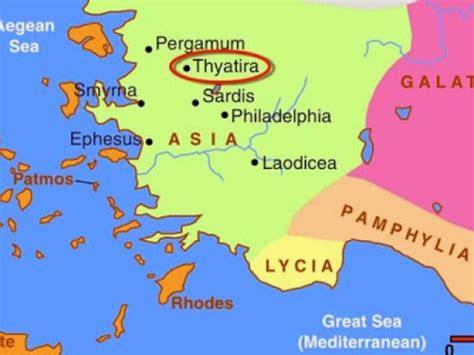
The name Thyatira belonged to a city in Asia Minor, now called Akhisar in Turkey, 65 km from the west coast, about half-way up in the north-south direction and about 175 km away from the ruins of Troy to its north-west. After Pergamos, Thyatira is the second-most northern city of the seven mentioned in Revelation, and original home of Lydia the purple-seller whom Paul converted while at Philippi in Macedonia.
Situated at a strategic crossroads, Thyatira played a crucial role in trade and commerce in ancient times, attracting different cultures and influencing local religious practices. Thyatira was a wealthy town on the Lycus River in the Roman province of Asia, in modern-day Turkey.
Today, Akhisar stands as a modern city that preserves the remnants of its glorious past and embodies the city's enduring legacy as an important Biblical site.
The Meaning and Origin of the Name Thyatira
The name Thyatira was not original to the city but was given to it by Seleucus I Nicator, one of four successors of Alexander the Great and founder of the Seleucid Empire, that stretched from Persia to Asia Minor.
The original name of Thyatira was Pelopia, after a Theban princess, daughter of king Tantalus of Lydia. Alternatively, the name Semiramis was used to describe the town. This after a legendary queen of Assyria, who managed to rule the empire for five years against all traditions that forbade women to hold power.
The name Thyatira is mentioned 4 times in the New Testament.
The traditional meaning assigned to Thyatira is “female butcher” or “she who rages madly.” The proposed etymology connects the name with the verb thuo, meaning “to slaughter” or “to rage,” and the suffix -teira, meaning “she who...”
Thyatira’s Early History
Thyatira's fascinating origins date back to the legendary Amazons as noted in historical records. According to what is said, the region was the scene of Amazonian Queen Myrine establishing towns. She gave her name to the district.
The area later fell under Lydian rule. Lydians changed the name of the city to Thyatira. The city held significant importance within the Lydian Kingdom and stood in the northernmost boundaries of the kingdom.
Its prominence continued until 547 BC, when it was conquered by the Persian Empire. However, this period of Persian domination was eventually brought to an end by Alexander the Great during his Anatolian expedition in 334 BC.
It was under his rule that Thyatira was integrated into the Kingdom of Macedonia. Later, the city came under the rule of the Kingdom of Pergamon.
After the death of King Attalos the Third of Pergamum in 138 BC, the kingdom and treasure of Pergamum were inherited by the Roman Republic.
Thyatira During the Roman Period
It became an important industrial city during the Roman period. The most important industry was textile. They were advanced in wool dyeing, linen weaving and leather processing.
Thyatira was known for its thriving textile industry and guilds. The city was the headquarters for many ancient guilds: the potters, tanners, weavers, robe makers and dyers guilds. It was actually the center of the dyeing industry.
Trade guilds were established in various business lines. These guilds organized commercial activity and connected the city’s workers, producers, and merchants.
| Aspect | Importance in Thyatira |
|---|---|
| Textiles | The most important industry |
| Wool | Thyatira was known for wool dyeing |
| Linen | The city was advanced in linen weaving |
| Leather | Leather processing was an important craft |
| Guilds | Trade guilds were established in various business lines |
Thyatira and the Purple-Dye Industry
In Roman Imperial times, Thyatira was a noted center of production of purple dye. Thaytira was famous for the wealth of its purple-dyed wool industry in Roman times.
Purple dye was associated with royalty and wisdom in the ancient world. The city’s reputation for dyed textiles helps explain the biblical reference to Lydia, a woman from Thyatira who was involved in selling purple goods.
It is widely believed that Lydia was a Greek Gentile who was involved in the trade in purple dyed wool. Acts 16:14 tells us that Lydia was from Thyatira. She became Paul’s first convert in Europe.
Lydia of Thyatira in the New Testament
It is possible that during Paul's second or third missionary journey, he and Silas visited the ancient city of Thyateira, as mentioned in Acts 16:13-16.
As Paul and Silas traveled through the region, they made a point of visiting various small towns nearby; but the names of these towns were not specifically mentioned in the Bible.
In Philippi they found hospitality in the home of Lydia, a woman from Thyateira. Beyond simply offering them a place to stay, Lydia continued to help Paul and Silas even after they faced prison time and were later released.
Lydia is a notable figure in the New Testament and represents the first documented woman to convert to Christianity in Europe. Her name “Lydia” indicates that she is from Lydia in Asia Minor, indicating her origin as a woman from that region.
Thyatira and Pagan Religion
Thyatira was also notable for its worship of pagan gods, which challenged the early Christian community. Apollo, the sun god, was primarily worshiped here.
The city’s commercial life and religious life were closely connected. Many scholars believe Jezebel was encouraging the church to join the trade guilds of Thyatira, even though that would mean giving honor to the guild god or goddess which included participating in the festivals where they sacrificed food to idols.
The pressure facing Christians was therefore not only theological. Participation in guild activities could also involve religious ceremonies, idolatrous meals, and behavior that conflicted with Christian teaching.
Thyatira as One of the Seven Churches of Revelation
During the Roman times and in early Christian times, Thyateira held a prominent position as the home to a significant Christian church. This church's importance is evident as it is listed among the seven Churches of the Book of Revelation.
In chapter one, we saw John the Apostle, exiled to the island of Patmos, in which he turned around to see Jesus in His unveiled, resplendent glory, with a message to seven distinct churches in the region of Asia Minor.
These were seven literal churches, who needed to heed the words Jesus brought to them. But these words also apply to every church in history and to the greater body of Christ at large.
We are studying the seven churches of Revelation chapters two and three. In each letter, we have been learning more about each distinct city, along with a characteristic of Christ from Revelation one.
Jesus gives almost every church a commendation, a criticism and a correction, as well as a crown for the one who overcomes.
The Letter to the Church at Thyatira
In Revelation 2:18-29 Jesus sends His message to the church of Thyatira. The message was from the Lord Jesus Christ through an angel, or “messenger”: “To the angel of the church in Thyatira write...”
This was not John’s message to the Thyatiran believers; it was a message from the Lord. The description at the end of verse 18 verifies the author of this message is Jesus Christ: “The words of the Son of God, whose eyes are like blazing fire and whose feet are like burnished bronze.”
The letter to the church at Thyatira focuses on the praiseworthy actions of the church, but also touches on issues of false teachings and immorality.
How Jesus Describes Himself
“These things says the Son of God, who has eyes like a flame of fire, and His feet like fine brass.”
This is not the introduction the Thyatirans were hoping for. Jesus says He is the Son of God, giving His authoritative place in the Trinity.
Then, He refers to His eyes, which are like blazing fire, seeing all things we think are unseen. His feet are like burnished bronze, like a refining fire melting brass.
When Jesus says there is fire in His eyes, He isn’t talking about a romantic stare with eyes of deep passion. It means eyes that see through the pretenses, eyes of judgment.
Our culture doesn’t particularly like the idea of someone looking at us with judgment, but Jesus’ penetrating gaze is ultimately to heal, not condemn. He also has feet of brass or bronze. Bronze is always Biblically symbolic of judgment.
Jesus’ Commendation of Thyatira
In the Book of Revelation, Thyatira is praised for the growing faith and devotion of the church. Church members are praised for their commitment in the face of hardship and adversity.
After identifying Himself, Jesus affirms the church’s positive actions: “I know your deeds, your love and faith, your service and perseverance, and that you are now doing more than you did at first” (Revelation 2:19).
Five qualities are listed: 1) love, 2) faith, 3) service, 4) patient endurance, and 5) greater works.
1. Works
This fellowship had hard workers that were known for their actions, not just their beliefs.
2. Love
The church at Thyatira, in contrast to Ephesus, had love for many people. In fact, they are the only church that Jesus commended for having love.
3. Faith
Their deeds and love were motivated by their faith in Christ.
4. Service
This church was heavily involved in ministry and in serving others.
5. Perseverance
They had patient endurance and steadfastness.
6. Growing Works
Their latter works exceeded the first. That means they were growing in their faith, not just resting in something God did for them in the past.
“I know your deeds...” “I know...your love...” “I know...your faith...” “I know...your perseverance...” “I know....that your deeds of late are greater than at first”.
Jesus’ Criticism of Thyatira
However, there is also a criticism. The church's tolerance of Jezebel, a self-proclaimed prophetess known for her immoral behavior.
Jesus says: “Nevertheless, I have this against you: You tolerate that woman Jezebel, who calls herself a prophetess. By her teaching she misleads my servants into sexual immorality and the eating of food sacrificed to idols” (Revelation 2:20).
Apparently, a false prophetess was leading believers into compromise. The church was engaging in sexual immorality and dabbling in idolatry.
Rather than rebuke this false teacher and send her out of the church, the believers in Thyatira were allowing her to continue her deception.
What Was Wrong with Tolerating Jezebel?
The word “tolerate” is rarely used in Scripture because it carries with it the meaning to compromise in a way that allows biblically ill behavior.
In Pergamum it was said, “...some...hold the teaching of Balaam” (Revelation 2:14), but here it is not an issue of endorsing and following someone and their false teaching, but tolerating it-allowing it to continue unchallenged even though you don’t believe it.
Jesus said the church in Thyatira tolerated Jezebel. The perennial problem with the church of Thyatira was that they tolerated Jezebel’s doctrine.
Ephesus was commended, back in verse two, for not “tolerating wicked men, but testing those who claim to be apostles but are not, and have found them false.” Here Thyatira is criticized for allowing sinful heresy into the body of Christ.
The faithful may not be following false influences in the Church, but neither are they to tolerate them.
Who Was Jezebel?
It is widely believed that Jezebel was a symbolic name given to a specific woman in Biblical times. The mention of Jezebel in the Old Testament further increases the importance of this name.
As originally recorded in the books of 1 & 2 Kings, she was an unbelieving daughter of a Gentile king married to Ahab, then ruler of the Northern Kingdom of Israel.
To her is attributed the introduction of Ba’al worship into Israel, which again fits very well with the character of “feminine oppression”.
Jezebel is the name of an Old Testament character, the notorious wife of Ahab who set up Baal worship in Israel.
Was this actually the name of the woman in the church of Thyatira? Probably not. But she was an idol worshiper. She was Jezebel-like.
She introduced immorality and idolatry in the church. She is symbolically called Jezebel in the way that Jerusalem would be symbolically called Sodom and Egypt in its time of iniquity.
Jezebel, Idolatry, and False Worship
This was not merely bringing in a false god to compete with the True God of Israel, but was incorporated into Hebrew worship with a false priesthood, false temples, and false practices which all used the terminology and outward appearances of Judaism.
What is taking place in Thyatira is an attempt to look, sound, and feel like Christianity so it will be accepted and eventually replace the authentic.
Jezebel led people to commit sexual immorality and to offer their food to idols. Jesus said that Jezebel was committing sexual immorality and was teaching and seducing people to do the same.
Scripture calls idolatry the same thing as spiritual adultery, like an unfaithful wife leaving her husband. So Jezebel in a sense represents things in our life that lead to idolatry-to worshiping things instead of God.
Jezebel and the Church as God’s Bride
The Hebrew word for “Ba’al” means “husband” or “master”, and Israel was supposed to be exclusively faithful to Yahweh her Husband and Master.
This is also true of the Church, often referred to as His woman: “Then one of the seven angels who had the seven bowls full of the seven last plagues came and spoke with me, saying, ‘Come here, I will show you the bride, the wife of the Lamb.’” (Revelation 21:9)
The spirit of Jezebel embodies the attempt to seduce God’s woman into unfaithfulness to another.
Jezebel is targeting Christ’s servants: “she teaches and leads My bond-servants astray so that they commit acts of immorality and eat things sacrificed to idols” (Revelation 2:20).
Jezebel as a False Prophetess
The second charge levied against Jezebel is that she “calls herself a prophetess” (Revelation 2:20).
Her false prophecies are directly tied to her teaching. False prophecies and false teaching are two sides of the same coin-where one is present the other inevitably follows.
The church tolerated this woman-an idolatrous one, one into the deep things of Satan. Jezebel was convincing the church that paganism and its expressions, even to the point of immorality, were acceptable.
The Judgment Announced Against Jezebel
Despite being given the chance to repent, Jezebel stubbornly refuses. Jesus says: “And I gave her time to repent, and she does not wish to repent of her sexual immorality.”
Jesus pronounces judgment on this Jezebel and calls the church of Thyatira to repent of their sin: “I will cast her on a bed of suffering, and I will make those who commit adultery with her suffer intensely, unless they repent of her ways. I will strike her children dead” (Revelation 2:22-23).
Jesus is graciously giving her time to repent-like He gives all of us-like Ahab had time and actually did repent. Yet this Jezebel in Thyatira didn’t change her ways, so He would cast her onto a sickbed.
Notice that He says that people who commit adultery with her will also face consequences, in this case-dead children-meaning more consequences of their sin. Jesus said that if they did not repent, they would eventually die.
“And all the churches will know that I am He who searches the minds and hearts; and I will give to each one of you according to your deeds” (Revelation 2:23).
Literally that means the hearts and kidneys. To the ancient Jews, the heart was the seat of the intellect, and the kidneys were the centerpiece of emotion. He’s saying, “I know every thought and feeling you have” (Psalm 139:23-24).
There were a whole lot of other churches like Thyatira, and there were a lot of churches moving in that direction. Killing the people in this church would be a warning to other churches of what might happen.
The Lord says, “Repent, you’re in danger of being executed. Repent.”
Jesus’ Promise to the Faithful
Jesus encourages those who had remained faithful: “Now I say to the rest of you in Thyatira, to you who do not hold to her teaching and have not learned Satan’s so-called deep secrets-I will not impose any other burden on you: Only hold on to what you have until I come” (Revelation 2:24-25).
The faithful believers did not fall into Satan’s trap, and they only needed to remain faithful until Christ’s return.
Jesus lists His promises to the believers in Thyatira: “To him who overcomes and does my will to the end, I will give authority over the nations-‘He will rule them with an iron scepter; he will dash them to pieces like pottery’-just as I have received authority from my Father. I will also give him the morning star” (Revelation 2:26-28).
These blessings would include authority over the nations, victory over all enemies, and the morning star. This morning star is Jesus Himself, as Revelation 22:16 reveals.
Jesus will give Himself to His church, and they will fellowship together forever.
Why the Letter to Thyatira Matters
The longest letter written by Jesus to the seven churches was necessary to correct what could very well be the most corrupt of all the churches.
If the church of Pergamum is an example of the compromising church that is taking the first kiss toward sin, then the church of Thyatira is the church that has completely gone to bed with idolatry and is suffering the life-threatening side effects of immorality.
This letter shows what compromise with the world leads to. It leads to full-scale idolatry and immorality.
This is not just a church infiltrated by the world, such as Pergamum was. This is a church that has absorbed sin and error and lived happily with it.
There are countless churches like Thyatira, churches that tolerate sin. And tolerating sin to any degree is a serious issue with our Holy Lord.
Love and Truth in the Message to Thyatira
Sadly, the church in Thyatira had too much love. That is actually an incorrect statement, because love was not the problem in itself.
Ephesus was strong in doctrine but lacked love. Thyatira was strong in love but weak in doctrine. They weren’t willing to disagree with anyone about doctrinal heresies.
One without the other can lead to a dangerous imbalance. But combined they provide flavor and health to the body of Christ.
Love without truth isn’t love. It’s infatuation. It’s concession. It’s masqueraded hatred.
Because if I truly love someone, I’m not going to withhold truth from them which would lead to their destruction. If I do, that means I’m indeed loving: I’m loving myself and my comfort, but I’m not truly loving the other person.
Five Warnings Drawn from Thyatira
1. A desire to fit in with the culture
How does a church that is solid suddenly become tolerant of heresy and sin? It isn’t always sudden, actually.
We are growing up in a culture that embraces postmodernism. It is a whole system that basically teaches that we can’t really know anything for sure, that truth changes, and as long as you believe it personally enough, it is true for you.
In other words, there is no absolute right and wrong, and if you can’t allow me to believe what I believe, you are racist or a bigot, and you are intolerant.
So we have to desire to please Jesus, not just fit in with the culture around us.
2. A failure to rightly define sin
We no longer call sin what it is: lawlessness, rebellion, treason, spiritual adultery, breaking God’s laws and commands.
We start wanting to use new words that don’t sound so offensive. So we stop saying, “sin” and start saying “struggle,” or “disease,” or “disorder.”
The faithful may not be following false influences in the Church, but neither are they to tolerate them.
3. Forsaking absolute truth for relativism
Only 44 percent of born again adults are certain that absolute, moral truth exists. Barna also discovered that only 9 percent of born again teenagers believe in absolute, moral truth.
“Now tolerance means that you must not say that anybody is wrong. You have to say that all positions are equally valid.”
4. Moving close-handed issues into open-handed ones
The Christian believes there are open-handed issues and close-handed. And we must never, ever begin to open the close-handed issues for debate.
This begins with questioning a foundational, Biblical doctrine. Then the questions get considered, and suppositions get formed. Then those turn into arguments to defend. And before you know it, we have a full-blown heresy.
5. Failing to take a stand for truth
What does the Bible say about how we should react to heresy? “Timothy, guard what has been entrusted to your care. Turn away from godless chatter and the opposing ideas of what is falsely called knowledge, which some have professed and in so doing have wandered from the faith” (1 Timothy 6:20-21, NIV).
“Have nothing to do with godless myths and old wives’ tales; rather, train yourself to be godly” (1 Timothy 4:7, NIV).
“For there are many rebellious people, full of meaningless talk and deception, especially those of the circumcision group. They must be silenced…rebuke them sharply, so that they will be sound in the faith” (Titus 1:10-13, NIV).
“But avoid foolish controversies and genealogies and arguments and quarrels about the law, because these are unprofitable and useless” (Titus 3:9, NIV).
The Broader Biblical Significance of Thyatira
Thyatira shows that a church may be active, loving, faithful, serving, patient, and growing while still facing serious spiritual danger.
The church’s positive works did not cancel the need to confront false teaching. Its love did not excuse its tolerance of immorality. Its service did not remove the responsibility to protect the community from idolatrous influence.
The message to Thyatira therefore holds together two truths: Christ recognizes genuine faithfulness, and Christ judges compromise with sin.
Churches should be known by how they exalt righteousness and how they condemn unrighteousness. Churches should be known for confronting sin and pursuing holiness.
We talk about the need for revival in the church. What would it look like? What would change? The church would get very serious about holiness and very serious about dealing with sin.
That’s the reformation our Lord calls for. The reformation would include a new love for Christ. It would include the exclusion of compromise and a confrontation of sin.