Easter scriptures from the King James Version center on the crucifixion, burial, and resurrection of Jesus Christ. The central message is expressed in the words of the angel: “He is not here: for he is risen, as he said.”
The KJV also contains the word “Easter” once, in Acts 12:4. In that verse, however, the Greek word is pascha, which the King James translators rendered as “Passover” in the other 28 New Testament occurrences. The passages below therefore focus on the biblical events and themes traditionally associated with Easter: Christ’s triumphal entry, His suffering and death, the empty tomb, the resurrection, forgiveness, salvation, and living hope.
The resurrection of Jesus Christ
Matthew 28:5-6
And the angel answered and said unto the women, Fear not ye: for I know that ye seek Jesus, which was crucified. He is not here: for he is risen, as he said. Come, see the place where the Lord lay.
Mark 16:6
And he saith unto them, Be not affrighted: Ye seek Jesus of Nazareth, which was crucified: he is risen; he is not here: behold the place where they laid him.
Luke 24:6-7
He is not here, but is risen: remember how he spake unto you when he was yet in Galilee, Saying, The Son of man must be delivered into the hands of sinful men, and be crucified, and the third day rise again.
Luke 24:34
The Lord is risen indeed, and hath appeared to Simon.
John 20:8-9
Then went in also that other disciple, which came first to the sepulchre, and he saw, and believed. For as yet they knew not the scripture, that he must rise again from the dead.
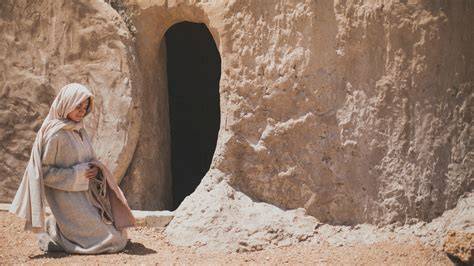
The Easter message in the King James Version
The Easter story recounts Jesus’ resurrection three days after His crucifixion. The Bible states how Jesus made a triumphal entry into Jerusalem. Shortly after, His apostle Judas agreed to betray Jesus and deliver Him to the chief priests for thirty silver pieces. After attending the last supper with His apostles and visiting the garden of Gethsemane to pray to God, Jesus was delivered to Pontius Pilate and sentenced to death.
Jesus took His final steps walking through a crowd of angry people while carrying a cross. He was crucified, and with His last breath He committed himself to His father’s hands. Shortly after, Jesus’ body was returned to His followers, and He was buried in a tomb. However, on the following Sunday, Jesus’ followers went to His tomb to find it open. Jesus’ body was not inside. They knew that Jesus had risen.
The triumphal entry into Jerusalem
Zechariah 9:9
Rejoice greatly, O daughter of Zion; shout, O daughter of Jerusalem: behold, thy King cometh unto thee: he is just, and having salvation; lowly, and riding upon an ass, and upon a colt the foal of an ass.
Matthew 21:9
And the multitudes that went before, and that followed, cried, saying, Hosanna to the son of David: Blessed is he that cometh in the name of the Lord; Hosanna in the highest.
The triumphal entry presents Jesus as the promised King who comes with salvation in humility. The crowd’s cry, “Hosanna in the highest,” connects the arrival of Christ with praise, expectation, and the fulfillment of Scripture.
Jesus foretells His death and resurrection
Matthew 20:18-19
Behold, we go up to Jerusalem; and the Son of man shall be betrayed unto the chief priests and unto the scribes, and they shall condemn him to death, And shall deliver him to the Gentiles to mock, and to scourge, and to crucify him: and the third day he shall rise again.
These words show that the crucifixion and resurrection were not unexpected events. Jesus spoke beforehand of His betrayal, condemnation, suffering, death, and rising again on the third day.
Jesus prays in Gethsemane
Mark 14:36
Abba, Father, all things are possible unto thee; take away this cup from me: nevertheless not what I will, but what thou wilt.
The prayer in Gethsemane reveals both the depth of Christ’s suffering and His complete submission to the Father’s will. The words “nevertheless not what I will, but what thou wilt” express obedience in the face of the approaching cross.
Jesus before Pilate and the judgment of the crowd
Luke 23:20-25
Wanting to release Jesus, Pilate appealed to them again. But they kept shouting, “Crucify him! Crucify him!” For the third time he spoke to them: “Why? What crime has this man committed? I have found in him no grounds for the death penalty. Therefore I will have him punished and then release him.” But with loud shouts they insistently demanded that he be crucified, and their shouts prevailed. So Pilate decided to grant their demand. He released the man who had been thrown into prison for insurrection and murder, the one they asked for, and surrendered Jesus to their will.
The judgment scene contrasts the innocence of Jesus with the violence of the demand for crucifixion. Pilate repeatedly states that he finds no basis for the death penalty, yet Jesus is surrendered to the will of the crowd.
The mockery and suffering of Christ
Matthew 27:28-29
And they stripped him, and put on him a scarlet robe. And when they had platted a crown of thorns, they put it upon his head, and a reed in his right hand: and they bowed the knee before him, and mocked him, saying, Hail, King of the Jews!
Christ was mocked as a king while being prepared for execution. The scarlet robe, crown of thorns, reed, and false homage were instruments of humiliation, yet the title “King of the Jews” also points to the identity that the mockers failed to understand.
Jesus carries the cross
Luke 23:26-28
As the soldiers led him away, they seized Simon from Cyrene, who was on his way in from the country, and put the cross on him and made him carry it behind Jesus. A large number of people followed him, including women who mourned and wailed for him. Jesus turned and said to them, “Daughters of Jerusalem, do not weep for me; weep for yourselves and for your children.
Matthew 27:30-31
They spit on him, and took the staff and struck him on the head again and again. After they had mocked him, they took off the robe and put his own clothes on him. Then they led him away to crucify him.
The crucifixion
Luke 23:33-34
When they came to the place called the Skull, they crucified him there, along with the criminals-one on his right, the other on his left. Jesus said, “Father, forgive them, for they do not know what they are doing.” And they divided up his clothes by casting lots.
At the cross, Jesus prayed for the forgiveness of those who crucified Him. His words reveal mercy in the midst of suffering and provide one of the clearest expressions of forgiveness in the Easter narrative.
1 Peter 2:24
Who his own self bare our sins in his own body on the tree, that we, being dead to sins, should live unto righteousness: by whose stripes ye were healed.
Philippians 2:8
And being found in fashion as a man, he humbled himself, and became obedient unto death, even the death of the cross.
Galatians 2:20
I am crucified with Christ: nevertheless I live; yet not I, but Christ liveth in me: and the life which I now live in the flesh I live by the faith of the Son of God, who loved me, and gave himself for me.
These passages describe the cross as the place where Christ bore sins, humbled Himself, and gave Himself in love. The meaning of the crucifixion is not limited to physical suffering; it is also presented as the foundation of forgiveness, righteousness, healing, and transformed life.
Jesus is declared King
John 19:19
And Pilate wrote a title, and put it on the cross. And the writing was, JESUS OF NAZARETH THE KING OF THE JEWS.
Matthew 27:37
And set up over his head his accusation written, THIS IS JESUS THE KING OF THE JEWS.
The inscription placed above the cross identified Jesus as “The King of the Jews.” Although intended as an accusation, the title echoes the earlier prophecies and the crowd’s proclamation during the triumphal entry.
Jesus forgives and receives the repentant criminal
Luke 23:39-43
One of the criminals who hung there hurled insults at him: “Aren’t you the Messiah? Save yourself and us!” But the other criminal rebuked him. “Don’t you fear God,” he said, “since you are under the same sentence? We are punished justly, for we are getting what our deeds deserve. But this man has done nothing wrong.” Then he said, “Jesus, remember me when you come into your kingdom. ” Jesus answered him, “Truly I tell you, today you will be with me in paradise.”
This conversation at the cross presents confession, recognition of Jesus’ innocence, faith in His kingdom, and Christ’s promise. Even in His final hours, Jesus responds with mercy.
Darkness at the crucifixion
Mark 15:33
At noon, darkness came over the whole land until three in the afternoon.
Luke 23:44-45
It was now about noon, and darkness came over the whole land until three in the afternoon, for the sun stopped shining. And the curtain of the temple was torn in two.
The darkness and the torn temple curtain mark the solemnity of the crucifixion. They appear at the moment when Jesus gives His life and the events of the cross reach their climax.
Jesus gives His life
John 19:30
When Jesus therefore had received the vinegar, he said, It is finished: and he bowed his head, and gave up the ghost.
Luke 23:46
And when Jesus had cried with a loud voice, he said, Father, into thy hands I commend my spirit: and having said thus, he gave up the ghost.
Luke 23:46
Jesus called out with a loud voice, “Father, into your hands I commit my spirit.” When he had said this, he breathed his last.
The words “It is finished” express the completion of Christ’s earthly work. His final prayer, “Father, into thy hands I commend my spirit,” expresses trust and willing surrender.
The burial of Jesus
Matthew 27:57-59
As evening approached, there came a rich man from Arimathea, named Joseph, who had himself become a disciple of Jesus. Going to Pilate, he asked for Jesus’ body, and Pilate ordered that it be given to him. Joseph took the body, wrapped it in a clean linen cloth…
John 19:40-41
Taking Jesus’ body, the two of them wrapped it, with the spices, in strips of linen. This was in accordance with Jewish burial customs. At the place where Jesus was crucified, there was a garden, and in the garden a new tomb, in which no one had ever been laid.
Luke 23:50-56
Now there was a man named Joseph, a member of the Council, a good and upright man, who had not consented to their decision and action. He came from the Judean town of Arimathea, and he himself was waiting for the kingdom of God. Going to Pilate, he asked for Jesus’ body. Then he took it down, wrapped it in linen cloth and placed it in a tomb cut in the rock, one in which no one had yet been laid. It was Preparation Day, and the Sabbath was about to begin. The women who had come with Jesus from Galilee followed Joseph and saw the tomb and how his body was laid in it. Then they went home and prepared spices and perfumes. But they rested on the Sabbath in obedience to the commandment.
The empty tomb
Luke 24:1-6
On the first day of the week, very early in the morning, the women took the spices they had prepared and went to the tomb. They found the stone rolled away from the tomb, but when they entered, they did not find the body of the Lord Jesus. While they were wondering about this, suddenly two men in clothes that gleamed like lightning stood beside them. In their fright the women bowed down with their faces to the ground, but the men said to them, “Why do you look for the living among the dead? He is not here; he has risen!
Matthew 28:5-6
And the angel answered and said unto the women, Fear not ye: for I know that ye seek Jesus, which was crucified. He is not here: for he is risen, as he said. Come, see the place where the Lord lay.
The empty tomb is the immediate sign of the resurrection. The women came expecting to find the body of Jesus, but the angel directed them to the place where He had been laid and declared that He had risen.
Jesus appears to His followers
Matthew 28:8-10
So the women hurried away from the tomb, afraid yet filled with joy, and ran to tell his disciples. Suddenly Jesus met them. “Greetings,” he said. They came to him, clasped his feet and worshiped him. Then Jesus said to them, “Do not be afraid. Go and tell my brothers to go to Galilee; there they will see me.”
Luke 24:34
The Lord is risen indeed, and hath appeared to Simon.
1 Corinthians 15:4-8
And that he was buried, and that he rose again the third day according to the scriptures: And that he was seen of Cephas, then of the twelve: After that, he was seen of above five hundred brethren at once; of whom the greater part remain unto this present, but some are fallen asleep. After that, he was seen of James; then of all the apostles. And last of all he was seen of me also, as of one born out of due time.
The resurrection was proclaimed through appearances to the women, Simon, the apostles, James, Paul, and many other witnesses. The risen Christ was not presented as an idea or memory but as the living Lord who appeared to His followers.
Christ’s victory over death
Acts 2:24
Whom God hath raised up, having loosed the pains of death: because it was not possible that he should be holden of it.
Acts 3:15
And killed the Prince of life, whom God hath raised from the dead; whereof we are witnesses.
Acts 10:40
Him God raised up the third day, and shewed him openly.
Revelation 1:18
I am he that liveth, and was dead; and, behold, I am alive for evermore, Amen; and have the keys of hell and of death.
These verses describe the resurrection as God’s victory over death. Jesus is called the Prince of life, the One who lives forever, and the One who holds the keys of hell and death.
The resurrection and Christian hope
1 Peter 1:3
Blessed be the God and Father of our Lord Jesus Christ, which according to his abundant mercy hath begotten us again unto a lively hope by the resurrection of Jesus Christ from the dead.
Romans 8:11
But if the Spirit of him that raised up Jesus from the dead dwell in you, he that raised up Christ from the dead shall also quicken your mortal bodies by his Spirit that dwelleth in you.
1 Thessalonians 4:14
For if we believe that Jesus died and rose again, even so them also which sleep in Jesus will God bring with him.
1 Corinthians 15:20-21
But now is Christ risen from the dead, and become the firstfruits of them that slept. For since by man came death, by man came also the resurrection of the dead.
The resurrection gives believers a “lively hope.” It is connected with new birth, the future raising of mortal bodies, the resurrection of those who have died in Christ, and Christ as the firstfruits of those who sleep.
Christ as the resurrection and the life
John 11:25-26
Jesus said unto her, I am the resurrection, and the life: he that believeth in me, though he were dead, yet shall he live: And whosoever liveth and believeth in me shall never die. Believest thou this?
Jesus does not merely announce the resurrection; He identifies Himself as “the resurrection, and the life.” The promise is presented in relation to faith in Him and extends beyond physical death.
Romans 8:34
Who is he that condemneth? It is Christ that died, yea rather, that is risen again, who is even at the right hand of God, who also maketh intercession for us.
The risen Christ is described as being at the right hand of God and interceding for believers. His death and resurrection are joined together as the basis for the answer to condemnation.
The cross as the power of God
1 Corinthians 1:18
For the preaching of the cross is to them that perish foolishness; but unto us which are saved it is the power of God.
Colossians 1:20
And, having made peace through the blood of his cross, by him to reconcile all things unto himself; by him, I say, whether they be things in earth, or things in heaven.
Hebrews 12:2
Looking unto Jesus the author and finisher of our faith; who for the joy that was set before him endured the cross, despising the shame, and is set down at the right hand of the throne of God.
Revelation 5:12
Saying with a loud voice, Worthy is the Lamb that was slain to receive power, and riches, and wisdom, and strength, and honour, and glory, and blessing.
The cross is presented as the means of reconciliation and peace, while the risen Christ is honored as the Lamb who was slain. The shame of the cross is set alongside Christ’s exaltation at the right hand of God.
Salvation through faith in the risen Christ
John 3:16
For God so loved the world, that he gave his only begotten Son, that whosoever believeth in him should not perish, but have everlasting life.
Romans 10:9
That if thou shalt confess with thy mouth the Lord Jesus, and shalt believe in thine heart that God hath raised him from the dead, thou shalt be saved.
John 14:6
Jesus saith unto him, I am the way, the truth, and the life: no man cometh unto the Father, but by me.
1 Timothy 1:15-16
This is a faithful saying, and worthy of all acceptation, that Christ Jesus came into the world to save sinners; of whom I am chief. Howbeit for this cause I obtained mercy, that in me first Jesus Christ might shew forth all longsuffering, for a pattern to them which should hereafter believe on him to life everlasting.
These scriptures connect Easter’s central message with God’s love, eternal life, confession, faith in the resurrection, mercy, and salvation. The resurrection is not separated from the call to believe in Jesus Christ.
Forgiveness and renewal
2 Corinthians 5:21
For he hath made him to be sin for us, who knew no sin; that we might be made the righteousness of God in him.
1 John 1:9
If we confess our sins, he is faithful and just to forgive us our sins, and to cleanse us from all unrighteousness.
Titus 3:5
Not by works of righteousness which we have done, but according to his mercy he saved us, by the washing of regeneration, and renewing of the Holy Ghost.
Psalm 51:10
Create in me a clean heart, O God; and renew a right spirit within me.
Ezekiel 36:26
A new heart also will I give you, and a new spirit will I put within you; and I will take away the stony heart out of your flesh, and I will give you an heart of flesh.
The Easter message includes the promise of cleansing, forgiveness, regeneration, and renewal. These passages describe salvation as God’s merciful work that produces a changed heart and a renewed spirit.
Hope, joy, and new life
Romans 15:13
Now the God of hope fill you with all joy and peace in believing, that ye may abound in hope, through the power of the Holy Ghost.
Colossians 1:27
To whom God would make known what is the riches of the glory of this mystery among the Gentiles; which is Christ in you, the hope of glory.
Psalm 118:24
This is the day which the Lord hath made; we will rejoice and be glad in it.
2 Corinthians 4:16-18
For which cause we faint not; but though our outward man perish, yet the inward man is renewed day by day. For our light affliction, which is but for a moment, worketh for us a far more exceeding and eternal weight of glory; While we look not at the things which are seen, but at the things which are not seen: for the things which are seen are temporal; but the things which are not seen are eternal.
Psalm 23:3
He restoreth my soul: he leadeth me in the paths of righteousness for his name’s sake.
Lamentations 3:22-23
It is of the Lord’s mercies that we are not consumed, because his compassions fail not. They are new every morning: great is thy faithfulness.
Romans 8:24-25
For we are saved by hope: but hope that is seen is not hope: for what a man seeth, why doth he yet hope for? But if we hope for that we see not, then do we with patience wait for it.
These passages associate Christian hope with joy, peace, renewal, restoration, patience, and the faithfulness of God. The resurrection points toward life that is renewed inwardly and directed toward eternal things.
The word “Easter” in the King James Version
Acts 12:4
And when he had apprehended him, he put him in prison, and delivered him to four quaternions of soldiers to keep him; intending after Easter to bring him forth to the people.
The word “Easter” is only found in the King James Bible version of the Old Testament, in Act 12:4, when King Herod captures Peter.
In the 1611 version of the King James Bible, this is the only verse where “Easter” is used.
The Greek New Testament uses the word pascha or πάσχα in this verse. What does pascha mean?
This Greek word pascha occurs 29 times in the New Testament, and Tyndale translated this word as Easter 14 times; esterlambe (Easter Lamb) 11 times; paschall lambe (Passover Lamb) three times; and esterfest (Easter Festival) once.
Why did the translators of the King James Bible translate as Passover all 28 other occurrences of pascha in the New Testament except for this one verse, Acts 12:4, where they translated it Easter?
Many scholars in researching this puzzling question conclude that it must have been an oversight, and that it would have been changed if it had been caught prior to printing.
Most modern translations use “Passover” instead of “Easter” in Acts 12:4. The wording of the King James Version is therefore important to examine carefully, especially because the passage describes Herod’s intention to bring Peter before the people after the feast.
Passover and Easter in Acts 12:4
In the 1611 version of the King James Bible, this is the only verse where “Easter” is used.
The word means “passover” (or “passover meal,” or, twice, “passover lamb”).
The standard Greek-English lexicon says that “the Easter festival” is a sense of the word pascha that developed only “in later Christian usage.”
It’s very unlikely that “Easter” was a thing when Luke wrote Acts. That’s why no translations but one use the word.
Nearly every scholar today understands that the early New Testament Church kept the Passover and not the modern holiday observance of Easter, which had its origins in ancient paganism.
Rather than supporting the Christian observance of Easter, Acts 12:4 corroborates the other 28 uses of the word pascha in the New Testament to show us that the early Church of God observed the Passover.
The 29 references cover the span from Christ’s death through the later writing of the apostle Paul.
Most modern translations do not use “Easter” in any verse!
Short King James Version scriptures for children
John 3:16
For God so loved the world, that he gave his only begotten Son, that whosoever believeth in him should not perish, but have everlasting life.
1 Corinthians 6:14
And God hath both raised up the Lord, and will also raise up us by his own power.
Mark 10:14
But when Jesus saw it, he was much displeased, and said unto them, Suffer the little children to come unto me, and forbid them not: for of such is the kingdom of God.
Matthew 18:3
And said, Verily I say unto you, Except ye be converted, and become as little children, ye shall not enter into the kingdom of heaven.
Romans 10:9
That if thou shalt confess with thy mouth the Lord Jesus, and shalt believe in thine heart that God hath raised him from the dead, thou shalt be saved.
John 14:6
Jesus saith unto him, I am the way, the truth, and the life: no man cometh unto the Father, but by me.
These short passages are suitable for memorization because they express the central themes of Easter in direct language: God’s love, Christ’s resurrection, salvation, faith, the kingdom of God, and Jesus as the way, the truth, and the life.
Additional resurrection scriptures
Philippians 3:10-11
That I may know him, and the power of his resurrection, and the fellowship of his sufferings, being made conformable unto his death; If by any means I might attain unto the resurrection of the dead.
2 Timothy 1:9
Who hath saved us, and called us with an holy calling, not according to our works, but according to his own purpose and grace, which was given us in Christ Jesus before the world began.
Romans 8:34-35
Who is he that condemneth? It is Christ that died, yea rather, that is risen again, who is even at the right hand of God, who also maketh intercession for us. Who shall separate us from the love of Christ?
1 Corinthians 15:20-21
But now is Christ risen from the dead, and become the firstfruits of them that slept. For since by man came death, by man came also the resurrection of the dead.
1 Timothy 1:15-16
This is a faithful saying, and worthy of all acceptation, that Christ Jesus came into the world to save sinners; of whom I am chief. Howbeit for this cause I obtained mercy, that in me first Jesus Christ might shew forth all longsuffering, for a pattern to them which should hereafter believe on him to life everlasting.
These verses connect the resurrection with knowing Christ, sharing in the meaning of His suffering, salvation by grace, intercession, the love of Christ, mercy, and the hope of resurrection from the dead.