The EWTN Advent wreath is a circle of evergreen branches with four candles that marks the four weeks of Advent and helps Catholics prepare spiritually for the birth of Jesus Christ at Christmas. The evergreen circle represents eternity and the everlasting life found in Christ, while the progressively lighted candles express the expectation and hope surrounding the coming of the Messiah.
During the first week, one purple candle is lighted; during the second week, two purple candles are lighted; during the third week, the rose or pink candle is added for Gaudete Sunday; and during the fourth week, all four candles are lighted. Advent is not only a countdown to Christmas but also a season of prayerful expectation for Christ’s second coming.
What Advent Means
The word “Advent” is from the Latin adventus for “coming” and is associated with the four weeks of preparation for Christmas. Advent always contains four Sundays, beginning on the Sunday nearest the feast of St. Andrew the Apostle (November 30) and continuing until December 24.
Advent comes from the Latin “ad + venire,” which means, essentially, “to come to” or “to come toward.” “Ad + venire” is the root of the Latin “adventus,” which means “arrival.” So Advent is the season of arrival: the arrival of Christ in our hearts, in the world, and into God’s extraordinary plan for our salvation.
The people of Israel waited for generations for the promised Messiah to arrive. Their poetry, their songs and stories, and their religious worship focused on an awaited savior who would come to them to set them free from captivity and to lead them to the fulfillment of all that God had promised.
Israel longed for a Messiah, and John the Baptist, who came before Jesus, promised that the Messiah was coming and could be found in Jesus Christ, God’s Son, the “Lamb of God who takes away the sins of the world.” Advent is a season in the Church’s life intended to renew the experience of waiting and longing for the Messiah.
Though Christ has already come into the world, the Church invites us to renew our desire for the Lord more deeply in our lives and to renew our desire for Christ’s triumphant second coming into the world. Advent is the time in which we prepare for Christmas, the memorial of Jesus Christ being born into the world.
When Advent Begins and Ends
Advent starts four Sundays before Christmas. But because Christmas is on a fixed date and could fall on different days of the week, Advent can be as short as three weeks and a day or as long as four weeks.
In 2026, Advent begins on November 29 and ends on December 24 (Christmas Eve), as the Mass of the Lord’s Nativity begins. Christmas Day is December 25.
The Church’s feasts and celebrations run on a yearlong cycle, which we call the “liturgical year.” The “liturgical year” starts on the first Sunday of Advent. So it’s a new liturgical year when Advent starts.
Why Catholics Celebrate Advent
The Catechism of the Catholic Church (paragraph 524) says, When the Church celebrates the liturgy of Advent each year, she makes present this ancient expectancy of the Messiah, for by sharing in the long preparation for the Savior’s first coming, the faithful renew their ardent desire for his second coming.
By celebrating the precursor’s birth and martyrdom, the Church unites herself to his desire: “He must increase, but I must decrease.”
This is a period of preparation for the celebration of the Incarnation at Christmas. Preparations are practical, like decorating trees and gift giving, but they’re also intended to be spiritual.
During Advent, we’re invited to enter more frequently into silence, into prayer and reflection, into Scripture, and into the sacramental life of the Church - all to prepare for celebrating Christmas. The Catechism of the Catholic Church says the goal of Advent is to make present for ourselves and our families the “ancient expectancy of the Messiah … by sharing in the long preparation for the Savior’s first coming.”
Advent is considered the Little Lent, as it begins by recalling that Christ will come at the end of the world as Judge, a reminder of the holiness with which we should be prepared to greet the Lord. Thus, although not strictly a penitential season, the faithful should turn their hearts toward Jesus in prayer, almsgiving, and sacrifice.
In the last part of Advent, we look forward with anticipation and joy to His First Coming, in Bethlehem. One way to do this is to meditate on the O Antiphons used in the Mass, each of which represents a messianic title of Christ from the Old Testament.
What the Advent Wreath Represents
During Advent, Catholics celebrate the season with an Advent wreath. The wreaths are made with a circle of evergreen branches (symbolizing life) and hold four candles representing the four weeks of Advent.
The Catholic Church has been using Advent wreaths since the Middle Ages. Lighting candles as we prepare for Christmas reminds us that Christ is the light of the world. And the evergreen boughs remind us of new and eternal life in Christ, the eternal son of the Father.
The Advent Wreath brings to mind the time before Jesus when the world was in spiritual darkness. During Advent, we remember the Old Testament days as we anxiously anticipate His Birth at Christmas.
The circle of the wreath, with no beginning or end and made with evergreens, represents eternity and the everlasting life found in Christ. The four candles represent the four weeks of Advent whose progressive lighting expresses the expectation and hope surrounding the coming of the Messiah.
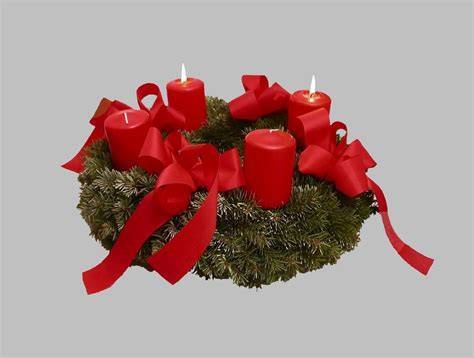
The Meaning of the Evergreen Circle
The evergreen branches symbolize life. Their enduring green color points to new and eternal life in Christ, the eternal Son of the Father.
The circle has no beginning or end, representing eternity and the everlasting life found in Christ. The wreath therefore brings together two related signs: the unending circle of God’s life and the living hope proclaimed by the evergreen branches.
The Meaning of the Candles
The candles represent the four weeks of Advent and the number of candles lighted each week corresponds to the number of the current week of Advent. The rose candle is lighted on the Third Sunday of Advent, also known as Gaudete Sunday.
The four candles indicate the different weeks of Advent. These colors match the liturgical colors of the vestments for those weeks, with purple representing penance and rose representing rejoicing.
The three purple candles are sometimes said to represent prayer, fasting, and almsgiving - the three spiritual disciplines that are key to a fruitful Advent.
Advent Candle Colors
Violet or purple, a symbol of suffering and penitence, is, therefore, the liturgical color used in Advent and Lent. The liturgical year has different colors for the different seasons.
Redemptionis Sacramentum (No. 121) says, “The purpose of using different colors is to express the specific character of the various mysteries. The use of the diverse colors is both pedagogical and symbolic of the various liturgical feasts and seasons.”
| Candle | Color | Meaning or use |
|---|---|---|
| First candle | Purple | Lighted during the first week of Advent |
| Second candle | Purple | Added during the second week of Advent |
| Third candle | Rose or pink | Lighted on Gaudete Sunday |
| Fourth candle | Purple | Added during the fourth week of Advent |
Customarily the Advent Wreath is constructed of a circle of evergreen branches into which are inserted four candles. According to tradition, three of the candles are violet and the fourth is rose. However, four violet or white candles may also be used.
There are different systems of considering the four weeks. For example, Week 1 evokes the patriarchs and the virtue of hope. Week 2 recalls the prophets and peace. Week 3 recalls John the Baptist and joy while Week 4 presents the figure of Mary and the virtue of love.
Other systems of representing the weeks are also possible provided they match the liturgical character of the season.
Which Advent Candle Is Lighted First?
First Week: A purple candle
Second Week: A second purple candle, in addition to the first week’s candle
Third Week: The first two week’s candles and the rose or pink candle
Fourth Week: All four candles
| Week of Advent | Candles lighted |
|---|---|
| First Week | One purple candle |
| Second Week | Two purple candles |
| Third Week | Two purple candles and the rose or pink candle |
| Fourth Week | All four candles |
There does not appear to be any prescribed order, either officially or even traditionally, except that the rose-colored candle is lit on the third (Gaudete) Sunday of Advent.
While there appears to be no prescribed order for the first and second candle, it does appear to be a tradition that the order in which they are lit should be maintained.
In other words, when the fourth Sunday arrives the candle from the first week is lit first, then the second week, the rose candle follows, and finally the last candle begins to shine. This order should be maintained on each occasion that the candles are lit over the four weeks.
Gaudete Sunday and the Rose Candle
The Latin word “Gaudete” (rejoice) is the first word in the Entrance Antiphon of the Mass for the Third Sunday of Advent. It directs us to rejoice for the Lord’s coming is at hand.
On that day, the priest wears rose instead of purple vestment. The rose candle is lighted on the Third Sunday of Advent, also known as Gaudete Sunday.
Gaudete is a word that means “rejoice,” and we rejoice on Gaudete Sunday because we are halfway through Advent. Some people have the custom of throwing Gaudete parties, and this is also a day on which Christmas carolers may begin caroling door to door.
The Scriptures for the Third Sunday of Advent proclaim their message in no uncertain terms: Rejoice! Joy is all around us and our celebration of Advent calls us to discover it.
The joy that the Scripture passages speak about is not a joy that equates with hilarious laughter. It is a joy that comes from a security with our God, those around us, and our place in the world.
It is the joy Isaiah describes when he writes, “I rejoice heartily in the Lord, in my God is the joy of my soul.” It is a joy that cannot be bought or obtained from artificial highs.
It is a joy that comes from our living faith in a living God. It is the joy we feel as we approach the birth of our Savior and remember the awesome beauty of what happened on that cold Bethlehem night. Rejoice!
Advent Wreath Blessing
The use of the Advent Wreath is a traditional practice which has found its place in the church as well as in the home. The blessing of an Advent Wreath takes place on the First Sunday of Advent or on the evening before the First Sunday of Advent.
The blessing may be celebrated during Mass, a celebration of the word of God, or Evening Prayer. The Advent Wreath may be blessed by a priest, deacon, or a lay minister.
When the blessing of the Advent Wreath is celebrated in the home, it is appropriate that it be blessed by a parent or another member of the family; the shorter rite may appropriately be used for this purpose.
When the Advent Wreath is used in the home, the opening prayer of the Sunday Mass is recited when the candles are lighted. The lighting of the candles may be preceded or followed by an Advent hymn and a Scripture reading.
The lighting of the Advent Wreath may fittingly be included as a part of the evening meal.
Short Form of the Advent Wreath Blessing
All make the sign of cross as the minister says:
Our help is in the name of the Lord.
All reply:
Who made heaven and earth.
One of those present or the minister reads a text of sacred Scripture, for example:
Brothers and sisters, listen to the words of the prophet Isaiah:
The people who walked in darkness have seen a great light. The people who walked in darkness have seen a great light; Upon those who dwelt in the land of gloom a light has shone.
You have brought them abundant joy and great rejoicing, As they rejoice before you as at the harvest, as men make merry when dividing spoils.
For a child is born to us, a son is given us; upon his shoulder dominion rests. They name him Wonder-Counselor, God-Hero, Father-Forever, Prince of Peace.
His dominion is vast and forever peaceful, From David's throne, and over his kingdom, which he confirms and sustains By judgment and justice, both now and forever.
A minister who is a priest or deacon says the prayer of blessing with hands outstretched; a lay minister says the prayer with hands joined.
Lord God, your Church joyfully awaits the coming of its Savior, who enlightens our hearts and dispels the darkness of ignorance and sin. Pour forth your blessings upon us as we light the candles of this wreath; may their light reflect the splendor of Christ, who is Lord, for ever and ever. R. Amen.
Or:
Lord our God, we praise you for your Son, Jesus Christ: he is Emmanuel, the hope of the peoples, he is the wisdom that teaches and guides us, he is the Savior of every nation.
Lord God, let your blessing come upon us as we light the candles of this wreath. May the wreath and its light be a sign of Christ's promise to bring us salvation. May he come quickly and not delay. We ask this through Christ our Lord. R. Amen.
Full Prayer for the First Candle
Let the hills sing for joy together before the LORD, for he comes to judge the earth. He will judge the world with righteousness, and the peoples with equity. (Psalm 98:8-9)
Lord, our God, we praise You for Your Son, Jesus Christ, for He is Emmanuel, the Hope of all people. He is the Wisdom that teaches and guides us. He is the Savior of us all.
O Lord, let your blessing come upon us as we light the first (purple) candle of this wreath. May the wreath and its light be a sign of Christ's promise of salvation. May He come quickly and not delay. We ask this in His holy name. Amen.
Prayer for the Second Week
The light of the moon will be like that of the sun and the light of the sun will be seven times greater (like the light of seven days). On the day the Lord binds up the wounds of His people, He will heal the bruises left by His blows. (Isaiah 30:26)
Lord, our God, we praise You for Your Son, Jesus Christ, for He is Emmanuel, the Hope of all people. He is the Wisdom that teaches and guides us. He is the Savior of us all.
O Lord, let your blessing come upon us as we light two (purple) candles of this wreath. May the wreath and its light be a sign of Christ's promise of salvation. May He come quickly and not delay. We ask this in His holy name. Amen.
Prayer for the Third Week
Sing aloud, O daughter of Zion; shout, O Israel! Rejoice and exult with all your heart, O daughter of Jerusalem! (Zephaniah 3:14)
Lord, our God, we praise You for Your Son, Jesus Christ, for He is Emmanuel, the Hope of all people. He is the Wisdom that teaches and guides us. He is the Savior of us all.
O Lord, let your blessing come upon us as we light two (purple) candles and the third (pink) candle of this wreath. May the wreath and its light be a sign of Christ's promise of salvation. May He come quickly and not delay. We ask this in His holy name. Amen.
How to Use the Wreath at Home
When the wreath is used in the home, the opening prayer of the Sunday Mass is recited when the candles are lighted. The lighting of the candles may be preceded or followed by an Advent hymn and a Scripture reading.
The lighting of the Advent Wreath may fittingly be included as a part of the evening meal. A family may gather around the wreath, read a passage from Sacred Scripture, pray, and light the appropriate candles for that week.
First, it is a good idea to pray more, possibly including the Joyful Mysteries of the Rosary, the Franciscan Crown, and the Christmas Novena, all of which call to mind the mysteries associated with the Lord coming into the world.
It is also important to read Sacred Scripture, especially the Infancy Narratives of Matthew and Luke. The Catechism of the Catholic Church, chapters 2 and 3 of the Second Part of the Creed, expresses the Church’s Faith in the Incarnation and Nativity of the Lord.
Finally, to truly prepare, it is important to go to Confession at least once during the season, and maybe go to daily Mass and do Eucharistic Adoration when you are able.
Advent Wreath in Church and at Mass
From a liturgical point of view, only the blessing of the wreath on the first Sunday of Advent is included among those that may be used at Mass. This rite has received the approval of the Holy See for those countries that requested its inclusion in their translation and adaptation of the Book of Blessings.
It is not found in the original Latin benedictional. The multitude of other rites and ceremonies that have grown up around the lighting of the wreath are mostly geared to family celebrations.
These may be profitably used in church but outside of Mass. For example, it is possible to organize a prayer service before the Saturday evening Mass.
If, however, there is no ceremony outside of Mass to light the candles on Sundays 2, 3 and 4 of Advent, I think that it is legitimate for the priest to do so at the very beginning of the first Mass of the corresponding Sunday (or Saturday evening) with no added rituals or texts.
For example, after genuflecting toward the tabernacle or bowing toward the altar, the celebrant could simply light a taper from an earlier candle and, saying nothing, use this to light the next candle. He could then go to kiss the altar and continue Mass as normal.
The sacristan would light the wreath candles before the celebration of later Masses.
The Advent liturgy is itself sufficient to provide all the necessary teaching material so as to prepare for Christmas. The Advent wreath is one non-liturgical symbol, and its importance should not be exaggerated.
Why the Wreath Should Not Be Combined with the Penitential Act
General liturgical principles do not allow anyone, on his own authority, to add or remove anything from the sacred rites.
This proposal removes the necessary freedom of the celebrant to use any other form of the penitential rite and thus subjects the liturgy to the needs of a devotional practice.
Combining the lighting of the candle with the penitential rite quite likely would distract from this primary meaning toward various other messages that are best reserved for other moments.
The admission of our sinfulness is an important part of every Mass, as we prepare our souls to live the sacred mysteries. The Advent wreath itself has various shades of meaning and is not essentially penitential in character.
These other nuances could be lost by associating it too closely to the penitential rite.
Advent Hope and the Light of the Wreath
We light an advent candle today, a small dim light against a world that often seems forbidding and dark. But we light it because we are a people of hope, a people whose faith is marked by an expectation that we should always be ready for the coming of the Master.
The joy and anticipation of this season is captured beautifully in the antiphons of hope from the monastic liturgies:
- See! The ruler of the earth shall come, the Lord who will take from us the heavy burden of our exile
- The Lord will come soon, will not delay.
- The Lord will make the darkest places bright.
We must capture that urgency today in the small flame of our candle. We light the candle because we know that the coming of Christ is tied to our building of the kingdom.
Lighting the flame, feeding the hungry, comforting the sick, reconciling the divided, praying for the repentant, greeting the lonely and forgotten - doing all these works hastens His coming.
Advent Prayer and Christian Practice
The Joyful Mysteries of the Rosary should help you focus more on Jesus’ Incarnation. Also, the Christmas Anticipation Novena is often said throughout Advent.
Advent is the season in which prayer, almsgiving, sacrifice, Scripture, and the sacraments help prepare the heart for Christ. The wreath’s light becomes a visible reminder that preparation involves both expectation and action.
If we are open to the guiding touch of God's hand and willing to discover His plan for our lives, miracles will happen. What prevents us from seeing and being a part of God's miracles? Would we rather be blind?
Lord, clarify my vision that I may see You in others and sense You within my own soul.
The Christmas Anticipation Novena
This novena is a unique prayer for the last nine days of Advent, beginning on December 16th and ending on Christmas Eve. It will help you to prepare your heart for the Nativity of the Lord.
Hail, and blessed be the hour and moment At which the Son of God was born Of a most pure Virgin At a stable at midnight in Bethlehem In the piercing cold
At that hour vouchsafe, I beseech Thee, To hear my prayers and grant my desires (mention request here) Through Jesus Christ and His most Blessed Mother
Other Advent Symbols
There are many symbols for Advent: the Advent calendar, Advent wreath with candles, the Jesse Tree, and the Crèche - with the Baby Jesus absent until Christmas Eve.
Each of these can be the basis of a family tradition, especially to teach children how to prepare for Jesus’ Birth.
The Jesse Tree
The Jesse Tree helps to teach about salvation history by going through the lineage of Jesus. In Isaiah 11:1-3, we read:
There shall come forth a shoot from the stump of Jesse, and a branch shall grow out of his roots. And the Spirit of the LORD shall rest upon him, the spirit of wisdom and understanding, the spirit of counsel and might, the spirit of knowledge and the fear of the LORD.
And his delight shall be in the fear of the LORD.
Jesse is the father of King David and an ancestor of Jesus. Thus, the Davidic kings all sprang “from the root of Jesse” (Isaiah 11:1-3). This would be one of the characteristics of the Messiah, fulfilled in Our Lord.
The Jesse Tree is a medieval practice whose exact origin is uncertain. However, as early as the 11th century it was depicted in an illuminated (illustrated) Gospel, the Vyšehrad Codex, in Bohemia (now part of the Czech Republic).
The Nativity Scene
In its present form the custom of displaying figures depicting the birth of Jesus Christ owes its origin to Saint Francis of Assisi who made the Christmas creche or manger for Christmas eve of 1223.
However, as early as the fourth century representations of the nativity of the Lord were painted as wall decorations depicting not only the infancy narrative accounts of Christ's birth, but also the words of the prophets Isaiah and Habakkuk taken to mean that the Messiah would be born in the midst of animals in a manger.
The blessing of the Christmas manger or nativity scene, according to pastoral circumstances, may take place on the Vigil of Christmas or at another more suitable time.
When the manger is set up in the home, it is appropriate that it be blessed by a parent or another family member; the shorter rite may be used for this purpose.
Advent Music and Christmas Decorations
There are a lot of great Advent hymns and songs, such as “O Come O Come Emmanuel,” “Come Thou Long Expected Jesus,” “O Come Divine Messiah,” “Come Thou Fount,” and “Hark! A Thrilling Voice Is Sounding.”
When to put up the tree is a decision that families decide on their own. Some people put up their tree and decorate it on the first Sunday of Advent to make a big transformation in their home and get them into “preparing for Christmas” mode.
Some put up the tree on the first Sunday of Advent, put on lights the next Sunday, ornaments the next, and decorate it more and more as they get closer to Christmas.
Some put up the tree on Gaudete Sunday, as a kind of rejoicing, and decorate it in the weeks between Gaudate and Christmas.
When the tree goes up and gets decorated is up to the individual and family, but having a Christmas tree is a big part of many people’s Advent traditions.