The German Evangelical Church Congress is a major Protestant gathering that combines worship, Bible study, music, cultural events, public debate, education, and social engagement. It brings together people of different ages, cultures, sexual orientations, abilities, denominations, and religious backgrounds, presenting the church as both a spiritual community and a forum for discussing contemporary society.
The German Protestant Kirchentag is held every second (odd-numbered) year. Tens of thousands participants are expected to attend. They will experience fellowship, worship together, listen to concerts and participate in honest, passionate political debates - across denominational and religious borders.
Historical background of German Protestantism
The history of the German Evangelical Church Congress is rooted in the long and difficult development of Protestant churches in Germany. The territorial churches in Germany had sought closer cooperation among themselves for many years. They had developed out of both the changes in church life and organization and the various religious and political settlements brought about by the 16th-century Protestant Reformation.
No one liked the Westphalian settlement, but the lines were drawn, the Reformation over. Germany lay devastated, plundered by lawless armies, much of its population decimated. Commerce and industry had disappeared; moral, intellectual, and spiritual life had stagnated. Religion was dispirited and leaderless.
Although the churches had been protected by the Treaties of Westphalia, they were isolated from one another in a divided Germany. Neither peace treaties nor the warming of hearts to social concern could erase the ravages of war. The population of Germany had been reduced from 16 million to six million. For lack of manpower, a third of German land still lay fallow between 1648 and 1680.
Peasants existed on linseed and oilcakes or bread of bran and moss. The 17th century was marked by greedy rulers bent on a lifestyle of opulent ease and aggressive attacks on neighboring states. German princes coined money and levied taxes on impoverished people to support it all.
Pietism and the spiritual renewal of Protestantism
A time for mystics and poets, much of German hymnody comes from this early 17th century. Out of such sensitivities, a new Protestant movement, Pietism, arose. Pietism became the heart of a number of Lutheran-Reformed unions.
The pathetic human condition in war-torn 17th century Germany awakened Pietism, a theology of the heart, balanced by moral stringencies for self-discipline. The Pietist movement was initiated by Philip Jacob Spener (1635-1705), a Lutheran pastor sensitive to the needs of his congregation demoralized by war.
Drunkenness and immorality were rife, church services sterile. Spener inspired a moral and spiritual reformation, emphasizing personal warmth, Christian experience of everyday living, and the building up of Christian virtues.
His “little churches” within the church successfully taught self-discipline, including abstinence from card playing, dancing, the theatre. Similar proscriptions found their ways into Puritan churches of the British Isles.
Despite charges of heresy, Pietism held fast, and the University of Halle became its chief center. The warm heart and social concern of Pietism at Halle inspired the commission of missionaries to India, and at least one, a Lutheran, Henry Melchior Muhlenberg, to Germans in the American colonies.
Lutheran and Reformed unions
In 1817, the Evangelical Church of the Prussian Union, by order of Frederick William III (1797-1840) of Prussia, united the Lutheran and Reformed Churches of his kingdom, giving birth to the ancestral church of the Evangelical Synod of North America, a grandparent of the United Church of Christ.
The Evangelical Church of the Prussian Union became a model in other German kingdoms for Lutheran and Reformed unions. In small bands, thousands of German Reformed people, free in their faith in God, quietly slipped away in 1709, to find a haven in London.
From there, most sought a permanent home among the American colonists in the New World. Having endured such pain and hardship, many found great promise in the ideal of brotherly love and joined William Penn’s Pennsylvania Colony.
Others, many of them indentured servants, went to New York, Virginia, and the colonies of North and South Carolina.
The development of interchurch conferences
Evangelical Church Conference the name of periodical meetings of delegates of the Protestant state churches of Germany. The object of these meetings is, to have a free exchange of opinion on important questions of ecclesiastical life, to furnish a bond of union for the several Protestant state churches of Germany, and: to advance their harmonious development.
The impulse to meetings of this kind proceeded, in 1815, from king Wilhelm of Wirtemberg. Invitations to a conference were issued conjointly by Prussia and Wurtemberg to the governments of South Germany, and by Prussia. and Hanover to the governments of Northern Germany.
At the first conference, which met at Berlin in 1846, the Church boards of all the German states except Austria, Bavaria, Oldenburg, and the FreeCities were represented. This meeting was secret, and the proceedings have never been officially published.
It is known, however, that they concerned the periodical holding of conferences of this kind, confessions, liturgy, and Church constitution. The second meeting was to have been held at Stuttgardt in 1848, but did not take place, in consequence of the disturbances caused by the revolution.
At the Church diets (q.v.) of Stuttgardt (1850) and Elberfeld (1851), ecclesiastical officers of several countries deliberated on the resumption of the official Church conferences, and suggested the establishment of a central organ, which was to contain the decrees of all the supreme Church boards of the German States.
Accordingly, the conference met ,again at Eisenach in June 1852, and in the same year an official central organ of the German Church governments was established at Stuttgardt (Allgem. Kirchenblatt fur das evangel. Deutschland).
Since then the conference has met always at Eisenach, in 1855, 1857, 1859, 1861, 1863, 1865, and 1868.
Early subjects and achievements
One of the first results of the conferences was a compilation of 150 of the best German Protestant hymns (Kernlieder), which was recommended to the several states as a proper basis of, or appendix to, the hymn-books of the several churches.
In 1855 some resolutions concerning the treatment of sects by the state churches were unanimously adopted. These resolutions declared against the principle of full religious liberty, but recommended that the members 'of sects be allowed to contract valid civil marriages.
The same conference adopted resolutions in behalf of a better observance of Sunday; of giving to congregations the right of cooperation (votum negativum) in the appointment of ecclesiastical officers, and of introducing special liturgical devotions during the week of Passion.
The conference of 1857 held important discussions on the revival of Church discipline, on reforms in the legislation concerning divorces, and on Christian burial.
Among the results of the later meetings of the conference were the following: The introduction of a prayer for the German fatherland, to be used every Sunday in every Protestant church; resolutions on Church patronage, on liturgical, matters, on the examinations of theological students, on catechization, on the revision of the Lutheran Bible, on the best' way of collecting the statistics of the German Lutheran Church, on the construction of evangelical churches, on the State-Church system, etc.
From territorial churches to the Evangelical Church in Germany
Until 1918 the ruler of each German state was the head of the Protestant church in his territory, which was Lutheran, Reformed, or United. After Germany was defeated in World War I, the German Empire was replaced by the Weimar Republic, whose new Weimar constitution severed this connection between church and state.
The territorial churches reorganized themselves into self-governing churches. Attempts to gain closer union were made. During the Nazi era the churches cooperated in various ways to resist the government’s efforts to control them.
The Evangelical Church in Germany, federation of Lutheran, Reformed, and United (a combination of Lutheran and Reformed) territorial churches in Germany. Organized in 1948 after the difficult years of the Nazi era (1933-45), it helped the German Protestant churches restore themselves, and it reestablished relations with churches outside of Germany.
After World War II a group of territorial church leaders met in August 1945 to consider forming the EKD. The constitution for the new federation was adopted in July 1948 in Eisenach, despite tensions arising out of the theological differences between the Lutherans and the Reformed.
The establishment of the Federal Republic of Germany (West Germany) and the German Democratic Republic (East Germany) in 1949 meant that, until German reunification in 1990, the EKD de facto represented only the West German territorial churches. In 1991 the EKD included all Lutheran, Reformed, and United churches.
Structure and significance of the EKD
Twenty Lutheran, Reformed and United regional churches (Landeskirchen) form the Evangelical Church in Germany. German Protestant church structures are based on federal principles at all levels.
Each local congregation is responsible for Christian life in its own area, while each regional church has its own special characteristics and retains its independence. Without in any way diminishing this autonomy, the EKD carries out joint tasks with which its members have entrusted it.
The Evangelical Church in Germany (EKD) is the communion of the twenty regional churches of Lutheran, Reformed or United confession within the borders of the Federal Republic of Germany. In association with the United Evangelical Lutheran Church of Germany (VELKD) and the Union of Evangelical Churches (UEK), the EKD supports the regional churches in fulfilling their tasks.
It promotes activities that are important for the entire protestant church and, with the Gospel as its foundation, takes a public stand on contemporary religious and social debates. It represents the community of member churches in dealings with the federal government, the states, the EU, and civil society.
Democratic governing bodies
The EKD has the following governing bodies, all organized and elected on democratic lines: the Synod, the Council and the Church Conference. They are responsible for fulfilling the EKD's tasks as laid down in the constitution of the EKD.
Three bodies guide the work of the EKD: the Synod, the Church Conference, and the Council of the EKD. The EKD Church Office works under the direction of these three bodies.
| Body | Role in the EKD |
|---|---|
| The Synod | One of the governing bodies responsible for fulfilling the EKD's tasks |
| The Church Conference | One of the governing bodies representing cooperation among the regional churches |
| The Council of the EKD | One of the governing bodies guiding the work of the EKD |
| The EKD Church Office | Works under the direction of the Synod, the Church Conference, and the Council of the EKD |
Activities and responsibilities
The EKD gives the territorial churches a common voice in their relationship to the state and the society and in ecumenical relationships. The work of the EKD is limited to that assigned to it by the member churches and primarily involves ecumenical relations, works of mercy, and tasks concerned with the society and government of Germany.
Specifically, the EKD’s tasks include the following areas of work: proclamation of the gospel and theological reflection, social welfare and developmental policy, pastoral care and counseling, education and upbringing, social responsibility, ecumenism and work abroad, interreligious relations, communication and digitalization.
- proclamation of the gospel and theological reflection
- social welfare and developmental policy
- pastoral care and counseling
- education and upbringing
- social responsibility
- ecumenism and work abroad
- interreligious relations
- communication and digitalization
Ecumenical relations
In the area of ecumenical work, the EKD is involved in various alliances: in the Arbeitsgemeinschaft Christlicher Kirchen in Germany, the Conference of European Churches, the Communion of Protestant Churches in Europe, the Commission of the Churches for Migrants in Europe, the Lutheran World Federation, the World Communion of Reformed Churches, and the World Council of Churches.
Those territorial churches which followed the recommendation of the United Evangelical Lutheran Church in Germany (VELKD) in 1949 to apply directly for WCC membership are counted as direct members of the WCC (+), though they are represented in the WCC through the EKD.
The EKD also maintains numerous bilateral and multilateral ecumenical relations: It conducts theological dialogues and contact talks with the German Bishops’ Conference of the Catholic Church (DBK), with the Free Church (VEF), and with the Orthodox Bishops’ Conference of Germany and the Oriental Churches in Germany, as well as with various Byzantine Orthodox patriarchates.
It maintains partnerships with the Church of England (Meissen Declaration), with churches whose roots lie in German emigration (Latin America, southern Africa), with Protestant churches in Europe (Sweden, Finland, Netherlands, Switzerland, Austria, Italy, France, Czech Republic, Romania and Russia and its neighboring countries), with the Evangelical Lutheran Church in Jordan and the Holy Land, with churches in Asia (Thailand, Korea, Japan, Indonesia and China) and with the Evangelical Lutheran churches in the USA and Canada.
Work with congregations abroad
The EKD has parishes and pastors in more than 60 countries. Through these and other contacts, it has a variety of partnerships and dialogues.
It has connections with over one hundred German-speaking congregations in more than seventy countries in all parts of the world, which offers the approximately two million German-speaking Protestant Christians living abroad the opportunity to find a spiritual home.
The EKD sends pastors to these congregations and provides them with content and financial support. It cooperates with congregations of other languages and origins within Germany.
Interreligious dialogue
The Interreligious Partnerships of the EKD are Diverse: It participates in the Christian-Jewish dialogue, among other ways through relations with the Central Council of Jews in Germany and the International Council of Christians and Jews, as well as holding regular contact discussions between the Council of the EKD, the DBK, and the two Rabbinical Conferences.
It is in contact with the Coordination Council of Muslims in Germany and other Islamic organizations and reflects on fundamental questions of Christian-Islamic dialogue. It participates in the Round Table of Religions in Germany and in international interreligious forums (e.g. European-Arab Dialogue, European Council of Religious Leaders).
The German Protestant Kirchentag
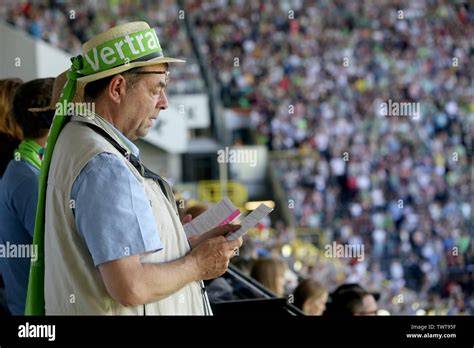
The German Protestant Kirchentag is a recurring public gathering of German Protestant Christians and their guests. Its purpose extends beyond formal worship: it creates opportunities for fellowship, spiritual reflection, cultural participation, political discussion, and encounters across denominational and religious borders.
The Kirchentag itself is also another example of the Church’s efforts to remain relevant through attracting people from different backgrounds. The multi-day event showcased and celebrated the full diversity of the Church, involving a variety of events that included people of different ages, cultures, sexual orientations, and abilities.
It was also emblematic of the value of dialogue in German religious culture. It is a popular stereotype that Germans don’t like small talk, but I have found that this simply means they prefer talking about deep and important topics instead.
The 2017 Kirchentag
In 2017, it will take place from May 24th to 28th in Berlin and Wittenberg. Six Kirchentag-style programmes 'on the way' will offer an opportunity to get to know other cities in Central Germany.
The anniversary-year gathering was designed as a civil society forum reaching far beyond a mere church event. Around 2500 individual events will deal with international policy-making and living together in family and society.
Celebrity speakers will take up the Kirchentag topics in panels, debates, lectures and workshops, with a lot of public participation. The closing ceremony of the 36th Kirchentag, a festive service of thanksgiving, will take place on the meadows of the Elbe River near Wittenberg.
Kirchentag on the Way
Since some guests intend to come to Wittenberg but will not attend the Kirchentag in Berlin beforehand, it will be possible to stop over on the way. Visitors from Speyer and Garmisch-Partenkirchen, from Flensburg and Görlitz will travel together and worship on the Elbe meadows on 28 May.
The backdrop of the service will be the unchanged medieval skyline of Wittenberg. Kirchentag on the Way, held in six different locations, offers an opportunity to get to know a variety of cities in Central Germany, to rediscover an old cultural landscape, and to enjoy the hospitality of the people from the region.
Starting with an ecumenical service on Ascension Day, with the same liturgy in all six venues as well as at the Kirchentag in Berlin, the respective locations will continue with their own programmes, reflecting their local traditions and history.
Programme formats
There will be programmes of music, culture, spirituality - along with Bible studies, lectures, discussions, guided tours, activities for families and children, and outstanding concerts.
- music and concerts
- culture and local history
- spirituality and Bible studies
- lectures and discussions
- guided tours
- activities for families and children
- ecumenical services
Local cities and their themes
Local people devise the programme. Leipzig, Magdeburg, Erfurt, Jena/Weimar, Dessau-Rosslau and Halle/Eisleben will demonstrate their own special significance as Luther sites or important centres of the Reformation.
During the days before the festive service and the popular festival in Wittenberg, these cities will offer varied programmes, prepared by local congregations, regional groups and municipal organisations.
In Leipzig, the programme will centre around music and the sound of freedom, while in Magdeburg it will cover topics from the Reformation communication centre.
Erfurt will share its ecumenical experiences, e.g. Christian-Jewish dialogue. Jena/Weimar will ask Gretchen's famous question from Goethe's Faust ("Now tell me how you feel about religion?") and invites scientists to enter into dialogue about religion and their faith.
Dessau-Rosslau will focus on its cultural heritage - the Bauhaus and the composer Kurt Weill. Halle/Eisleben will recall not only the place of Martin Luther's birth and death in Eisleben, but also the adversaries of the Reformation in Halle.
The Kirchentag on the Way will offer a range of different stopovers on the way to Wittenberg - in addition, it will take up the tradition of churches in the German Democratic Republic, which used to hold their own Kirchentag on a regional level.
| Location | Programme emphasis |
|---|---|
| Leipzig | Music and the sound of freedom |
| Magdeburg | Topics from the Reformation communication centre |
| Erfurt | Ecumenical experiences and Christian-Jewish dialogue |
| Jena/Weimar | Dialogue between scientists, religion, and faith |
| Dessau-Rosslau | The Bauhaus and the composer Kurt Weill |
| Halle/Eisleben | Martin Luther and the adversaries of the Reformation in Halle |
Public debate and social responsibility
In my experience, topics like religion and politics are much less taboo in Germany than they are in the United States. This was particularly the case at the Kirchentag, where there were events discussing the wars in the Ukraine and Gaza, how to better welcome and involve underrepresented members of the Church, and even hosting the outgoing chancellor Olaf Scholz to talk about facing the “challenging times” of today.
I have also seen events about political topics hosted in churches and listened to political sermons in Berlin, which shows me the importance that the German Protestant Church places on discussing current issues even when they may be controversial.
I have no doubt that this comes from the history of theologians and churches, both Protestant and Catholic, speaking out against authoritarian regimes in Germany, but I was surprised and pleased to see that such dialogue is still valued in the less dire circumstances of the present era.
A church with banners advertising a prayer service for Turkey and an event about the Protestant church and COVID-19
Music, worship, and cultural participation
One way that they do this is through music. Many churches in Berlin contribute to the local music scene by hosting free concerts for the public.
I found this to be a great way to listen to music by traditional German composers as well as new compositions. These concerts usually attract the older generation as well as people from the neighborhood, which often extends beyond the church’s members.
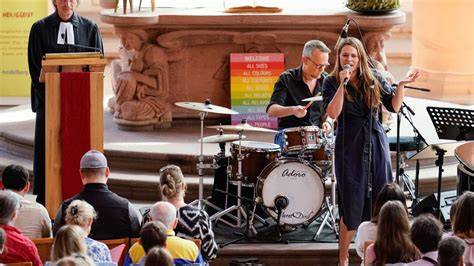
Furthermore, a church in Heidelberg hosts Taylor Swift-themed church services, which I assume is to attract the younger generations. I saw an advertisement for their service while visiting Heidelberg, and a few months later I was able to attend their Swiftie service at a Germany-wide Protestant Church festival called the Kirchentag.
Although the service itself was a bit cheesy, I think the idea of comparing modern pop music with biblical messages is really interesting, and it certainly attracted a lot of youth at the Kirchentag.
The Kirchentag as a community forum
Although attendance is low at church services, many churches have retained their relevance as community spaces for engaging dialogue, entertainment, and a welcoming environment.
These are the methods that they have chosen to remain relevant, and I have come to believe that the church can strive for this relevance without relativizing its beliefs.
The church brings people of so many different identities and opinions together, and it is worth engaging this diversity to remain present and active in society.
This willingness of the church to engage with important topics and current events is what I will primarily carry with me as I return to the United States. I have learned that religion does not have to be reliant on the social or political climate in order to remain relevant.
Politicians and celebrities can sometimes give religion a heightened emphasis, but it is ultimately the church that takes responsibility for how involved it will be in social, political, and cultural issues.
I have been inspired by the way German churches have embraced this responsibility and found unique ways to engage with their community.
I have seen German churches be a good example of this, and I hope to find ways to work towards such dialogue in my own community and congregation as well.
The German Evangelical Alliance
The German Evangelical Alliance (EAD) celebrates its 140th anniversary this year, with a special conference that will take place from 5 to 9 August. It will be held in Bad Blankenburg, a town in the Thuringia region, the same place where writer Anna von Weling invited Christians across Germany to the first Alliance Conference in 1886.
“What began as a small prayer and encouragement gathering, quickly developed into a key meeting place for the Alliance movement in Germany”, explains the EAD in a press release.
The conference has only had to be cancelled during times of war and disaster. For 120 years, the venue has always been the Conference Hall of the Evangelical Alliance Germany headquaters, “a place for fellowship, spiritual renewal and social engagement”.
Commitment and hope
Organisers point out that the main focus of the conference “has always been, and remains, how faith in Jesus Christ positively transforms personal lives and society”.
For Reinhardt Schink, chair of the EAD, “the history of the Evangelical Alliance reminds us that the Christian faith is always linked to a responsibility towards our neighbours and society”.
“Whether in the historic campaign against slavery and injustice, in the reconciliation between former mortal enemies in Europe after the Second World War, or in the joint prayer service in Bad Blankenburg for 140 years, the focus has consistently been on building bridges, protecting human dignity and working to promote peace in the world”.
There will be a special event to celebrate the 140 anniversary, under the theme ‘Together through the ages’. All that is only posible, “not through our own strength, but through our unity in Jesus Christ”; that is why, they “are embracing this responsibility more than ever in, the face of today’s challenges”.
Conference programme
The daily plenaries of the gathering will delve in the book of Job, which “is arguably one of the most fascinating and challenging books in the Bible. It invites us to reflect anew on suffering, faith and God’s actions”, explain the organisers.
There will also be workshops and seminars “on topics relating to pastoral care, evangelism and mission”; panel discussion which “will feature engaging debates on current topics”; creative and sporting activities; and times of worship and prayer.
The 140th anniversary will have a special event on Satuarday afternoon. It will start with a Bible study by Hans-Günter Schmidts, the director of the conference; followed by “a look back and a look ahead with distinguished guests, under the theme ‘Together through the ages’”.
The celebration will end with “a big party to reminisce, catch up, get to know one another and meet old and new guests”.
International evangelical connections
On its 140th anniversary, the EAD also remembers the 180th anniversary of the World Evangelical Alliance (WEA), which coincides with that of the German evangelical entity.
They recall that in August 1846, 921 representatives from 52 Christian churches, congregations and movements gathered in London, “with active German participation from the very beginning”.
The German Evangelical Alliance describes the foundation of both alliances, as well as that of the European Evangelical Alliance (EEA), as “milestones” that “stand for the movement’s commitment to social responsibility, human dignity, and cross-border networking”.
Church, society, and historical continuity
In 1981, the United Church of Christ recovered these roots when a Kirchengemeinschaft (church communion) with representative leaders of that church from the German Democratic Republic and the Federal Republic of Germany acknowledged with joyous celebration full communion with the United Church of Christ at the 13th General Synod.
The history of German Protestantism therefore includes territorial independence, Lutheran-Reformed cooperation, resistance to authoritarian control, ecumenical reconstruction, international partnerships, and public engagement with social questions.
The German Evangelical Church Congress expresses this history in a contemporary form: it joins worship with discussion, local church life with national coordination, and Protestant identity with dialogue across religious and social boundaries.
tags: #german #evangelical #church #congress