“Give Me Oil in My Lamp,” also known as “Oil in My Lamp” or “Sing Hosanna,” is a traditional English Christian gospel hymn based on Jesus’ Parable of the Ten Virgins in Matthew 25:1-13. Its central message is spiritual readiness: believers are encouraged to remain faithful, watchful, prayerful, and prepared for the coming of Christ.
The hymn uses the image of a burning lamp as a picture of a living and enduring faith. Its later verses ask for joy, peace, love, and faith, while the refrain invites worshippers to “Sing hosanna to the King of kings.” The repetitive melody and simple wording have made it especially popular in Sunday schools, children’s ministries, Bible camps, family worship, and communal singing.
Quick facts about “Give Me Oil in My Lamp”
| Aspect | Details |
|---|---|
| Common titles | “Give Me Oil in My Lamp,” “Oil in My Lamp,” and “Sing Hosanna” |
| Language | English |
| Genre | Gospel chorus and children’s hymn |
| Lyricist | A. Sevison is widely credited, although the exact authorship is unknown |
| Musical tradition | Traditional Christian gospel chorus |
| Biblical basis | The Parable of the Ten Virgins, Matthew 25:1-13 |
| Earliest known print appearance | Dawning Light (1943) |
| Early songbook appearance | Boundless Praise (1944), attributed to “Author unknown” |
| Later publication | Published in Singspiration in 1951, with A. Sevison credited |
| Notable popular recordings | Eric “Monty” Morris in Jamaica in 1964 and the Byrds in 1969 |
| Copyright status | Listed as public domain in hymnary information |
Common lyrics of “Give Me Oil in My Lamp”
The most widely sung version begins with a prayer for oil to keep the lamp burning until morning. The refrain follows each verse and gives the hymn its alternative title, “Sing Hosanna.”
Verse 1
Give me oil in my lamp, keep me burning,
Give me oil in my lamp, I pray;
Give me oil in my lamp, keep me burning,
Keep me burning till the break of day.
Refrain
Sing hosanna, sing hosanna,
Sing hosanna to the King of kings!
Sing hosanna, sing hosanna,
Sing hosanna to the King!
Verse 2
Give me joy in my heart, keep me praising,
Give me joy in my heart, I pray;
Give me joy in my heart, keep me praising,
Keep me praising till the break of day.
Verse 3
Give me peace in my heart, keep me loving,
Give me peace in my heart, I pray;
Give me peace in my heart, keep me loving,
Keep me loving till the break of day.
Verse 4
Give me love in my heart, keep me serving,
Give me love in my heart, I pray;
Give me love in my heart, keep me serving,
Keep me serving till the break of day.
Other hymnals and songbooks use slightly different verbs or additional verses. For example, the second verse may say “keep me singing” instead of “keep me praising,” the peace verse may say “keep me resting,” and the love verse may say “keep me sharing.” Another traditional verse asks, “Make me a fisher of men, keep me seeking.” A further version asks for faith in the heart and says, “Keep me praying till the break of day.”
Why the lyrics vary
“Give Me Oil in My Lamp” belongs to a tradition of gospel choruses that were transmitted orally and adapted for different congregations, camps, children’s groups, and songbooks. Both words and tunes could be changed and adapted in folk music fashion, so different communities often sang their own verses.
The repeated pattern makes substitutions easy: a request is made, an action is attached to it, and the final line extends that action “till the break of day.” This structure allows singers to add virtues, forms of service, or playful topical verses without changing the basic melody.
- “Give me joy in my heart, keep me singing.”
- “Give me peace in my heart, keep me resting.”
- “Give me love in my heart, keep me serving.”
- “Give me faith in my heart, keep me praying.”
- “Make me a fisher of men, keep me seeking.”
- “Give me truth as my guide, keep me seeking.”
Children and youth groups have also created humorous or situational verses, including lines about batteries in a torch, gas in a Ford, fuel in an engine, surfing, picking, and other activities. These additions reflect the participatory character of camp and Sunday-school singing rather than a single fixed official text.
The biblical story behind the hymn
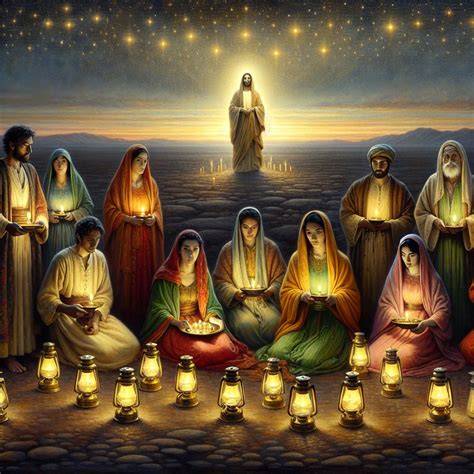
The hymn’s imagery comes from the Parable of the Ten Virgins, found in the Gospel of Matthew. In the story, ten young women take lamps and wait for a bridegroom who is coming to a wedding celebration. Five are wise and bring extra oil, while five are foolish and take no reserve supply.
The bridegroom is delayed, and all ten women become tired and sleep. At midnight, a cry announces that the bridegroom is coming. The women rise and prepare their lamps, but the foolish ones discover that their oil is running out.
They ask the wise women to share their oil, but the wise women refuse because there may not be enough for everyone. The foolish women leave to buy more oil, and while they are away, the bridegroom arrives. The women who are ready enter the wedding feast, and the door is shut before the others return.
The parable ends with the instruction: “Watch therefore, for ye know neither the day nor the hour wherein the Son of man cometh.” The hymn transforms that warning into a personal prayer: “Give me oil in my lamp, keep me burning.”
What the oil represents
In Christian interpretation, the oil commonly represents the Holy Spirit, faith, spiritual vitality, and readiness to meet Christ. The hymn’s prayer is therefore not merely about possessing a physical lamp; it is a request for the inner strength needed to remain faithful.
The image of oil is especially effective because a lamp cannot give light without fuel. A lamp filled with water will not burn, and a lamp without a flame does not illuminate the path. In the hymn’s spiritual symbolism, the Holy Spirit is the fuel that enables a believer’s light to continue shining.
The metaphor also emphasizes perseverance. The singer does not ask only for a temporary flame but asks to be kept burning “till the break of day.” The phrase suggests endurance through darkness, uncertainty, hardship, and delay until the arrival of a new day.
“Till the break of day”: readiness and perseverance
The phrase “till the break of day” connects the hymn directly with the delay in the parable. The wise women are prepared even though the bridegroom does not arrive immediately. Their readiness lasts through the night.
The line can also be understood as a prayer to remain faithful until Christ returns or until one’s earthly life is complete. It expresses the desire to keep the heart alive with love, truth, devotion, and purpose rather than allowing faith to fade when circumstances become difficult.
The hymn therefore combines two related ideas: watchfulness and persistence. Christians are called to be ready for an event whose timing they do not know, while continuing to live faithfully during the waiting period.
Meaning of the refrain: “Sing hosanna”
The refrain is an exuberant call to praise: “Sing hosanna to the King of kings.” It turns the personal prayer of the verses into a communal act of worship. The singer asks for spiritual strength and then responds by praising Jesus as King.
“Hosanna” originally expressed a plea meaning “Save us!” in Hebrew. In Christian worship, the word also became a joyful acclamation of praise and celebration. The term is associated with the crowds who welcomed Jesus at his entry into Jerusalem and cried out words from Psalm 118.
Because “hosanna” is often used as a general praise expression, its original sense of asking for salvation can be overlooked. In the context of this hymn, both meanings are appropriate: the refrain praises Christ, while the verses acknowledge the believer’s need for God’s sustaining presence and salvation.
The refrain also identifies the one whom the singer is waiting for. The bridegroom in the parable is understood by Christians as a figure pointing to Christ, and the “King of kings” in the chorus is Jesus, the Savior and Lord.
Line-by-line meaning of the hymn
“Give me oil in my lamp, keep me burning”
These lines express the desire to remain spiritually awake and faithful. The singer asks God to fuel the soul with divine presence so that faith, love, and devotion do not fade before Christ’s return.
The language is childlike, but the request is serious. It is a prayer for perseverance: “Lord, help me keep going.” The burning lamp represents a life that continues to shine with faith and good works.
“Give me oil in my lamp, I pray”
This line makes the hymn explicitly a prayer rather than merely a statement of religious confidence. The singer recognizes that spiritual strength is received rather than produced entirely through human effort.
The words also convey humility. The person singing does not claim to be permanently ready or spiritually self-sufficient but asks God for the grace to remain prepared.
“Keep me burning till the break of day”
This is a plea for endurance through the night. The “night” may suggest a period of waiting, trial, doubt, sorrow, or uncertainty, while the coming dawn represents hope, deliverance, Christ’s return, or final victory.
The image does not imply that the believer never becomes tired. In the parable, all ten women sleep while waiting. The crucial distinction is that the wise women have prepared for the delay. The hymn similarly emphasizes sustained readiness rather than momentary enthusiasm.
“Sing hosanna to the King of kings”
These words direct the congregation’s attention toward Jesus. The hymn is not simply about self-improvement or personal emotional strength; its spiritual energy is centered on worship of Christ.
The repeated refrain makes praise accessible to children and adults alike. Simple words become a shared confession of faith in Jesus as King and Savior.
“Give me joy in my heart, keep me praising”
The joy verse asks for an inner joy that expresses itself in praise. It presents joy not merely as a passing emotion but as a spiritual quality that can sustain worship through changing circumstances.
In this interpretation, praise is not limited to easy moments. The singer asks to keep praising “till the break of day,” including during the long and difficult seasons of life.
“Give me peace in my heart, keep me resting”
The peace verse is a prayer for calm confidence in God. It acknowledges that life may be uncertain while affirming that the heart can rest in divine care.
Where some versions use “keep me loving,” “keep me resting” emphasizes trust, stillness, and freedom from anxious striving. These are different adaptations of the same basic pattern rather than necessarily contradictory meanings.
“Give me love in my heart, keep me serving”
The love verse connects inner devotion with practical action. Love is not presented as a private feeling only; it becomes service, patience, humility, and care for other people.
The request to keep serving “till the break of day” gives the verse an enduring and sacrificial character. Christian love is portrayed as active and persistent, continuing until God brings the promised dawn.
“Give me faith in my heart, keep me praying”
This version emphasizes faith as the foundation of a life directed toward God. Prayer becomes the outward practice that keeps faith active and attentive.
The verse also reflects the idea that faith is a gift of grace sustained by the Holy Spirit. The believer asks not only to receive faith but to continue living in prayer throughout the period of waiting.
Spiritual themes in the hymn
Spiritual wakefulness
The parable calls listeners to be watchful because the bridegroom’s arrival is not announced in advance. The hymn applies this teaching through the repeated request to keep the lamp burning.
Dependence on God
The wording “Give me” and “I pray” presents spiritual life as dependent on God’s provision. The singer asks for the oil, joy, peace, love, and faith needed to live as a faithful Christian.
Faith expressed in action
The verses move from inward qualities to outward behavior. Joy leads to praise, love leads to sharing or serving, faith leads to prayer, and spiritual light leads to a life that can be seen by others.
The hymn is therefore not only a request to feel spiritually alive. It is also a request to live in a way that reflects Christ through worship, service, compassion, and perseverance.
Communal praise
The verses are personal prayers, but the refrain is communal. A congregation, camp group, or children’s class can sing it together, creating a movement from individual devotion to collective worship.
History and authorship
The exact author of “Give Me Oil in My Lamp” is unknown. Many hymn references list the song as traditional, while A. Sevison is widely credited in mid-twentieth-century sources for the familiar verses or for an important adaptation of the song.
Hymnary information identifies A. Sevison as the author but provides no biographical information. Other records list the author as anonymous or the source as traditional. This difference reflects the song’s development through oral transmission and successive printed adaptations.
The earliest appearance of at least one version of the lyrics that has been identified is in Arthur Huff Fauset’s short story “Safe in the Arms of Jesus,” published in Opportunity: A Journal of Negro Life in April 1929. In the story, a male chorus sings a form of the song that includes the words “Keep me singing in the camp” and “Until the break of day.”
Arthur Huff Fauset was an African American writer, anthropologist, and folklorist who conducted fieldwork among Black communities in the Deep South, the British West Indies, and Nova Scotia. The appearance of the song in his work suggests that it was already circulating orally before the 1929 publication.
The earliest songbook appearance identified is in Boundless Praise, published in Lawrenceville, Tennessee, in 1944, where the song was attributed to “Author unknown.” The song was later printed in Singspiration in 1951 with A. Sevison named as the author.
One explanation is that Sevison contributed or adapted some of the familiar material, including the verse “Make me a fisher of men, keep me seeking,” and possibly the “Sing hosanna” refrain. This would explain why some sources credit Sevison while others continue to describe the song as traditional.
Publication history
| Publication or recording | Significance |
|---|---|
| 1929 | A version appears in Arthur Huff Fauset’s short story “Safe in the Arms of Jesus.” |
| 1943 | The earliest known print appearance is identified in Dawning Light. |
| 1944 | Boundless Praise prints the song with the attribution “Author unknown.” |
| 1951 | Singspiration publishes the text and credits A. Sevison. |
| 1950s onward | The hymn spreads through church songbooks, children’s collections, Girl Scout and Girl Guide songbooks, and other networks. |
| 1963 | Singspiration publishes an arrangement by “the Csehys” and Norman Johnson. |
| 1964 | Eric “Monty” Morris records the song in Jamaica with Byron Lee and the Dragonaires. |
| 1969 | The Byrds record the song for Ballad of Easy Rider. |
| 1986 | The song appears on Wee Sing Bible Songs. |
| 1997 | It appears on Bible Songs by Cedarmont Kids. |
| 2002 | It appears in the VeggieTales Sing-Alongs collection Bob and Larry’s Sunday Morning Songs. |
Hymnal appearances
The hymn has appeared in a range of collections under several titles. Its subjects include children’s hymns, praise, Christian discipleship, outreach, joy, peace, service, and the Christian life.
- Songs #158c lists “Give Me Oil In My Lamp” and credits A. Sevison.
- The Book of Praise #655 includes the hymn with biblical references to Matthew 25:1-13 and several related passages.
- Worship in Song #156 lists “Give Me Oil in My Lamp” as a traditional children’s song associated with hosanna, joy, love, guidance, and truth.
- Sing With Me #190 connects the hymn with Matthew 25:1-13 and the theme of walking with God.
- Complete Mission Praise #167 includes it under the Christian life, praise and thanksgiving, and outreach.
- CPWI Hymnal #546 uses “Sing hosanna, sing hosanna” as the display title and identifies the tune as “SING HOSANNA.”
- Bible Truth Hymns #254 includes it as a children’s hymn and chorus of praise.
These entries show how the same song can serve different purposes. It can function as a children’s chorus, a hymn of praise, a lesson about discipleship, a song for evangelism, or a meditation on spiritual preparation.
Musical form and style
“Give Me Oil in My Lamp” follows a straightforward verse-and-refrain structure. Each verse repeats the same melodic and verbal pattern, while the refrain provides a memorable communal response.
The tune is lively and suitable for group singing. Repetition makes it easy to learn without extensive musical training, and the action words-burning, praising, singing, resting, loving, serving, seeking, and praying-give singers natural opportunities for participation.
In some communities, words such as “burning, burning, burning” are repeated three times. This produces a more energetic performance and helps children join in even when they do not know the entire verse.
The hymn’s traditional tune is often associated with the title “Sing Hosanna” or “Sing Hosanna to the King of Kings.” Some hymnals give the meter as 10.8.10.9 with a refrain, while the precise musical arrangement may vary between collections.
From church and camp song to international popular music
The song spread widely during the 1950s through traveling song leaders, publishers, church networks, and children’s organizations. It became especially familiar in Sunday schools, Bible camps, youth gatherings, and Girl Scout or Girl Guide settings.
Its international reach became particularly visible in Jamaica during the 1960s. In 1964, Jamaican ska singer Eric “Monty” Morris recorded the hymn with Byron Lee and the Dragonaires, and the recording became a major hit.
Other Caribbean and Jamaican artists also recorded versions. Jackie Edwards recorded it in 1964, while Desmond Dekker and The Specials recorded a later version in 1993. The song has also appeared on reggae gospel compilations.
Jamaican singer-songwriter and percussionist Dick “Syncona” Smith, who later became an important figure in Toronto’s music scene, released a notable variation in 1974. His version begins with an additional verse about weariness, loneliness, and needing someone to hear his song.
The popularity of the hymn among Caribbean artists has led to questions about whether it may have originated in the Caribbean and later been carried to the United States by migrants. The available history does not establish that origin, but the question reflects the difficulty of tracing a song that circulated orally across communities and countries.
The Byrds’ 1969 recording
The American band the Byrds included “Oil in My Lamp” on their 1969 album Ballad of Easy Rider. The song was also released as the B-side of the “Ballad of Easy Rider” single.
The Byrds’ version was arranged by guitarist Clarence White and drummer Gene Parsons and presented the gospel song in a country-rock setting. This arrangement introduced the hymn to listeners who might not have encountered it in church or at camp.
A later version by Neal Casal in 1999 used more minimal instrumentation and a slower tempo, giving the song a more contemplative character.
Oil In My Lamp (Album Version)
Alternative words in recorded and informal versions
Because the song is traditional and adaptable, recordings do not always use the same refrain. One version replaces “Sing hosanna” with “Sing, oh sinner,” while the traditional chorus remains “Sing hosanna.” Other performances use a shortened refrain or alter the final line.
The 1929 version found in Fauset’s story has a different wording from the later standard form. It repeats “Give me oil in my lamp” and asks, “Keep me singing in the camp,” followed by a verse about a cup overflowing with joy.
Some songbooks include verses such as “Give me truth as my guide, keep me seeking,” “Give me joy in my soul, keep me shining,” and “Give me love in my life, keep me sharing.” Others include playful lines such as “Give me umption in my gumption, let me function.”
These variations are consistent with the hymn’s folk and camp-meeting character. The text is not preserved in only one universally fixed form, and different communities have treated the song as a framework for prayer, praise, teaching, and improvisation.
Use in children’s ministry and worship
The hymn is especially effective for children because its vocabulary is concrete and its melody is easy to remember. The lamp, fire, oil, dawn, singing, and serving provide images that children can understand while introducing larger ideas about faith and Christian life.
Its repetition also supports participation. Children can learn the refrain quickly, join in repeated phrases, and act out the ideas of burning, singing, praising, serving, or praying.
- Sunday school: The song introduces the Parable of the Ten Virgins and the idea of spiritual readiness.
- Vacation Bible school: Its lively rhythm works well for group singing and movement.
- Family worship: The simple refrain encourages participation by different ages.
- Bible camps: The song’s communal and repetitive style suits campfire singing.
- Church services: Additional verses can connect the hymn with praise, peace, service, and discipleship.
- Contemporary arrangements: Guitar, percussion, or other instruments can support its gospel-style energy.
For adults, the hymn can function as a reminder that spiritual life requires continued dependence on God. Its simplicity does not remove its seriousness: the singer asks to remain spiritually awake, full of love, ready for Christ, and faithful in service.
How the hymn relates to Palm Sunday and Christian worship
The word “hosanna” connects the hymn with the account of Jesus’ entry into Jerusalem, celebrated by Christians on Palm Sunday. The crowds welcomed Jesus with words associated with Psalm 118, including the cry traditionally translated as “Hosanna.”
In that setting, “hosanna” is both a plea for salvation and an acclamation of the arriving King. The hymn’s refrain similarly combines urgent dependence on Christ with joyful praise.
The contrast between the excitement of public praise and the need for lasting readiness is important. The hymn does not ask only for an enthusiastic moment of worship; it asks for a lamp that continues burning through the night and until the break of day.
The hymn as a prayer for daily Christian life
Each verse translates the parable’s central warning into a daily spiritual practice. Oil becomes spiritual vitality, joy becomes praise, peace becomes trust, love becomes service, and faith becomes prayer.
The sequence suggests that readiness is not passive. To be prepared for Christ means to continue praising, loving, serving, seeking, resting, and praying. The lamp remains lit through a life shaped by these actions.
The hymn also presents Christian virtues as gifts for which believers may ask. Rather than claiming that people can maintain spiritual strength by willpower alone, it uses the language of dependence: “Give me,” “keep me,” and “I pray.”
Frequently asked questions
Who wrote “Give Me Oil in My Lamp”?
The exact author is unknown. The song is traditionally described as a Christian folk or gospel chorus, while A. Sevison is widely credited in many twentieth-century hymnals and songbooks.
When was the hymn written?
Its precise date of composition is unknown. A version of the lyrics appeared in print in 1929, the earliest known songbook appearance identified is from 1943 or 1944, and the hymn spread widely through publications from the 1950s onward.
What does the oil symbolize?
The oil symbolizes the Holy Spirit, faith, spiritual readiness, and the divine strength that keeps a believer’s light burning.
What Bible passage inspired the song?
The hymn is based on the Parable of the Ten Virgins in Matthew 25:1-13. The parable teaches people to remain watchful and ready because they do not know when the bridegroom will arrive.
Why is the hymn popular with children?
Its repetitive structure, lively melody, simple language, and memorable refrain make it easy for children to learn and sing together.
What does “hosanna” mean?
“Hosanna” originally expressed a plea meaning “Save us!” in Hebrew. In Christian worship, it is also a joyful word of praise and celebration directed toward Jesus.
Are there different versions of the lyrics?
Yes. Different hymnals and communities use verses about singing, praising, resting, loving, sharing, serving, seeking, and praying. Informal camp versions may also include humorous or topical verses.
Who recorded the song outside church settings?
Notable recordings include Eric “Monty” Morris with Byron Lee and the Dragonaires in Jamaica in 1964, the Byrds in 1969, and later recordings by other Jamaican and Caribbean artists.