In the Bible, “holy ground” means ground made sacred by the presence of God. The soil itself has no special quality; it becomes holy because God is present there and reveals Himself.
The phrase appears explicitly in Exodus 3:5, when God speaks to Moses from the burning bush: “Do not come any closer. Take off your sandals, for the place where you are standing is holy ground.” A similar command is given to Joshua near Jericho in Joshua 5:15: “Take off your sandals, for the place where you are standing is holy.” The event involving Moses is quoted again in the New Testament in Acts 7:33.
What Made the Ground Holy?
Nothing about the dirt itself had changed. Moses had been walking across that same wilderness ground moments earlier without any warning to stop. What made it holy wasn't a hidden property in the soil - it was God's presence, right there, in that specific spot.
The ground became set apart the instant God showed up in it, and would presumably have returned to ordinary ground once He moved on. Holiness, here, wasn't a quality some places had and others lacked. It was what happened to any place when God was actually present in it.
It was not that the actual ground on which Moses stood was holy; rather, it was the presence of the holy God that made it holy. The ground was holy because God was present. Clearly the ground was not holy because it contained some unique substance, mineral or gems.
The place where God appears or dwells ceases to be common ground; it becomes holy. Dust, rocks, vegetation, wood, metals, everything roundabout soaks in his sacredness.
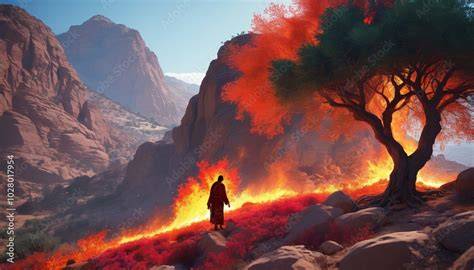
Moses and the Burning Bush
Moses noticed a bush burning without being consumed, and he turned aside to look closer. On a mountain, with a mountain of history behind him, Moses encounters God in the form of a fiery bush that doesn’t burn up.
There, where Moses had led his father-in-law’s flock, on the mount called Horeb, was a bush full of flames but void of ashes. To himself, Moses said, “I will turn aside to see this great sight, why the bush is not burned,” (Exodus 3:3).
Inching closer to see this strange sight, he hears a voice tell him that the place is holy. It is holy because God is there. The presence of God sanctifies a place so that it must be treated with respect.
“Moses, Moses!” the voice called out. The eighty-year-old man must have felt his heart skip a beat or two at this unexpected salutation. Unexpected, for the address came not from the lips of a man, woman, or child, but from the mouth of a bush.
There the angel of the LORD appeared to him in flames of fire from within a bush. Moses saw that though the bush was on fire it did not burn up. So Moses thought, “I will go over and see this strange sight-why the bush does not burn up.”
When the LORD saw that he had gone over to look, God called to him from within the bush, “Moses! Moses!” And Moses said, “Here I am.” “Do not come any closer,” God said. “Take off your sandals, for the place where you are standing is holy ground.”
God’s Presence in the Burning Bush
The passage first says that “the angel of the Lord appeared to him in a flame of fire out of the midst of a bush,” (Exodus 3:2). But then it says that “when the Lord saw that he turned aside to see, God called to him from the midst of the bush,” (Exodus 3:4).
The being in the bush goes on to say, “I am the God of your father…” (Exodus 3:6), at which disclosure “Moses hid his face, for he was afraid to look at God,” (Exodus 3:6).
So was it an angel, a creature of heaven? No. In Hebrew, “angel” simply means “messenger”. This messenger from God was God. Indeed, Christian tradition, from ancient times, has identified this messenger as the Son of the Father.
God was about to reveal His nature to Moses as the great I AM THAT I AM. And God was going to commission Moses to bring the Children of Israel out of captivity in Egypt.
Why Did Moses Remove His Sandals?
The instruction to remove his sandals wasn't primarily practical - it was a gesture of humility and respect, an acknowledgment that Moses had stepped into something set apart from the ordinary ground he'd been standing on a moment before.
His sandals carried the dust of everywhere else he'd walked; removing them was a way of leaving behind everything except that moment, in that presence. Removing sandals was the ancient near-Eastern equivalent of a gesture many Christians still practice today, just in a different form: kneeling.
Scripture describes kneeling this same way - a physical posture of humility and reverence before God (Psalm 95:6, Daniel 6:10) - the outward body matching an inward recognition of whose presence you're in.
Moses didn't kneel; he removed his sandals, because that was the gesture his culture understood as humbling yourself before someone greater. The specific act has changed across centuries and cultures. What it's meant to express hasn't: that some moments call for the body to physically acknowledge what the heart already recognizes.
As a gesture of humility and reverence, acknowledging that he had stepped into the presence of something set apart from the ordinary - not for a practical reason related to the ground itself. The act was in conformity with what was well known to Moses, for, having been brought up in Egypt, he would have known that the Egyptian priests observed the custom in their temples.
Today it is observed in all Eastern countries where the people take off their shoes or sandals before entering mosques and synagogues as a confession of personal defilement and conscious unworthiness to stand in the presence of unspotted holiness.
God had Moses remove his sandals-shoes being considered highly unclean. Later, Moses’ successor Joshua, would be given the same instruction in a similar circumstance (Joshua 5:13-15).
Sandals, Humility, and Reverence
Moses responds by not only removing his shoes, but also by hiding his face, a sign that he understood he was in the presence of the glory of the divine Majesty and was conscious of his own sinfulness and unworthiness.
In fact, Moses was so aware of God’s holiness that he was afraid to look at Him (Exodus 3:6). Standing in the presence of God is no light matter. Moses sees the representation of God, hears His voice, and is afraid.
Often in ancient cultures you would take off your sandals when you entered someone’s home, because they had all the dirt of your travels on them. It was a sign of respect. For Moses it symbolized being in God’s presence, and the fact there was nothing between him and this moment of God revealing Himself.
There's something fitting in the original gesture too - sandals carried the dust of everywhere else a person had walked, every place before this one. Removing them meant leaving all of that behind, standing bare and present in this moment alone, with nothing from the journey still clinging to you.
The specific gesture has changed across centuries; what it's meant to express hasn't - a physical response to being in a holy presence, undistracted by anywhere else you've been.
Joshua Also Stood on Holy Ground
This wasn't a one-time event tied only to Moses. Decades later, as Joshua prepared to lead Israel into the promised land, he encountered “the commander of the Lord's army” and received almost the exact same instruction: “Take off your sandals, for the place where you are standing is holy” (Joshua 5:15).
Same command, different leader, same underlying pattern - wherever God's presence showed up, the ordinary ground beneath it became something else entirely, whether that was a burning bush in the wilderness or the edge of a battlefield about to begin.
In Joshua 5:15 we also discover that Joshua was standing on holy ground because a holy angel was present - the captain of the Lord’s host. The holy angle was a theophany or an Old Testament appearance of Christ.
Now it came about when Joshua was by Jericho, that he lifted up his eyes and looked, and behold, a man was standing opposite him with his sword drawn in his hand, and Joshua went to him and said to him, “Are you for us or for our adversaries?” He said, “No; rather I indeed come now as captain of the host of the Lord.”
And Joshua fell on his face to the earth, and bowed down, and said to him, “What has my lord to say to his servant?” The captain of the Lord’s host said to Joshua, “Remove your sandals from your feet, for the place where you are standing is holy.” And Joshua did so.
In Joshua 6:2 the angel is revealed as the “Lord.” The following reveals that ground near the “captain of the Lord” was holy.
Was the Ground Different, or Was It the Encounter?
It’s tempting to think of “holy ground” as a special category of place - as if certain locations carry lasting sacredness the way a landmark carries a name. But both stories point somewhere else: it was never really about the ground. It was about who was there.
The moment of encounter is what mattered, not the coordinates. Once that encounter ended, nothing in the text suggests the physical dirt itself remained different from any other patch of wilderness.
The ground Saul was on was about as far away from being holy as possible. He stood on hatred for anyone following Jesus. But that’s right where God met him. That’s right where Christ spoke to him. And that’s right where Saul was humbled and found his holy ground.
Holy ground is anywhere God’s presence resides. The concept of holy ground extends beyond physical locations to encompass the idea that any place can become sacred when God is present.
What Does “Holy” Mean?
It does not mean what the average man-on-the-street thinks it means. Far too many wrongly equate holiness with morality, so that a “holy woman” is a morally upright lady-even a “holier than thou”, as we say.
Holiness is not something achieved but received. To be holy means to be especially claimed by God as his very own, brought into contact with himself.
Thus, the holy church is God’s special people, chosen by him. Holy Baptism is God’s special washing, ordained by him. A believer is holy because Christ has made him part of his own holy body.
Moses stood on “holy ground” because he stood in the presence of Christ, on soil made sacred by the manifestation of the holy, holy, holy God.
Holy Ground and Sacred Space in the Old Testament
The Bible, while giving very precise details about what priests were to wear during the liturgy, never mentions footwear. Jewish tradition tells us the likely reason: priests who served in the tabernacle and temple did so barefoot, year round, for like Moses and Joshua, they stood on holy ground.
In the Old Testament, the acme of sacred space was the Holy of Holies, God’s throne-room in the sanctuary (Leviticus 16:2). Rippling outward from there were spheres of holiness: the outer room of the temple, the holy courts, the holy city, the holy land.
| Sacred place | Why it was holy |
|---|---|
| Mount Horeb | God appeared to Moses in the burning bush. |
| The ground near Jericho | The commander of the Lord’s army appeared to Joshua. |
| The tabernacle | God would inhabit the Holy of Holies. |
| Solomon’s temple | God’s glory dwelled there. |
| Jerusalem | God would dwell there as the city of His kingdom. |
Mount Sinai
While scripture never states that Mount Sinai was holy because our holy God was present, we read in Exodus 19:21-25 that the Israelites were to consecrate themselves.
The people could not come up to Mount Sinai because the mountain was holy ground. This implies that the mountain was holy because God Himself was present. Scripture implies that the mountain and the surrounding area was holy ground.
The Tabernacle
In Exodus 26:33 God tells Moses that the tabernacle would have a “holy place” and a “holy of holies.” While we are not told the floor of the holy of holies is “holy ground” it becomes clear that the “holy of holies” in which God would “dwell” would be holy.
The two parts of the tabernacle were to be regarded as holy because God would inhabit the Holy of Holies on future occasions. This reveals that the surrounding area where God dwells is holy.
You shall hang up the veil under the clasps, and shall bring in the ark of the testimony there within the veil; and the veil shall serve for you as a partition between the holy place and the holy of holies. Exodus 26:33
Solomon’s Temple
Next we find that Solomon’s temple was also holy. David says in Psalm the temple of God was holy (Psalm 5:7). He wanted to enter the holy temple because the temple contained the presence of God.
But as for me, by Your abundant lovingkindness I will enter Your house, at Your holy temple I will bow in reverence for You. Psalm 5:7
Numerous Old Testament passages also refer to God’s temple as being holy (Psalm 138:2; Jonah 2:4; Micah 1:2; Habakkuk 2:20).
But the Lord is in His holy temple. Let all the earth be silent before Him. Habakkuk 2:20
These verses help us understand that the temple in Jerusalem was holy because God would be there in all His glory: “O Lord, I love the habitation of Your house and the place where Your glory dwells.” Psalm 26:8
Jerusalem
God tells us that the city of Jerusalem is holy and will be holy. Jerusalem is the city of our God. It will be the capital of His kingdom.
But as for Me, I have installed My King Upon Zion, My holy mountain. Psalm 2:6
Then you will know that I am the Lord your God, Dwelling in Zion, My holy mountain. So Jerusalem will be holy. Joel 3:17
Thus says the Lord, “I will return to Zion and will dwell in the midst of Jerusalem. Then Jerusalem will be called the City of Truth, and the mountain of the Lord of hosts will be called the Holy Mountain.” Zechariah 8:3
Jerusalem is holy because God will dwell there. In the prophecy of Revelation we are told that God will dwell in the eternal and New Jerusalem (Revelation 21:1-3). The reason the city is holy is because our God will dwell there.
People as a Dwelling Place of God
Amazingly the Lord said the people of Israel would be holy eventually; but since they were not holy, God urged them to pursue holiness. Why? Because He was holy.
Speak to all the congregation of the sons of Israel and say to them, “You shall be holy, for I the Lord your God am holy.” Leviticus 19:2
In Ephesians 2:19-21 God tells us that Christians are growing into a holy temple since the Holy Spirit dwells in every believer.
So then you are no longer strangers and aliens, but you are fellow citizens with the saints, and are of God’s household, having been built on the foundation of the apostles and prophets, Christ Jesus Himself being the corner stone, in whom the whole building, being fitted together, is growing into a holy temple in the Lord, in whom you also are being built together into a dwelling of God in the Spirit. Ephesians 2:19-21
One could say Christians are a “holy temple.” We are holy in the sense that God dwells within them by His holy Spirit.
But Christians are not practically holy since we still sin (Romans 7:15-24). Yet, Christians are positionally holy since God has declared believers to be legally righteous. That is, we have been justified (Romans 3:24). But we can say that Christians are becoming a holy temple. Some day we will be a holy temple but not in this life.
Scripture never says that Christians are holy ground, but some day we will be completely holy.
Holy Ground in Christian Worship
Today, where Christ is present to speak to his people, to deliver his gifts, that space is sacred. So in the Kyrie we pray for “this holy house and for all who offer here their worship and praise.”
In the “holy house” of his church, where the liturgy is celebrated, there we stand on holy ground. Our Holy of Holies is around the altar, where Jesus is present in his body and blood, much more intimately than he was present in the burning bush.
As Moses removed his sandals, so we too acknowledge by how we act and what we do, that we stand on sacred soil. We have our entertainment in the movie theater; we have our fun and games in a gym; but in the holy house of Christ, we have our liturgy.
Or, rather, in the liturgy, Christ has us, filling us with himself, that we might “share his holiness,” (Hebrews 12:10). The “holy house” of Christ is not a living room, stadium, or coffee house. It is a place of reverence.
All too often, though, we treat it as common ground, betraying by our speech, actions, and dress that the sanctuary is a space no different than any other. Christ does not play hide-and-seek with us. He reveals and is found.
He is found where he doles out his gifts, in the holy waters of baptism, from the holy pulpit, around the holy altar. In those zones of sanctity, where his liturgy is prayed, our heavenly Lord is literally down-to-earth.
With Moses, Joshua, and the priest of old, we take off our shoes, for we stand on holy ground. And Christ, ever the Servant, washes our feet, our hearts, our minds, our souls, with the cleansing liquid of his grace.
Holy Ground and Everyday Life
You’ve probably never had a burning bush moment - no voice from a fire, no command to remove your shoes. But that doesn't mean you haven't stood on holy ground without recognizing it.
The waiting room where you got news that changed everything. The quiet car ride where something finally broke open and you told the truth for the first time. The ordinary Tuesday that turned out to be the last one with someone you loved, though nothing marked it as different while it was happening.
None of these places looked sacred while you were standing in them. Neither did a patch of desert scrubland look sacred to Moses, right up until it was.
This is the real weight of what happened at that bush: holiness was never about grand architecture or a mountaintop retreat. It showed up in the middle of an ordinary workday, to a man tending sheep who wasn't looking for anything.
If presence is what makes ground holy, then the places in your life that felt most unremarkable while they were happening may turn out, in hindsight, to have been exactly where you needed to notice Him - and the ground you're standing on today, however ordinary it feels right now, might be closer to holy than you think.
God Can Meet People in Unexpected Places
When Joshua encountered the commander of the Lord’s army, he received an unexpected instruction: “Take off your sandals, for the place where you are standing is holy.” This command echoed God’s words to Moses at the burning bush decades earlier.
This teaches us a profound truth: holiness isn’t inherent in places or things; it comes from God’s presence. We often compartmentalize our world into “sacred” and “secular” spaces-church buildings are holy, workplaces are not; Sunday mornings are sacred, Monday mornings are ordinary.
But this division misses the point. Any place where God is present becomes holy ground. God doesn’t confine Himself to religious buildings or ceremonial moments. He can transform a battlefield into a sanctuary, a prison cell into a place of worship, a hospital room into holy ground.
His presence sanctifies our everyday experiences and ordinary locations. Today, wherever you find yourself, remember that you can encounter God there. Your kitchen, your office, your classroom, your car-any place can become holy ground when you recognize and reverence God’s presence.
The question isn’t whether God can meet you where you are; it’s whether you’re aware of His presence in that place.
Manasseh’s Unexpected Holy Ground
Holy ground didn’t always look very holy. I’m thinking of Manasseh, king of Judah. Manasseh was twelve years old when he became king, and he reigned in Jerusalem fifty-five years.
He did what was evil in the LORD’s sight, following the detestable practices of the pagan nations that the LORD had driven from the land ahead of the Israelites. Manasseh led the people of Judah and Jerusalem to do even more evil than the pagan nations that the LORD had destroyed when the people of Israel entered the land.
The LORD spoke to Manasseh and his people, but they ignored all his warnings. So the LORD sent the commanders of the Assyrian armies, and they took Manasseh prisoner. They put a ring through his nose, bound him in bronze chains, and led him away to Babylon.
But while in deep distress, Manasseh sought the LORD his God and sincerely humbled himself before the God of his ancestors. And when he prayed, the LORD listened to him and was moved by his request.
So the LORD brought Manasseh back to Jerusalem and to his kingdom. Then Manasseh finally realized that the LORD alone is God.
Manasseh also removed the foreign gods and the idol from the LORD’s Temple. He tore down all the altars he had built on the hill where the Temple stood and all the altars that were in Jerusalem, and he dumped them outside the city.
Then he restored the altar of the LORD and sacrificed peace offerings and thanksgiving offerings on it. He also encouraged the people of Judah to worship the LORD, the God of Israel.
Manasseh had gone after so many distractions and was lured by so many decoys, he was not only bringing harm to himself, which eventually landed him in a foreign prison, he also caused a large majority of the population of Israel to follow his wicked ways.
But in spite of all this, God still led Manasseh to holy ground. Manasseh’s holy ground was actually being a prisoner in Assyria. It’s where he met God, perhaps for the first time.
It’s where he symbolically took off his sandals and humbled himself before God. This was the crossroads for Manasseh where he turned away from idol worship and turned to God. As a result, God delivered him from captivity and restored him to his kingdom.
Whatever mistakes we’ve made in the past, big or small, or however we’ve been influenced by the distractions and decoys in life, however far down the wrong path we’ve gone, there is always an opportunity to find the holy ground of humility, to hear and obey God’s voice.
Saul’s Encounter on the Road to Damascus
Perhaps the most dramatic example of this is when Saul was on the road to Damascus with the intention of capturing Christians and putting a stop to their claims that Jesus was the Messiah.
Paul was so upset with these upstart Christians. He was “breathing out murderous threats against the Lord’s disciples.” But on his way to Damascus, Saul stumbled upon his holy ground.
A blinding light engulfed him and he heard Christ speaking to him, rebuking him, and telling him what to do. You can read the whole story in Acts, Chapter 9.
For three days he could not see. For three days he ate and drank nothing. For three days he humbled himself in prayer. For three days, he took off his sandals, so to speak.
For three days he remained on this holy ground of humility and seeking guidance from God. At that point Ananias came to him and healed his blindness.
After just a few days talking with the followers of Jesus in Damascus, he began preaching in the synagogues that Jesus was the Son of God.
If there is someone you know personally, or hear about in the news, who is “breathing out murderous threats against the Lord’s disciples,” it’s encouraging to remember how Christ appeared to Saul.
They may actually be very close to their own holy ground. They may be just moments away from Christ appearing to them, revealing a holy path to them.
Jesus in the Wilderness
Probably the best example in the Bible of not being enticed by the distractions and decoys the world throws at us is when Jesus was tempted in the wilderness.
Actually, these were not subtle and harmless distractions coming to Jesus. The devil was putting some pretty alluring decoys in Jesus’s path. Well, alluring perhaps if Jesus was just an ordinary human.
But the Son of God was not fooled at all by the glitter of the devil’s promises of power. Jesus was out in the wilderness, but he was truly on holy ground.
He stood squarely on the Scriptures, quoting a verse from Deuteronomy each time he was tempted. This gives you and me a powerful example of how to stand on holy ground.
Every time you feel distracted from your God-given purpose, every time you feel attracted to a way of thinking or acting that’s not from God, you are on holy ground.
Holy Ground as Humility and Obedience
There are lots of decoys in the world today that lure people away from their spiritual freedom as a child of God. Sometimes they’re activities we get addicted to like drugs, alcohol, pornography, or cheating on our taxes.
Other times, these decoys take on the form of addiction to ways of thinking that harm us, like greed, resentment, pride, self-depreciation, or worrying about anything and everything.
Basically, a decoy in life, lures you away from freedom into captivity, where you cannot fulfill your life purpose.
At the very moment when you’re distracted or deceived by decoys, God is right there talking to you, protecting you, and guiding you to a better path.
In fact, whenever you’re distracted or attracted to a decoy, it’s a sure sign that God is calling you to a higher purpose in life. The question is who will you listen to, who will you follow?
Whenever you are at a crossroads in life and turn away from the distractions and decoys toward God, whenever you listen to and obey His voice, you are standing on holy ground.
It’s not the dirt, the grass, or the gravel under your feet that’s holy. When you hear and obey God’s voice, you’re standing on the Rock of Christ, and that is holy ground indeed.
Every time you resist temptation, you are on holy ground. Every time you return love for hate, you are on holy ground. Every time you forgive, you are on holy ground.
Every time you obey God, you are on holy ground. Every time you follow Christ, you are on holy ground. Every time the Holy Spirit guides you, you are on holy ground.
What is this holy ground? It is the Rock of Christ. It is the firm foundation of knowing our inseparable relationship with God. And it’s humility, knowing we can’t solve a problem without God’s help.
Now it is God who makes both us and you stand firm in Christ. God puts us on this holy ground. 2 Corinthians 1:21
Holy Ground Today
Scripture doesn't identify a specific location as holy ground for believers today the way it did for Moses and Joshua. But since holiness comes from God's presence rather than a place's inherent qualities, many understand this to mean any place can become holy ground in the moment God is genuinely present there.
Your holy ground is not a geographical location. If you went to the exact spot Moses saw the burning bush, it would not be holy ground for you, unless you had the humility to hear God’s voice.
If you were in prison like Manasseh, or on the exact spot on the road to Damascus where Christ appeared to Saul, these places would not be holy ground to you, unless you came with the same spirit of humility they did.
The fact is you are always on holy ground. You are always a nanosecond away from hearing and obeying God’s voice, no matter how far you may feel from God at the time.
Right this moment, you are standing on holy ground. Take off your sandals, anything that would make you feel separated from God. Be quiet. Be still. Be humble. And listen.
Moses and the Burning Bush | Exodus 3 | Mount Horeb | Egypt | Pharaoh | Israelites out of Egypt
Common Questions About Holy Ground
What does it mean that ground is “holy”?
The ground itself has no special quality - it becomes holy because of God's presence there. Once His presence is no longer specifically manifest in that location, the ground isn't inherently different from any other place.
Why did Moses have to remove his sandals?
As a gesture of humility and reverence, acknowledging that he had stepped into the presence of something set apart from the ordinary - not for a practical reason related to the ground itself.
Is removing sandals the same as kneeling today?
Not identical, but they express the same posture of humility. Removing sandals was the ancient near-Eastern gesture of reverence before someone greater; many Christian traditions express that same humility today through kneeling (Psalm 95:6, Daniel 6:10).
The specific act has changed across centuries and cultures. What it's meant to express hasn't: that some moments call for the body to physically acknowledge what the heart already recognizes.
Does the Bible say holy ground exists anywhere today?
Scripture doesn't identify a specific location as holy ground for believers today the way it did for Moses and Joshua. But since holiness comes from God's presence rather than a place's inherent qualities, many understand this to mean any place can become holy ground in the moment God is genuinely present there.
Does the Bible say Christians are holy ground?
Scripture never says that Christians are holy ground, but some day we will be completely holy. We are holy in the sense that God dwells within us by His holy Spirit, and Christians are becoming a holy temple.