Jesus of Nazareth was crucified, buried, and, three days and three nights later, resurrected from the dead. The empty tomb and the appearances of Jesus to his disciples stand at the center of the Christian proclamation.
The resurrection is not presented as a metaphor or later legend, but as a decisive event in history. If Jesus Christ did not rise from death to life again, our faith is meaningless; if he did rise from the grave-just as he said he would-everything changes.
Why the Resurrection of Jesus Is Central to Christianity
The role of the resurrection of Jesus Christ is critical, and the truth of that resurrection gives power and hope to true Christians. Unlike many of the religious faiths and philosophies of the world, true Christianity is rooted in fact and history.
We proclaim that certain facts of our faith took place in real history, seen and heard by real people. Among these facts, the Bible bears witness to the centrality of one key event: Three days and three nights after He was killed by crucifixion, Jesus of Nazareth was resurrected from the dead.
Sadly, some “Christians” in the world actually deny the reality of Christ’s resurrection. They write it off as a later legend, myth, or metaphor, hoping to strip miracles and supernatural elements from their faith to make it more credible and less “embarrassing.” God’s word, however, says quite the opposite.
Consider the Apostle Paul’s clear statement in 1 Corinthians 15:14-19:
[If] Christ is not risen, then our preaching is empty and your faith is also empty. Yes, and we are found false witnesses of God, because we have testified of God that He raised up Christ, whom He did not raise up-if in fact the dead do not rise. For if the dead do not rise, then Christ is not risen. And if Christ is not risen, your faith is futile; you are still in your sins! Then also those who have fallen asleep in Christ have perished. If in this life only we have hope in Christ, we are of all men the most pitiable.
Indeed, Jesus staked the credibility of His Messiahship on the fact that He would rise from the grave, alive once more, after three days and three nights in the tomb (Matthew 12:39-40).
If Jesus Christ did not rise from death to life again, then there is no forgiveness of sins, there is no future resurrection of the dead, there is no coming Kingdom of God, and there is no Son of God living His life in us, helping us to overcome day by day, building His own character within us, and bringing us into increasingly intimate union with our Creator.
Yet if He did rise from the grave-just as He said He would-everything changes. He is the Son of God, His word is true, His kingdom is coming, and He does live within Christians through His Spirit, transforming them throughout their lives to fulfill God’s purpose for them.
The Resurrection as a Historical Claim
Are there reasons to believe such a claim? Does it make sense to believe that this man, Jesus of Nazareth, actually rose again to life three full days after He died? Yes, there are. And yes, it does.
In a world of growing skepticism, in which the historic claims of Christianity are completely discounted and we are ridiculed for believing in ancient “fairy tales,” it is increasingly vital to prove the truth of our beliefs for ourselves.
And this is certainly true for the one sign Jesus gave for His Messiahship (Matthew 12:38-40), without which Paul says our faith is meaningless: His resurrection from the dead.
Because the Bible says that the resurrection is a matter of history, not myth or legend, the claims of the story can be examined in the same way that the claims of any historical account are examined.
And, in the case of the resurrection of Jesus Christ, there are a number of elements that someone impartially examining the evidence must address. Whether or not someone believes in the claims of Christianity, these are claims about historical events, to be either refuted or accepted and explained.
Jesus Was Crucified and Buried
That Jesus lived, had a ministry in first-century Judea, and was killed by crucifixion are facts of history beyond any reasonable dispute.
The consensus of scholarship-including secular scholarship-accepts these facts. They are mentioned by numerous ancient scholars, such as first-century historians Flavius Josephus, Tacitus, Lucius, Pliny the Elder, and Celsus.
Even His miracles are mentioned by many ancient secular writers, though they often dismiss them as tricks or “sorceries”-much the same as Jesus’ Jewish detractors did in His day (Matthew 12:24).
The life and death by crucifixion of Jesus of Nazareth is one of the most thoroughly attested facts of ancient history. But so, too, is His empty tomb.
Fact One: The Tomb Was Found Empty
The Bible says that the tomb of Jesus was first found empty by female followers of Jesus and later by others, such as Peter and John.
If you have proven the Bible to be trustworthy in its every word, then you accept this account completely. But can a case be made for those unfamiliar with the Bible? Would it also be reasonable for a secular, non-Christian to believe that Jesus’ tomb was found empty? Can the Bible’s claim be supported? Yes, it can.
The account of the empty tomb has many hallmarks of historical authenticity, both within and outside of the Bible. For instance, the Bible states in all four historical accounts of Jesus’ ministry that the first people to discover the empty tomb were women (Matthew 28:1-8; Luke 24:1-3; Mark 16:1-8; John 20:1-2).
Why is this significant? It matters to historians because women were not trusted as credible witnesses in first-century Judea.
Historians consider the “embarrassment principle” when evaluating historical claims: If people are fabricating a story for their own benefit, they generally do not include elements that embarrass or hurt their cause.
In the case of the empty tomb, given the carnal customs and beliefs of the first-century culture in which Christianity began, it would have been embarrassing for the discovery of the empty tomb-a keystone of the Apostles’ claims to the legitimacy of their message (e.g., Acts 2:32; 10:39-41; 17:31)-if it were first made by women.
Yet the writers of the New Testament reported this fact clearly and plainly. If the resurrection of Jesus and the empty tomb were a fiction that ancient Christians were “making up” to prop up their religion, they would not have chosen women as the first witnesses.
The account of the tomb’s discovery passes the historian’s “embarrassment principle” test of authenticity.
The Empty Tomb in Luke’s Account
On the first day of the week, very early in the morning, the women took the spices they had prepared and went to the tomb.
They found the stone rolled away from the tomb, but when they entered, they did not find the body of the Lord Jesus.
While they were wondering about this, suddenly two men in clothes that gleamed like lightning stood beside them. In their fright the women bowed down with their faces to the ground, but the men said to them:
“Why do you look for the living among the dead? He is not here; he has risen! Remember how he told you, while he was still with you in Galilee: ‘The Son of Man must be delivered over to the hands of sinners, be crucified and on the third day be raised again.’”
Then they remembered his words.
When they came back from the tomb, they told all these things to the Eleven and to all the others. It was Mary Magdalene, Joanna, Mary the mother of James, and the others with them who told this to the apostles.
But they did not believe the women, because their words seemed to them like nonsense. Peter, however, got up and ran to the tomb. Bending over, he saw the strips of linen lying by themselves, and he went away, wondering to himself what had happened.

The Testimony of the Earliest Opponents
Also consider the evidence provided by the earliest attacks on Christianity. Had the tomb of Jesus not been empty, then all the enemies of the growing Church had to do was produce the body.
When the Apostles claimed that Jesus Christ had risen from the dead, the Jewish leaders seeking to silence the troublesome movement had merely to point to the tomb and demonstrate that the body of the man named Jesus was still present in the tomb and still very dead.
Yet there is no historical record of any such claim ever being made by the Jews or anyone else. Quite the opposite-history records that the enemies of the Church tried to explain why the tomb was empty.
Again, even the enemies of the Apostles acknowledged the empty tomb and the absence of a body.
We see evidence of this in the gospels, as well. Matthew 28 relates the tale of the Jewish leadership bribing the guards at Jesus’ tomb and instructing them to say, “Tell them, ‘His disciples came at night and stole Him away while we slept.’”
Matthew then closes by explaining to his readers that “this saying is commonly reported among the Jews until this day.”
This is evidence within the Bible itself that the Jewish enemies of the early Church were not arguing that the tomb was not empty-rather, they were trying to explain the empty tomb away.
Even many skeptical scholars recognize that the evidence for the fact of the empty tomb is powerful. Jesus died and was buried, but three days and three nights later, His tomb was empty.
Fact Two: The Disciples Claimed to See Jesus Alive
Some secular historical sources, such as Josephus, tell us that the disciples of Jesus reported that they had seen Him alive again after His death by crucifixion.
Concerning biblical evidence-even if we only treat it as a mere historical source, and not the fully inspired and inerrant word of God that we know it to be-the account is the same: Without doubt, many disciples of Jesus Christ claimed to see Him and interact with Him, alive again after His death.
Paul’s Early Testimony in 1 Corinthians
For just one example, let’s consider 1 Corinthians 15. Part of why Paul’s account in 1 Corinthians is a powerful one to use with skeptics is because of its broad acceptance as “authentic,” even by scholars who are opposed to Christianity.
While those in the Church of God believe that Paul wrote the letters attributed to him in the New Testament, worldly scholars often debate and argue endlessly about this fact. Yet when it comes to the book of 1 Corinthians, there is broad consensus-even among skeptical scholars-that not only did the Apostle Paul write it, but also that it was written only 20 years or so after the death of Jesus Christ.
So, even for academic and secular purposes, 1 Corinthians represents a powerful primary source concerning the beliefs of the first-century Church.
For this reason, 1 Corinthians 15:3-8 provides powerful evidence that a startling number of the first Christians did, indeed, claim to have seen Jesus Christ resurrected from the dead with their own eyes:
For I delivered to you first of all that which I also received: that Christ died for our sins according to the Scriptures, and that He was buried, and that He rose again the third day according to the Scriptures, and that He was seen by Cephas, then by the twelve.
After that He was seen by over five hundred brethren at once, of whom the greater part remain to the present, but some have fallen asleep. After that He was seen by James, then by all the apostles. Then last of all He was seen by me also, as by one born out of due time.
There is much to highlight here. Notice that this is not a statement about some sort of ghostly “vision.” Paul is claiming that a whole host of people saw the previously dead Jesus of Nazareth alive again, just as He had predicted He would be (John 2:19; Mark 8:31).
But he also provided details so that his readers could validate his claims for themselves. He named individuals who could serve as witnesses, such as Peter, whom Paul called by his Aramaic name, “Cephas,” and James, Jesus’ brother.
Listing James is significant, as the gospel of John records that earlier James did not believe in his brother’s Messiahship (John 7:3-5).
Perhaps even more impressively, Paul said that the resurrected Jesus Christ was seen by “over five hundred brethren at once.” And, further still, he explained that while some of those 500 had died in the last 20 years, most of them were still alive.
That is significant-it means that their testimony could be checked at will by his readers. Had Paul been making up his tale-lying about the claims of those who said they had seen Jesus alive again-his testimony could have been easily invalidated.
Only a fool would lie about several hundred people who were still alive and able to contradict his story. Rather than discredit him, these facts gave Paul’s message power and authenticity, allowing him to proclaim before kings such as Agrippa that these things were true and verifiable by everyone, “since this thing was not done in a corner” (Acts 26:26).
Paul’s comment here has the hallmarks of history, and, again, even skeptics who do not personally believe in the resurrection do believe that the first generation of disciples believed they had seen and interacted with the resurrected Jesus.
As skeptical scholar Gerd Lüdemann admits in his book What Really Happened to Jesus: A Historical Approach to the Resurrection, “It may be taken as historically certain that Peter and the disciples had experiences after Jesus’ death in which Jesus appeared to them as the risen Christ.”
Again-a fact of history.
Jesus’ Resurrection Appearances
Luke, writing some thirty years later, tells us that, after rising from the dead, Jesus appeared to his disciples over a period of forty days, “and proved in many ways that he was alive” (Acts 1:3).
Jesus rises from the dead, as he said he would, on the Sunday morning-the third day after his crucifixion and burial on the preceding Friday.
According to the account, the women who bring spices to anoint Jesus’s body on the morning after the Sabbath find the tomb empty. An angel tells them that Jesus has risen from the dead.
Jesus appears to Mary Magdalene outside the tomb near Golgotha early on the Sunday morning before sunrise. Mary runs back into the city to tell Peter and another disciple, probably John, both of whom then visit the empty tomb.
All they find are the strips of linen and the burial cloths that had been placed around Jesus’ face.
Mary Magdalene and the Women
Jesus appears to Mary Magdalene and Mary, the mother of Jesus and of James, on the road near the tomb.
The testimony of the women is important in the narrative because they are presented as the first witnesses of the empty tomb and as the first people instructed to announce what had happened.
The Road to Emmaus
That same day two of them were going to a village called Emmaus, about seven miles from Jerusalem. They were talking with each other about everything that had happened.
As they talked and discussed these things with each other, Jesus himself came up and walked along with them, but they were kept from recognizing him.
He asked them, “What are you discussing together as you walk along?” They stood still, their faces downcast.
One of them, named Cleopas, asked him, “Are you the only one visiting Jerusalem who does not know the things that have happened there in these days?”
“What things?” he asked.
“About Jesus of Nazareth,” they replied. “He was a prophet, powerful in word and deed before God and all the people. The chief priests and our rulers handed him over to be sentenced to death, and they crucified him; but we had hoped that he was the one who was going to redeem Israel. And what is more, it is the third day since all this took place.”
“In addition, some of our women amazed us. They went to the tomb early this morning but didn’t find his body. They came and told us that they had seen a vision of angels, who said he was alive. Then some of our companions went to the tomb and found it just as the women had said, but they did not see Jesus.”
He said to them, “How foolish you are, and how slow to believe all that the prophets have spoken! Did not the Messiah have to suffer these things and then enter his glory?”
And beginning with Moses and all the Prophets, he explained to them what was said in all the Scriptures concerning himself.
As they approached the village to which they were going, Jesus continued on as if he were going farther. But they urged him strongly, “Stay with us, for it is nearly evening; the day is almost over.” So he went in to stay with them.
When he was at the table with them, he took bread, gave thanks, broke it and began to give it to them. Then their eyes were opened and they recognized him, and he disappeared from their sight.
They asked each other, “Were not our hearts burning within us while he talked with us on the road and opened the Scriptures to us?”
They got up and returned at once to Jerusalem. There they found the Eleven and those with them, assembled together and saying, “It is true! The Lord has risen and has appeared to Simon.”
Then the two told what had happened on the way, and how Jesus was recognized by them when he broke the bread.
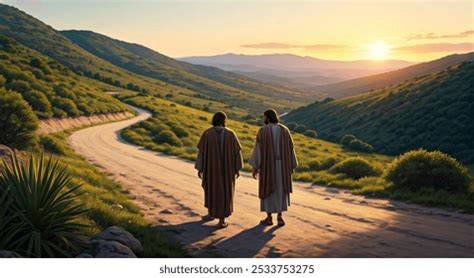
The Location of Emmaus
The precise location of Emmaus has been a matter of conjecture for centuries. Luke tells us that the risen Jesus appeared to two disciples who were going to a village called Emmaus, sixty stadia from Jerusalem.
Sixty Greek stadia was the equivalent of about 7 miles or 11 km.
Until the Arab-Israeli War of 1967, the Biblical name Emmaus was preserved in the Arab village of Imwas, near Latrun, alongside the main highway from Jerusalem to Tel Aviv.
According to the Jewish historian Josephus, the village became the centre of an anti-Roman insurrection after Herod’s death in 4BC.
The settlement expanded after the Christian scholar Sextus Julius Africanus successfully appealed to the Emperor Elagabalus in 221AD for permission to rebuild his home village as a Roman city with a new name, Emmaus Nicopolis.
From the 3rd century, the Biblical Emmaus was equated with Emmaus Nicopolis, and a large Byzantine church was erected during the 5th century.
The city was decimated by a plague in 639AD and never fully recovered. The site of Emmaus Nicopolis is now a country park.
Visitors to the Cistercian abbey and Crusader fortress at Latrun can also view the excavated remains of the Crusader church built inside the remnants of the larger 5th century Byzantine church at nearby Emmaus.
The main difficulty of identifying Emmaus Nicopolis with the Biblical Emmaus is that it is 160 stadia, about 20 miles or 32 km, from Jerusalem, not 60 stadia, about 7 miles or 11 km.
While some old manuscripts say “160 stadia,” it is likely that 60 stadia was the actual distance in the original manuscript.
Other contenders for the location of the Biblical Emmaus include the villages of Abu Ghosh and Qubeiba, both about 7 miles or 11 km to the west of Jerusalem.
Abu Ghosh, the site of the Old Testament settlement of Kiriath Jearim, was regarded as a holy site by early Christians. A Byzantine church was built here in the 5th century.
The village began to be regarded as the site of Emmaus by pilgrims during Crusader times, and a church was built here by the knights of the Hospital of St John in 1140.
Today, the remains of the earlier Byzantine church, including parts of its mosaic floor, are incorporated within the Church of Notre-Dame de l’Arche d’Alliance, built in 1901.
After the defeat of the Latin Kingdom of Jerusalem by Saladin at the Horns of Hattin in 1187, few Christian pilgrims passed through Abu Ghosh, and the identification of Emmaus moved to the village of Qubeiba by the 16th century.
This lay on a different pilgrim route to the north of Abu Ghosh. Although the house of Cleopas is said to lie within the Franciscan church built at Qubeiba in 1902, there is little evidence that this is the actual site of the Biblical Emmaus.
Another possible site is a 1st century village much closer to Jerusalem, called Emmaus. This settlement was only 30 stadia, about 3 miles or 5 km, from Jerusalem.
The village became swallowed up in a Roman “colonia,” a settlement for retired soldiers, after the Romano-Jewish War of 66-70AD. The Arab village on this site retained the name Qoloniya until it was abandoned in 1948.
Jesus Appears to the Disciples
While they were still talking about this, Jesus himself stood among them and said to them, “Peace be with you.”
They were startled and frightened, thinking they saw a ghost. He said to them, “Why are you troubled, and why do doubts rise in your minds?”
“Look at my hands and my feet. It is I myself! Touch me and see; a ghost does not have flesh and bones, as you see I have.”
When he had said this, he showed them his hands and feet. And while they still did not believe it because of joy and amazement, he asked them, “Do you have anything here to eat?”
They gave him a piece of broiled fish, and he took it and ate it in their presence.
He said to them, “This is what I told you while I was still with you: Everything must be fulfilled that is written about me in the Law of Moses, the Prophets and the Psalms.”
Then he opened their minds so they could understand the Scriptures.
He told them, “This is what is written: The Messiah will suffer and rise from the dead on the third day, and repentance for the forgiveness of sins will be preached in his name to all nations, beginning at Jerusalem.
You are witnesses of these things. I am going to send you what my Father has promised; but stay in the city until you have been clothed with power from on high.”
How the Resurrection Is Explained
If these two items-the empty tomb of Jesus and His disciples’ sightings of Him alive again after His death-are facts of history, then they cannot be avoided and must be explained.
What could that explanation be? Many secular, “miracle-free” explanations have been provided by unbelieving scholars to explain these facts.
The “Swoon” Theory
This is the idea that Jesus didn’t really die during His crucifixion, but, rather, faked His death-or, perhaps, was only thought to be dead and revived once He was placed in the tomb.
Then, the theory contends that He only claimed to be resurrected later.
This is, of course, ridiculous. The Romans knew how to execute and were brutally thorough. They made a living at dealing death.
The idea that Jesus could somehow “play dead” and fool centurions whose own lives depended on their success at killing the crucified is highly implausible.
Even worse, the suggestion that He somehow survived His torturous beating and agonizing crucifixion in some kind of “coma,” that He simply began to “feel better” in the tomb, that He somehow rolled away the massive stone blocking the tomb in His battered and weakened state, and that He then presented Himself to His disciples in such a way that they would believe He had been miraculously resurrected by God in power and glory should be considered a stretch too far for even the most desperate of unbelievers.
The Hallucination Theory
This, too, is a highly implausible explanation, suggesting that all of the individual experiences of a resurrected Jesus Christ were mere hallucinations.
This is absolutely irrational. Not only does it fail as a matter of common sense and experience-given the number of witnesses, the individual nature of them, the consistency of the belief, the nature of hallucinations, etc.-but it also fails to explain all of the historical evidence.
If the risen Jesus Christ were only an illusion born of hallucination, the tomb would not be empty, and the enemies of the Church could have easily exposed the hallucinations for what they were.
The Great Lie
Finally, is it possible that the Apostles and other disciples were simply lying?
Is it possible that the first-century accusations were true and that the disciples came one night and, with no one watching-ignoring the matter of the guards at the tomb-stole Jesus’ body, hid it somewhere, and then simply claimed to have seen Him alive and resurrected?
Not a chance.
Why Was Jesus Raised from the Dead?
To Fulfill the Scriptures
1 Corinthians 15 tells us that Jesus was raised from the dead in accordance with the Scriptures.
If we seek to understand Old Testament passages about resurrection, we find that the Bible gives us a very simple picture.
At the end of time, God will raise all the dead back to life. He will open their graves, pull them out, condemn some to everlasting destruction, and others to new life.
Those who receive resurrection bodies will inhabit a new heavens and new earth and their bodies will be perfect, glorious, Spirit-filled.
This is what many of the Jews in Jesus’ day expected.
So what happens with Jesus? This event that is supposed to take place at the end of time, actually takes place in the middle of time to one person.
That is the surprise! The new creation promised at the end of time actually begins simultaneously.
So we have Old Creation and New Creation continuing now.
To Provide Salvation
Are you saved because of Jesus’ death or because of his resurrection? Or both?
Would salvation exist if Jesus had died, and not been raised?
Paul makes it clear in 1 Corinthians 15 that there is no atonement without the resurrection. If Jesus has been raised, then we too have hope for a future resurrection.
If Jesus has not been raised, then there is no hope. We are still in our sins. Jesus is just a false messiah. Jesus’ disciples are false witnesses.
Our salvation was not provided only by Jesus’ cross. Jesus’ resurrection was absolutely necessary.
It wasn’t enough for Jesus to die. He had to defeat the final enemy, death itself.
To Guarantee the Resurrection of Believers
This is crucial. Paul’s explanation in 1 Corinthians 15:20-23 is that Jesus’ resurrection serves as the down payment, the firstfruits, the guarantee of our own future resurrection.
There can’t be one without the other. Because Jesus rose from the dead, we are assured that each of us that are in Him will also be raised from the dead.
To Defeat Death
Death is always an enemy. Watch someone die and you know that something is wrong with our world.
Death is never a friend. It is a curse on God’s good creation. It mars this world with pain and suffering.
Death is to be fought, not embraced.
Jesus defeated death. Death had no hold on him. And because we are in Christ, death will have no hold on us.
We are rescued from the clutches of this enemy and then promised eternal life.
The Resurrection and the Mission of the Disciples
After Jesus appeared to his disciples, he connected his resurrection with the fulfillment of Scripture and the proclamation of forgiveness.
He told them, “The Messiah will suffer and rise from the dead on the third day, and repentance for the forgiveness of sins will be preached in his name to all nations, beginning at Jerusalem.”
He also told them, “You are witnesses of these things.”
When he had led them out to the vicinity of Bethany, he lifted up his hands and blessed them.
While he was blessing them, he left them and was taken up into heaven.
Then they worshiped him and returned to Jerusalem with great joy. And they stayed continually at the temple, praising God.
The Empty Tomb | Luke 24 : 1-12.
| Resurrection event | Reported detail |
|---|---|
| The tomb | The stone was rolled away and the body was not found. |
| First witnesses | Mary Magdalene, Joanna, Mary the mother of James, and other women. |
| Peter’s investigation | He saw the strips of linen lying by themselves. |
| Emmaus appearance | Jesus walked with two disciples and was recognized when he broke bread. |
| Appearance to the disciples | Jesus showed his hands and feet and ate broiled fish in their presence. |
| Extended appearances | Jesus appeared to his disciples over a period of forty days. |
| Mission | Repentance and forgiveness of sins were to be preached to all nations. |