“How Can I Keep from Singing?” is a nineteenth-century American Christian hymn associated with Baptist minister and hymn writer Robert Wadsworth Lowry (1826-1899). Its central message is that Christian peace and praise can continue even in the presence of grief, darkness, conflict, and earthly suffering.
The hymn’s question, “How can I keep from singing?”, expresses praise as the natural outpouring of a grateful soul. The singer hears a “far-off hymn” announcing a new creation, clings to Christ as an unshakable rock, trusts in the living Savior, and receives the peace of Christ as a continually flowing fountain.
Lyrics of “How Can I Keep from Singing?”
The hymn is also known by its opening line, “My Life Flows on in Endless Song.” The following version preserves the explicitly Christian language associated with the hymn’s original form.
1 My life flows on in endless song, above earth’s lamentation. I catch the sweet, though far-off hymn that hails a new creation.
Refrain: No storm can shake my inmost calm while to that Rock I’m clinging. Since Love is lord of heav’n and earth, how can I keep from singing?
2 Through all the tumult and the strife, I hear that music ringing. It finds an echo in my soul. How can I keep from singing?
Refrain: No storm can shake my inmost calm while to that Rock I’m clinging. Since Love is lord of heav’n and earth, how can I keep from singing?
3 What though my joys and comforts die, I know my Savior liveth. What though the darkness gather round? Songs in the night he giveth.
Refrain: No storm can shake my inmost calm while to that Rock I’m clinging. Since Love is lord of heav’n and earth, how can I keep from singing?
4 The peace of Christ makes fresh my heart, a fountain ever springing! All things are mine since I am his! How can I keep from singing?
Refrain: No storm can shake my inmost calm while to that Rock I’m clinging. Since Love is lord of heav’n and earth, how can I keep from singing?
Alternative Wording and Later Versions
Different hymnals and arrangements preserve different versions of the text. In one form, the refrain reads, “Since Christ is Lord of heaven and earth,” while another version reads, “Since love is lord of heaven and earth.” “Christ” is the original word and gives the hymn its focus and meaning.
It is not some generalized airy love that is being referenced, but God in Christ who is “Lord of heaven and earth.”
Another version of the third stanza begins, “What tho’ my joys and comforts die? The Lord my Saviour liveth,” and continues, “No storm can shake my inmost calm / While to that refuge clinging.” A later stanza reads, “I lift mine eyes; the cloud grows thin; I see the blue above it,” and describes the peace of Christ as “a fountain ever springing.”
The folk version associated with Pete Seeger includes additional words by Doris Plenn:
When tyrants tremble, sick with fear,
And hear their death-knell ringing,
When friends rejoice both far and near,
How can I keep from singing?
In prison cell and dungeon vile,
Our thoughts to them go winging;
When friends by shame are undefiled,
How can I keep from singing?
This verse isn’t some generalized condemnation of tyranny vs. liberty but instead a specific reference to 1950’s McCarthyism and the “witch hunts” of the House Un-American Committee.
Who Wrote “How Can I Keep from Singing?”
The hymn is commonly identified with Robert Wadsworth Lowry, an American Baptist minister, composer, and hymn writer. According to Hymnary.org, Robert Lowry was born in Philadelphia, March 12, 1826.
His fondness for music was exhibited in his earliest years. As a child, he amused himself with the various musical instruments that came into his hands. At the age of seventeen, he joined the First Baptist Church of Philadelphia and soon became an active worker in the Sunday school as a teacher and chorister.
At the age of twenty-two, he gave himself to the work of the ministry and entered upon a course of study at the University of Lewisburg, Pa. At the age of twenty-eight, he was graduated with the highest honors of his class.
In the same year of his graduation, he entered the work of the ministry. While pastor at Lewisburg, he was also a professor of belles lettres in the University and received the honorary degree of D. D. in 1875.
Lowry was a prolific hymn writer whose other well-known hymns include “Shall We Gather at the River?”, “One More Day’s Work for Jesus,” “I Need Thee Every Hour,” “The Mistakes of My Life,” “All the Way My Saviour Leads Me,” and “We’re Marching to Zion.” “Shall We Gather at the River?” is perhaps the most widely popular of all his songs.
The Doctor frequently said that he regarded “Weeping Will Not Save Me” as the best and most evangelistic hymn he ever wrote.
When Was the Hymn Written and Published?
The date of composition is often given as 1860, but the earliest documented printing identified in the hymn’s history appeared later. This hymn was first printed in the 27 August 1868 issue of the New York Observer, given in three stanzas of eight lines, headed “For the New York Observer,” titled “Always Rejoicing,” and credited to Pauline T.
Every stanza ends with the question, “How can I keep from singing?” The original title, “Always rejoicing,” is possibly an allusion to 2 Corinthians 6:10.
This hymn was reprinted in other papers, using the same title, including The Bangor [Maine] Daily Whig and Courier (23 September 1868), uncredited, The Brooklyn Daily Times (6 October 1868), uncredited, The Christian Pioneer (March 1869), uncredited, and Cottage Visitor [Hendersonville, NC] (29 October 1869), credited to the Observer.
The attribution of this text to Pauline T. seems to have never been reprinted in any other periodical or early source, but a sonnet by her titled “Full Assurance” was given in the New York Observer on 15 October 1868. Nothing more of Pauline T. is known.
Why Robert Lowry Is Associated with the Hymn
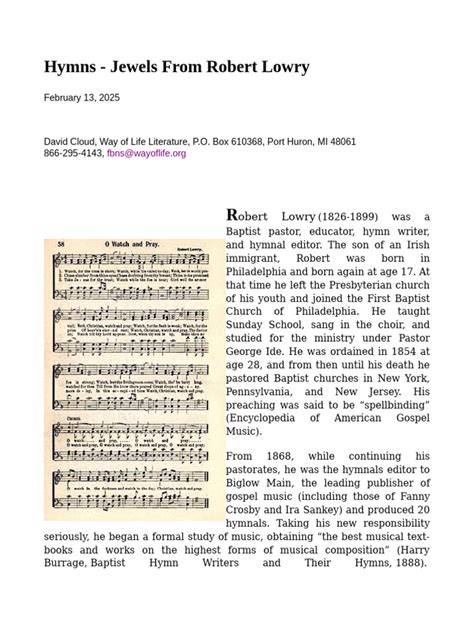
In 1869, the hymn was included in Bright Jewels for the Sunday School, edited by Robert Lowry, pastor of Hanson Place Baptist Church in Brooklyn, NY. The way his initials were placed in the upper-right corner, this could either indicate his claim on the tune only, or on the text and tune together.
A similar presentation of text and tune was given in Chautauqua Carols (1878), no. 91, with only Lowry’s name. The picture becomes more clear in another collection Lowry edited, the Gospel Hymn and Tune Book, published in 1879.
In that collection, the Index of First Lines included the names of all the text authors; on the line for “My life flows on in endless song,” the authorship was left blank. The music was credited to Lowry.
Therefore, Lowry (or William Doane, his co-editor) either didn’t know the name of the author, or he was protecting someone’s anonymity. The former seems more likely.
The Pauline T. and F. J. Hartley Attributions
When the song was published in Winnowed Hymns in 1873, edited by C.C. McCabe and D.T. Macfarlane, it was credited to F.J. Hartley.
This attribution was reprinted in other collections, including Royal Songs (1875, with a tune by S.J. Vail), Calvary Songs (1875), Beulah Songs (1879), Songs of Joy and Gladness (1885), Hymns of Consecration and Faith (1902), and Gospel Carols (1905).
But who is F.J. Hartley? An announcement in The Buffalo Commercial, 31 May 1873, page 2, reads:
Sunday School Anniversary week this year has been one of special interest, from the presence of a deputation from the London S.S. Union, Mr. F.J. Hartley, one of the Secretaries, who has been received with open arms by the Sunday-School men of New York.
Having heard, he says, that America is the land, par excellence, of Sunday Schools, where the art of popular religious education, as well as secular, is in advance of all the world, he has come over, at the urgent and long-urged desire of his friends and the friends of Sunday Schools in England, to investigate the claim with his own senses and to see what can be learned of us and carried back for the benefit of the cause in the mother country.
If this is the same Hartley, his case for authorship is highly unlikely. His arrival in the U.S. postdates the earliest printing of the text, so this attribution would presume he sent the text to the New York Observer or to Pauline T. or to Robert Lowry to be published in the U.S. rather than a British publication, and his name was willfully obscured.
F.J. Hartley is not known to have written other hymns. Carl Daw argued, “it seems more likely that he was somehow involved in making the text available to the respective editors than that he was the actual author.”
Anna Bartlett Warner and the Authorship Question
Some modern discussions identify the original author as Anna Bartlett Warner, an American woman who lived from 1820-1915. Her lyrics are often misattributed and/or thought to be anonymous, perhaps because Lowry listed them as such in his published hymnal.
Warner is most famous today for the words to “Jesus Loves Me.” A perfectly good song, but not terribly representative of her work.
Warner’s original lyrics are much more distinctly Christian than the version associated with later folk arrangements. One version preserves the following wording:
What tho’ my joys and comforts die?
The Lord my Saviour liveth;
What tho’ the darkness gather round?
Songs in the night he giveth.
No storm can shake my inmost calm
While to that refuge clinging;
Since Christ is Lord of heaven and earth,
How can I keep from singing?
The differing attributions show why the authorship of the text remains complicated. Early publications connected the hymn with Pauline T., F.J. Hartley, and Robert Lowry, while later accounts have identified Anna Bartlett Warner as the original author.
The Quaker Tradition and Pete Seeger
The common identification of the song as a Quaker hymn was popularized by folk singer Pete Seeger (1919-2014), who “learned it in 1956 from a lady who had it from a Quaker grandmother in North Carolina.”
The woman from whom he learned the song was Doris Plenn, and she is credited with writing a new stanza, “When tyrants tremble, sick with fear,” etc.
Seeger published the text and Lowry’s tune, uncredited, in the folk-song journal Sing Out, vol. 7, no. 1, in Spring 1957, and he recorded the song on his album In Concert: I Can See a New Day in 1964.
One reason why the Quaker attribution has been accepted by many people is likely because Lowry’s tune is pentatonic, meaning it has a simple, timeless quality.
Plenn had apparently told Seeger that the song was “a traditional Quaker/Shaker hymn,” I guess not knowing about Anna Barlett Warner’s true authorship. So that’s how Seeger published the song, and he also included Plenn’s verse, presenting the whole thing as being in the public domain.
How Can I Keep From Singing - PETE SEEGER
The Connection with McCarthyism
Seeger’s version became especially important during the folk-music revival of the 1960s. The additional stanza by Doris Plenn gave the hymn a political dimension connected with fear, imprisonment, shame, courage, and resistance.
This verse isn’t some generalized condemnation of tyranny vs. liberty but instead a specific reference to 1950’s McCarthyism and the “witch hunts” of the House Un-American Committee.
The song’s continuing popularity demonstrates how a hymn can acquire new meanings in different historical settings without losing its central image of singing in the face of adversity.
Enya’s 1991 Recording
Some messages are universal and lasting, but they tend to don new robes as decades and even centuries pass and new generations discover anew their timeless truths.
Consider “How Can I Keep from Singing?” - a song that, penned first as a hymn in 1860, was revived as a folk song with populist overtones in the 1950s before again being reinvented for a 1991 album with a decidedly Celtic twist.
Popular singer Enya beautifully reimagined the 19th-century lyrics in the album Shepherd Moons. Her signature synth sound evokes a deep searching for peace in troubled times that, when coupled with the Irish singer’s soothing brogue, immediately places the listener inside an otherworldly sense of calm.
Enya’s performance almost landed in copyright violation hot water. Somehow, though, when Enya released her mega-popular version, Seeger’s publisher decided that maybe it wasn’t public domain, after all.
In the end it was decided that Plenn had never wanted her verse to be copyrighted but simply preserved and publicized, and Enya was let off the hook.
How Can I Keep From Singing - PETE SEEGER
Musical History and Arrangements
Variations of this song sometimes include rhythmic changes, such as being arranged in duple meter, sometimes with syncopations. The song is sometimes restructured to have a refrain; this seems to date as early as the Wesleyan Methodist Sacred Hymns and Tunes (1902).
A tune written by Ira Sankey was included in Gospel Hymns No. 4 (1881). The text has also been paired with MATERNA.
Rhythmic, especially syncopated, versions of the tune detract from the steady, flowing shape of the original melody.
The hymn has also been frequently arranged for choirs. The tune is truly lovely, written by a Baptist minister, Robert Lowry, in the mid-1800’s.
What Does “How Can I Keep from Singing?” Mean?
The hymn’s main question is not merely about making music. It asks how a person who has encountered divine love, hope, and peace could remain silent.
The main question of the song, “How can I keep from singing?,” evokes Jesus’ admonition to the Pharisees, “I tell you that if these [disciples] should keep silent, the stones would immediately cry out” (Lk. 19:40), or perhaps the words of the psalmist, “I will bless the Lord at all times; his praise shall continually be in my mouth” (Ps. 34:1).
That is to say, praise is a natural outpouring of a grateful soul. Singing becomes the response to grace, not an escape from reality.
Peace in the Midst of Trouble
The hymn does not claim that believers avoid suffering. It acknowledges earth’s lamentation, tumult, strife, darkness, dying comforts, and storms.
While the song testifies that we are in God’s hands, it does not ignore the fact that on earth we still lament; we face tumult and strife. Yet in the midst of the laments, the underpinning of our lives is a different tune-a peaceful, hope-filled song of faith.
From its outset, the song introduces the idea that maintaining a sense of peace within chaos is possible, and each of us has access to an eternal stillness that exists beyond time and space.
Leaning on the certainty or promise of a divine love, even and especially when life appears bleak, is a common subject for hymns and gospel music. But this song goes further by recognizing how, within a single moment, both divine love and earthly trial may be coexistent.
We need not rid ourselves of the tumult and the strife to hear the music ringing; we must simply train ourselves to listen to that which calls out to us and from within us.
Biblical Themes in the Hymn
The New Creation
The first stanza also resembles the hopefulness of Lamentations 3:22-24; in spite of great trials, our hope is renewed.
The anticipation of a new creation could either be in reference to a spiritual renewal, as in 2 Corinthians 5:17, or to the new heaven and new earth promised in Isaiah 65:17 and Revelation 21:1.
The Living Savior
The second stanza grounds the hymn in the Christian faith. The first four lines are structured in a question-and-answer format, in which the question poses a challenge, and the answer offers hope.
Hope comes from a living Savior who gives songs in the night. The phrase recalls Job 35:10 and Psalm 77:6, where song appears in the darkness of suffering and remembrance.
God as Rock and Refuge
The line “No storm can shake my inmost calm” presents faith as an inner stability founded on God. The image of clinging to the Rock recalls biblical passages such as Isaiah 41, Job 5:21-24, and Psalm 46.
The wording also resembles the biblical portrayal of God as a refuge in danger. The storm remains real, but it cannot ultimately destroy the peace of the person who clings to God.
Christ as Lord of Heaven and Earth
In the Bible, God is frequently affirmed as Lord or king of heaven and earth, including in Genesis 14:22, Joshua 2:11, Isaiah 37:16, Isaiah 66:1, Acts 7:49, and Acts 17:24.
The refrain therefore presents Christ not simply as a source of private comfort but as Lord over the whole created order.
Songs in the Night
The stanza about darkness and songs in the night presents faith as a form of hope that remains possible even when circumstances do not immediately change.
Stanza 3 echoes Psalm 121, “I will lift up my eyes to the hills,” and the third line carries the sense of Proverbs 3:5-6.
The Peace of Christ
The peace of Christ is mentioned in Ephesians 2:14, Philippians 4:7, and elsewhere. In the hymn, this peace is not static or fragile; it is described as “a fountain ever springing.”
The image suggests continuing renewal. The peace of Christ makes the heart fresh even as earthly conditions remain uncertain.
A Hymn That Holds Joy and Lament Together
Reformed editor Joyce Borger said of the song:
While the song testifies that we are in God’s hands, it does not ignore the fact that on earth we still lament; we face tumult and strife. Yet in the midst of the laments, the underpinning of our lives is a different tune-a peaceful, hope-filled song of faith.
Paul Westermeyer described the perspective of the hymn and why the word “Christ” is necessary:
Though cast in the first-person singular, it has the character of anonymity as, in the medieval sense of the music of the spheres, the individual joins the song that transcends earth’s lamentations.
The hymn’s first-person voice is therefore both personal and communal. One person sings, but the song joins a larger music that reaches beyond individual sorrow.
It is so easy to become frustrated and discouraged with our lives day-to-day. Some of us have terrible crosses to bear; most of us, on an average day, have mere annoyances-bad weather, bills to pay, onerous chores, petty disappointments, and not having enough time to do the things we like to do.
Great or small, our troubles bear so much less upon us when we remember how much harder others’ are than our own, and how abundantly we have been blessed.
One needs to think of but one thing to be thankful for, and then a second, and a third, and . . . before you know it, your sky is lightening and so are your burdens.
There’s no better armor against despair than humility, faith, and remembrance of the infinite Love that bought our souls with pains far greater than we could ever comprehend.
Why the Hymn Continues to Resonate
Although tuning our minds and hearts to our own “inmost calm” can be difficult when seas outside are raging, the chord of universal presence is always struck and waiting for us to align ourselves with it.
Once we resonate with this timeless truth-the unending love and acceptance at the center of all things, even us-we need never be lost.
It is a comfort to remember that the expansive song of life is present beneath the surface of all things, and it is even more comforting to think that at any time, with some adjustments in our mood and frame of mind, we are capable of echoing that song back.
One reason the hymn remains powerful is that it does not require the singer to deny grief before expressing praise. Its faith is practiced in the middle of lamentation, while storms are still present and darkness still gathers.
“How Can I Keep from Singing” is the song of my heart. In the midst of the laments, the underpinning of our lives is a different tune-a peaceful, hope-filled song of faith.