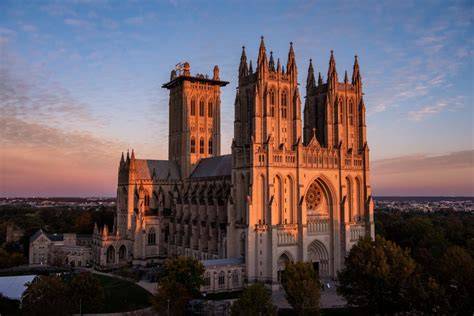
The Darth Vader sculpture is located high on the north side of the Washington National Cathedral’s northwest tower in Washington, D.C. From the ground, stand on the Cathedral’s north lawn or near the northwest parking lot, look toward the northwest tower, and use binoculars or a camera with a powerful zoom.
The sculpture is positioned beneath the middle pinnacle of a gable, between two massive arches and near a raccoon grotesque. From the northwest parking lot, Darth Vader can be spotted between two massive arches. The bust will be to the upper left of a closer, larger skull-shaped grotesque.
Where to Stand and Where to Look
Exit the cathedral through the northwest doors or approach the building from the northwest parking lot. The Vader statue is high up on the northwest tower.
Visitors typically stand on the lawn north of the Cathedral, near Wisconsin Avenue NW, to get the best view. From this angle you can see the entire gable section. The grotesque is located on the north side of the Cathedral’s northwest tower, just beneath the middle pinnacle of a gable and slightly to the left of the tower from the front.
The stone head projects outward, balanced between the raccoon grotesque and other pinnacles. The Darth Vader grotesque lives on the northwest side of the Cathedral, only visible with binoculars.
Simple directions
- Exit through the Cathedral’s northwest doors or walk toward the northwest parking lot.
- Move to the north lawn, near Wisconsin Avenue NW.
- Face the northwest tower.
- Locate the gable beneath the middle pinnacle.
- Look for the raccoon grotesque and then search for Darth Vader nearby.
- Use binoculars, a telephoto lens or a camera with zoom to distinguish the helmet and facial details.
Look for the raccoon. The raccoon grotesque sits opposite Vader on the same gable; spotting the raccoon can help you locate Vader.
What the Sculpture Looks Like
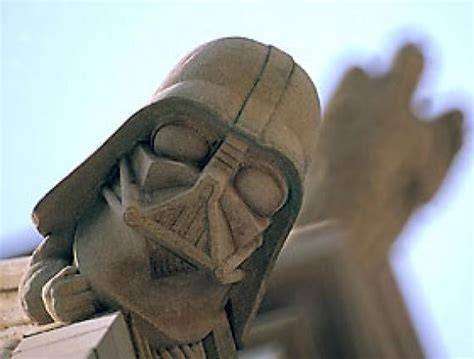
The design preserved the menacing silhouette recognizable from the Star Wars films while simplifying certain details so the sculpture would withstand centuries of weathering. Carpenter molded a clay version of the iconic helmet, capturing the flared dome, triangular mouthpiece and brooding brow.
Without binoculars or a telephoto lens, it appears as a small bump. From ground level the figure is almost invisible without optical aid; visitors often seek it out as a hidden gem.
Keep in mind that the grotesque does not face downward like a gargoyle; it peers horizontally out from the building, so a side view is best. Unsuspecting onlookers should take heed-this is no optical illusion.
Viewing Tips
- Bring binoculars or a camera with zoom. The sculpture is small and set high above the ground.
- Stand on the north lawn. The grotesque is on the north side of the northwest tower, so position yourself accordingly.
- Look for the raccoon. The nearby raccoon grotesque provides a useful visual reference.
- Ask docents for help. The Cathedral’s volunteers are accustomed to Darth Vader seekers and can point you in the right direction.
- Check tour schedules. Some tours allow access to the tower’s interior walkway, giving a closer view of carvings.
Some guests prefer to climb to the Cathedral’s observation deck-available during certain tours-which provides a closer perspective of the tower’s carvings. Guided tower climbs to see Darth Vader aren’t taking place right now, but you can still get a good look from the ground.
A pair of binoculars is therefore essential for spotting the Sith Lord. To see the sculpture, binoculars or a high-powered zoom lens are recommended to see the intricacies of the high roof.
Why Darth Vader Is Called a Grotesque, Not a Gargoyle
Visitors sometimes refer to the Darth Vader carving as a gargoyle. In fact, the sculpture is a grotesque because it lacks a water spout.
Gargoyles serve a functional purpose: they divert rainwater away from the building by channeling it through their mouths. Grotesques, by contrast, are purely decorative, deflecting rain by allowing it to run over their heads.
| Feature | Gargoyle | Grotesque |
|---|---|---|
| Function | Acts as a water spout, channeling rain through its mouth | Decorative; rain flows over the head |
| Form | Often depicts monsters, animals or mythical creatures | Similar subjects but no spout; includes modern designs like Darth Vader |
| Origin | Medieval cathedrals to protect masonry and symbolize warding off evil | Decorative carvings with symbolic meanings; sometimes playful |
| Example at National Cathedral | Traditional gargoyles on upper levels | Darth Vader, raccoon, girl with braces and umbrella man |
Both forms serve to protect masonry from water damage, but only gargoyles qualify as downspouts. Because Darth Vader lacks a mouth spout, he deflects rainwater from his helmet rather than channeling it.
“Any purpose of a grotesque or a carving is to help bounce rainwater off of the building, so yes he does have that function,” Eckstrom said. “He’s not a gargoyle though. A gargoyle has a water pipe in his mouth, he does not.”
How Darth Vader Came to the Cathedral
During the 1980s an outer portion of the National Cathedral was under construction, and a contest was held for schoolchildren to design a sculpture to be added to the towers being renovated. A 13-year-old drew up Darth Vader. His artwork turned into stone.
By the early 1980s the northwest tower was still unfinished, and Cathedral leadership sought to engage younger generations in its completion. National Geographic World magazine partnered with the Cathedral to host a “Draw-A-Grotesque” competition.
The April 1984 issue invited schoolchildren worldwide to submit drawings for new grotesques. Over 1,400 children from sixteen countries responded, sending in imaginative designs ranging from fanciful animals to pop-culture icons.
The contest sparked international interest and gave children a stake in one of America’s most important churches. The winners were announced in the February 1986 issue.
The contest results
Judges selected a winning design and three runners-up. Alison Garner, age 12, took first place with her drawing of a toothy man holding an umbrella-she reasoned that he needed to shield himself from rainwater since grotesques do not spout water.
The runners-up included a raccoon, a girl with pigtails and braces, and 13-year-old Christopher Rader’s drawing of Darth Vader. Contrary to what you may believe, it wasn’t the grand prize winner, but one of three runners-up.
Although Darth Vader placed third, Cathedral officials decided to sculpt all four top designs and install them high on the tower. Fortunately for Star Wars fans, contest organizers decided to carve the top four submissions and add them to the building’s façade.
The Artists Behind the Helmet
Chris Rader
As a 13-year-old from Nebraska, Chris Rader read that grotesques often depict demons or monsters and decided that Darth Vader fit the bill. He submitted a detailed drawing to National Geographic World, complete with annotations on proportions and features.
Rader’s design was far more technical than the rest of the submissions, with labels that gave clarifying information to Carpenter and Plunkett. Explaining his choice of design, Rader said, “I read that grotesques are often demons or monsters. Darth Vader is a lot like a demon. He’s evil, so I thought he would be a good choice.”
Although his design placed third, the Cathedral decided to sculpt it along with the other top submissions. In interviews he expressed surprise that his drawing would become a permanent part of such an iconic building.
Jay Hall Carpenter
Sculptor Jay Hall Carpenter, then the Cathedral’s first artist-in-residence, received the children’s sketches and movie stills for reference. Carpenter used Chris Rader’s drawing and still frames from the Star Wars movies to sculpt the Vader helmet out of clay.
Born in 1957, Jay Hall Carpenter grew up in the Washington area and studied sculpture at the Pratt Institute. He joined the Washington National Cathedral’s carving studio at age 19 and eventually became its first artist-in-residence.
Carpenter sculpted more than 400 gargoyles, grotesques, angels and decorative elements for the Cathedral’s west towers over a 20-year period. Carpenter retained the character’s distinctive lines while simplifying details to make the design carvable in limestone.
Patrick J. Plunkett
Once the clay model was approved, master stone carver Patrick J. Plunkett transformed the design into stone. Plunkett, a native of Ireland, brought European stone-carving techniques to the Cathedral’s studio.
Working with Indiana limestone, he chiseled the helmet’s contours, eye sockets and breathing vents, ensuring the piece would weather gracefully. Plunkett’s craftsmanship appears throughout the Cathedral, where he carved angels, animals and saints.
The Darth Vader grotesque remains one of his most recognized contributions. In 1986 the four grotesques were set into place on the northwest tower, with Darth Vader occupying a gable near the middle pinnacle.
The Other Designs on the Tower
The 1984 competition produced four winning designs that still adorn the tower. Each design reflects the creativity of its young artist and adds personality to the Cathedral.
- Sagacious Grotesque: Alison Garner’s umbrella-toting man stands beneath the Vader figure. His comical grin and practical accessory reminded judges that even grotesques can be whimsical.
- Darth Vader Grotesque: Chris Rader’s third-place drawing of the Sith Lord captured the angular lines and demonic imagery associated with villainy. Sculptor Jay Hall Carpenter emphasized the helmet’s menacing shape.
- Raccoon Grotesque: This mischievous animal peers from the opposite side of Vader’s gable. Its bushy tail and masked face provide a light-hearted counterpoint to the Sith Lord.
- Girl with Pigtails and Braces: Another runner-up design shows a young girl with braces and pigtails, adding a human element to the stonework.
These sculptures join more than 112 gargoyles and grotesques that help control rainwater and decorate the Cathedral. Over time, additional modern carvings have been added, including a yuppie businessman, a gas-mask-wearing pacifist, and other caricatures, reinforcing the tradition of integrating contemporary imagery.
Why Darth Vader Belongs on a Gothic Cathedral
The cathedral is designed to tell two stories at once,” said Kevin Eckstrom, a spokesperson for the church. “One of faith and the other of the American people.”
To understand the symbolism, it helps to consider the historic purpose of grotesques. In medieval Europe, grotesques and gargoyles represented the evil lurking outside the church and served as warnings to the faithful.
Richard T. Feller, historian of the Washington National Cathedral, explained that grotesques were intended to symbolize “the evil that existed outside the church”. In a modern context, Darth Vader personifies temptation, fear and the struggle between good and evil.
“There are people who believe he chases away the evil spirits and keeps the cathedral safe, so we’ll go with that.”
The redemption story
Over the course of the original Star Wars trilogy, Darth Vader begins as a ruthless, irredeemable villain until it is revealed that he is the father of the heroic Luke Skywalker. Vader tempts Luke to join the dark side while Luke tries to convince him to renounce his villainous ways.
In the end (spoiler alert!) good conquers evil, but not before Vader can die a redemptive death in his son’s arms. Darth Vader may represent evil, but he also represents the power of good over evil, and the choice that one person can make between the two.
At the same time, his narrative arc-from ruthless Sith Lord to redeemed father-echoes themes of repentance and forgiveness that resonate in a sacred setting.
Modern Art in a Sacred Space
The cathedral was built in the style of a 14th-century Gothic cathedral, but it was always meant to reflect modern America. According to Robert Calhoun Smith, a senior partner in the cathedral’s architectural firm, the cathedral, “uses contemporary art and sculpture” which “accurately reflects the spirit of the 14th century, when cathedrals used contemporary art, [more] than would mere imitation of that art.”
Robert Calhoun Smith, a senior partner at the architecture firm responsible for the Cathedral, explained that the building “uses contemporary art and sculpture” to reflect the spirit of medieval cathedrals, which often incorporated imagery from their own time.
By carving a 20th-century movie villain alongside traditional grotesques, the Cathedral connected past and present and invited future generations to leave their mark. The Darth Vader grotesque stands as a testament to the idea that sacred spaces are living institutions shaped by each generation.
It also invites conversation about the intersection of faith and culture: is Darth Vader a symbol of evil, a cautionary tale, or a redeemed soul? The answer may be all three.
The National Cathedral Beyond Darth Vader
The Washington National Cathedral is a functioning place of worship as well as a popular tourist destination. The sixth-largest cathedral in the world, this stunning Neo-Gothic construction is a functioning place of worship as well as a popular tourist destination.
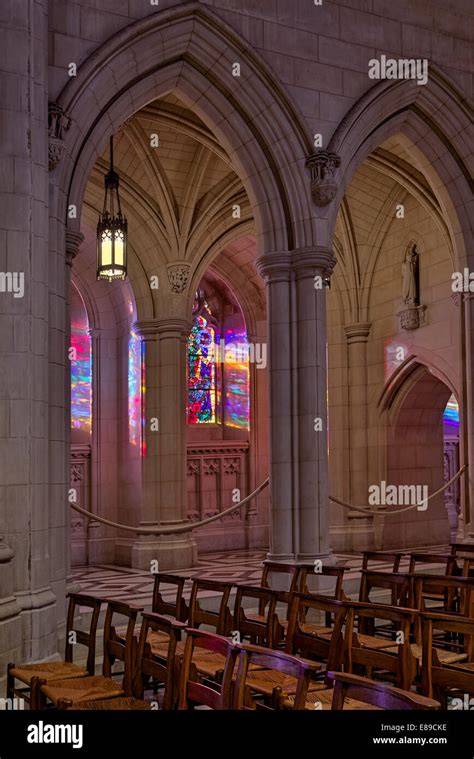
Nearly half a million people enter through its doors each year, many of them just to admire its breathtaking beauty. While Darth Vader is one of its most unusual details, the Cathedral also contains soaring Gothic architecture, ornate carvings and luminous stained-glass windows.
Part of that story is engrained in one of the 215 stained-glass windows that holds seven grams of lunar rock donated by the Apollo 11 crew. “One of the few places you can actually see a piece of the moon that’s not in some government lab or facility somewhere,” Eckstrom said.
The Cathedral contains 762 boss stones, which function as structural key stones. Its limestone weighs 150,000 tons, while an average piece of stone at the Cathedral weighs 300 pounds.
The building has 112 gargoyles, 215 stained-glass windows and more than 1,500 needlepoint pieces. Its Great Organ has 10,650 pipes, and more than 220 people are interred in the Cathedral, including President Woodrow Wilson and Helen Keller.
Can You See Darth Vader from the Ground?
Yes. You can still get a good look from the ground, although the sculpture’s tiny size and lofty perch make it easy to miss.
From the northwest parking lot, near the top of the northwest tower, Darth Vader can be spotted between two massive arches. The bust will be to the upper left of a closer, larger skull-shaped grotesque.
Visitors who arrive expecting to see Darth Vader staring directly from the façade may be disappointed. The figure is high above the ground and appears very small without optical aid.
If you’re uncertain where to look, ask a docent or follow the path of excited Star Wars fans pointing skyward.
Future Additions
While pop culture and the space race have their place at the National Cathedral, it may be a while before a Jedi joins the force. When asked whether the church has plans to add a Luke Skywalker statue, Eckstrom replied: “Darth Vader is ultimately a redemption story….so you never know. There aren’t any spots for new gargoyles that we have discovered yet.”