Our Lady of Blind River is a small Catholic chapel hidden deep in the cypress wilderness of Blind River, Louisiana, about 50 miles from New Orleans. Accessible only by boat, the one-room chapel was built in the early 1980s by Martha and Bobby Deroche as a place where Martha could pray and where visitors could stop for prayer.
Today, the chapel is a destination for kayakers, boaters, Catholic pilgrims, and travelers interested in Louisiana’s swamps and bayous. It stands on the banks of Blind River, near the border of Livingston, St. James, and St. John the Baptist parishes, and remains cared for by Martha’s daughter, Patricia Hymel.
What Our Lady of Blind River Is
Our Lady of Blind River is a little church on the banks of the Blind River, about 50 miles from New Orleans. It’s become a popular site for kayakers lately, but it’s long been a fixture in the local community.
It’s a little cypress-shingled chapel, tucked away deep in the swamp. For outdoorsy types - it’s a cool thing to check off your “must see” list - but it actually came to be because of one family’s deep faith.
Boaters new to the Blind River may be surprised to discover a steeple nestled between the moss-covered trees and the black-tinted backwaters, but that’s exactly what they’ll find perched on the border of Livingston, St. James, and St. John the Baptist parishes.
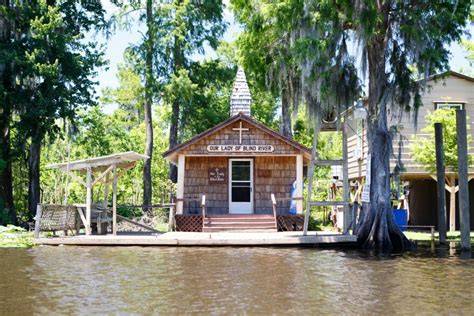
The chapel is one room, raised on wooden stilts a few feet above the water, with a steeple reaching heavenward among the trees and a dock extending into the river.
The Chapel’s Origins
The one-room chapel in Blind River was built in the 1980s. Patricia Hymel is the caretaker.
Over sixty years ago, a sixteen-year-old in Gramercy, La., had an important train to catch. He was early, so he grabbed a table at the Sycamore Inn, hoping for a bite to eat before he hopped on the train to meet his girlfriend in Baton Rouge.
It was there that Bobby Deroche met sixteen-year-old Martha Waguespack-beautiful, charming, and proudly engaged to a soldier overseas.
“I gotta go see my girlfriend now,” Bobby told Martha as he left, “but I’ll be back.”
“I’m engaged, buddy,” she curtly replied. “You don’t have a chance!”
Shortly after his arrival in Baton Rouge, Bobby discovered that, as fate would have it, his girlfriend had come down with chicken pox.
“He couldn’t be with her,” explained Bobby’s daughter Patricia Hymel years later.
Naturally, Bobby went back home to Gramercy, beelined straight to Sycamore Inn, and married Martha Waguespack three days later.
In January of 2012, Bobby Deroche left the plane of the living; Martha followed him about a year later.
The couple had lived out their days on the wild banks of Blind River: the natural border between Livingston, St. James, and St. John the Baptist parishes, which later flows eastward to join Lake Maurepas.
Their lives in that remote locale, however, were anything but solitary. By the time of Martha’s death, she’d met thousands of strangers who had stumbled upon the gift that she and her husband had constructed for the world to discover: a hand-built chapel honoring the Virgin Mary, accessible only by boat, hidden five miles deep in Blind River’s cypress-kneed wilderness.
Martha Deroche’s Vision
After Hymel was grown, her parents, Martha and Bobby, moved out from town into a little house on Blind River - no roads to get there. Her dad fished. Her mom got religion.
“Mamma had visions,” she says. “She was a very faithful woman, you know, a very religious woman.”
In the early ‘80s, Martha told her husband that she’d been having visions of Christ kneeling at a rock in prayer.
Months passed and the visions didn’t stop coming; soon, she felt the need to build a place of worship.
“She told my daddy, she said ‘Bobby I been having these visions of Jesus kneeling by the rock… I think the good Lord is telling me to build something here. I want something here where I can go and pray and if people want to pray they can stop and pray.’”
So Martha convinced her husband to build her a prayer chapel in the swamp.
That desire also had a practical origin. When Martha and Bobby moved to the river, attending church required a long journey that included a five-mile boat ride from their waterfront home to the nearest parking lot, followed by the rest of the trip by car.
“Mom was a very devout woman. She always was,” Patricia explained. “When they moved out on the river from Gramercy, they couldn’t really get to church every Sunday like they wanted to. She wanted a place where she could go just to pray.”
Building a Chapel in the Swamp
It wasn’t easy. People came from all over to help - floating supplies down the river and cutting thousands of cypress shingles by hand.
Some of the neighbors might’ve thought she was crazy, but not all of them.
“Because when they started it a lot of people went, like, ‘Wow!’ and before you knew it the word spread.”
“They started building on Easter Sunday, 1982,” said Patricia, “and they finished it three months later.”
Bobby and about a dozen volunteers tackled the chapel’s construction.
The patience and skill exercised by this group is still apparent-the exterior is layered with over two thousand cypress shingles, each one hand-cut to overlap the one below it.
Those cypress cuts have kept the walls and ceiling dry for more than thirty years, though Patricia said the shingles are due for a makeover.
Look past the craftsmanship, and three decades of sun and wind are visible on the exposed edges, where time and humidity have done their part to fray the wood.
“The guys who made that really knew what they were doing,” Patricia added. “They floated it all the way down the river and cut it to fit that space.”
| Feature | Details |
|---|---|
| Construction | Started on Easter Sunday, 1982 |
| Construction time | Three months |
| Builders | Bobby and about a dozen volunteers |
| Exterior | Over two thousand hand-cut cypress shingles |
| Access | Only by river |
| Dedication | August 23, 1983 |
A Hidden House of Prayer
Getting to the tiny chapel on Blind River is no cakewalk. In fact, no amount of casual walking will get you anywhere near it.
That’s one reason why the chapel was built in the first place-Martha wanted a prayer sanctuary that wasn’t a five-mile boat ride away.
Patricia described her mother as a warm and inviting presence who insisted on personally greeting every boatload of strangers that came to see her sanctuary.
Every pilgrim got a scapula and a finger rosary along with a personal tour of the chapel’s history, as depicted in an oversized, aging photo album.
Patricia Hymel greeted visitors with the same welcoming spirit. She’s always game to talk about the chapel.
Both of Hymel’s parents passed away a few years ago. Pat’s taken on Our Lady of Blind River as her own devotion to them.
The Journey Down Blind River
It’s a lot of work to get out there.
Hymel’s husband, Kenneth, backs his little Toyota down a ramp to launch the boat.
Pat says, “You can only get there by river.”
The breeze from the boat ride cools down the sweltering day. Spanish moss dangles from tall cypress and water lilies bounce up and down in the boat’s wake.
We pass little houses on the water, fishing camps.
About three miles in, we turn a bend and see the church.
In another description of the journey, the chapel is identified as five miles deep in Blind River’s cypress-kneed wilderness, making the trip ten miles round-trip.
Its dock reaches out into the river, providing the only practical arrival point for visitors traveling by boat.
The Chapel’s Exterior and Interior
The chapel is one-room, raised up on wood stilts a few feet above the water, its steeple reaching heavenward among the trees.
Its dock reaching out into the river.
There’s a little welcome sign out front and a sign above telling you it’s Our Lady of Blind River.
The paint is peeling on the steeple and some of the shingles are falling off.
Hymel pushes hard to open the door, which is sticky and jammed.
The floor and doors have all been damaged by frequent flooding.
It’s hot inside. She rushes to turn on the AC.
Inside, Mary’s altar pops like a pansy on a gray day.
The enormous, brightly-painted likeness of the Virgin stands tall, swaddled by yet another hand-hewn cypress work of art: a cross-section of a whole cypress trunk, hollowed out and lacquered to a shiny finish.
Mother Mary is nestled in a hollowed out cypress trunk.
“These all these pews were made out of cypress. Now this tree that the blessed mother is enshrined in is over 2,000 years old. It was hit by lightning.”
Prayer Petitions and the Madonna
A naturally occurring knot in the tree created a small hole below the statue, and over the years, it’s been used as a receptacle for handwritten prayer intentions from visitors.
A hole at the base of the tree is filled with scraps of paper.
Hymel explains, “This little knot - you can see all the paper in there. That people leave their little petitions, or their blessing, and leave it in there.”
They’re private - she would never read them.
But sometimes people tell her their wishes - one woman prayed to get pregnant, another asked that her disabled child could walk again.
People come and go throughout the day; lighting candles at the feet of the second-hand Madonna - bought and then donated from another church.
Hymel’s mother started the chapel, today she lights a candle for her.
The Chapel’s Name and the Polaroid
Oddly enough, Martha’s favorite photo isn’t actually in the album.
In the late ‘80s, a random visitor snapped a Polaroid of Mary’s altar inside the chapel, then took one of the sign above the entrance.
Whether by God or camera mishap, both shots ended up in a single photo, resulting in a double-exposure that seems to show the Mary statue pulled outside of the church.
In the photo, Mary stands beneath the sign above the entrance, which reads, “Our Lady of Blind River.”
Martha took it as a sign that Mary was happy with that title and told the traveler to keep the Polaroid as a gift from Heaven.
Thus, the only evidence of the intervention is a photo of the original photo, which leaves imagination to fill in the gaps left by the glare.
“Mom saw it as a holy event,” Patricia said, “and I’ve heard that Polaroid cameras can’t do that.”
Visitors, Pilgrims, and Local Curiosity
Hymel’s husband Kenneth docks the boat and Hymel calls out to some visitors who’ve just been inside.
She walks up the platform to greet them and asks how they enjoyed the chapel.
Shawn Boudreaux responds, “It was nice, I really like it, I could see that they really put a lot of time and effort into it.”
Boudreaux found the chapel through a geo-tagging game.
He grew up Catholic. He likes to bring friends when they visit.
For many it’s a novel pilgrimage.
Pat sees it as her mother’s legacy.
Hymel asks if he asked for a blessing, and Boudreaux says, “Of course. I lit a candle for my sister.”
To which Hymel responds, “Thank you, thank you, I hope your blessing comes true.”
Patricia wants people to visit.
Despite rumors to the contrary, Patricia says that the chapel doors are never locked, nor will they ever be-her mother wouldn’t have it any other way.
“We’ll keep those doors open as long as it’s there. This place is special, it’s meant to be shared,” she said.
“Mom always said, ‘Never lock that door! Never, ever, lock that door.’”
Visitors from Around the World
The guest book shows people from around the country, she says, even from around the world.
Just inside the chapel’s entrance is a modest podium with a simple spiral notebook where guests have logged their names and hometowns over the years.
In some cases, even a country of origin is given.
“People come from all over the place-Australia, Germany, everywhere,” Patricia said, adding that many of them had heard of the chapel beforehand and knew what they were looking for when they came to Blind River.
In the first few years after it opened to the public, Patricia’s husband, Kenneth Hymel, said the chapel logged over seven thousand visitors.
As he flipped through the guest book’s most recent pages, he counted over one hundred entries made between September and December of 2013.
“Generally the summer months are when most people end up out here,” he added.
Among the other pictures layering the album’s pages are details of the chapel’s dedication day-August 23, 1983-when a local Catholic priest came out to bless it.
Standing on the humble dock in the present, it sounded improbable to me that four hundred people could have occupied the space; but Patricia said it happened on that (likely sweltering) August day.
“There were people still in their boats,” she recalled. “Everybody came out that day. My mother always said she got more visitors out here than she ever did in Gramercy.”
Blind River Chapel - Our Lady of Blind River - Heart of Louisiana - By Dave McNamara St James Parish
Stories of Healing and Faith
Martha, and Patricia by proxy, have witnessed other mysterious works over the years-usually invested upon those who have arrived seeking divine healing.
“People will come here sick, in pain, paralyzed, and they pray to the Blessed Mother,” she said.
“We’ve heard back from people who’ve been healed in the months after they come visit-from cancer, from all kinds of things. It’s amazing what faith can do.”
The chapel’s visitors leave prayer intentions, blessings, and personal hopes in the hollow of the cypress tree.
One woman prayed to get pregnant, while another asked that her disabled child could walk again.
Flooding and Preservation
As Hymel and her husband age, the chapel has become both a blessing and burden.
It’s flooded four or five times.
People along the bayou check on Our Lady of Blind River after heavy rain.
They need to raise the building higher, freshen up the outside.
The paint is peeling on the steeple and some of the shingles are falling off.
The floor and doors have all been damaged by frequent flooding.
Unlike Patricia’s parents, Kenneth and Patricia Hymel don’t live on Blind River; but they take the ten-mile round-trip ride to the chapel about once a week during the spring and summer.
Using the small amount of visitor contributions, as well as her own pocketbook, Patricia maintains the constant stash of finger rosaries and scapular pendants that her mother lovingly handed out.
The former Deroche residence, now inhabited by a cousin, still stands next to the chapel.
How to Reach Our Lady of Blind River
Seaworthy vessels may launch for free at the St. James Parish Boat Club.
From there, Blind River Chapel is a five-mile ride, ten miles round-trip.
All may enter the chapel free of charge.
| Starting point | Directions |
|---|---|
| From Baton Rouge | Take I-10 Exit 187, turn right onto Airline Hwy. (US 61) toward Gramercy. Drive 5.7 miles to the St. James Parish Boat Club, on the left side of the road. |
| From New Orleans | Take I-10 West, Exit 194 toward Lutcher/Gramercy. Take LA 641 toward Airline Hwy. (US 61); veer right on Junction US 61. Drive 3.9 miles to St. James Parish Boat Club. |
| Boat ride | Five miles from the St. James Parish Boat Club; ten miles round-trip. |
| Chapel access | All may enter the chapel free of charge. |
A Family Legacy on the River
Both of Hymel’s parents passed away a few years ago. Pat’s taken on Our Lady of Blind River as her own devotion to them.
As Hymel and her husband age, the chapel has become both a blessing and burden.
Husband Kenneth Hymel says, “You’ve got to be a believer. It’s like anything in life - you’ve got to be able to believe that things will happen and it’ll come true. And that’s the way she feels about this, her mamma instilled that in her, and she’s just carrying the message on.”
And he’s carrying her on, as Pat sees out her mother’s vision and legacy - mother Martha’s private chapel now open to whoever the water brings by.