The Islamic State, commonly known as ISIS, used the execution of Christians as a deliberate instrument of terror, propaganda, forced displacement, and religious persecution. One of the most widely reported cases occurred in February 2015, when a video purported to show the beheading of 21 Egyptian Coptic Christians kidnapped in Libya.
The violence formed part of a broader campaign against Christian communities and other religious minorities in Iraq, Syria, Libya, and elsewhere. ISIS attacks included forced conversion, enslavement, extortion, execution, displacement, destruction of churches, and the use of highly produced videos to intimidate local populations and attract international attention.
The 2015 Execution of 21 Egyptian Coptic Christians
On February 15, 2015, a video emerged that purported to show militants of the self-declared Islamic State beheading 21 Egyptian Christians kidnapped the previous week in Libya. Reuters reported that the militants in black marched the captives, dressed in orange jumpsuits, to a beach, forced them onto their knees, and then beheaded them.
A caption on the five-minute video read: “The people of the cross, followers of the hostile Egyptian church.” Egypt’s MENA news agency quoted the spokesman for the Coptic Church as confirming that the 21 men were believed to be dead. The video appeared on the Twitter feed of a website that supported Islamic State.
The victims were Coptic Christian guest workers who had been kidnapped in Sirte, on Libya’s coast, by ISIS units based there in two operations in December and January. ISIS claimed to have kidnapped the 21 men the previous month.
| Element | Reported detail |
|---|---|
| Date of video report | February 15, 2015 |
| Number of victims | 21 Egyptian Christians |
| Victims’ religious community | Coptic Christians |
| Location of kidnapping | Sirte, Libya |
| Location depicted in video | A beach |
| Claimed perpetrators | Militants of the self-declared Islamic State |
| Victims’ clothing | Orange jumpsuits |
The footage followed another video from the extremist group that showed the immolation death of a Jordanian pilot shot down over Syria, as well as videos showing the execution of two Japanese hostages. In the video involving the Coptic Christians, a masked man speaking in English said that the group planned to conquer Rome.
Reuters, quoting Egypt’s state television, reported that President Abdel Fattah al-Sisi called a seven-day mourning period and convened an urgent meeting of the country’s top military commanders. Egypt’s government said it had no choice but to take urgent measures as ISIS expanded across Libya, a war-stricken neighboring country.
Egypt offered to evacuate thousands of its citizens from Libya. Egypt’s foreign ministry stated that citizens who wanted to return from Libya would be assisted in reaching their home country.
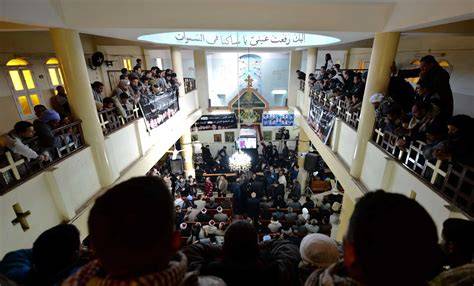
Why the Beheadings Were Used as Propaganda
The executions were not only acts of physical violence against the victims. They were also staged as political and psychological messages. The captives were dressed in orange jumpsuits, marched in formation, placed on their knees, and filmed on a beach before their deaths.
The composition of the footage transformed the victims’ deaths into a public spectacle directed at several audiences at once: the local population, governments in the region, Christian communities, Muslim communities, foreign governments, and potential recruits to ISIS.
The video’s caption identified the victims collectively as “the people of the cross” and portrayed them as followers of a hostile church. This language reduced individual human beings to a religious category and presented their execution as an ideological act rather than a crime against civilians.
The threat to conquer Rome also connected the killings in Libya to ISIS’s wider propaganda narrative. Rome was presented as a symbol of Christianity and of the international order that the group claimed it intended to defeat.
ISIS and the Attack on Christian Communities
The attack on Christianity was central to ISIS’s ideology and operational strategy. The videos showing the beheading and execution of Ethiopian and Egyptian Christians were entitled “A Message in Blood Written to the Nation of the Cross.” In October, the front page of the ISIS magazine featured a picture of St. Peter’s Square with an ISIS flag superimposed on the obelisk at the center of the square.
In major addresses and written communications, ISIS founder Abu Bakr al-Baghdadi declared the group’s intention to march “all the way to Rome.” Along the way, he promised to “break the crosses” of Christians and to “trade and sell their women.”
According to the supplied account, encounters between ISIS and Christian communities resulted in four recurring outcomes: forced conversion, slavery, extortion, or execution.
- Forced conversion required Christians to abandon their religious identity or submit to the group’s authority.
- Slavery included the trafficking and sexual enslavement of women and girls.
- Extortion placed financial and political pressure on communities already weakened by war.
- Execution was used against people who resisted, refused conversion, or were selected for propaganda purposes.
These practices were accompanied by displacement, torture, sexual violence, destruction of religious buildings, and the erasure of Christian symbols and historical memory.
The Destruction of Christianity in the Nineveh Plain
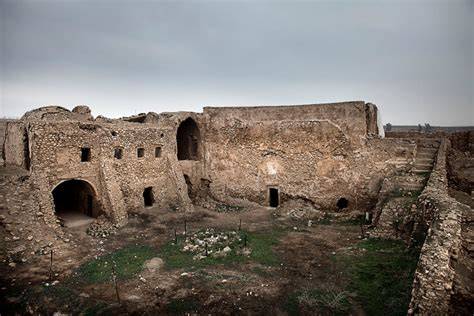
In Iraq, ISIS devastated the ancient Christian presence around Mosul and the Nineveh Plain. More than a year after the last of Mosul’s 60,000 Christians had been displaced, killed, or trafficked by ISIS, only Christians held as sex slaves were reported to remain in the entire Nineveh Plain.
Nearly all of the region’s ancient churches and monasteries had been destroyed or converted into a mosque, madrassa, or prison. In some places, ISIS militants used chisels to remove crosses engraved on tombstones in Christian cemeteries.
The destruction targeted both living communities and the physical evidence of their long history. A community that had taken 2,000 years to build was destroyed in a matter of months.
Christians in Iraq, Syria, and Libya
The persecution of Christians took different forms depending on local military and political conditions. In Iraq and Syria, ISIS seized territory and imposed its authority over established Christian communities. In Libya, the group operated in a security vacuum created by civil war and fragmented political control.
The Coptic Christians killed in 2015 were migrant workers in Libya rather than members of a Christian community living in an ISIS-controlled city. Their kidnapping nevertheless reflected the same broader pattern: Christians were selected because of their religious identity and then used to advance a political and propagandistic message.
The security vacuum in Libya enabled ISIS units to establish a presence along the coast. Sirte became an important location for the group’s operations, including the kidnapping of foreign workers.
The attacks showed how extremist organizations could exploit civil conflict, weak state institutions, uncontrolled territory, and the movement of migrant laborers.
The Wider Pattern of Genocide and Religious Persecution
The situation in Iraq and Syria was characterized by the United Nations as among the worst crises of the modern era. Non-Muslims in Syria and Iraq were slaughtered, sexually violated, displaced, and tortured.
Christians were not the only victims. ISIS also threatened Yazidis and other religious minorities, while killing large numbers of Muslims. The group’s violence therefore combined targeted religious persecution with a broader campaign against communities that rejected its authority.
The ancient Christian communities of the region were especially vulnerable because they had limited military protection and were caught between armed groups, state forces, foreign intervention, and collapsing institutions.
The destruction of churches, monasteries, cemeteries, and other religious sites served several purposes. It removed places of worship, disrupted communal life, erased historical symbols, and communicated that Christians had no secure future under ISIS rule.
Sexual Slavery and Violence Against Women and Girls
Sexual violence was used as a tactic of terror. Christian women and girls were among those subjected to abduction, trafficking, and sexual enslavement.
Victims were often reluctant to speak because of religious norms, stigma, and fear that their communities would reject them. These pressures made it more difficult to document the crimes and to provide survivors with protection and assistance.
The same pattern appeared in the persecution of other religious minorities. The supplied account compares the enslavement of Christian schoolgirls in Nigeria by Boko Haram, which waged a relentless war against Christians, with the broader use of sexual violence by extremist organizations.
Religious Justifications and Muslim Opposition
ISIS presented its crimes as religiously justified, but many leading Muslim scholars rejected the group’s interpretation of Islam. Within weeks of ISIS’s rapid advance in Iraq and Syria, 126 prominent Islamic voices signed an open letter to Abu Bakr al-Baghdadi.
The letter identified 24 areas in which ISIS’s actions were directly opposed to Islamic teaching. Regarding Christians, it stated: “these Christians are not combatants against Islam … indeed they are our friends, neighbors and co-citizens.”
The king of Jordan similarly stated that protecting Christians in the Middle East was “our duty, rather than a favor.”
This opposition is important for understanding the difference between ISIS’s ideology and the views of Muslim communities and scholars who rejected its treatment of civilians and religious minorities.
ISIS threatened Muslims as well as Christians, Yazidis, and other minorities. In fact, ISIS killed more Muslims than anyone else. Opposition to the group therefore included a potential alliance between Christian and Muslim communities against a common enemy.
International Law and Accountability
The crimes attributed to ISIS included genocide, crimes against humanity, war crimes, torture, religious persecution, forced displacement, and sexual violence. International criminal law provides legal categories for addressing these acts, although enforcement depends on jurisdiction, evidence, political cooperation, and the ability to apprehend suspects.
Trials of Nazi war criminals after World War II helped establish the legal foundations that later contributed to the International Criminal Court in The Hague. The court hears cases involving genocide, crimes against humanity, and war crimes.
The Rome Statute established the International Criminal Court. However, because neither Syria nor Iraq recognizes the court’s authority, the ICC has faced limitations in prosecuting the genocide and persecution of Christians by ISIS in those countries.
International law also includes national mechanisms. The Torture Act, signed by President Clinton in 1994, provides legal means for the United States to prosecute and imprison offenders even when torture occurred abroad. It was used successfully to convict and imprison a defendant in the United States for torturing people in Liberia.
The same legal framework could be used against individuals responsible for torturing Christians in the Middle East, subject to the requirements of jurisdiction and evidence.
The Constitution authorizes Congress “to define and punish piracies and felonies committed on the high Seas and Offences against the Law of Nations.” This constitutional authority forms part of the broader legal background for addressing international crimes.
Crimes against humanity
Evidence, Documentation, and Historical Memory
Videos, photographs, witness testimony, survivor accounts, forensic evidence, and records of displacement are essential for documenting ISIS crimes. Propaganda footage can confirm that an organization claimed responsibility, but independent investigation is necessary to establish the identity of victims, the circumstances of their deaths, and the responsibility of specific perpetrators.
The 2015 video was widely reported as purporting to show the execution of 21 Egyptian Christians. The Coptic Church spokesman said the men were believed to be dead, while the footage was circulated through an online network supporting ISIS.
Documentation also protects historical memory. The removal of crosses from tombstones, the destruction of churches, and the conversion of monasteries into military or administrative facilities were not isolated acts of vandalism. They were part of an effort to erase the visible presence of communities that had lived in the region for centuries.
Preserving records of the victims is therefore connected to accountability and to the right of displaced communities to remember their history.
Responses by Governments and Religious Communities
Egypt responded to the 2015 killings by declaring a seven-day mourning period and calling an urgent meeting of senior military commanders. The government also facilitated the return of Egyptian citizens from Libya and offered to evacuate thousands of Egyptians from the country.
Governments faced the difficult task of protecting citizens abroad while responding to extremist propaganda designed to provoke fear and retaliation. The presence of Egyptian migrant workers in Libya made the security crisis a regional issue rather than a purely domestic one.
Religious communities also faced a moral and practical challenge. Responses included public mourning, assistance to displaced people, advocacy for victims, support for survivors, and cooperation across religious lines.
Humanitarian assistance was presented as one way to oppose ISIS’s genocidal strategy. Every act of support for a person whom ISIS intended to kill undermined the group’s attempt to eliminate communities through terror, displacement, and deprivation.
Christian Interpretations of Persecution
Christian reactions to persecution have sometimes taken two different forms. Some Christians embrace a sense of fatalism, emphasizing the history of suffering and martyrdom and trusting God through it. This response can honor the faith of those who endure persecution, but it may also reduce the sense of urgency about stopping the violence.
Others focus only on the darkness and fail to see the historical role of sacrifice in strengthening Christian communities. They may interpret the suffering solely as destruction rather than also recognizing the courage of people who remain faithful under threat.
A more complete response combines both perspectives: honoring the sacrifice of persecuted Christians while praying and working for their freedom from the violence directed against them.
The crisis also raises questions about the responsibilities of churches outside the Middle East. Support for persecuted Christians cannot be limited to a single annual observance. It involves continued prayer, public attention, humanitarian assistance, advocacy, and solidarity with victims and their neighbors.
Solidarity Between Christians and Muslims
ISIS’s violence made clear that the conflict was not simply a confrontation between Muslims and Christians. ISIS attacked Muslims who rejected its authority and threatened the region’s historic religious diversity.
Muslim scholars, political leaders, and communities who condemned ISIS played an important role in challenging the group’s religious claims. Their statements also demonstrated that opposition to ISIS could be grounded in Islamic principles as well as in international law and universal human rights.
Christian and Muslim communities had a shared interest in resisting forced displacement, sectarian violence, slavery, and the destruction of civil society. Cooperation could take the form of protecting neighbors, aiding displaced families, preserving religious sites, and rejecting collective blame.
The Possibility of Change and Rehabilitation
Religious and humanitarian responses to ISIS persecution also included the belief that individuals involved in terrorism might abandon extremist ideology. Christian reflections on the conversion of Saul emphasized the possibility that a persecutor could become an advocate for the people he once opposed.
This belief does not remove the need for justice or accountability. It places rehabilitation alongside the protection of victims, prosecution of perpetrators, and prevention of further crimes.
The experience of former terrorists who later became preachers was cited as an example of the possibility of profound personal transformation.
tags: #isis #beheads #christians