King Jehoshaphat prayed when three enemy armies came against Judah and he did not know how to respond. He gathered the people to seek the Lord through prayer and fasting, remembered God’s past faithfulness, confessed their powerlessness, and asked God for help.
Jehoshaphat’s prayer teaches that we can come to God when we are afraid, overwhelmed, or unable to control our circumstances. We may not know what to do, but we know where to go for help: to the God who is powerful and mighty, hears His people, and remains with them in trouble.
The Crisis That Led Jehoshaphat to Pray
King Jehoshaphat led the people of the southern kingdom of Judah during the time when Israel was divided. In 2 Chronicles 20:1, three kingdoms came together to declare war on Jehoshaphat. The armies of Ammon, Moab, and Mount Seir marched against Judah, and the king was caught unprepared for how to respond.
Jehoshaphat was overwhelmed by his circumstances and afraid for what the future held. Verse three specifically tells us that “Jehoshaphat was terrified by this news and begged the LORD for guidance.” The three armies were vastly outnumbering and underprepared. The situation did not feel fair or right.
Our own lives can sometimes feel like they are careening out of control. We are left feeling powerless in the face of myriads of situations that we did not see coming and are not prepared to handle. It can feel hard to breathe, hard to function, even hard to pray.
In the fear of our circumstances, we can give way to anxiety and feel powerless. When big trouble pops up out of nowhere, it can make our hearts race, our stomachs twist into knots, and leave us feeling totally helpless.
Jehoshaphat Called the People to Prayer and Fasting
Jehoshaphat did not respond to the threat by pretending that everything was fine. He called for the people to come together in prayer and fasting. So people from all the towns of Judah came to Jerusalem to seek the LORD’s help.
Jehoshaphat gathered all the people together to do the most powerful thing possible: ask God for help. As all the men of Judah stood before the LORD with their little ones, wives, and children, the entire community faced the crisis together.
King Jehoshaphat leads the people in seeking the Lord in their dire situation and prays a bold and desperate prayer. His prayer shows that faith does not require us to deny fear. It teaches us to bring fear honestly into the presence of God.
Jehoshaphat Began With Worship
The king did not begin with the need. Instead, he started with worship that included a walk down memory lane when God supernaturally drove out the enemies of His people.
Jehoshaphat stood before the community of Judah and Jerusalem in front of the new courtyard at the Temple of the LORD. He prayed, “O LORD, God of our ancestors, you alone are the God who is in heaven. You are ruler of all the kingdoms of the earth. You are powerful and mighty; no one can stand against you!”
In the first four lines of a seven-verse prayer, the focus is on all the ways God’s power had been displayed in the past: creation, driving out nations as Israel settled in the land, promises made to Abraham, and the building of the Temple.
He describes God’s covenant promise to give His people land and how God’s people settled in and built a life on that promised land. Jehoshaphat’s prayer reminds the people of the scene where Solomon heard the Lord extend grace for those times when His people sinned.
Jehoshaphat’s prayer begins by acknowledging God’s authority over heaven and earth. Before he describes the size of the enemy, he declares the greatness of the Lord.
Jehoshaphat Prayed Scripture
Jehoshaphat’s prayer shows that Scripture can guide us when we do not know how to pray. Though the words are not exactly the same, they are similar enough for us to conclude that when Jehoshaphat repented of his sinful alliance with King Ahab, he turned to God’s Word for wisdom.
The story of Solomon became a roadmap for his own repentance journey. Jehoshaphat prays Scripture.
Solomon had heard this instruction from the Lord:
“When I shut up the heavens so that there is no rain, or command the locust to devour the land, or send pestilence among my people, if my people who are called by my name humble themselves, and pray and seek my face and turn from their wicked ways, then I will hear from heaven and will forgive their sin and heal their land.”
Jehoshaphat remembered the corresponding promise in his own prayer:
“If disaster comes upon us, the sword, judgment, or pestilence, or famine, we will stand before this house and before You-for Your name is in this house-and cry out to You in our affliction, and You will hear and save.”
The words are not identical, but the principle is clear: Jehoshaphat looked to what God had already said and allowed God’s Word to shape his response to the crisis.
He Remembered God’s Faithfulness
Jehoshaphat reminded God, himself, and the gathered people that “whenever we are faced with any calamity … we can come to stand in your presence … we can cry out to you to save us, and you will hear us and rescue us.”
He remembered that God had driven out the nations living in the land when Israel arrived. He remembered God’s promise to Abraham. He remembered that God’s people had settled in the land and built the Temple to honor His name.
He also remembered the promise that God’s people could stand before Him in times of war, plague, or famine. They could cry out to God to save them, and God would hear and rescue them.
One commentator suggested that “we can follow Jehoshaphat in calling to mind past acts of God’s deliverance as a basis for hope that He can also bring about deliverance in the present situation.”
Remembering God’s past faithfulness does not mean that every present circumstance will be reversed in the same way. It means that God’s character has not changed, His promises remain trustworthy, and His people can continue to seek Him.
He Presented the Threat Honestly
After worshiping God and remembering His faithfulness, Jehoshaphat described what the armies of Ammon, Moab, and Mount Seir were doing. The enemy had come to throw Judah out of the land God had given them as an inheritance.
Jehoshaphat did not minimize the danger. He did not pretend that the advancing armies were insignificant. He brought the real circumstances before the real God.
The prayer calls on God to stop what is happening and answer their need for guidance against this enemy. Jehoshaphat asked, “O our God, won’t you stop them?”
This kind of prayer is both desperate and faithful. It acknowledges the seriousness of the situation while refusing to believe that the situation is greater than God.
“We Are Powerless”
Jehoshaphat bookends his prayer by talking about who has the power in these situations. In verse six he prays, “You are powerful and mighty; no one can stand against you,” and in verse twelve he prays, “we are powerless … we are looking to you for help.”
The strength to handle this overwhelming situation of three advancing armies was solely on God, and that is where Jehoshaphat placed all his trust in that moment.
His prayer ends with a direct confession: “We are powerless against this mighty army that is about to attack us. We do not know what to do, but we are looking to you for help.”
Jehoshaphat, in his fear and anxiety, turns to God and essentially tells God that the outcome is all up to Him. He does not claim to have a strategy that will guarantee victory. He openly admits that he does not know what to do.
This confession is not spiritual weakness. It is an honest recognition that Judah needed God. The king’s helplessness became an opportunity to place the whole situation in the hands of the Lord.
What Jehoshaphat’s Prayer Teaches About Faith
This prayer reminds us that our prayers can be desperate for help, fearful of the circumstances, and still replete with trust in the full power of God.
We are challenged by Jehoshaphat’s example to look at the things we are anxious about and claim the same truth. We can confess our lack of control without surrendering to hopelessness.
When confronted with enemies too big for you to defeat on your own, whether it is the result of personal sin or circumstances beyond your control, humble yourself before the Lord in recognition that without Him you are lost.
Seek Him through prayer and His Word, as well as the covenant community. Start your prayers with reminders of God’s past faithfulness and pray Scripture, including the promises of God.
God Answered Through His Spirit
As the people stood before the Lord, the Spirit of the LORD came upon Jahaziel, a Levite who was a descendant of Asaph. Jahaziel delivered God’s answer to Jehoshaphat and the people.
He said, “Listen, all you people of Judah and Jerusalem! Listen, King Jehoshaphat! This is what the LORD says: Do not be afraid! Don’t be discouraged by this mighty army, for the battle is not yours, but God’s.”
The people were told to march out against the enemy the next day. Yet they were also told, “You will not even need to fight. Take your positions; then stand still and watch the LORD’s victory.”
God’s message addressed the fear directly: “Do not be afraid or discouraged.” The advancing army was mighty, but the battle belonged to God, and the Lord promised to be with the people of Judah and Jerusalem.
Jehoshaphat Responded With Worship
Then King Jehoshaphat bowed low with his face to the ground. All the people of Judah and Jerusalem did the same, worshiping the LORD.
The Levites stood to praise the LORD, the God of Israel, with a very loud shout. The people responded to God’s promise before they saw the outcome of the battle.
Their worship was an expression of trust. They had heard that God would fight for them, and they responded by honoring Him.
Faith Before the Battle
Early the next morning, the army of Judah went out into the wilderness of Tekoa. On the way Jehoshaphat stopped and said, “Listen to me, all you people of Judah and Jerusalem! Believe in the LORD your God, and you will be able to stand firm. Believe in his prophets, and you will succeed.”
Jehoshaphat did not tell the people to trust their numbers, weapons, or military strength. He directed them to believe in the Lord their God and to trust the message He had given through His prophet.
After consulting the people, the king appointed singers to walk ahead of the army, singing to the LORD and praising Him for His holy splendor.
This is what they sang: “Give thanks to the LORD; his faithful love endures forever!”
The people moved toward danger while declaring God’s enduring love. Their praise did not come because the circumstances looked safe. It came because they trusted the Lord.
God Fought the Battle
At the very moment they began to sing and give praise, the LORD caused the armies of Ammon, Moab, and Mount Seir to start fighting among themselves.
The armies of Moab and Ammon turned against their allies from Mount Seir and killed every one of them. After they had destroyed the army of Seir, they began attacking each other.
When the army of Judah arrived at the lookout point in the wilderness, all they saw were dead bodies lying on the ground as far as they could see. Not a single one of the enemy had escaped.
King Jehoshaphat’s army did not even have to fight. God took care of all three armies, and the people of God were defended by Him alone.
King Jehoshaphat and his men went out to gather the plunder. They found vast amounts of equipment, clothing, and other valuables-more than they could carry. There was so much plunder that it took them three days just to collect it all.
On the fourth day they gathered in the Valley of Blessing, which received its name that day because the people praised and thanked the LORD there.
The Result Was Peace
Then all the men returned to Jerusalem, with Jehoshaphat leading them, overjoyed that the LORD had given them victory over their enemies. They marched into Jerusalem to the music of harps, lyres, and trumpets, and they proceeded to the Temple of the LORD.
When all the surrounding kingdoms heard that the LORD Himself had fought against the enemies of Israel, the fear of God came over them.
In the end it is recorded that “Jehoshaphat’s kingdom was at peace, for his God had given him rest on every side.”
Peace came after the people trusted God in a situation they could not control. The peace did not come from Judah’s military strength. It came from the Lord’s presence and deliverance.
When God Does Not Change the Circumstances
Unfortunately, the circumstances that overwhelm us today will not always see a miraculous reversal of a situation. Not every crisis ends with the enemy destroying itself, and not every prayer receives the exact form of deliverance we hope for.
But we do have the same promise that we need only to trust God to work in our situation for us to have the victory. We are promised the same presence of God in those circumstances that seek to convince us that we are alone and already defeated.
We can have what Jehoshaphat received in the end: peace. Jesus Himself made us this same promise: “Peace I leave with you; my peace I give you. I do not give to you as the world gives. Do not let your hearts be troubled and do not be afraid.”
It is the peace of knowing that the Creator of the universe is on our side. We are not alone in our trouble; we may not know what to do, but we know where to go for help.
Peace comes from trusting God to be on our side. Peace leads to renewed courage to face our circumstances, “and watch the LORD’s victory” in our life.
How to Pray When You Do Not Know What to Do
When we do not know what to do, we pray. When we are under intense pressure from without or within, we pray. When we fear what the future holds, we pray.
We pray simple prayers that say, “we don’t know what to do, but we are looking to you for help.”
When faced with a difficult situation, begin by praising God for who He is. Remember His power, His goodness, His faithfulness, and His past acts of deliverance.
Then bring the circumstances honestly before Him. Do not hide fear, confusion, grief, or powerlessness. Jehoshaphat’s example shows that honest desperation can exist alongside deep trust.
Pray God’s Word. Use Scripture to remember what God has promised and to give structure to your prayer when you cannot find the words yourself.
Pray for other people and seek the support of the covenant community. Jehoshaphat did not face the crisis alone, and the people of Judah gathered together to seek the Lord.
Finally, ask God for the help you need. You do not have to carry giant problems all by yourself because God is always ready to listen and help you through anything.
A Simple Three-Step Prayer Pattern
Next time you face a scary situation, try using this simple three-step prayer pattern: first, praise God for how awesome He is; second, pray for other people; and third, ask God to help you with what you need.
- Praise God. Begin with worship and remember His character, authority, goodness, and faithfulness.
- Pray for others. Bring the needs of family, friends, the church, and the wider community before the Lord.
- Ask God for help. Tell Him honestly what you need and admit when you do not know what to do.
Not only can personal prayer times help soothe us by reminding us of God’s presence and promises, but hearing others pray in this way can deepen our faith and help our hearts rest in Him.
Questions to Consider
- When you are faced with a situation that makes you feel powerless, what is your most common response: seeking advice, living in denial, or withdrawing?
- Why is that your most common response?
- What anxiety do you need to “beg the Lord for guidance” on in your own life?
- What situation currently feels too large for you to handle on your own?
- What past act of God’s faithfulness can you remember as a basis for hope?
- How can Scripture guide your prayer in this situation?
- Who can pray with you when you feel overwhelmed?
- What is one specific situation your family is facing right now that you can pause and practice praying about together using the praise-others-you prayer steps?
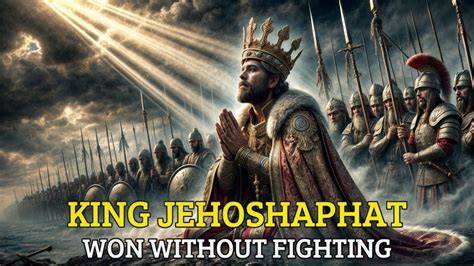
Jehoshaphat’s Victory | Bible Stories for Kids
tags: #king #jehoshaphat #prayed