Jesus knew from the beginning that Judas would betray him, yet Judas remained among the twelve apostles, ate with Jesus, received his teaching, witnessed his miracles, and had his feet washed by him. Jesus chose Judas because the betrayal fulfilled Scripture, served God’s sovereign saving purpose, revealed the difference between religious activity and saving faith, demonstrated that divine sovereignty does not remove human responsibility, and exposed the corrupting power of the love of money.
Jesus’ treatment of Judas also reveals the depth of his love. Jesus knew that Judas had sold him for thirty pieces of silver, but he still shared the meal with him, fed him, washed his feet, called him “Friend,” and moved toward him in the garden. The story is not merely about Judas’s treachery; it shows how Jesus responded to betrayal and how he gave himself to heal those who had betrayed God.
Jesus Chose Judas Knowing What He Would Do
John 6:64 says, “Jesus knew from the beginning who those were who did not believe, and who it was who would betray him.” Jesus chose his own betrayer to be part of his apostles.
Judas Iscariot, one of the twelve, knew where Jesus liked to pray. Under the cover of darkness, he led a small army into the grove of olive trees to arrest him. The irony of Judas’ betrayal is thick. He brought soldiers carrying torches to apprehend the Light of the World and clubs and swords to carry away the Prince of Peace.
It’s hard to imagine a character who saw more and learned less than Judas. For three years, he had a front-row seat to the most spectacular display of divine power, love, and grace the world had ever known. He saw storms stilled, the dead raised to life, the blind receive sight, and lame legs restored.
He received unimaginable privilege, yet he responded to it with unparalleled hypocrisy. Judas walked with Jesus, ministered with Jesus for three years, and he worked those miracles.
Why Did Jesus Choose Judas?
1. Scripture Cannot Be Broken
The Old Testament Scriptures prophesied that this would take place. So Jesus chose Judas to fulfill the Scriptures.
In John 13:18, Jesus says to his apostles, “I am not speaking of all of you; I know whom I have chosen. But the Scripture will be fulfilled.” And then he quotes Psalm 41:9: “He who ate my bread has lifted his heel against me.”
And Peter, on the day of Pentecost, in Acts 1:16, says, “Brothers, the Scripture had to be fulfilled . concerning Judas, who became a guide to those who arrested Jesus.”
Step by step, Jesus moved toward the cross, taking pains to fulfill every Scripture concerning his death, right down to the details of how he would be handed over. The point was to show that the Scriptures cannot be broken, and that God is in control.

2. Spectacular Sins Serve God’s Purpose
By choosing to be betrayed by a close friend, and even by a kiss, Jesus shows us that the most despicable act in the history of the world - the betrayal and consequent murder of the Son of God - was part of God’s saving plan.
That’s explicitly said in Acts 4:27-28, that by his hand and his predestination these things took place. In other words, the lesson of Judas is that the most horrible sins in the world are used by God for his saving purposes.
Just when people think they’re getting the upper hand, they find that their hand is serving the very one they are opposing. That’s a great lesson for us to learn.
Judas’s betrayal was genuinely evil, but it did not overturn God’s purpose. The betrayal, the arrest, and the consequent murder of the Son of God became part of the saving plan through which Jesus gave his life.
3. Saving Faith Is Not the Same as Religious Activity
By choosing from the beginning an apostle who was destined for apostasy and destruction, and by including him in his closest relations, and by giving him power over unclean spirits and over diseases, Jesus shows us that religious associations and religious practices and miracle-working are no sure evidences of being born again.
Matthew 10:1-4 describes the choosing of the twelve. It names Judas and says Jesus “gave them authority over unclean spirits, to cast them out, and to heal every disease and every affliction” (Matthew 10:1).
Judas becomes a vivid illustration of the people in Matthew 7:22-23: “On that day many will say to me, ‘Lord, Lord, did we not prophesy in your name, and cast out demons in your name, and do many mighty works in your name?’” That’s Judas - and many, many other people in history.
And then Jesus will declare to them, “I never knew you; depart from me, you workers of lawlessness.” What a vivid lesson to learn that right doctrine (“Lord, Lord, we know who you are; we’ve got our doctrine right, Lord, Lord”) and religious activity and miracle-working (“We’ve cast out demons; we’ve healed people”) prove nothing about saving faith and being born again.
That’s the lesson of Judas. Time with Jesus and miracle-working are no proof of saving faith.
4. Divine Sovereignty Does Not Remove Human Responsibility
Judas serves as an illustration that predestination and human responsibility go hand in hand. Judas’s destiny was set before his betrayal.
Jesus said that he kept all his disciples from apostasy except Judas, “the son of destruction” (John 17:12). In John 6:64, it says, “Jesus knew from the beginning . who it was who would betray him.”
And then Jesus explained in the next verse, “This is why I told you that no one can come to me unless it is granted him by the Father” (John 6:65).
In other words, Judas didn’t repent because it was not granted to him by the Father; his destiny was sealed. And yet he was guilty - really guilty, really accountable, really blameworthy. He was really responsible for what he did.
He himself said in Matthew 27:4, “I have sinned by betraying innocent blood.” So, we learn from Judas not to stumble over the fact that a person may be destined for destruction and yet be totally responsible for what he does.
5. Satisfaction in Money Corrupts the Soul
Judas serves as a vivid example of the terrible, terrible power of the love of money, and how it blinds us to what is true and beautiful and valuable in this world.
In John 12:4-6, when Mary anointed Jesus, Judas said, oozing with hypocrisy, “Why was this ointment not sold for three hundred denarii and given to the poor?”
And John comments, “He said this, not because he cared about the poor, but because he was a thief, and having charge of the moneybag he used to help himself to what was put into it.”
He did that under the nose of the very Son of God, who would give his life as a ransom for many, whose teachings he had heard for three years, in whose power he did miracles. Judas loved money more than he loved Jesus.
That’s horrific, unbelievable, unspeakably evil. It should make every one of us tremble at the thought of the power that money has in our lives to blind us to what is true and beautiful and precious.
So, when Judas got his chance, thirty pieces of silver is all it took to sell the very Son of God. The love of money is behind the worst sin in the world.
| What Judas’s story reveals | Biblical significance |
|---|---|
| His betrayal | Scripture cannot be broken, and God is in control. |
| His participation among the apostles | Religious associations and religious practices are no sure evidences of being born again. |
| His destiny and guilt | Predestination and human accountability go hand in hand. |
| His love of money | The love of money can blind people to what is true, beautiful, and precious. |
| His betrayal of Jesus | Even horrific sins serve the saving purposes of God in his sovereign plan. |
Why Did Judas Still Eat With Jesus?
“Think about this for a second. Jesus knew. He goes into that room with His disciples. He knows He is going to be betrayed. He knows it is Judas who will turn against him. He knows that He has been sold out for a handful of silver. Stabbed in the back by one He has poured His life into. Yet, in that room, hours before the death of Jesus, Judas ate too. Jesus fed Judas too. Jesus prayed for Judas too. Jesus washed Judas’ feet too.
I struggle to fathom that kind of love. A love that would feed the mouth that deceived you. A love that would wash the treasonous feet of the traitor. A love that could forgive even the vilest of betrayals. I honestly struggle to comprehend it. And then, suddenly, I realize that I'm Judas. And in that moment, I'm so thankful & altogether overwhelmed that Judas ate too.”
Jesus, even knowing who Judas was, still washed his feet and called him “Friend.” Jesus knew what Judas was doing. But Jesus did not treat him as an enemy before the betrayal had taken place.
Jesus’ willingness to share the meal with Judas was not ignorance, weakness, or approval of sin. Jesus knew from the beginning who would betray him, and he still acted with patience, dignity, and grace as he moved toward the cross.
The Betrayal in the Garden of Gethsemane
The glow from the torches and lanterns snaked along the road from Antonia’s Fortress toward Jesus and his disciples in the Garden of Gethsemane. The speckled line of light grew brighter, and the marching footsteps grew louder as they inched closer.
For the third time in the last hour, Jesus roused his sleeping disciples, “Why do you sleep? Rise and pray, lest you enter into temptation” (Luke 22:46).
With their hearts heavy from sorrow, and eyes heavy with sleep, the disciples struggled to make sense of the scene unfolding before them. Judas Iscariot, one of the twelve, knew where Jesus liked to pray.
“Judas, are you betraying the Son of Man with a kiss?” Luke 22:48
However, Judas still betrayed the Son of Man with a gesture of familiarity and fondness. Since the kiss was the pre-determined signal to identify who Jesus was in the crowd, Jesus’ motion towards Judas made the kiss unnecessary (and even more vile!).
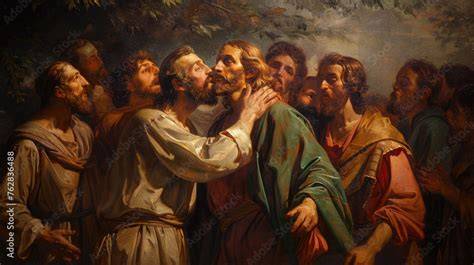
Jesus Was Betrayed by a Close Friend
If you’ve ever been betrayed, you can imagine how heartbreaking this betrayal must’ve been for Jesus. The Psalmist prophesied the Messiah’s angst from the betrayal of a familiar friend.
“If an enemy were insulting me, I could endure it; if a foe were rising against me, I could hide. But it is you, a man like myself, my companion, my close friend, with whom I once enjoyed sweet fellowship at the house of God, as we walked about among the worshipers.” Psalm 55:12-13
It’s one thing when a stranger wrongs us, but the pain inflicted by a friend hurts unlike anything else. When you look at all four gospel accounts together, the contrast grows between Jesus’s majesty and Judas’s monstrosity.
Jesus knew his disciples weren’t strong enough to endure arrest, so twice he made the soldiers who had come to arrest him identify who they were seeking. Even under duress, Jesus was looking not to his interests, but he was protecting his disciples.
Four Ways Jesus Confronted Betrayal
1. Jesus Acted on His Troubled Spirit
When something doesn’t sit right, we often make excuses for someone else’s behavior. Jesus didn’t do that. His troubled spirit prompted him to action.
Right before he instituted the first Lord’s Supper, John 13:21 says, “…He [Jesus] was troubled in his spirit, and testified, Truly, truly, I say to you, one of you will betray me.”
Jesus, knowing all things, told Judas to leave and do his deed quickly. (John 13:27). Jesus knew what Judas was doing.
But if you’re unsuspecting of betrayal in your midst, listen to your gut instincts. If your spirit is troubled, dig deeper to understand why.
2. Jesus Walked Toward His Betrayer
Jesus, therefore, knowing all things that would come upon him, went forward and said to them, “Whom are you seeking” (John 18:4)? Jesus didn’t wait for Judas to come to him in his act of betrayal; he boldly moved toward his betrayer.
The lesson is not to turn a blind eye to a betrayer in our midst. It’s a sign of strength to move towards those who offend us rather than shy away.
Our human response to betrayal is to retaliate, but not Jesus! He walked toward the betrayal he already knew was coming.
3. Jesus Protected His Disciples Under Arrest
“So he asked them again, ‘Whom do you seek?’ And they said, ‘Jesus of Nazareth.’ Jesus answered, ‘ I told you that I am he. So, if you seek me, let these men go.’ This was to fulfill his word: ‘Of those whom you gave me I have lost not one’ (John 18:7-9).
Even under life’s most trying circumstances, Jesus never loses any of his sheep. No matter how life-upending your betrayal has been, Jesus holds you fast.
If others are impacted by your betrayal (like your children), it’s important to do all that’s within your power to protect them.
4. Jesus Remained Gracious Toward Judas
After Jesus’ arrest, Judas knew he’d betrayed innocent blood and tried to return the money. Is it possible that he replayed the thousands of interactions he had with Jesus in his mind to find one good reason to hand him over?
No matter how hard he tried to justify his actions, he knew Jesus had never done one evil deed or said one less-than-gracious thing to anyone (including himself).
As impossible as it sounds, we are exhorted to respond like Jesus when mistreated. If possible, so far as it depends on you, live peaceably with all.
Beloved, never avenge yourselves, but leave it to the wrath of God, for it is written, “Vengeance is mine, I will repay, says the Lord.” On the contrary, “if your enemy is hungry, feed him; if he is thirsty, give him something to drink; for by so doing you will heap burning coals on his head.” Romans 12:18-20
Judas’s Motives and the Tragedy of Misplaced Hope
Despite all his privileges, Judas had ulterior motives for following Jesus. He thought Jesus would usher in an earthly kingdom and overthrow the oppressive Roman rule over Israel.
With his close relationship with Jesus, he thought if he hung around long enough, he’d rule alongside Jesus. Jesus was a means to an end, and when it became clear Jesus wasn’t overthrowing Rome, he tried to get out of the deal what he could.
Even if it was just the price of a common slave. Judas loved money more than he loved Jesus.
Judas’s proximity to Jesus did not mean that he loved Jesus. His outward participation concealed inward motives. He could share the table, hear the teaching, witness miracles, and occupy a place among the apostles without possessing saving faith.
“He Absorbed the Traitor’s Heel to Heal Traitors”
Our response to this story should not be to hate Judas (although his act is probably the worst in human history!). We must examine our response to Jesus and the truth we’ve been exposed to.
“He absorbed the traitor’s heel, to heal traitors.”
We are traitors, the natural-born enemies of God. But Jesus was betrayed by man so that God wouldn’t betray us. We, who were once God’s enemies, have been reconciled to him through his death. (Romans 5:10).
Isn’t that a glorious truth? It’s because Jesus was betrayed; you and I don’t have to be. He walks towards us, his betrayers, and he extends mercy and grace.
Because he absorbed the traitor’s heel, the story of Judas does more than expose treachery. It reveals the finished work of Christ and the mercy extended to those who have been enemies of God.
- To fulfill Scripture: Scriptures cannot be broken, and God is in control.
- Even horrific sins serve the saving purposes of God in his sovereign plan.
- Time with Jesus and miracle-working are no proof of saving faith.
- Predestination and human accountability go hand in hand.
- The love of money is behind the worst sin in the world.