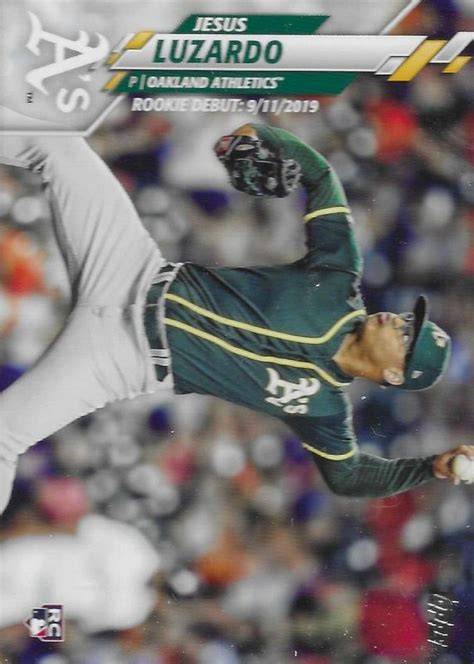
Jesus Luzardo rookie cards are baseball cards issued to commemorate the early stage of his Major League Baseball career and are collected in raw or professionally graded condition. Their potential value depends on the specific card, condition, centering, print quality, scarcity, demand, and the grade assigned by a third-party grading company.
Collectors should identify the exact Jesus Luzardo rookie card before evaluating it, then compare its condition with professional grading standards. Grading can significantly affect how a card is presented and valued, but collectors should also account for submission availability and processing conditions.
What a Jesus Luzardo rookie card is
A rookie card is generally regarded as one of the earliest mainstream cards issued during a player’s recognized rookie-card period. For Jesus Luzardo, the correct identification depends on the card’s release, product designation, league or prospect status, and whether collectors recognize it as a true rookie card rather than a prospect card or an insert.
The most important first step is to distinguish a Jesus Luzardo rookie card from other early-career cards. A prospect card, minor-league card, autograph card, or insert may be highly collectible, but it should not automatically be labeled a standard rookie card without checking the product details.
How to identify the exact card
Begin by recording the card’s manufacturer, product name, release year, card number, parallel designation, insert set, autograph status, serial numbering, and any variation printed on the card. These details allow collectors to separate the base rookie card from parallels, short prints, inserts, memorabilia cards, and autographed versions.
The front of the card may show the player’s team, position, photograph, and set branding, while the back often provides the card number, biographical information, statistics, copyright information, and product identifiers. The card number and set name are especially useful when several Jesus Luzardo cards appear similar.
Collectors should also inspect whether the card is serial numbered, contains a color or pattern variation, includes an autograph or memorabilia piece, or belongs to an insert series. Two cards featuring the same player can have very different scarcity and market demand when one is a standard base card and the other is a limited parallel.
Factors that influence Jesus Luzardo rookie card value
Card type and scarcity
Base cards are typically more widely available than serial-numbered parallels, short prints, autographs, and memorabilia cards. Scarcity can increase collector interest, although rarity alone does not guarantee a high value.
Autographed cards, low-numbered parallels, attractive color variations, and cards with strong visual appeal may attract more attention than ordinary base issues. Their desirability still depends on authenticity, condition, player performance, set popularity, and the number of competing examples available.
Condition and surface quality
Condition is one of the most important factors in evaluating a Jesus Luzardo rookie card. Collectors should examine the corners, edges, surface, centering, print quality, gloss, foil, and any signs of handling or storage damage.
Common condition issues include soft corners, edge chipping, scratches, print lines, dents, fingerprints, stains, wax residue, surface scratches, off-center borders, and color imperfections. Some defects are easier to see under direct light, while others become apparent only when the card is viewed at different angles.
Centering
Centering refers to the alignment of the printed design within the card’s borders. A card with balanced borders generally presents better than one that is visibly shifted, although centering standards can differ depending on the grading company and the specific card design.
Collectors should compare the left and right borders as well as the top and bottom borders. A card can have strong corners and a clean surface but still receive a lower grade if the image or borders are noticeably misaligned.
Professional grade
A professionally graded Jesus Luzardo rookie card is encapsulated in a protective holder and assigned a numerical grade after evaluation. The grade communicates the card’s assessed condition and can make comparisons between examples easier.
Higher grades generally indicate stronger overall condition, but the grade should not be considered the only factor. Eye appeal, centering, print defects, the grading company, the card’s scarcity, and the player’s collecting demand can all affect how the market views a graded example.
Raw versus graded Jesus Luzardo rookie cards
A raw card has not been encapsulated and graded by a third-party grading company. Raw cards can be less expensive to acquire and allow collectors to inspect the card directly, but the buyer must evaluate condition and authenticity independently.
A graded card provides a standardized holder, a stated condition assessment, and protection from ordinary handling. It may also be easier to compare with other graded examples, particularly when collectors are researching recent sales or building a registry-style collection.
Grading is not automatically beneficial for every card. Submission costs, turnaround time, shipping, insurance, the card’s expected value, and the likelihood of receiving a desirable grade should be considered before sending a card for evaluation.
Preparing a Jesus Luzardo rookie card for grading
Before submission, inspect the card under strong, even lighting and use a clean surface. Avoid touching the front or back with bare hands, and handle the card by its edges to reduce the risk of fingerprints, scratches, or surface contamination.
Check the corners and edges for whitening or chipping, examine the surface for scratches and print lines, and assess centering from multiple angles. A centering tool or magnification can help reveal defects that are difficult to see at normal viewing distance.
Place the card in an appropriate protective sleeve and holder suitable for submission. The card should be secure without being forced into an oversized or undersized holder, and the packaging should prevent movement during transport.
Beckett submission availability
Starting at 7 pm CT on September 9, Beckett took our digital platforms (i.e., all Beckett websites and the Beckett mobile app) offline to make infrastructure enhancements.
What this means for our customers: Effective immediately, we are not accepting any new submissions at Beckett.com (or other Beckett sites) until digital platforms are restored.
Existing orders Beckett has already received are not impacted; we will continue to process all in-house submissions.
We are working as quickly as possible through this process and will provide additional updates here.
In-person submission considerations
We will still accept in-person drop-off submissions for the shows we are attending, including the upcoming Dallas Card Show and the LA Card Show.
Collectors considering Beckett grading for a Jesus Luzardo rookie card should therefore distinguish between digital submissions and in-person drop-off submissions. The availability of one submission method does not necessarily mean that all online submission functions are available.
Before attending a show, collectors should verify the current submission arrangements and bring the card packaged securely for transport. Existing orders and new drop-off submissions should be treated as separate situations because the stated processing conditions differ.
How to organize a Jesus Luzardo rookie card collection
A focused collection can include a base rookie card, graded examples in different condition levels, parallels, short prints, autographs, memorabilia cards, and cards with distinctive photography or design. Organizing the collection by product, year, card number, parallel, serial numbering, and grade makes it easier to track what is owned and what remains missing.
Record the card’s exact identification, condition, grade if applicable, serial number, purchase date, and storage location. This information is useful for insurance records, future comparisons, trade discussions, and avoiding accidental duplication.
Safe storage and handling
Store raw cards in protective sleeves and rigid holders, and keep graded cards in their encapsulated holders. Avoid excessive heat, humidity, direct sunlight, pressure, and locations where cards may be exposed to liquids or rapid temperature changes.
Do not stack loose cards without protection, bend the card to test its flexibility, or clean the surface with household products. Attempts to remove marks can create additional damage and may affect professional grading.
Checklist for evaluating a Jesus Luzardo rookie card
- Confirm the manufacturer and product name.
- Record the release year and card number.
- Determine whether the card is a base card, parallel, insert, short print, autograph, or memorabilia card.
- Check for serial numbering and document the numbering exactly as printed.
- Inspect centering, corners, edges, surface, and print quality.
- Look for scratches, dents, stains, chipping, print lines, and other defects.
- Decide whether the card should remain raw or be submitted for professional grading.
- Consider submission availability, processing conditions, shipping, and protection before sending the card.
- Store the card securely after inspection or grading.