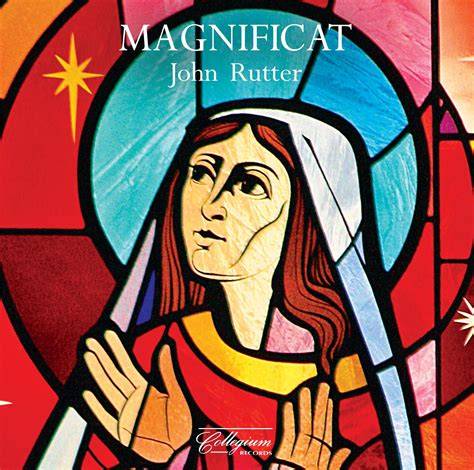
John Rutter’s Magnificat is a large-scale choral work completed in 1990, based primarily on the Latin canticle of the Blessed Virgin Mary from Luke 1:46-55. Written for soprano or mezzo-soprano solo, mixed choir and orchestra, or chamber ensemble, it combines the liturgical text with Marian poetry, Gregorian chant and a prayer to the Virgin Mary.
The composition is a joyous celebration of Mary, inspired by feast-day festivities in Spain, Mexico and Puerto Rico. Its energetic syncopations, strong melodies, dance-like rhythms, fanfares and vivid orchestration give the work a festive character, while its solo passages and Marian interpolations provide moments of tenderness and contemplation.
Historical and liturgical background
The Magnificat-the canticle of the Blessed Virgin Mary from Luke I:46-55-traditionally formed part of the ancient service of Vespers in the medieval Roman rite. After the Reformation it was incorporated into the evening services of the Lutheran and Anglican churches, where it was linked with the Nunc Dimittis.
The Magnificat has been set to music more often than any liturgical text other than the Mass itself, in settings that vary enormously in style and scale, from the purity of Palestrina’s exquisite four-part unaccompanied compositions to Monteverdi’s grand, dramatic settings written for St Mark’s, Venice, and later the almost symphonic conception of Mozart’s Vesperae Solennes de Confessore, of which the Magnificat forms the final movement, written in 1780 for use in Salzburg Cathedral.
The passage from St Luke, Chapter 1, verses 46-55, is a poetic outpouring of praise, joy and trust in God, ascribed by Luke to the Virgin Mary on learning that she was to give birth to Christ. It has always been one of the most familiar and well-loved of scriptural texts, not least because of its inclusion as a canticle in the Catholic office of Vespers and in Anglican Evensong.
Brevity is often demanded of composers of the Magnificat, so that the piece may fit within the liturgical setting. One notable exception from this rule of thumb is Bach’s musical setting. Although musical settings of the text abound, surprisingly few of them since J. S. Bach’s give the text extended treatment.
John Rutter and the genesis of the composition
John Rutter’s initial inspiration for his Magnificat was another great masterpiece-that of J. S. Bach. He has also revealed that he found the task of following in Bach’s footsteps a somewhat daunting prospect, as indeed any composer might.
Rutter had long wished to write an extended Magnificat, but was not sure how to approach it until he found his starting point in the association of the text with the Virgin Mary. In countries such as Spain, Mexico and Puerto Rico, feast days of the Virgin are joyous opportunities for people to take to the streets and celebrate with singing, dancing and processions.
These images of outdoor celebration were, Rutter said, somewhere in his mind as he wrote, although he was not fully conscious of the fact until afterwards. His intention was to write a Magnificat redolent of Mediterranean sunshine and celebration, evoking the spirit of the many exuberant festivals held throughout Europe in honour of the Virgin Mary.
The composition of the Magnificat occupied several hectic weeks in early 1990, and the premiere took place in May of that year at New York’s Carnegie Hall. The first performance was given on 26 May 1990, with the composer conducting.
| Work | Completion and première | Forces |
|---|---|---|
| Magnificat | Completed in 1990; first performed on 26 May 1990 at Carnegie Hall, New York | Soprano or mezzo-soprano solo, mixed choir and orchestra or chamber ensemble |
| UK première | Followed a year later in Coventry Cathedral | Chorus, soloist and instrumental ensemble |
Textual design and Marian additions
Rutter was conscious of following Bach’s example in adding to the liturgical text. The standard Latin text is interspersed with Of a Rose, a lovely Rose, an anonymous fifteenth-century English poem on Marian themes, the beginning of the Sanctus, and the prayer Sancta Maria.
Particularly memorable is Rutter’s haunting setting of the beautiful fifteenth-century poem “Of a Rose, a lovely Rose”, which uses the image of a rose as an allegory for the Blessed Virgin Mary and her powers to intercede for mankind. The poem describes the branching of the tree of Jesse, eventually leading to the birth of Jesus.
The refrain “Of a Rose, a lovely Rose…” refers to Mary as a loving and pure shoot. The poem strengthens the Marian connection and creates a poetic pause between the biblical sections of the work.
The other supplementary texts are the Sanctus from the Ordinary of the Mass and a Marian antiphon, Sancta Maria, meaning “Holy Mary”. The prayer is sung by the soloist to its Gregorian melody in the middle of the Gloria.
The interpolated Sanctus, set to the Gregorian chant of the Missa cum jubilo, seems to grow out of the preceding thought “et sanctum nomen eius”, meaning “and holy is His name”. The chant therefore does not function as an unrelated insertion but emerges organically from the text and musical argument.
As Bach included several additional Christmas movements in the original E-flat version of his Magnificat, Rutter incorporates three extra elements into the standard Latin text: Of a Rose, the Sanctus, and Sancta Maria. These additions also reinforce the work’s connection with the Virgin Mary and the Christmas story.
Relationship with Bach’s Magnificat
Although the two works are about as different in style as they could possibly be, they share several basic similarities. Both pieces conclude with a reiteration of the music of their opening movements, both make use of traditional Gregorian plainsong melodies, and in both works the focus is on the soloist for the more reflective verses.
In both compositions the chorus is called upon to provide appropriate vocal muscle in robust sections of the text such as Fecit potentiam in brachio suo, “He hath showed strength with his arm”. Bach’s model is therefore present not as a stylistic imitation but as a structural and conceptual point of departure.
Where Bach interpolates the text with Christmas texts, Rutter does likewise. Where Bach uses Gregorian plainchant associated with the text, Rutter does likewise. Where Bach concludes his work by revisiting the music of the first movement, Rutter does likewise.
Rutter’s work is one of the few extended versions of the canticle composed after Bach. Its relationship with Bach’s setting is particularly evident in its use of textual expansion, contrast between soloist and chorus, Gregorian material and a cyclic return to the opening music.
Instrumentation and vocal forces
The composition consists of seven movements for soprano or mezzo-soprano solo, mixed choir and orchestra, or chamber ensemble. Rutter’s writing is beautifully suited to the voice and is superbly orchestrated.
The solo voice is associated with the more reflective verses and with the personal dimension of Mary’s song. The chorus supplies public proclamation, rhythmic energy and dramatic power, while the orchestra supports both the architectural structure and the changing emotional states of the text.
The contrast between soloist, choir and orchestra is central to the work’s expressive design. The soloist introduces intimacy and personal reflection; the choir represents communal praise; and the orchestra amplifies images of strength, celebration, movement and spiritual grandeur.
Analysis of the seven movements
I. Magnificat anima mea
The outburst of joy Rutter describes is immediately apparent in the opening bars of the work. The rhythm, similar in feel to Bernstein’s “America” from West Side Story, is infectious in its drive and energy.
The opening movement paints Mary’s joy with dance-like rhythms and strong melodies. Its musical energy and rhythm give it a wonderfully festive spirit, while its strongly articulated patterns create a sense of movement reminiscent of outdoor celebration and procession.
Mary’s humility calls for a more subdued emotion before the music returns to the dance motifs. This contrast establishes one of the fundamental expressive principles of the entire work: public jubilation alternates with private reflection.
The opening movement also supplies important thematic material for the finale. Its rhythmic and melodic figures return at the close of the composition, giving the seven-movement work a rounded and coherent design.
II. Of a Rose, a lovely Rose
The second movement is a setting of a fifteenth-century English poem. It features all of the sections of the choir in varying combinations that colour the text beautifully.
The poet describes the branching of the tree of Jesse, eventually leading to the birth of Jesus. The image of the rose functions as an allegory for Mary, linking the natural image of the flower with the mystery of the Incarnation and the Virgin’s intercessory role.
The use of English rather than Latin creates a distinctive change of language, colour and atmosphere. The movement also strengthens the Marian connection further, making Mary’s presence more explicit than in the biblical text alone.
III. Quia fecit mihi magna
In the third movement the tenors and basses announce “For He that is mighty hath magnified me”, accompanied by splendid fanfares from the orchestra. The movement builds in a stately manner, with the fanfares giving the statement ceremonial weight.
The orchestral fanfares eventually subside, and the passage follows to which Rutter refers: et sanctum nomen eius, “and holy is His name”. From this thought the Gregorian Sanctus emerges, set to the chant of the Missa cum jubilo.
The use of Gregorian chant connects Rutter’s contemporary language with the historical worship traditions in which the Magnificat has been sung for centuries. The chant also provides a clear change of musical texture after the brilliance of the fanfares.
IV. Et misericordia
The Sanctus segues into Et misericordia, “and His mercy is on them that fear him”, a duet for soprano and choir. This is the first movement in which the beautiful flowing melodies written for the soprano soloist become especially prominent.
The movement has a pastoral tone. The soloist and choir interact rather than functioning as completely separate forces, creating an atmosphere of tenderness and compassion.
The movement also features the soloist repeating the opening text of the piece as a descant. The Magnificat text gains a more personal feel than it had earlier, and Rutter’s choice of solo voice strengthens the associations with the Virgin Mary.
V. Fecit potentiam
The fifth movement concerns the Lord’s strength, and the setting is muscular in its harmony and angular in its melodies. It is marked “Lively and energetic” and depicts the power of the Lord with fugal passages and regular meter changes.
A short and intense fugue ensues. The contrapuntal writing gives the movement a concentrated, forceful character, while the changing meters follow the shifting emphasis of the text.
The words Dispersit superbos, “he hath scattered the proud”, are heard as the choir scatters down the musical scale one part at a time. The musical procedure directly reflects the verbal image, transforming the meaning of “scattering” into a choral texture.
After the basses, tenors and altos in turn put the mighty “down from their seat”, Deposuit, the violence of the first half of the movement stops abruptly. Rutter then sets the words “he hath exalted the humble and meek”, et exaltavit humiles, exquisitely.
The sharp contrast between the turbulent opening and the delicate setting of the humble and meek illustrates the reversals at the centre of Mary’s text. The movement moves from strength and judgment to humility and elevation.
VI. Esurientes
Esurientes, “He hath filled the hungry with good things”, is a beautiful soprano solo with interjections by the choir. The movement returns to the dialogue between individual voice and community that is characteristic of the work’s more reflective passages.
The following movement, also concerned with God’s mercy, calls once more for the soprano solo in dialogue with the whole chorus. The solo writing is lyrical, flowing and pastoral, contrasting with the angular energy of Fecit potentiam.
VII. Gloria
The final movement, the Gloria, is set to the music of the third movement. This return creates a large-scale structural connection between the central part of the work and its conclusion.
The Gloria is interrupted by a final contemplative moment in which the soloist sings the antiphon used at feasts of the Virgin, Sancta Maria. The Marian prayer provides an intimate pause before the final resurgence of the main musical material.
The work concludes with the music from the opening of the entire piece and a rousing Amen. The return to the opening dance-like rhythmic and melodic figures gives the composition a cyclical design and brings the atmosphere of celebration to its climax.
Rhythm, melody and musical language
Rutter’s music is full of energetic, syncopated rhythms and strong melodies, with more than a hint of musical theatre from time to time. The opening movement’s rhythmic drive immediately establishes the festive Mediterranean atmosphere that guided the composition.
The dance-like rhythms are balanced by subdued passages associated with Mary’s humility, flowing soprano melodies associated with mercy, angular melodies associated with divine power, and Gregorian chant associated with liturgical continuity.
The composer’s treatment of rhythm is often closely linked to the meaning of the text. The choir’s downward scattering in Dispersit superbos, the fanfares in Quia fecit mihi magna, and the changes of meter in Fecit potentiam all translate verbal images into musical action.
The work’s harmonic and melodic language is direct and accessible, but its structure is carefully organized. Recurrent material, contrasting textures, chant interpolations and the return of opening themes help unite its varied musical styles.
Performance considerations
The performance of Rutter’s Magnificat requires a balance between festive brilliance and contemplative intimacy. The opening and closing movements need rhythmic vitality, clarity and buoyancy, while the Marian interpolations and solo passages require delicacy and a sustained lyrical line.
The chorus must move between several contrasting roles: it provides ceremonial proclamation, dramatic power, contrapuntal complexity, gentle responses and richly coloured combinations of vocal sections. Clear diction is particularly important because the musical design frequently mirrors the text.
The orchestra should support the choir without obscuring the text. Fanfares and energetic orchestral writing must retain their brilliance, but the balance should allow the soprano or mezzo-soprano soloist and the inner choral parts to remain audible.
The Gregorian chant passages require a different kind of attention from the rhythmic sections. Their success depends on an awareness of line, flexibility and liturgical character rather than on the sharply articulated pulse of the celebratory movements.
The soloist’s role is not limited to virtuosic display. The solo voice represents the personal and Marian dimension of the text, especially in Et misericordia, Esurientes and the Sancta Maria interpolation.
In the fifth movement, the choir must communicate both muscular energy and textual precision. The fugue, the changing meters and the scattered descending entries in Dispersit superbos should remain intelligible even at a lively tempo.
The final movement depends on the performers’ ability to integrate contrasting materials. The return of the third movement, the contemplative Sancta Maria and the closing reprise of the opening music must form a continuous dramatic arc rather than a series of unrelated episodes.
[4K] John Rutter - Magnificat :: Sop. 이윤정, 지휘 이보미, 인천시립합창단
First performances and publication
The first performance of Rutter’s Magnificat took place at Carnegie Hall in New York in May 1990, conducted by the composer. The UK première followed a year later in Coventry Cathedral.
Rutter conducted the first recording with the Cambridge Singers and the City of London Sinfonia. Oxford University Press published Magnificat in 1991 and published Of a Rose, a lovely Rose separately in 1998.
Rutter’s place in choral music
John Rutter is widely recognised as the leading choral composer of his generation. He is also a distinguished editor and arranger of choral music, as well as a renowned conductor.
He was born in London and received his first musical education as a chorister at Highgate School. He went on to study music at Clare College, Cambridge, where he wrote his first published compositions and conducted his first recording while still a student.
From 1975 to 1979 he was the Director of Music at Clare College, whose choir he directed in many broadcasts and recordings. After giving up the Cambridge post to allow more time for composition, he founded the Cambridge Singers as a professional chamber choir dedicated to recording, and he subsequently divided his time between composition and conducting.
Rutter’s writing career has embraced both large- and small-scale choral works, orchestral and instrumental pieces, a piano concerto, two children’s operas, music for television, and specialist writing for such groups as the Philip Jones Brass Ensemble and the King’s Singers.
He is also well known for co-editing four volumes of the Carols for Choirs series with Sir David Willcocks. Although he is perhaps best known for his carols and other short pieces, he also has a number of large-scale works for chorus and orchestra.
Most of these received their first performances in the United States, where Rutter is a frequent visitor, writing regularly for American choirs and conducting performances of his own music.
Rutter was considered cutting edge in the 1970s, 1980s and 1990s. In American choir circles during the late 1980s and early 1990s, he occupied a position comparable to that later associated with Morten Lauridsen and Eric Whitacre.
His unashamedly popular style has won him few friends amongst the upper reaches of the musical establishment, but choral societies and audiences throughout the world have responded with wholehearted enthusiasm to its uninhibited tunefulness.
Recordings and interpretive references
The composer’s performance with the Cambridge Singers and the City of London Sinfonia remains an important reference recording. Each movement is available as a separate clip with a convenient scrolling vocal score accompanying the music.
The choral singing is first-rate, and with the composer conducting, the tempi and pacing can be understood as closely reflecting his intended interpretation. The recording also provides a useful reference for the balance between soloist, chorus and orchestra.
A fine 2005 performance was given by the Choir of King’s College, Cambridge and the City of Birmingham Symphony Orchestra, conducted by Stephen Cleobury. The boy trebles of King’s College, Cambridge are typically superb, and their brilliant, forward timbre helps the choir project through the large orchestration.
Stephen Cleobury is fastidiously dedicated to the written score. The performance offers a contrasting perspective on the work, particularly in the choral sound, orchestral balance and treatment of the rhythmic and ceremonial passages.
Rutter’s own recording and the King’s College performance together offer two valuable interpretive reference points: one led by the composer and closely connected with the work’s original performance tradition, and another shaped by the precise and disciplined approach associated with Stephen Cleobury.
tags: #john #rutter #magnificat